
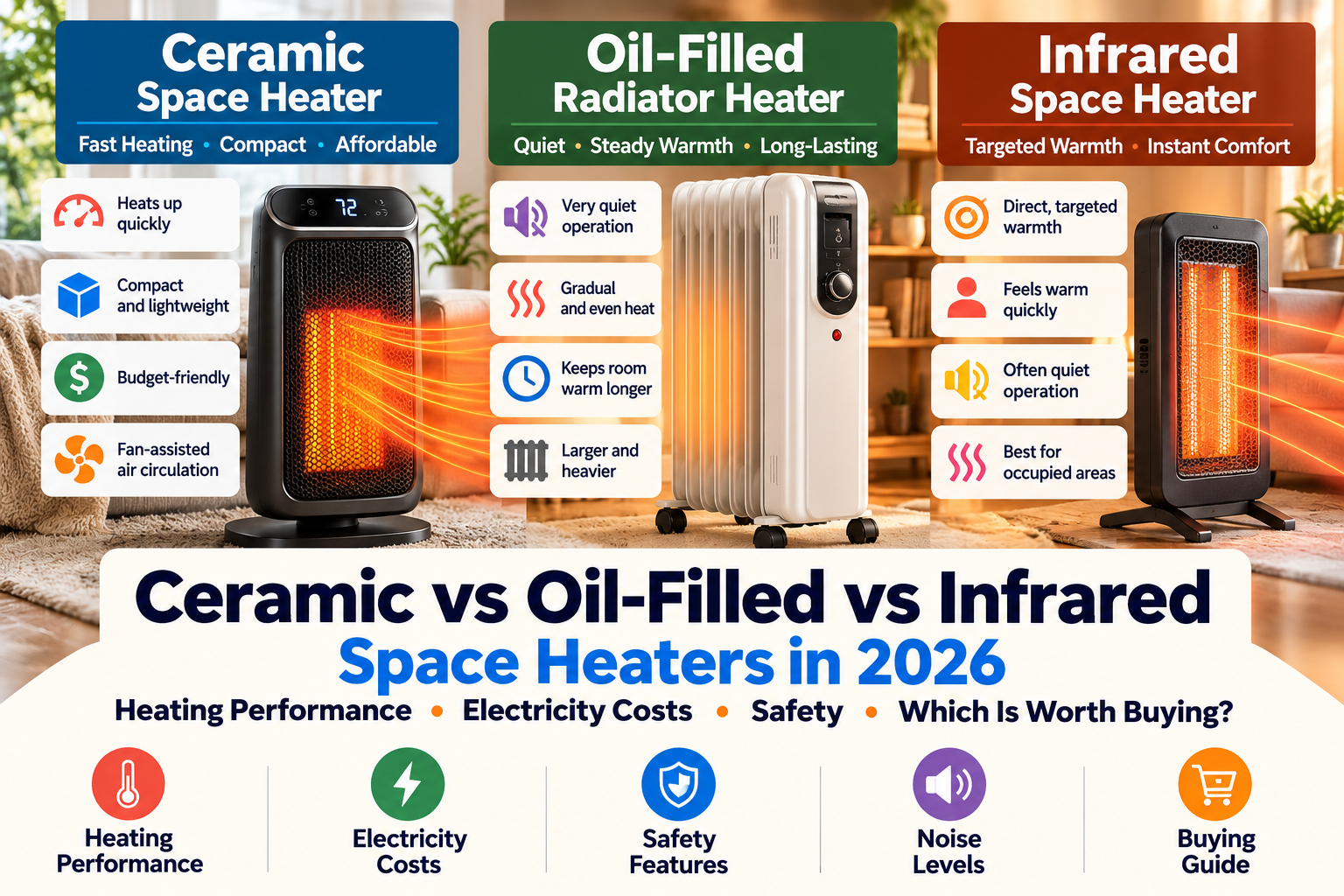
A practical, evidence-based guide to choosing an electric space heater based on heating speed, comfort, electricity consumption, safety, and long-term value.
Buying a space heater seems straightforward until you begin comparing the options.
One manufacturer promises rapid ceramic heating. Another advertises the lasting warmth of an oil-filled radiator. A third emphasizes the direct, targeted comfort of infrared heat.
Each technology sounds efficient in its own way.
But there is an important fact that most heater advertisements do not explain clearly:
A 1,500-watt ceramic heater, a 1,500-watt oil-filled radiator, and a 1,500-watt electric infrared heater generally convert approximately the same amount of electrical energy into heat when operating at their rated power.
The differences lie primarily in how that heat is delivered, how quickly you feel comfortable, how the thermostat controls electricity consumption, and how effectively the appliance matches your needs.
That distinction matters when a household is trying to heat a bedroom, home office, basement, or small living room without creating an unexpectedly expensive electricity bill.
In this 2026 guide, we compare three popular electric space heater technologies, calculate realistic operating costs, examine safety considerations, and explain which type is worth buying for different situations.
Quick Verdict: Ceramic, Oil-Filled, or Infrared?
Choose a ceramic space heater when you want relatively quick room heating, compact dimensions, and flexible everyday use.
Choose an oil-filled radiator when you prefer quiet operation and steady, gradual warmth during extended periods of supervised use.
Choose an infrared space heater when your priority is direct warmth for a person or a particular occupied area rather than quickly raising the temperature of an entire room.
However, none of these technologies is inherently guaranteed to reduce your electricity bill simply because of its heating element.
For conventional electric resistance heaters, electricity costs depend primarily on power consumption, operating duration, thermostat behavior, and the amount of heating actually required.
The best heater is therefore not necessarily the one with the most impressive efficiency claim. It is the one that provides the right kind of comfort without using more electricity than necessary.
1. How Ceramic Space Heaters Work
Ceramic space heaters typically use an electrically heated ceramic element, often combined with a fan that moves warm air into the room.
Many modern models use positive temperature coefficient (PTC) heating elements, whose electrical resistance changes with temperature.
This design can provide relatively fast heat delivery in a compact appliance.
Why ceramic heaters feel warm quickly
The fan circulates heated air beyond the immediate surface of the heating element.
As a result, a ceramic heater can make a cold room feel more comfortable relatively quickly, especially when the appliance is appropriately sized and the room is reasonably insulated.
Oscillating models can distribute warm air across a wider area.
However, airflow introduces another consideration: noise.
Some ceramic heaters produce a continuous fan sound, while others have noticeable changes in sound when the heating element or fan cycles.
Advantages
- Relatively fast delivery of warm air.
- Compact designs suitable for smaller spaces.
- Often affordable compared with premium oil-filled or infrared models.
- Widely available thermostat, timer, and oscillation features.
- Convenient for home offices and temporary supplemental heating.
Limitations
- Fan noise may be distracting.
- Warmth can feel less immediate when the fan is not directed toward the occupied area.
- Air circulation may stir settled dust.
- Thermostat quality varies substantially by model.
Best use case: A home office or living space where relatively quick, distributed warmth is more important than completely silent operation.
2. How Oil-Filled Radiator Heaters Work
An oil-filled electric radiator contains a sealed thermal fluid that transfers heat from an internal electric element to the radiator’s exterior surfaces.
The oil is not burned as fuel.
It is used as a heat-transfer medium inside the appliance.
The heated radiator then transfers energy to the room through a combination of natural convection and thermal radiation.
Why oil-filled heaters feel different
Oil-filled radiators usually take longer to reach their operating temperature than compact fan-assisted ceramic heaters.
But the radiator’s thermal mass also allows it to release stored heat after the heating element stops drawing electricity.
This produces a gradual heating and cooling pattern that some users find comfortable.
However, stored heat is not free energy.
An oil-filled radiator does not create additional heat after it is unplugged. It releases energy that was previously supplied by electricity.
That distinction is essential when evaluating efficiency claims.
Advantages
- Usually very quiet because many models have no fan.
- Gradual, relatively even warmth.
- No forced-air stream directed at the occupant.
- Suitable for sustained comfort in appropriately sized rooms.
- May appeal to users who dislike fan noise.
Limitations
- Slower initial warm-up.
- Larger and heavier than many ceramic heaters.
- Exterior surfaces can become hot.
- Residual heat continues after shutdown.
- Often higher purchase prices than basic ceramic models.
Best use case: A room occupied for an extended period where low noise and gentle heat delivery are priorities.
Oil-filled heaters should still be turned off when unattended or during sleep, in accordance with U.S. Consumer Product Safety Commission guidance.
3. How Infrared Space Heaters Work
Infrared heaters emit radiant energy that can warm people and surfaces directly.
Instead of relying exclusively on heating circulating room air, an infrared appliance transfers part of its energy through radiation.
That is why someone sitting within the effective heating area may feel warmer before the entire room temperature rises significantly.
Why infrared heat can feel immediate
Consider sitting near a sunny window on a cool day.
Sunlight can make your skin feel warm even when the surrounding air remains relatively cool.
Infrared heating uses a related principle: radiant energy is absorbed by surfaces and occupants.
The practical advantage is targeted comfort.
If you spend most of your time at a desk or in one seating area, direct radiant heat may reduce the need to raise the temperature of the entire room.
But that does not mean infrared heaters are universally more electrically efficient.
Advantages
- Direct warmth in the heater’s effective coverage area.
- Useful for occupied zones and spot heating.
- Some designs provide little or no fan noise.
- Can improve perceived comfort without rapidly heating all room air.
- Potentially useful in spaces where occupants remain in one location.
Limitations
- Comfort depends heavily on positioning.
- Furniture and other objects can obstruct radiant heat.
- Some heating elements and grilles become extremely hot.
- A model designed for spot heating may not warm an entire room evenly.
- Performance and noise vary significantly among infrared products.
Best use case: Targeted warmth for a desk, chair, or occupied zone, provided the heater can be positioned safely.
4. Ceramic vs Oil-Filled vs Infrared: Side-by-Side Comparison
| Buying factor | Ceramic | Oil-filled | Infrared |
|---|---|---|---|
| Primary heat delivery | Forced convection | Natural convection and radiation | Direct radiation, sometimes assisted by convection |
| Initial perceived warmth | Often quick | Usually gradual | Often quick within the radiant zone |
| Whole-room heating | Often suitable | Often suitable | Highly model-dependent |
| Fan noise | Common | Usually minimal | Depends on design |
| Physical size | Often compact | Often larger and heavier | Varies widely |
| Residual warmth | Limited | Noticeable | Depends on design |
| Purchase price | Often budget-friendly | Frequently midrange or premium | Broad price range |
| Electricity cost at equal wattage and runtime | Approximately equal | Approximately equal | Approximately equal |
| Main advantage | Fast air circulation | Quiet, steady warmth | Targeted comfort |
These are general characteristics, not guarantees for individual products.
A high-quality heater from one category may outperform a poorly designed heater from another.
5. The Efficiency Myth: Does One Type Use Less Electricity?
This is the most important technical question in the comparison.
Conventional electric resistance heaters convert electrical energy into heat.
For practical household calculations, nearly all the electrical energy consumed by the appliance ultimately becomes heat within the room.
That means a ceramic heater does not inherently produce more total heat from the same electricity simply because it has a fan.
An oil-filled radiator does not produce extra energy because its metal body remains warm after shutdown.
And an infrared heater does not automatically consume less electricity merely because it heats objects directly.
What 1,500 watts actually means
A 1,500-watt heater operating continuously for one hour consumes:
1.5 kilowatt-hours (kWh)
That is true regardless of whether the heater uses a ceramic element, oil-filled radiator, or conventional electric infrared element.
The approximate heat output is:
1,500 W × 3.412 = 5,118 BTU per hour
Therefore, when three heaters operate at the same actual electrical input, their total heat production is broadly comparable.
The important differences are heat distribution, comfort, control systems, and actual runtime.
When one heater can cost less to operate
A heater can reduce electricity consumption when it allows you to achieve adequate comfort with less total energy.
For example:
- An infrared heater may warm an occupied person without requiring the entire room to reach the same temperature.
- A ceramic heater with effective controls may stop drawing full power once the desired room temperature is reached.
- An oil-filled radiator may provide comfortable heat distribution that reduces unnecessary thermostat adjustments.
These outcomes depend on how the equipment is used.
They are not automatic efficiency advantages of the heating technology itself.
6. Electricity Costs: How Much Does a 1,500W Heater Cost to Run?
The basic electricity-cost formula is:
Cost = Power in kilowatts × Hours of operation × Electricity rate
Suppose a heater operates at 1,500 watts and electricity costs $0.18 per kWh.
The hourly cost is:
1.5 kW × $0.18 = $0.27 per hour
That may not seem expensive.
But daily operation can accumulate into a significant seasonal cost.
Full-power operating cost
| Daily use | Daily electricity | 30-day cost |
|---|---|---|
| 2 hours | 3 kWh | $16.20 |
| 4 hours | 6 kWh | $32.40 |
| 6 hours | 9 kWh | $48.60 |
| 8 hours | 12 kWh | $64.80 |
Assumptions: continuous 1,500W consumption during the stated hours, 30 days, and an electricity rate of $0.18/kWh.
These figures represent full-power equivalent operation.
They do not necessarily represent the consumption of a thermostatically controlled heater.
If the heating element switches off for part of the operating period, actual electricity consumption can be lower.
Conversely, poorly insulated rooms may require sustained heating, resulting in costs closer to the full-power examples.
7. Thermostat Cycling: The Variable That Changes Your Bill
Many space heaters use thermostats to control heating.
When the room reaches the desired temperature, the appliance may reduce power or switch its heating element off.
As the room cools, heating resumes.
This means the number of hours a heater is switched on is not always equal to the number of hours it consumes its full rated power.
Example: A heater running at 50% full-power equivalent
Suppose a 1,500W heater is available for eight hours daily, but its heating element consumes full power for the equivalent of four hours.
Daily energy consumption is:
1.5 kW × 4 hours = 6 kWh
At $0.18/kWh:
6 × $0.18 = $1.08 per day
Over 30 days:
$1.08 × 30 = $32.40
If the heating element instead consumed full power for all eight hours, the cost would be $64.80.
The difference comes from actual electricity consumption—not from whether the heating element contains ceramic, oil, or an infrared emitter.
Why this matters when shopping
A reliable thermostat, appropriate heater capacity, and effective heat distribution may be more valuable than a premium efficiency slogan.
When comparing models, examine control accuracy and independent heating tests where available.
8. Electricity Prices: How Location Changes Operating Costs
U.S. electricity prices vary by state, utility, season, and rate plan.
A heater that is inexpensive to operate in one household may be noticeably more expensive in another.
The following examples show the cost of operating a 1,500W heater at full power for five hours per day over 30 days.
Total energy consumption:
1.5 × 5 × 30 = 225 kWh
| Electricity rate | Monthly modeled cost |
|---|---|
| $0.12/kWh | $27.00 |
| $0.18/kWh | $40.50 |
| $0.25/kWh | $56.25 |
| $0.35/kWh | $78.75 |
These rates are illustrative scenarios, not claims about current prices in particular states.
For a personalized estimate, use the marginal electricity rate applicable to your household.
If your utility uses time-of-use pricing, heating during peak hours may cost more than heating during off-peak periods.
9. A Five-Year Ownership Cost Comparison
A low purchase price can make a basic ceramic heater attractive.
But how much does the purchase price matter compared with electricity costs over several years?
Consider three hypothetical 1,500W heaters.
Assumptions
- Ceramic heater purchase price: $45.
- Oil-filled radiator purchase price: $110.
- Infrared heater purchase price: $140.
- Each heater consumes 300 kWh per heating season.
- Electricity costs $0.18/kWh.
- Ownership period: five heating seasons.
- No repairs, replacements, or additional accessories.
- Equivalent annual electricity use is assumed for comparison.
Annual electricity cost:
300 kWh × $0.18 = $54
Five-year electricity cost:
$54 × 5 = $270
| Cost component | Ceramic | Oil-filled | Infrared |
|---|---|---|---|
| Purchase price | $45 | $110 | $140 |
| Five-year electricity | $270 | $270 | $270 |
| Five-year modeled total | $315 | $380 | $410 |
Under equal electricity-consumption assumptions, the ceramic heater is the least expensive to own.
However, the table does not establish that ceramic heaters are universally the best value.
An oil-filled model may provide quieter operation.
An infrared heater may offer more comfortable targeted heating.
And a particular model’s controls may result in different real-world electricity consumption.
The ownership-cost advantage changes only when purchase price, actual electricity use, maintenance, or replacement costs change.
10. When a Space Heater Can Actually Save Money
One common claim is that using a space heater will lower your household heating bill.
Sometimes it can.
Sometimes it makes the bill higher.
The outcome depends on what heating system you already have and whether you change how that system operates.
Scenario A: Adding a space heater without changing central heating
If your central heating system continues operating exactly as before and you add a space heater, total energy consumption generally increases.
The space heater adds an electrical load.
It does not create a financial saving simply because it heats a smaller area.
Scenario B: Heating one occupied room while reducing whole-home heating
A different outcome is possible when you lower the central thermostat and use a space heater only in an occupied room.
In this situation, the space heater may replace some whole-home heating demand.
Whether this saves money depends on:
- The efficiency of the existing heating system.
- The fuel and electricity prices.
- The temperature reduction elsewhere in the home.
- The size and insulation of the occupied room.
- The amount of time supplemental heating is required.
This strategy is sometimes called zone heating.
It can make sense in certain homes, but the savings are not guaranteed.
Scenario C: Replacing heat-pump heating with electric resistance heating
This is an especially important distinction.
A heat pump moves heat rather than producing it solely through electrical resistance.
According to the U.S. Department of Energy, modern heat pumps can use substantially less electricity for heating than electric resistance systems.
Consequently, using a portable electric resistance heater instead of an efficient heat pump may increase electricity consumption for the same delivered heat.
Do not assume a portable space heater is cheaper to operate than an existing heat pump.
The appropriate comparison is total energy consumption and cost for the heating service delivered.
11. Which Heater Warms a Cold Room Fastest?
Heating speed depends on both total heating power and the way heat is distributed.
A fan-assisted ceramic heater can circulate warm air quickly.
An oil-filled radiator takes time to heat its internal fluid and exterior surfaces.
An infrared heater may make a person feel warmer quickly, even before the entire room’s air temperature changes significantly.
These are different performance outcomes.
Heating the room versus heating the person
A heater can perform well at spot heating while performing less impressively at raising the average temperature of a large room.
Consumer Reports explicitly evaluates these as separate performance characteristics in its space heater testing.
That distinction is useful for shoppers.
If you want to warm a home office quickly, look for room-heating performance.
If you sit in one location and want immediate comfort, direct-heating performance may matter more.
Buying rule: Choose the type of heating you actually need rather than assuming the fastest perceived warmth means the greatest whole-room heating capacity.
12. Which Heater Is Best for a Bedroom?
Bedroom heating requires careful attention to noise, temperature control, and safety.
An oil-filled radiator may appeal to users who dislike fan noise.
A ceramic heater may offer more responsive warm-air circulation.
An infrared heater may provide localized comfort, depending on its design.
But there is an important safety limitation.
The U.S. Consumer Product Safety Commission advises consumers to turn off portable heaters when sleeping.
Therefore, none of these portable heater categories should be recommended for unattended overnight operation.
If a bedroom needs reliable heating throughout the night, consider a properly installed and maintained permanent heating system rather than relying on a portable space heater while asleep.
For supervised evening use, compare noise, thermostat behavior, surface temperature, and manufacturer safety instructions.
13. Safety Features That Matter More Than Heating Technology
Portable heaters can create serious fire and burn hazards if used incorrectly.
The CPSC’s January 2026 safety guidance emphasizes several essential precautions.
Maintain at least three feet of clearance
Keep portable heaters at least three feet away from combustible materials such as curtains, bedding, furniture, and clothing.
Plug directly into a wall outlet
Do not connect a space heater through a power strip or extension cord.
High electrical loads can create overheating hazards.
Turn off heaters when sleeping
Do not leave portable heaters operating while asleep.
Turn them off when leaving the area unattended.
Use a stable location
Place the heater on a stable, level surface where it is unlikely to be knocked over.
Check safety controls
When comparing products, look for appropriately designed tip-over protection, overheat protection, and credible independent safety certification.
These features can reduce risks, but they do not eliminate the need for safe operation.
Consider children and pets
A heater with a hot exterior surface may present a burn risk even if it includes electronic safety features.
The appropriate model and location depend on who uses the room.
No ceramic, oil-filled, or infrared heater should be considered inherently fireproof.
14. How Much Heater Power Do You Actually Need?
Many portable electric space heaters sold in the United States operate at or near 1,500 watts on their highest setting.
But that does not mean every 1,500W heater is suitable for every room.
The heating requirement depends on:
- Floor area and ceiling height.
- Insulation quality.
- Window size and performance.
- Outdoor temperature.
- Air leakage.
- Existing central heating.
- The desired indoor temperature.
A poorly insulated room can lose heat faster than a portable heater replaces it.
Why square-footage claims can mislead
Manufacturers may advertise coverage such as 150, 200, or 300 square feet.
Those figures can be useful starting points, but they are not substitutes for evaluating actual heat loss.
A 200-square-foot interior room in a well-insulated home may require much less supplemental heat than an equally sized room with drafty windows and exposed exterior walls.
For larger or persistently cold spaces, an HVAC professional can help determine whether the problem is insufficient heating capacity, insulation, air leakage, or system distribution.
Do not compensate for an undersized heater by using unsafe electrical connections or ignoring clearance requirements.
15. The Hidden Value of Thermostats, Timers, and Controls
When comparing heaters with similar wattage, the control system may have more practical value than the heating-element technology.
Adjustable thermostats
A thermostat can reduce unnecessary electricity consumption by limiting heating when the target temperature is satisfied.
Multiple power settings
A lower power setting may be useful when the room needs only modest supplemental warmth.
However, running at a lower wattage for longer can result in similar total energy consumption.
Timers
Timers may help users manage heating schedules, but they should not be used to justify unattended or sleeping operation contrary to safety guidance.
Remote controls
A remote can improve convenience, particularly when the heater must remain safely positioned on the floor.
Overheat and tip-over protection
These are important safety considerations rather than luxury features.
A heater with excellent marketing claims but inadequate safety information should not be considered a compelling purchase.
16. Buying Decision Matrix: Which Heater Should You Choose?
| Your situation | Best starting point | Main reason |
|---|---|---|
| Cold home office | Ceramic heater | Responsive warm-air circulation |
| Quiet evening reading | Oil-filled radiator | Low fan noise and gradual warmth |
| Person sitting in one location | Infrared heater | Targeted radiant comfort |
| Tight purchase budget | Basic ceramic heater | Often lower upfront cost |
| Long periods of supervised use | Oil-filled or thermostatically controlled ceramic | Comfort and temperature regulation |
| Large, poorly insulated room | Evaluate permanent heating and insulation | Portable heating may be inadequate |
| Home with young children or pets | Prioritize safety, placement, and surface-temperature testing | Burn and tip-over risks |
| Existing efficient heat pump | Compare costs before adding resistance heat | Portable heating may increase electricity use |
These are starting points, not unconditional recommendations.
The final decision should be based on a specific model’s safety features, tested performance, electrical requirements, and suitability for the room.
17. Five Mistakes to Avoid Before Buying
Mistake 1: Believing oil-filled heaters create free heat after shutdown
They release previously stored thermal energy.
They do not generate additional energy without electricity.
Mistake 2: Assuming infrared means lower electricity bills
Infrared heating can improve targeted comfort, but electrical consumption still depends on wattage and operating time.
Mistake 3: Choosing solely by advertised square footage
Room insulation, air leakage, and outdoor conditions can change the required heating capacity.
Mistake 4: Ignoring the existing heating system
Adding resistance heating to a home with an efficient heat pump may increase total electricity costs.
Mistake 5: Treating safety features as permission to leave a heater unattended
Electronic protection does not eliminate fire or burn risks.
Follow manufacturer instructions and CPSC safety guidance.
Frequently Asked Questions
Is an oil-filled heater cheaper to run than a ceramic heater?
Not inherently. At the same actual wattage and operating duration, conventional electric resistance heaters generally consume comparable electricity. Thermostat behavior and usage patterns determine differences in total consumption.
Do infrared heaters use less electricity?
Not automatically. Infrared heaters may provide comfortable targeted warmth without heating the entire room to the same temperature, which can reduce energy use in certain applications. The benefit depends on how the heater is used.
Which type heats a room fastest?
Fan-assisted ceramic heaters often distribute warm air quickly. Infrared heaters can provide rapid direct warmth to people and surfaces. Oil-filled radiators generally warm more gradually. Actual performance varies by model.
Are oil-filled radiators silent?
Many are effectively fanless and very quiet, although thermostats and thermal expansion can produce occasional sounds.
Is a 1,500W heater enough for a 300-square-foot room?
It depends on the room’s heat loss, insulation, climate, and whether the heater is supplemental or the primary heat source. A square-footage claim alone cannot establish adequate capacity.
Can I leave an oil-filled heater on overnight?
The CPSC advises turning off portable heaters when sleeping. Oil-filled construction does not exempt a portable heater from this safety recommendation.
Does a ceramic heater dry out the air?
Heating air can lower its relative humidity even when the absolute amount of moisture remains unchanged. This effect is not unique to ceramic heaters. Conventional electric heaters do not inherently remove moisture in the way a dehumidifier does.
Are expensive space heaters more energy-efficient?
Not necessarily. Premium prices may reflect controls, design, quietness, materials, or convenience. Conventional resistance heaters of similar wattage do not gain a fundamental heat-production advantage simply from being more expensive.
Should I buy a space heater or upgrade my central heating?
If a room is consistently cold, first investigate insulation, air leakage, and heating distribution. An efficient permanent heating solution may be more economical and appropriate than repeated use of portable resistance heaters.
Final Verdict: Choose the Right Heat, Not the Most Impressive Claim
Ceramic, oil-filled, and infrared heaters all have legitimate advantages.
Ceramic models can provide convenient, responsive warm-air circulation.
Oil-filled radiators offer gradual warmth with minimal fan noise.
Infrared models can deliver targeted comfort to occupied areas.
But for conventional electric resistance heaters, the most important financial principle remains unchanged:
Electricity costs are determined by the energy consumed—not by the marketing name of the heating technology.
A premium heater may be worth buying because it is quieter, more comfortable, easier to control, or better suited to a particular room.
It should not be purchased on the unsupported assumption that it will automatically generate substantially more heat from the same amount of electricity.
For 2026 buyers, our recommendation is to prioritize:
- The type of warmth you need.
- Appropriate heating capacity.
- Verified safety features and safe placement.
- Effective thermostat and power controls.
- Realistic electricity-cost calculations.
- Purchase price and long-term value.
The best space heater is not necessarily the most powerful or expensive.
It is the one that delivers appropriate comfort safely, without consuming more energy than your situation requires.
Sources and Editorial Methodology
Independent testing and buying guidance
- Consumer Reports — Best Space Heaters of 2026: https://www.consumerreports.org/appliances/space-heaters/best-space-heaters-of-the-year-a6792168873/
- Consumer Reports — Space Heater Buying Guide: https://www.consumerreports.org/appliances/space-heaters/buying-guide/
- WIRED — Best Space Heaters of 2026: https://www.wired.com/gallery/the-best-space-heaters/
Government and technical references
- U.S. Consumer Product Safety Commission — 2026 Winter Heating Safety Guidance: https://www.cpsc.gov/Newsroom/News-Releases/2026/Keep-Warm-and-Safe-This-Winter-Tips-for-Using-Generators-Furnaces-and-Space-Heaters
- U.S. Department of Energy — Heat Pump Systems: https://www.energy.gov/energysaver/heat-pump-systems
Editorial disclosure: All electricity-cost and five-year ownership examples are illustrative calculations, not measured results from specific products. Prices, electricity rates, operating schedules, and purchase costs are assumptions. Living Pick Lab does not claim to have independently laboratory-tested the heaters discussed in this article.