
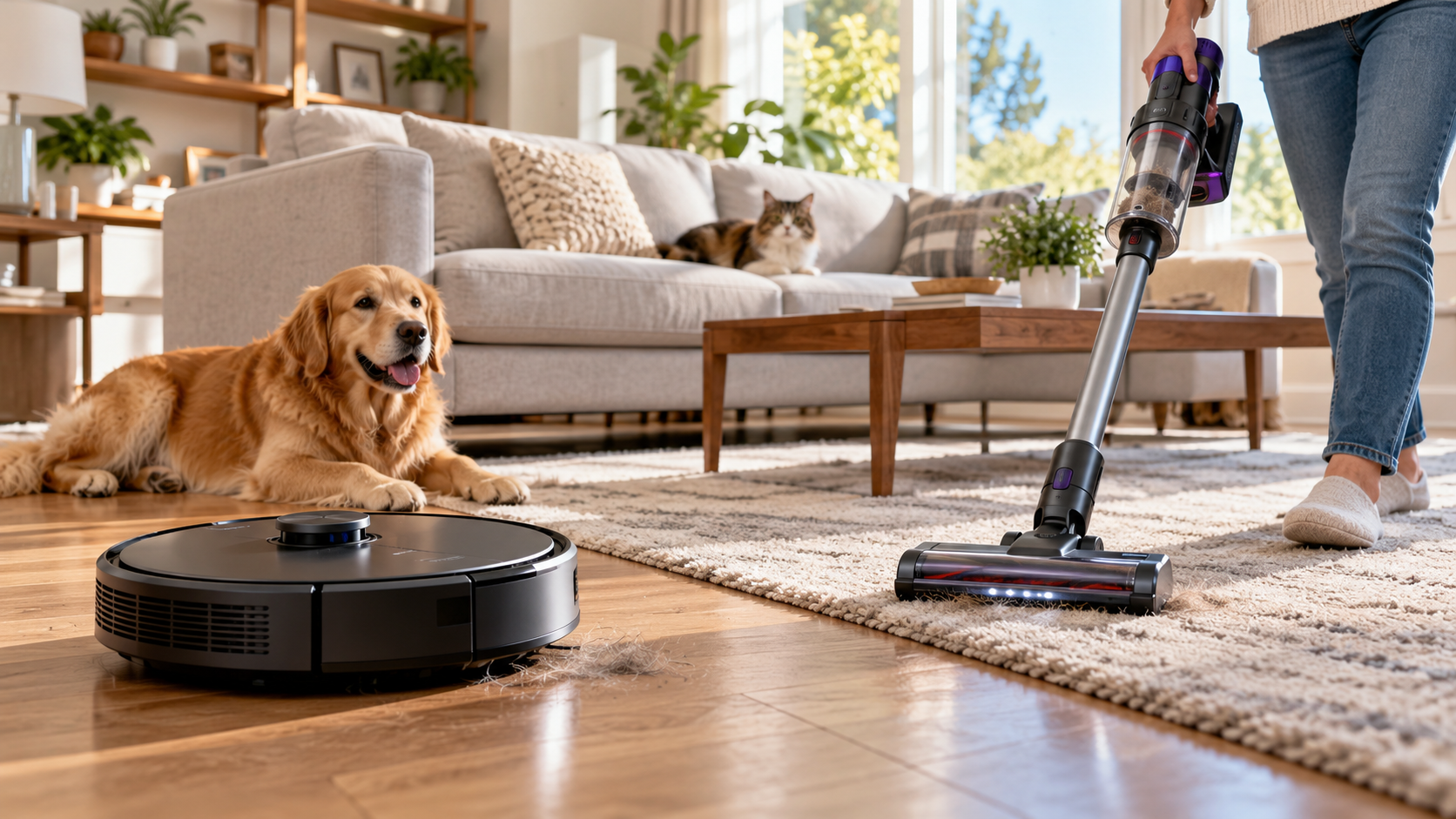
Buying a robot vacuum or a cordless vacuum is not simply a question of which machine has stronger suction. It is a question of how your home gets dirty, which cleaning tasks you want to automate, and how much you are willing to spend over five years.
A robot vacuum can keep floors cleaner between major cleaning sessions without requiring you to push a machine around. A cordless stick vacuum gives you direct control over carpets, stairs, furniture, and sudden messes.
But neither is automatically the better investment.
Quick verdict: Choose a robot vacuum if you have mostly hard floors, frequent everyday debris, and a layout that allows reliable automated cleaning. Choose a cordless vacuum if your home has significant carpeting, stairs, upholstered furniture, or pet hair embedded in fabric.
For some households, keeping an existing corded vacuum is the smartest financial decision.
This guide compares cleaning performance, practical limitations, maintenance, replacement parts, and five-year ownership costs so you can decide which type makes sense for your home.
1. Quick Verdict: Which Vacuum Should You Buy?
| Your home or cleaning priority | Better starting choice | Why |
|---|---|---|
| Small apartment with mostly hard floors | Robot vacuum | Scheduled floor cleaning reduces repetitive work |
| Home with thick carpeting | Cordless vacuum | Direct cleaning and powered brush agitation are valuable |
| Dog or cat that sheds daily | Depends on floor type | Robot for daily floor hair; cordless for furniture and carpets |
| Two-story home with stairs | Cordless vacuum | Easier to carry between floors and clean steps |
| Busy household with open floor space | Robot vacuum | Automatic scheduled cleaning |
| Home with many cords and obstacles | Cordless vacuum | Fewer navigation and preparation issues |
| Tight budget with a working corded vacuum | Keep existing vacuum | Avoid unnecessary replacement spending |
The most important distinction: A robot vacuum reduces the frequency of manual floor cleaning. A cordless vacuum makes manual cleaning more convenient and versatile.
These are different benefits, and they should not be treated as interchangeable.
2. Cleaning Reality: Pet Hair, Carpets, Hardwood and Stairs
Pet hair on hard floors
For homes with shedding pets and mostly hard flooring, a robot vacuum can provide meaningful convenience.
Scheduled cleaning helps collect loose hair before it accumulates along baseboards or under furniture.
However, robot performance depends on navigation, brush design, floor transitions, and how often the dustbin or dock requires attention.
A robot that repeatedly becomes stuck under furniture will deliver less practical value than its advertised features suggest.
Pet hair embedded in carpet
Carpet is a more demanding cleaning surface.
Hair can become trapped among carpet fibers, and removing it requires more than simply passing over the surface.
A capable cordless vacuum with a motorized brush head can provide stronger targeted cleaning, although actual performance varies substantially between models.
Independent vacuum testing from RTINGS shows that brushroll design and carpet pickup performance matter significantly when choosing a vacuum for pet owners.
A robot vacuum can still help prevent daily buildup, but it should not automatically be considered a complete replacement for deeper carpet cleaning.
Hardwood and other hard floors
Both types can perform well on suitable hard floors.
Robot vacuums are particularly convenient for frequent maintenance cleaning. Cordless vacuums are useful for larger spills of dry debris, corners, and places that need immediate attention.
Check whether the brushroll and wheels are appropriate for your flooring manufacturer’s care instructions.
Stairs, sofas and upholstery
This is one of the clearest differences.
Most robot vacuums cannot clean stairs or upholstered furniture.
A cordless vacuum with a suitable handheld configuration and upholstery attachment can clean these areas, as well as car interiors and tight spaces.
If these tasks account for much of your cleaning routine, a cordless vacuum offers greater versatility as your only vacuum.
3. Robot vs Cordless Vacuum: Everyday Convenience
| Feature | Robot vacuum | Cordless vacuum |
|---|---|---|
| Scheduled cleaning | Yes, on compatible models | No |
| Requires manual operation | Usually limited, but not zero | Yes |
| Stairs | Cannot clean stairs | Can clean stairs |
| Upholstery | Generally unsuitable | Suitable with attachments |
| Under-furniture cleaning | Good if clearance permits | Depends on design and access |
| Carpet deep cleaning | Model-dependent; often limited | Potentially better with a suitable powered head |
| Charging | Usually automatic | Dock or charger |
| Obstacle management | May require floor preparation | Controlled directly by user |
| Maintenance | Brushes, sensors, filters, bins, dock | Filters, brushroll, bin, battery |
A self-emptying robot vacuum may reduce how often you manually empty debris, but it does not eliminate cleaning the brushes, checking sensors, or replacing consumables.
Similarly, a cordless vacuum eliminates the power cord during cleaning but introduces battery runtime and charging considerations.
4. Five-Year Ownership Cost: What Should You Actually Count?
The sticker price is only the beginning.
For a meaningful comparison, calculate the total amount spent during the period you expect to own the vacuum.
Five-year ownership cost = purchase price + replacement filters + brushes + batteries + bags + repairs + other required consumables.
Electricity can also be included, but it is often less important to the purchase decision than replacement parts and unexpected repairs. Actual consumption should be measured or estimated from model-specific power use.
Verified examples of replacement-part costs
iRobot’s US accessories store lists the following examples:
| Replacement item | Listed price |
|---|---|
| Compatible automatic dirt-disposal bags, 3-pack | $19.99 |
| High-efficiency filters for specified Roomba series, 3-pack | $36.99 |
| Dual multi-surface rubber brushes for specified models | $39.99 |
| Replenishment kit for specified models | $66.99 |
These are examples from different compatible product families, not a universal maintenance kit for every robot vacuum.
Prices, compatibility, promotions, and availability can change. Always confirm the exact model before buying parts.
Illustrative five-year budget
The following scenarios are planning examples, not verified retail-price quotations or forecasts of component failure.
| Cost category | Robot scenario | Cordless scenario |
|---|---|---|
| Initial purchase assumption | $600 | $400 |
| Filters and brushes over five years | $180 | $100 |
| Bags and other consumables | $100 | $0 |
| Battery replacement allowance | $0 | $120 |
| Repair contingency | $100 | $80 |
| Illustrative five-year total | $980 | $700 |
Under these assumptions, the robot vacuum costs $280 more over five years.
But that difference alone does not determine which purchase is better.
A household that benefits from regular automated cleaning may reasonably value the time saved. Another household may prefer the flexibility of a cordless vacuum and spend less.
These figures are deliberately editable assumptions. They do not imply that every cordless battery needs replacement or that every robot will require repairs within five years.
5. Break-Even Analysis: How Much Is Automated Cleaning Worth?
A robot vacuum does not necessarily save the full amount of time you previously spent vacuuming.
You may still need to move obstacles, maintain the machine, and perform occasional manual cleaning.
The relevant measure is net time saved.
Suppose a robot vacuum saves 20 minutes of hands-on cleaning per week after accounting for its additional maintenance.
Over five years:
20 minutes × 52 weeks × 5 years = approximately 86.7 hours.
Using the illustrative $280 ownership-cost difference:
$280 ÷ 86.7 hours = approximately $3.23 per net hour saved.
This does not mean the robot produces $3.23 in income or guarantees 86.7 hours of savings. It means the household is paying an additional $3.23 for each assumed hour of hands-on work avoided.
If the robot saves only five minutes per week, the economics change substantially.
Calculate your own break-even point
- Estimate the robot’s additional five-year ownership cost.
- Estimate weekly manual cleaning time avoided.
- Subtract weekly robot-related preparation and maintenance time.
- Multiply net weekly minutes by 260 and divide by 60.
- Divide the additional cost by net hours saved.
If the net time saving is zero or negative, automation does not provide a time-saving justification for the price premium.
6. Who Should Buy Neither?
Sometimes the best purchasing decision is not to upgrade.
Consider keeping your current vacuum if:
- Your corded vacuum still cleans your floors effectively.
- Your home is small enough to clean quickly.
- You rarely need to vacuum.
- Your floors have many obstacles that would limit robot navigation.
- You cannot justify the additional cost of replacing a functional appliance.
A working corded vacuum may also remain a better primary cleaner for certain carpet-heavy homes.
Avoid treating convenience features as essential simply because they are available.
7. Final Decision Matrix
Choose a robot vacuum when:
Your home has mostly hard flooring, accessible open areas, and recurring floor debris. You value scheduled cleaning and are comfortable maintaining the robot and its dock.
Choose a cordless vacuum when:
You need one versatile cleaner for floors, stairs, sofas, and occasional car cleaning. You prefer direct control and want to avoid robot navigation limitations.
Consider owning both when:
You have pets that shed frequently, a mixture of floor types, and enough cleaning demand to justify two machines. The robot handles routine accessible-floor maintenance while the cordless vacuum handles targeted and above-floor cleaning.
Keep your current vacuum when:
Your existing machine performs well and the potential time savings or convenience do not justify the extra ownership cost.
8. Frequently Asked Questions
Can a robot vacuum replace a cordless vacuum completely?
Sometimes, for households with mostly hard floors and very limited above-floor cleaning needs. However, robots generally cannot clean stairs, upholstery, or many tight spaces, so a separate cleaning tool may still be necessary.
Which vacuum is better for dog hair?
A robot vacuum is convenient for frequent loose-hair pickup on accessible floors. A capable cordless vacuum is often more versatile for embedded carpet hair, furniture, and stairs. The specific model matters more than the category alone.
Are self-emptying robot vacuums worth the extra money?
They may be worthwhile for households that generate substantial daily debris and value reduced bin-emptying frequency. Compare the price premium with compatible bag costs, dock maintenance, and the time actually saved.
How long should a cordless vacuum battery last?
There is no universal replacement interval. Battery life depends on chemistry, usage, storage, temperature, and the specific product. Check replacement battery availability and price before purchasing a vacuum.
Is a robot vacuum worth buying for a small apartment?
It can be, especially if the apartment has accessible hard floors and needs frequent cleaning. But a compact cordless vacuum may be more versatile when storage space and budget are limited.
Which is cheaper over five years?
Neither category is universally cheaper. The result depends on the initial purchase price, replacement parts, battery needs, repair costs, and how long the product remains usable.
9. Final Verdict
A robot vacuum is primarily an investment in automated routine cleaning.
A cordless vacuum is primarily an investment in flexible, convenient manual cleaning.
For homes with mostly hard floors and recurring pet hair, automation can make a meaningful difference. For carpet-heavy homes, stairs, furniture, and varied cleaning tasks, a capable cordless vacuum is often the more practical first purchase.
Before choosing, calculate five-year ownership costs and ask how much hands-on cleaning time you will realistically save.
The best vacuum is not the one with the longest feature list. It is the one that solves your home’s actual cleaning problems at a cost you can justify.
Sources and Further Reading
- RTINGS — Best Cordless Vacuums for Pet Hair (2026)
- RTINGS — Best Robot Vacuums for Carpet (2026)
- RTINGS — Best Vacuums for Carpets (2026)
- iRobot — Official Replacement Parts and Accessories
Editorial note: This guide uses independent published testing and manufacturer-listed replacement-part examples. Living Pick Lab has not independently laboratory-tested the products discussed. Cost scenarios are illustrative and should not be interpreted as current retail quotations.