
A practical, numbers-driven guide to choosing the right portable AC for your room, climate, installation constraints, and long-term budget.
Portable air conditioners promise a convenient solution to a frustrating problem: you need reliable cooling, but a conventional window unit may not be practical, permitted, or easy to install.
Yet two portable air conditioners with similar advertised BTU ratings can deliver noticeably different results. One may cool a bedroom adequately on a moderate summer evening, while another struggles to maintain the same temperature during a heat wave.
The difference is not always compressor size. It may involve the way the appliance moves air through your home.
That is where the debate between single-hose and dual-hose portable air conditioners becomes important.
A single-hose model generally costs less and is simpler to install. A dual-hose model can reduce some of the air-pressure and heat-infiltration problems associated with conventional portable cooling. But a dual-hose design does not automatically guarantee lower electricity bills, quieter operation, or better performance than every single-hose alternative.
The smartest purchase depends on measurable cooling capacity, energy efficiency, room conditions, and how you actually use the appliance.
This guide explains the differences, provides realistic electricity-cost calculations, and offers a decision framework for choosing the right portable air conditioner in 2026.
Quick Answer: Is a Dual-Hose Portable AC Better?
For demanding cooling conditions, a well-designed dual-hose portable air conditioner is often the stronger choice. Its condenser can draw air from outdoors rather than relying entirely on air that has already been cooled inside the room.
That design can reduce the negative-pressure effect associated with single-hose appliances.
However, the most useful comparison is not simply one hose versus two.
Compare the following:
- DOE SACC cooling capacity, rather than relying on the largest advertised BTU figure.
- Energy-efficiency ratings reported under the same testing framework.
- Electrical input in watts, ideally including operating behavior at different cooling loads.
- Noise characteristics, especially for bedrooms and home offices.
- Window compatibility, hose length, and installation quality.
- Total ownership cost, including electricity, accessories, and the initial purchase price.
A high-quality single-hose model can be a reasonable choice for occasional use in a smaller space. A properly sized dual-hose model becomes more compelling when outdoor temperatures are high, cooling hours are long, or maintaining indoor comfort is difficult.
1. How a Single-Hose Portable Air Conditioner Works
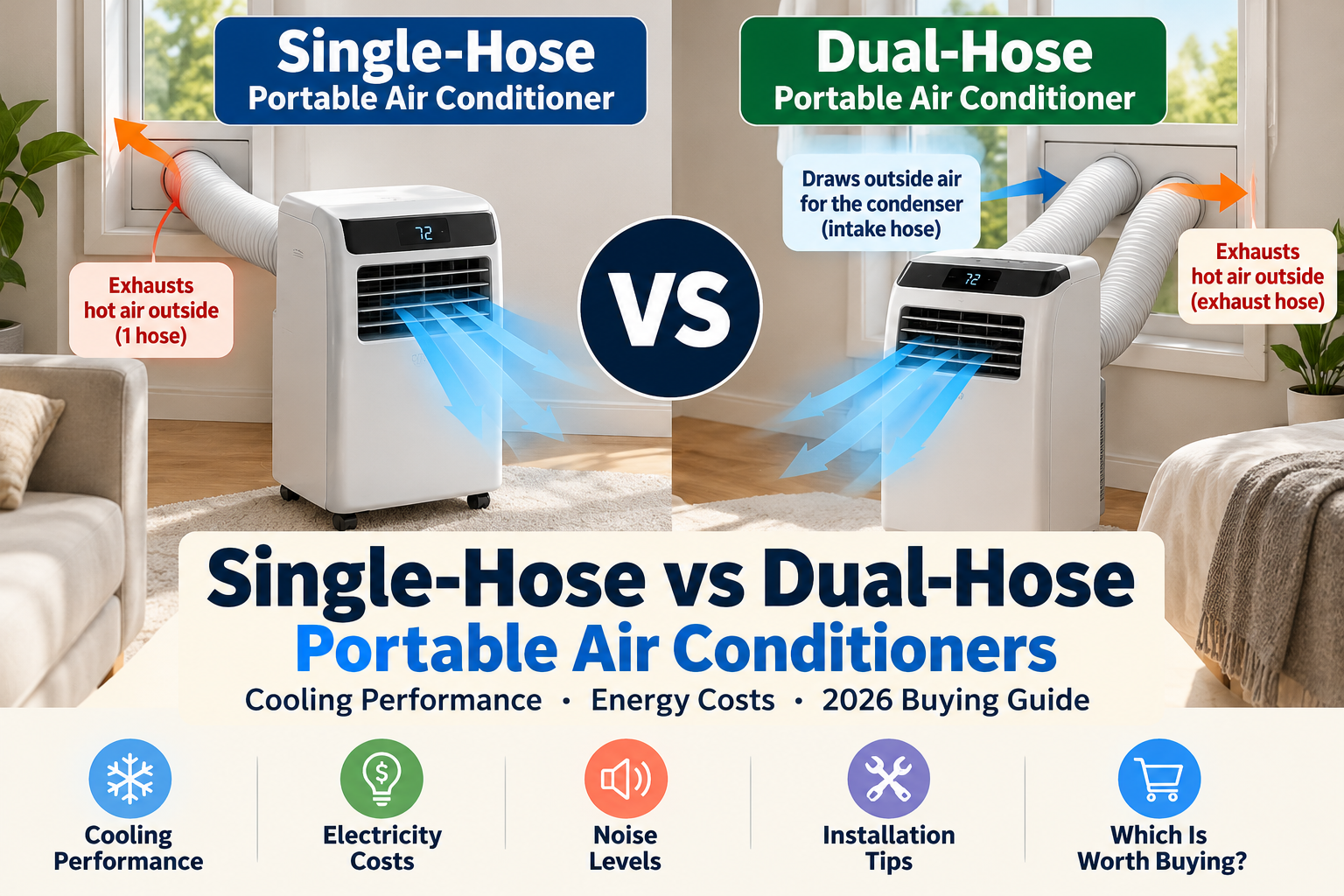
A single-hose portable air conditioner uses one exhaust duct to discharge heat outdoors.
Inside the appliance, refrigerant absorbs heat from indoor air. A separate airflow path helps remove that heat through the condenser.
In a conventional single-hose configuration, the condenser draws air from the conditioned room and exhausts it outdoors.
This creates a practical complication.
The air leaving the building must be replaced.
If the room or home becomes slightly depressurized, replacement air may enter through window gaps, door openings, wall penetrations, or other leakage paths.
During summer, that replacement air may be warmer and more humid than the indoor air.
The air conditioner must then handle part of the additional cooling and moisture-removal burden.
Why negative pressure matters
Imagine cooling a bedroom to 74°F while the outdoor temperature is 92°F.
A single-hose appliance continuously exhausts air through its duct. If some replacement air enters from outdoors, the system may face an additional heat load that would not exist to the same extent in a perfectly balanced airflow arrangement.
The exact effect varies with building airtightness, exhaust airflow, outdoor conditions, and the location of air leakage.
A tightly sealed room does not necessarily eliminate the problem; air-pressure differences can instead change where replacement air enters or how the appliance operates.
This is why two households using the same single-hose model may report different cooling experiences.
Advantages of single-hose models
Single-hose portable ACs still have practical strengths:
- Typically simpler window installation.
- Often lower initial purchase prices.
- Fewer ducts to arrange behind furniture.
- Convenient for occasional or temporary cooling.
- Potentially suitable for smaller rooms with moderate cooling demands.
The key is choosing a model with adequate rated cooling capacity under the applicable DOE test procedure, not assuming the advertised headline BTU figure tells the whole story.
2. How a Dual-Hose Portable Air Conditioner Works
A conventional dual-hose portable air conditioner uses two separate air pathways connected to the outdoors.
One hose brings outside air to the condenser. The other expels heated condenser air outdoors.
The room’s conditioned air is therefore less directly involved in the condenser’s cooling process.
This arrangement can reduce the negative-pressure effect created when a single-hose model exhausts conditioned indoor air.
Why the design can improve performance
A dual-hose appliance can preserve more of the air that has already been cooled inside the room.
That advantage may become particularly relevant when:
- Outdoor temperatures remain high for extended periods.
- The room receives strong afternoon sunlight.
- The home has noticeable air leakage.
- The appliance operates for many hours daily.
- The space requires sustained cooling rather than brief temperature reduction.
However, dual-hose designs introduce their own engineering trade-offs.
The outdoor intake air may be very hot. Hose insulation, condenser design, compressor efficiency, fan power, and installation quality all affect the final result.
A poorly engineered dual-hose unit can still perform worse than a well-engineered competitor.
The correct conclusion is that dual-hose architecture offers a potential efficiency advantage—not a universal performance guarantee.
What about hose-in-hose designs?
Some newer portable air conditioners combine two separate air passages within a single physical hose assembly.
These appliances may look like single-hose units from a distance, but their airflow arrangement is functionally different.
Before buying, inspect the manufacturer’s airflow description rather than judging the product by the number of visible plastic tubes.
3. SACC vs ASHRAE BTU: The Rating Difference That Changes the Comparison
Portable air conditioner listings can display more than one cooling-capacity number.
A product may advertise a relatively large ASHRAE BTU rating while showing a substantially smaller DOE Seasonally Adjusted Cooling Capacity (SACC).
These numbers are not interchangeable.
ASHRAE capacity
Traditional ASHRAE-based ratings describe cooling performance under specified test conditions.
They can be useful when comparing equipment evaluated under the same method, but the headline figure may not fully communicate the practical penalties associated with portable AC ducts and air infiltration.
DOE SACC
The DOE portable air conditioner test procedure accounts for factors including duct heat transfer and infiltration-related effects.
SACC is intended to provide a more representative measure of portable cooling capacity under standardized conditions.
That makes it especially useful when comparing different portable AC designs.
Example: Why the smaller number matters
Consider two hypothetical products:
| Specification | Model A | Model B |
|---|---|---|
| Hose design | Single hose | Dual hose |
| Advertised ASHRAE capacity | 12,000 BTU/h | 12,000 BTU/h |
| DOE SACC | 7,500 BTU/h | 9,000 BTU/h |
| Advertised price | $350 | $470 |
Illustrative models only; these are not specifications for real products.
Both units display the same ASHRAE capacity.
Yet Model B has a 20% higher SACC rating:
(9,000 − 7,500) ÷ 7,500 × 100 = 20%
That does not mean Model B will cool every room exactly 20% faster. Real-world outcomes depend on room conditions and how the equipment cycles.
It does mean the standardized cooling-capacity ratings differ substantially, despite identical headline ASHRAE figures.
Buying rule: When comparing portable ACs, prioritize SACC figures measured under the same applicable DOE procedure.
Also verify whether a listing’s energy-efficiency figure is CEER or another metric. Ratings from different test procedures should not be treated as directly interchangeable.
4. Single-Hose vs Dual-Hose: Side-by-Side Comparison
| Buying factor | Single-hose portable AC | Dual-hose portable AC |
|---|---|---|
| Condenser air source | Typically indoor room air | Typically outdoor intake air |
| Negative-pressure effect | More likely | Generally reduced |
| Installation | Usually simpler | May require more window space |
| Initial price | Often lower | Often higher |
| Hot-weather performance | Depends heavily on design and conditions | Can offer an advantage |
| Electricity use | Depends on actual power and runtime | Depends on actual power and runtime |
| Noise | Model-specific | Model-specific |
| Portability | Often easier to move and reconnect | Additional ducting may complicate moving |
| Best application | Moderate or occasional cooling | Sustained or demanding cooling |
The table describes common design tendencies, not guaranteed results for every model.
A premium single-hose unit with a variable-speed compressor may outperform a poorly designed dual-hose model on noise, comfort, or operating cost.
5. Electricity Costs: What Will You Actually Pay?
Electricity consumption is one of the most misunderstood parts of portable AC shopping.
Consumers sometimes assume that a dual-hose model must consume fewer watts because its airflow arrangement can be more efficient.
That assumption is unreliable.
A more powerful dual-hose appliance may draw more electricity while operating, yet cool the room more effectively or reach the thermostat setting sooner.
A smaller single-hose appliance may draw fewer watts but run for longer periods.
The correct calculation starts with electricity consumption.
Basic electricity-cost formula
Electricity cost = Power (kW) × Operating hours × Electricity rate ($/kWh)
For example, a unit averaging 1,000 watts while operating for six hours consumes:
1.0 kW × 6 hours = 6 kWh
At $0.18 per kWh:
6 kWh × $0.18 = $1.08
That is the estimated cost for that six-hour period.
Actual consumption can differ because thermostats cycle compressors, inverter systems adjust power, and room temperatures change.
Example A: Equal operating hours
Assume two hypothetical appliances:
- Single-hose model: average electrical draw of 1,000 watts.
- Dual-hose model: average electrical draw of 1,150 watts.
- Usage: six hours per day for 90 days.
- Electricity price: $0.18 per kWh.
| Calculation | Single hose | Dual hose |
|---|---|---|
| Average power | 1.00 kW | 1.15 kW |
| Daily consumption | 6.00 kWh | 6.90 kWh |
| Daily cost | $1.08 | $1.24 |
| 90-day cost | $97.20 | $111.78 |
Illustrative calculation; the power figures are assumptions, not laboratory measurements.
Under these assumptions, the dual-hose unit costs $14.58 more over the 90-day period.
But that calculation does not establish which model is more efficient at delivering cooling.
The dual-hose unit may have higher cooling capacity. It may also maintain the desired temperature more reliably.
Example B: Different operating durations
Now assume that the single-hose appliance must operate for eight equivalent full-power hours per day to maintain comfort, while the dual-hose appliance requires six.
Keep the same electrical draw and electricity price.
| Calculation | Single hose | Dual hose |
|---|---|---|
| Average operating power | 1.00 kW | 1.15 kW |
| Equivalent operating hours/day | 8 | 6 |
| Daily electricity use | 8.00 kWh | 6.90 kWh |
| 90-day electricity cost | $129.60 | $111.78 |
Under this second hypothetical scenario, the dual-hose unit costs $17.82 less in electricity over the season.
The lesson is important:
Lower wattage does not automatically mean lower total electricity cost. Runtime matters.
Neither scenario predicts actual savings from switching hose designs. They demonstrate how electricity costs change under different operating assumptions.
For a more reliable estimate, use a product’s rated electrical input, credible independent measurements, and your expected cooling schedule.
6. A Five-Year Ownership Cost Comparison
The cheapest portable air conditioner on the shelf is not necessarily the least expensive to own.
However, paying more upfront for a dual-hose model does not automatically produce financial savings either.
Consider this illustrative five-year comparison.
Assumptions
- Single-hose purchase price: $350.
- Dual-hose purchase price: $470.
- Single-hose seasonal electricity: $129.60.
- Dual-hose seasonal electricity: $111.78.
- Five cooling seasons.
- Same electricity rate and operating assumptions throughout.
- No repair costs, replacement costs, financing, or additional accessories included.
| Cost component | Single hose | Dual hose |
|---|---|---|
| Initial purchase | $350.00 | $470.00 |
| Five-year electricity | $648.00 | $558.90 |
| Five-year modeled total | $998.00 | $1,028.90 |
Under these specific assumptions, the dual-hose model costs $30.90 more over five years, despite using less electricity.
Its five-year electricity savings total $89.10, which does not fully offset the $120 purchase-price premium.
Break-even calculation
The annual modeled electricity savings are:
$129.60 − $111.78 = $17.82
The simple purchase-premium payback period is:
$120 ÷ $17.82 = approximately 6.7 cooling seasons
That calculation ignores changes in energy prices, equipment lifespan, repairs, and the time value of money.
More importantly, the comparison does not assign a dollar value to better temperature control or comfort.
If the more expensive model cools a challenging room effectively while the cheaper model cannot, the lower purchase price may be a false economy even without an electricity-cost payback.
Use ownership-cost calculations to test claims about savings—not to reduce every purchasing decision to the lowest dollar total.
7. Which Type Works Better in Extreme Heat?
High outdoor temperatures can expose weaknesses in portable cooling systems.
A single-hose appliance may struggle if it continuously draws warm replacement air into the home.
A dual-hose appliance can reduce that particular problem, but it still must reject heat into hot outdoor air.
As outdoor temperatures rise, both systems can experience reduced cooling effectiveness, depending on their design and operating limits.
The room itself may be the bigger problem
Before blaming the hose configuration, consider:
Solar heat gain: West-facing windows can add significant afternoon cooling demand.
Insulation: Poorly insulated ceilings, walls, or attic spaces increase heat entering the room.
Air leakage: Gaps around windows and doors can introduce warm, humid air.
Room size: A unit suitable for a compact bedroom may be inadequate for an open-plan living space.
Internal heat sources: Computers, cooking equipment, and other appliances add heat.
A dual-hose design cannot compensate indefinitely for an undersized cooling system or a room with excessive heat gain.
For demanding rooms, choose sufficient SACC capacity and address obvious sources of heat infiltration.
8. Bedroom Cooling: Noise May Matter More Than Hose Count
A portable air conditioner can provide adequate cooling and still be unpleasant to sleep beside.
Unlike many window-mounted systems, portable units keep the compressor and much of the mechanical assembly inside the room.
That makes acoustic performance a critical buying consideration.
Look beyond the lowest decibel figure
Manufacturers may publish noise ratings measured under different conditions.
A low-fan-mode specification may not represent what you hear during full cooling operation.
For bedrooms, consider:
- Noise at the cooling setting you are likely to use.
- Compressor startup and cycling sounds.
- Fan pitch and tonal noise.
- Vibration transferred through the floor.
- Whether sleep mode reduces cooling performance.
- Whether an inverter compressor can adjust output gradually.
Two appliances with similar decibel readings can sound quite different.
A smooth, consistent airflow sound may be less distracting than a quieter unit with frequent abrupt compressor changes.
Our bedroom recommendation
For a bedroom, prioritize adequate SACC capacity, independently measured noise, and stable temperature control.
A dual-hose configuration can be useful, but hose count alone is not a reliable noise specification.
9. Installation Quality Can Erase an Efficiency Advantage
Even a technically superior portable AC can perform poorly if installed incorrectly.
Warm air leaking through the window adapter, a badly positioned exhaust hose, or an obstructed intake can reduce practical cooling effectiveness.
Installation checklist
Seal the window opening. Use a properly fitted window kit and suitable removable weatherstripping where needed.
Avoid excessive hose length. Follow the manufacturer’s limits. Extra duct length and sharp bends can restrict airflow.
Keep hoses away from obstructions. Crushed or kinked ducting can interfere with normal operation.
Check window compatibility. Some casement, sliding, or unusually narrow windows require special arrangements.
Allow the required clearance. Follow the manufacturer’s specified space around air intakes and outlets.
Plan for condensate. Some portable ACs may need draining under certain humidity conditions or operating modes.
Use a suitable electrical outlet. Follow the appliance’s electrical instructions. Do not assume a power strip or extension cord is acceptable.
For dual-hose models, ensure both intake and exhaust paths are connected as intended.
A disconnected or poorly sealed intake hose can undermine the reason you purchased a dual-hose system.
10. An Important Safety Consideration: Combustion Appliances
Single-hose portable air conditioners can depressurize the space in which they operate.
In some circumstances, negative pressure can interfere with the venting of naturally drafted combustion appliances.
This matters in spaces containing equipment such as certain gas-fired water heaters, furnaces, or other fuel-burning appliances.
Under unfavorable conditions, backdrafting can allow combustion products, including carbon monoxide, to enter occupied areas.
A dual-hose appliance may reduce the pressure imbalance associated with condenser airflow, but it is not a substitute for proper combustion ventilation or a safety assessment.
If the room contains combustion equipment or connects to an area with potentially vulnerable natural-draft appliances, consult a qualified HVAC professional before installing a portable AC.
Maintain functioning carbon monoxide alarms in accordance with applicable guidance and local requirements.
Never assume that a portable air conditioner is safe in a combustion-appliance space solely because its window kit appears tightly sealed.
11. When a Window Air Conditioner Is the Better Purchase
Before spending extra money on a premium portable AC, consider whether a window air conditioner is an option.
A window unit places more of the heat-rejection equipment outside the conditioned room and avoids the same exhaust-hose arrangement used by portable models.
In many applications, that makes window air conditioners a more compelling choice for energy efficiency and cooling performance.
However, installation constraints may rule them out.
Portable air conditioners can make sense when:
- A lease or building rule prohibits conventional window units.
- The window design is incompatible with standard equipment.
- Temporary installation is essential.
- You need a cooling solution that can be removed seasonally.
- A permanent mini-split installation is not practical.
If a window unit is permitted and can be safely installed, compare its efficiency and total cost before committing to a portable model.
Portable does not necessarily mean more economical.
12. Buying Decision Matrix: Which Portable AC Should You Choose?
| Your situation | Recommended approach | Main reason |
|---|---|---|
| Small room, occasional use | Consider a properly sized single-hose model | Lower initial cost and simpler setup |
| Hot climate, daily cooling | Compare strong dual-hose models first | Potential reduction in infiltration-related losses |
| Bedroom or home office | Prioritize SACC and independent noise testing | Comfort depends on more than hose count |
| Tight purchase budget | Compare total cost, not just purchase price | A premium may not pay back through electricity alone |
| Difficult window installation | Verify window-kit compatibility before choosing | A poor installation can reduce performance |
| Room with combustion equipment | Obtain professional safety guidance | Depressurization can create venting risks |
| Window AC installation permitted | Compare window units before portable units | Often a more efficient cooling arrangement |
This framework is more reliable than choosing based on marketing language such as “maximum cooling,” “ultra-efficient,” or “12,000 BTU power.”
13. Five Questions to Ask Before Buying
1. What is the DOE SACC rating?
Use this as a primary cooling-capacity comparison for portable models tested under the same procedure.
2. How much electricity does the unit use?
Look for rated input power, energy-efficiency information, and credible independent testing.
Do not assume a lower advertised BTU rating means a lower electricity bill.
3. Is the appliance genuinely dual-hose?
Check the condenser airflow design, including any hose-in-hose configuration.
4. Will the window kit fit securely?
Confirm window dimensions, opening style, and hose-routing requirements before ordering.
5. How many hours will you use it?
An occasional-use appliance and an everyday cooling system have very different ownership economics.
The longer the operating schedule, the more valuable careful efficiency comparisons become.
14. Frequently Asked Questions
Is a dual-hose portable AC always more energy-efficient?
No. Dual-hose architecture can reduce certain airflow-related losses, but actual energy efficiency depends on the complete appliance design and operating conditions.
Compare standardized efficiency ratings and credible power-consumption measurements.
Does a single-hose portable AC pull hot air into the room?
It can contribute to warm replacement air entering the building because it exhausts air drawn from the conditioned space.
The amount and source of replacement air depend on building leakage, pressure relationships, and operating conditions.
Why does my portable AC say 12,000 BTU but have a lower SACC rating?
The figures reflect different rating methods. DOE SACC accounts for additional effects relevant to portable AC performance, including duct-related and infiltration-related factors.
Are dual-hose portable air conditioners quieter?
Not necessarily. Noise depends on compressor design, fans, cabinet construction, vibration control, and operating settings.
Choose based on model-specific evidence rather than hose configuration.
Can I convert a single-hose portable AC into a dual-hose unit?
Do not modify the appliance’s airflow system unless the manufacturer explicitly supports that configuration.
Improvised duct modifications can restrict airflow, impair cooling, or create safety and reliability problems.
Is a portable AC cheaper to run than central air conditioning?
It depends on the comparison.
Cooling one occupied room may use less total electricity than cooling an entire home under some conditions. However, a portable AC may be less efficient per unit of cooling than a well-designed central system.
Thermostat settings, zoning, equipment efficiency, climate, and operating hours all matter.
How long should a portable air conditioner last?
Service life varies by model, maintenance, operating conditions, and component quality. Avoid assuming a fixed lifespan when calculating long-term costs.
Check warranty coverage, parts availability, and manufacturer support.
Final Verdict: Buy the Cooling Performance, Not the Hose Count
The single-hose versus dual-hose debate is useful because it highlights a real engineering issue: removing heat from a room is not the same as removing heat from a building without consequences.
Single-hose portable air conditioners can be practical, affordable solutions for occasional cooling. Their simpler installation and lower initial prices may be worthwhile when the cooling load is manageable.
Dual-hose portable air conditioners can offer a meaningful advantage by reducing the use of conditioned indoor air for condenser cooling. That benefit may be especially valuable during sustained hot weather or in rooms where single-hose units struggle.
But the purchase decision should not stop there.
Our recommendation for 2026 is to compare portable air conditioners in this order:
- Confirm the appliance can meet your room’s cooling demand using a comparable DOE SACC rating.
- Check the actual condenser airflow configuration.
- Compare efficiency, electrical consumption, and expected operating hours.
- Evaluate noise, window compatibility, and drainage requirements.
- Calculate the total ownership cost using your own electricity rate.
A dual-hose model is often worth considering for serious, sustained cooling. A single-hose model can still be a sensible value purchase for lighter use.
Ultimately, the best portable air conditioner is the one that delivers enough cooling, fits your space safely, and remains economical under the conditions in which you will actually use it.
Sources and Further Reading
The following sources provide regulatory context, testing methodology, and independent product evaluation:
- U.S. Department of Energy — Portable Air Conditioners: https://www.energy.gov/cmei/buildings/portable-air-conditioners
- Electronic Code of Federal Regulations — Appendix CC: https://www.ecfr.gov/current/title-10/chapter-II/subchapter-D/part-430/subpart-B/appendix-Appendix%20CC%20to%20Subpart%20B%20of%20Part%20430
- Electronic Code of Federal Regulations — Appendix CC1: https://www.ecfr.gov/current/title-10/chapter-II/subchapter-D/part-430/subpart-B/appendix-Appendix%20CC1%20to%20Subpart%20B%20of%20Part%20430
- The New York Times Wirecutter — Best Portable Air Conditioners: https://www.nytimes.com/wirecutter/reviews/the-best-portable-air-conditioner/
Editorial methodology: Electricity and ownership-cost examples in this article are hypothetical calculations designed to illustrate purchasing trade-offs. They are not manufacturer specifications, measured product test results, or predictions of household savings. Product performance and operating costs vary with equipment, installation, weather, usage, and electricity rates.