
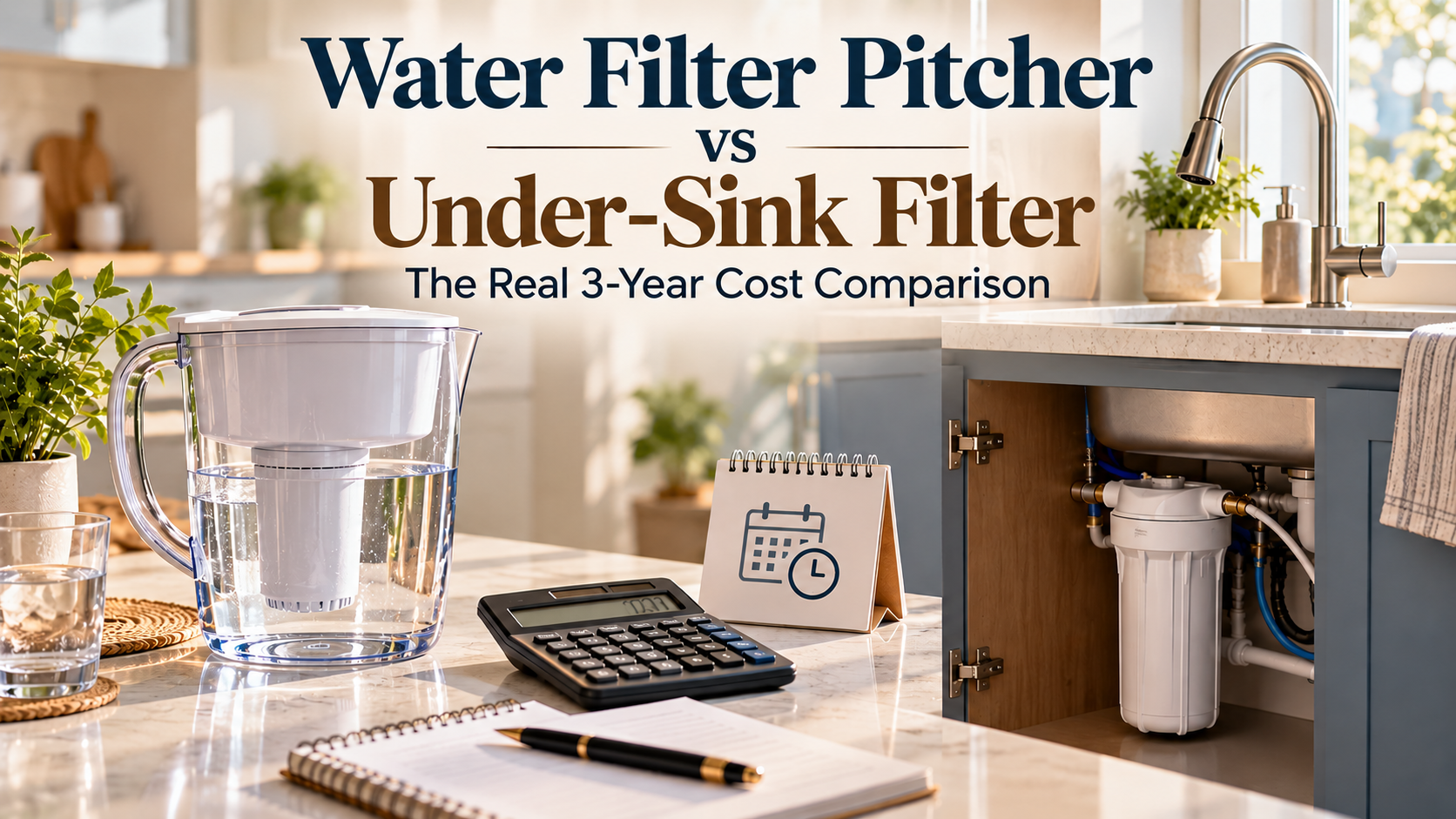
A water filter pitcher may cost less at checkout, but an under-sink system could be more convenient—and potentially less expensive per gallon—over time. Here’s how to compare the real three-year cost without overlooking filtration performance.
A $30 water filter pitcher and a $200 under-sink filtration system seem to serve completely different budgets.
One sits in your refrigerator. The other connects to your plumbing. One takes minutes to set up; the other may require installation, cabinet space, and occasional maintenance.
But the initial price tells only a small part of the story.
Over three years, you may replace dozens of pitcher cartridges, several under-sink filters, or both, depending on your household’s drinking-water consumption and the manufacturer’s replacement requirements.
And even if one option costs less, it may not be the better choice if it doesn’t address the contaminants you actually want to reduce.
The smarter comparison isn’t simply pitcher versus under-sink. It’s total ownership cost, verified filtration performance, and the amount of daily effort each system requires.
This guide walks through all three so you can make a decision that fits your household—not just a product’s marketing claims.
The Quick Verdict: Which Water Filter Should You Choose?
| Your situation | Better starting point | Why |
|---|---|---|
| Renter or student | Water filter pitcher | No plumbing changes and easy to move |
| One person with modest water consumption | Pitcher | Lower upfront commitment |
| Family using filtered water throughout the day | Under-sink filter | Convenient on-demand supply |
| Small kitchen with limited cabinet space | Pitcher | Avoids under-sink installation |
| Household that frequently forgets to refill a pitcher | Under-sink filter | Less daily handling |
| Concern about a specific contaminant | Either, if properly certified | Verified contaminant reduction matters more than format |
| Household focused on lowest three-year cost | Calculate both | Replacement schedules can reverse the initial price advantage |
Our recommendation: Start with your water-quality needs, then compare three-year ownership costs. A cheap pitcher is not a bargain if its cartridges are expensive or its filtration claims do not match your needs.
1. The Real Difference Between Pitcher and Under-Sink Filtration
A water filter pitcher is a portable container with a replaceable filtration cartridge.
You fill its reservoir with tap water and wait for gravity to move the water through the filter into the storage compartment.
An under-sink filter is installed beneath the kitchen sink and treats water as it passes through the system. Depending on the design, filtered water may come through the existing faucet or a dedicated drinking-water faucet.
These formats solve similar problems but create different daily experiences.
Water Filter Pitcher: Low Commitment, More Handling
The main attraction of a pitcher is simplicity.
You can buy one, install the cartridge, and begin using it without changing your plumbing.
Pitchers are especially appealing to renters, students, and smaller households.
However, convenience depends on consumption.
A single person filling a glass or two may barely notice the refilling process. A family preparing coffee, cooking, filling water bottles, and serving meals may refill the same pitcher repeatedly.
That time isn’t reflected in the purchase price.
Under-Sink Filter: Higher Commitment, Less Daily Work
An under-sink system typically requires more money and effort initially.
But once installed, it can provide filtered water without repeatedly filling a countertop container.
That advantage becomes more noticeable as household consumption increases.
The trade-offs include installation requirements, filter access, possible plumbing compatibility issues, and the need to check for leaks after installation or maintenance.
Some systems are relatively straightforward to install. Others may be better handled by a qualified professional.
Important: An under-sink carbon filter and an under-sink reverse-osmosis system are not the same product. Reverse osmosis often involves additional components, different maintenance costs, and wastewater considerations. This article primarily compares conventional pitcher filters with non-RO under-sink drinking-water filters.
2. The Three-Year Cost Comparison Most Shoppers Never Make
To compare filtration systems fairly, calculate what each will cost over the same ownership period.
Use this formula:
Three-year ownership cost = initial system price + replacement cartridges + installation + other required maintenance
For a pitcher, installation is usually zero.
For an under-sink system, installation may be free if you can safely complete it yourself—or an additional expense if professional assistance is necessary.
Example A: A Budget Water Filter Pitcher
Consider a hypothetical pitcher with these costs:
- Initial purchase: $30
- Replacement cartridge: $12
- Replacement interval: every two months
- Ownership period: 36 months
Assume the original purchase includes the first cartridge and it lasts the first two months.
You would then need 17 replacement cartridges.
Three-year cost = $30 + (17 × $12) = $234
This example assumes the filter reaches its time-based replacement interval before its rated water capacity.
If your household uses enough water to reach the cartridge’s gallon limit earlier, you may need more frequent replacements.
Example B: A Conventional Under-Sink Filter
Now consider a hypothetical under-sink system:
- Initial purchase: $180
- Replacement cartridge: $45
- Replacement interval: every six months
- Installation: $0 for a suitable DIY installation
- Ownership period: 36 months
Assume the original system includes its first filter.
You would need five replacement cartridges during the remaining period.
Three-year cost = $180 + (5 × $45) = $405
Under these assumptions, the pitcher costs $171 less over three years.
But the under-sink system may provide substantially greater convenience, depending on how much water your household uses.
What Happens If Professional Installation Costs $150?
Add the installation expense to the under-sink scenario:
$180 + $225 + $150 = $555
Now the difference rises to $321.
That doesn’t make the under-sink system a poor purchase. It simply means the extra convenience has a measurable price.
Three-Year Cost at a Glance
| Cost component | Pitcher example | Under-sink example |
|---|---|---|
| Initial system | $30 | $180 |
| Replacement cartridges | $204 | $225 |
| DIY installation | $0 | $0 |
| Three-year total | $234 | $405 |
| Total with $150 professional installation | $234 | $555 |
All prices, replacement intervals, and scenarios above are illustrative—not verified prices for specific products. Actual replacement schedules depend on both elapsed time and rated water capacity. Prices, included filters, labor charges, and maintenance requirements vary by model.
The most useful lesson is not that pitchers always cost less.
It’s that replacement filters and installation can matter more than the price difference you notice in the store.
3. Household Size Changes the Economics
A filtration system that works beautifully for one person may become inconvenient for a family of four.
But household size alone doesn’t determine filter consumption.
What matters is how much filtered water people actually use.
For planning purposes, consider three hypothetical household profiles.
| Household | Illustrative filtered-water use | Three-year volume |
|---|---|---|
| One person | 0.5 gallon/day | 547.5 gallons |
| Two people | 1 gallon/day | 1,095 gallons |
| Family of four | 2 gallons/day | 2,190 gallons |
These are calculation examples, not recommended drinking-water amounts. Filtered water may be used for beverages and cooking, so your actual household demand can differ substantially.
Why Rated Filter Capacity Matters
Imagine two cartridges:
- Cartridge A is rated for 40 gallons.
- Cartridge B is rated for 300 gallons.
At two gallons per day, the first reaches its rated capacity in approximately 20 days.
The second reaches 300 gallons in approximately 150 days.
However, manufacturers may also specify a maximum replacement interval in months.
Always replace a cartridge when it reaches either its rated capacity or its specified time limit, whichever comes first.
This means a household with high consumption may spend far more on cartridges than a simple six-month replacement estimate suggests.
Calculate Your Real Filter Replacement Count
For each system:
- Estimate your daily filtered-water use.
- Multiply by 365 for annual consumption.
- Divide by the cartridge’s rated gallon capacity.
- Compare that result with the manufacturer’s time-based replacement requirement.
- Use the more frequent replacement schedule.
For a 36-month ownership period, include every replacement required before the end of that period.
Do not count a new cartridge installed exactly at the end of the three-year period unless you want to include its value for continued use.
This approach produces a more meaningful cost comparison than assuming every pitcher filter lasts two months or every under-sink cartridge lasts six.
4. Filtration Performance: Don’t Choose Based on Price Alone
A filter is only useful if it addresses the water-quality issue that matters to your household.
Some buyers simply want better-tasting tap water.
Others are concerned about lead, certain industrial chemicals, or other contaminants.
These are different purchasing problems.
A pitcher may be appropriate for either situation if the exact product carries verified claims relevant to the contaminant of concern.
Likewise, an expensive under-sink system should not be assumed to remove everything.
What NSF/ANSI Certifications Actually Mean
| Standard | Main purpose | What to verify |
|---|---|---|
| NSF/ANSI 42 | Aesthetic effects such as chlorine taste and odor | The specific reduction claim |
| NSF/ANSI 53 | Specific contaminants associated with health effects | Certification for the contaminant you care about |
| NSF/ANSI 401 | Certain emerging or incidental compounds | The individual certified reduction claims |
| NSF/ANSI 58 | Reverse-osmosis drinking-water systems | The exact RO system and its certified performance claims |
A standard number is not a universal guarantee.
For example, a product certified under NSF/ANSI 53 does not necessarily reduce every contaminant addressed by that standard.
The exact model and its listed reduction claims matter.
Similarly, the phrase “tested to NSF standards” should not automatically be treated as equivalent to an independently verified certification.
Before buying, check the manufacturer’s performance data sheet and confirm relevant certification information with an accredited certification body.
What About Lead and PFAS?
If your concern is lead, select a filter with a verified lead-reduction claim that meets the appropriate applicable certification requirements.
The U.S. Environmental Protection Agency provides guidance for identifying pitcher and point-of-use filters certified for lead reduction.
If you’re concerned about PFAS, look for a verified claim addressing the specific PFAS chemicals relevant to your water.
Do not assume that ordinary chlorine taste-and-odor filtration establishes PFAS reduction.
And remember: if your water supplier issues a boil-water advisory or another safety notice, follow the official instructions. A typical household pitcher or carbon filter is not a substitute for an appropriate microbiological treatment method.
5. Installation, Space, and Daily Convenience
Cost and certification are essential, but a filtration system must also fit your kitchen and routine.
The Pitcher Advantage: Flexibility
A pitcher can move between apartments, dorm rooms, vacation homes, and different kitchen layouts.
It also avoids installation-related complications.
However, you need refrigerator or counter space, regular cleaning, and a reliable cartridge replacement routine.
A large pitcher can be awkward in a small refrigerator.
And filtered water may not be available immediately if the reservoir is empty.
The Under-Sink Advantage: On-Demand Water
A properly installed under-sink filter can make daily water use feel nearly effortless.
That matters when several people fill bottles, prepare drinks, and cook throughout the day.
But before buying, confirm:
- Available cabinet space
- Plumbing and faucet compatibility
- Whether drilling or a separate faucet is required
- Accessibility for future cartridge changes
- Installation instructions and any warranty conditions
- Whether the system is intended for cold-water use only
Never assume a system is suitable for your plumbing simply because it is advertised as easy to install.
Renters Should Check the Rules First
If you rent, review your lease and obtain any required permission before modifying plumbing or countertops.
A pitcher generally avoids these complications.
For many renters, that flexibility can outweigh a possible long-term cost advantage from a permanently installed system.
6. Hidden Costs That Can Change Your Decision
Replacement Filter Availability
A low-cost filtration system becomes frustrating if replacement cartridges are difficult to find.
Before purchasing, check whether the exact replacement model is readily available and whether the manufacturer still supports it.
Avoid assuming that a generic cartridge will provide the same certified performance as the original.
Cartridge Prices Over Time
Replacement cartridges can change in price.
A three-year estimate should therefore be treated as a planning model, not a guaranteed future expense.
If you want a more conservative budget, calculate a second scenario using replacement prices 15–20% above today’s price.
That is a sensitivity test, not a prediction.
Cleaning and Maintenance
Pitchers require routine cleaning according to the manufacturer’s instructions.
Under-sink systems require appropriate filter changes, periodic inspections, and attention to leaks.
Neglected maintenance can compromise performance and create avoidable problems.
Water Waste
Conventional carbon-based pitcher and under-sink filters generally differ from reverse-osmosis systems.
RO systems may send a portion of incoming water to the drain as part of the treatment process.
If you are considering RO, include the system’s rated efficiency or recovery performance and relevant water charges in your comparison.
Don’t assume the costs of a simple carbon filter apply to a reverse-osmosis system.
7. The Better Buying Decision: Match the Filter to the Household
Choose a Water Filter Pitcher If…
You want a low upfront price, do not want to modify plumbing, and have relatively modest filtered-water needs.
A pitcher is also a sensible way to try a filtration routine before committing to a permanent installation.
Prioritize certified performance, cartridge availability, realistic replacement costs, and a size that fits your refrigerator.
Choose an Under-Sink Filter If…
You use filtered water frequently and value a convenient, on-demand supply.
An under-sink system may be especially appealing for a busy kitchen where repeatedly refilling a pitcher would become inconvenient.
Prioritize relevant certification, installation compatibility, accessible filter changes, and long-term cartridge costs.
Consider a Different Solution If…
Your main concern is a contaminant that neither product is certified to reduce.
In that case, identify the treatment method appropriate for your water-quality issue before choosing a format.
You may need a different certified filtration system or professional water-quality guidance.
The right filter is the one that treats the right water-quality problem, fits your routine, and remains affordable to maintain.
8. A Five-Minute Water Filter Buying Checklist
Before clicking “Buy,” answer these questions:
- What am I trying to improve? Taste, odor, a specific contaminant, or everyday convenience?
- Is the exact model certified for that purpose? Check the named contaminant claim—not just a badge.
- How much filtered water will my household use? Estimate gallons per day.
- What will replacements cost over 36 months? Include both time and capacity limits.
- Can I install and maintain it properly? Consider space, plumbing, cartridge access, and rental restrictions.
If you cannot answer these questions from the product documentation, keep comparing.
A well-marketed filter is not necessarily a well-matched filter.
Frequently Asked Questions
Is an Under-Sink Water Filter Better Than a Pitcher?
Not automatically. Under-sink filters often offer greater convenience, while pitchers usually require less initial investment and no plumbing changes. Filtration performance depends on the exact model and its verified claims.
Which Is Cheaper Over Three Years?
It depends on the system price, cartridge costs, rated capacity, replacement schedule, and installation. A pitcher may remain cheaper for a low-consumption household, but a higher-capacity under-sink system can become more competitive as water use increases.
Do Water Filter Pitchers Remove Lead?
Some do, but not all. Look for the exact model’s independently verified lead-reduction certification and follow its replacement instructions.
Do Under-Sink Filters Remove PFAS?
Some systems have certified claims for specific PFAS chemicals. The under-sink format alone does not establish PFAS reduction. Verify the relevant claim for the exact model.
How Often Should I Replace a Water Filter?
Follow the manufacturer’s instructions. Many products specify both a time interval and a rated gallon capacity. Replace the cartridge when the first limit is reached.
Is Reverse Osmosis Worth the Extra Cost?
Reverse osmosis may be appropriate when its verified contaminant-reduction capabilities match your water-quality needs. However, it can involve higher purchase and maintenance costs, additional installation requirements, and water discharged during treatment.
Final Verdict: Compare Three-Year Value, Not Just the Checkout Price
A water filter pitcher is often the easier choice for renters, smaller households, and buyers who want a simple, low-commitment solution.
An under-sink filter can be worth the additional investment for households that use filtered water frequently and prefer an on-demand supply.
But neither format wins automatically on cost or filtration performance.
Before buying, compare three things: the exact contaminants the filter is certified to reduce, the full 36-month ownership cost, and how well the system fits your daily routine.
A lower initial price is useful. A lower cost per gallon can be even more useful.
But the best value comes from a filtration system that consistently does the job you actually need.
Editorial Sources and Further Reading
- U.S. EPA — Choose the Water Filter That’s Right for You
- U.S. EPA — Certified Filters for Lead Reduction
- NSF — Water Treatment System Standards
- NSF — Standards 42, 53 and 401
- NSF — Reverse Osmosis Standard 58
Editorial note: This guide is based on published technical and consumer guidance, not original laboratory testing. All cost examples are illustrative and should be recalculated using the specifications and prices of the exact products being considered.