
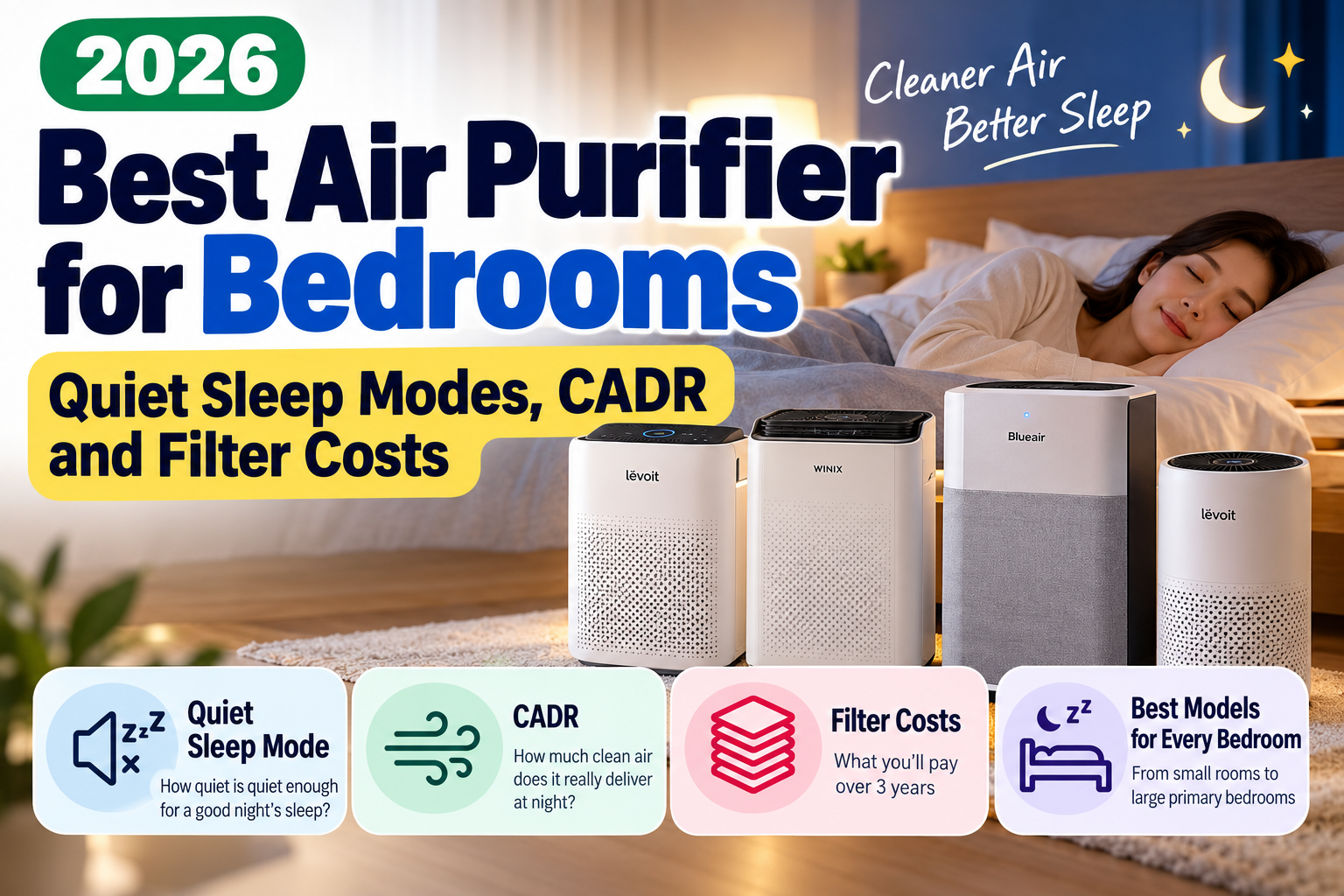
Updated October 2026
A bedroom air purifier needs to do two things well: clean the air and let you sleep.
That sounds simple, but many shoppers make the same mistake. They choose the purifier with the lowest advertised noise level, turn on Sleep Mode, and assume it is still cleaning the room effectively.
The problem? The quietest setting is not always the most useful setting.
Lower fan speeds usually move less air through the filter. A purifier can be almost silent at night while delivering much less clean air than its maximum CADR rating suggests.
This guide explains how to choose a bedroom air purifier based on actual sleeping conditions—not just impressive numbers on a product box.
We’ll compare several models worth considering in 2026, explain the difference between quiet operation and effective filtration, and show you how to calculate the ongoing cost of replacement filters.
Quick Answer: Which Bedroom Air Purifier Should You Consider?
For many standard bedrooms, the Levoit Vital 200S is a sensible starting point because it combines relatively quiet operation, useful controls, and a manageable footprint.
The Winix 5530 is another strong option for shoppers who want solid performance without moving into premium pricing.
For a larger primary bedroom where budget is less important, the Blueair Blue Signature Large offers considerably more air-cleaning capacity.
For a very small bedroom, the Levoit Core 200S may be sufficient, but its limited airflow makes it a less convincing choice for larger spaces.
These are research-based shopping considerations, not products independently tested by Living Pick Lab. The comparisons below draw on published third-party testing and general guidance from the U.S. Environmental Protection Agency (EPA).
1. Why Sleep Mode Can Be Misleading
Sleep Mode usually reduces fan speed to make an air purifier quieter. Some models also dim or switch off indicator lights.
Both features are useful, but a lower fan speed creates a trade-off.
An air purifier works by drawing room air through its filters. When the fan moves less air, fewer airborne particles can pass through the filter over the same period.
According to the EPA, higher fan speeds and longer operating times generally increase the amount of air filtered.
That means two purifiers with similarly quiet Sleep Modes may deliver very different levels of air cleaning.
What to check instead
When comparing bedroom models, ask:
- How much clean air does the purifier deliver at a comfortable noise level?
- Can it run at a moderate speed without disturbing sleep?
- Does Sleep Mode reduce airflow too aggressively?
- Can the display lights be turned off?
- Is the purifier appropriately sized for the bedroom?
Buying tip: A larger purifier running at a comfortable intermediate speed may be more useful than a small purifier operating at its maximum speed. However, this depends on each model’s actual performance and noise characteristics.
2. CADR Explained: Why the Maximum Number Is Not Enough
CADR stands for Clean Air Delivery Rate.
It describes how quickly an air purifier delivers air cleaned of certain airborne particles. CADR is commonly expressed in cubic feet per minute (CFM).
A higher CADR generally means the purifier can clean a larger room or remove particles more quickly.
The EPA provides the following approximate sizing guidance for rooms with 8-foot ceilings:
| Bedroom Size | Approximate Minimum CADR |
|---|---|
| 100 sq ft | 65 CFM |
| 150 sq ft | 98 CFM |
| 200 sq ft | 130 CFM |
| 250 sq ft | 163 CFM |
| 300 sq ft | 195 CFM |
The values for 150 and 250 square feet are interpolated from the EPA’s published sizing table.
Important: These are approximate room-sizing targets, not guaranteed Sleep Mode performance requirements.
Most advertised CADR figures describe a purifier’s rated performance under specified testing conditions, rather than its airflow on the quietest setting.
If you plan to use Sleep Mode for eight hours every night, pay attention to independent testing at lower noise levels whenever that information is available.
For a more detailed explanation of room sizing, read our earlier guide:
What Size Air Purifier Do I Need? CADR Guide for 150, 300 and 500 Sq Ft Rooms
3. Bedroom Air Purifiers Worth Comparing in 2026
The following models represent different bedroom sizes, budgets, and performance priorities.
This is not a claim that every model has been personally tested by our editorial team.
Levoit Vital 200S — A Balanced Choice for Many Bedrooms
The Levoit Vital 200S is worth considering if you want a practical combination of filtration, quiet operation, and convenient controls.
Independent testing by RTINGS found that it operates quietly at its lowest fan setting and offers useful overnight features, including display control.
Potential advantages
- Quiet low-speed operation
- App-based controls
- Display-off functionality
- Reasonable balance of performance and size
Potential limitations
- Less suitable for very large bedrooms at quieter fan settings
- Sleep Mode does not deliver the same airflow as maximum speed
- Replacement filter costs should be checked before purchase
Best fit: A standard bedroom where noise and value matter more than maximum airflow.
Winix 5530 — A Mid-Range Alternative
The Winix 5530 deserves attention if you want a mid-range air purifier with useful air-cleaning performance.
RTINGS identified it as a mid-range bedroom option in its 2026 comparison.
Potential advantages
- Competitive filtration performance
- Suitable for many typical bedroom layouts
- Quiet low-speed operation
- A practical alternative to premium models
Potential limitations
- Larger physical footprint than some compact units
- Display-light controls may be less flexible than a complete display-off feature
- Replacement filter availability and pricing should be checked
Best fit: Shoppers who prioritize performance and value over the smallest possible design.
Blueair Blue Signature Large — For Larger Bedrooms
A large primary bedroom may need more airflow than a compact bedside purifier can comfortably provide.
The Blueair Blue Signature Large is a premium option with strong measured filtration performance, including at relatively quiet operating levels.
Potential advantages
- Strong air-cleaning capacity
- Suitable for larger rooms
- Quiet operation relative to its performance
- Display-off capability
Potential limitations
- Premium purchase price
- More capacity than a small bedroom may require
- Larger size and potentially higher long-term ownership cost
Best fit: Larger bedrooms where effective quiet filtration matters more than the lowest upfront price.
Levoit Core 200S — A Compact Budget Option
The Levoit Core 200S is a smaller, lower-cost model.
Its compact design may appeal to people furnishing a dorm room, small guest bedroom, or limited-space sleeping area.
Potential advantages
- Compact footprint
- Quiet low-speed operation
- Display-off function
- Lower initial spending than many larger models
Potential limitations
- Limited air-cleaning capacity
- Not an ideal choice for a large primary bedroom
- No built-in air quality sensor for automatic adjustment
Best fit: A small enclosed bedroom where space and purchase price are the main concerns.
4. Comparison: What Matters Most at Night?
| Model | Bedroom Priority | Main Strength | Main Trade-Off |
|---|---|---|---|
| Levoit Vital 200S | Balanced everyday use | Quiet operation and controls | Limited low-noise coverage in large rooms |
| Winix 5530 | Mid-range value | Strong practical filtration | Size and display-light compromises |
| Blueair Blue Signature Large | Large primary bedrooms | High low-noise cleaning capacity | Premium price |
| Levoit Core 200S | Small bedrooms | Compact and affordable | Lower airflow |
The most important question is not simply which purifier has the highest maximum CADR.
It is which purifier delivers enough clean air at a noise level you can tolerate while sleeping.
That is why independent low-noise performance testing can be more useful for bedroom shoppers than manufacturer noise specifications alone.
5. How Quiet Should a Bedroom Air Purifier Be?
Noise specifications are usually expressed in decibels, often dBA.
A lower number generally indicates a quieter sound, but the character of the sound matters too.
For example, two machines with similar measured noise levels may sound different because of fan pitch, vibration, or intermittent changes in speed.
As a practical shopping guide:
- Around 30–34 dBA: Often quiet enough for many bedrooms, although sensitive sleepers may still notice it.
- Around 35–40 dBA: Potentially acceptable as background fan noise, depending on personal preference.
- Above 40 dBA: More likely to be noticeable in a quiet sleeping environment.
These are general comfort considerations, not medical or universal sleep thresholds.
Also consider whether the air purifier makes clicking sounds, produces vibrations against furniture, or changes speed suddenly in Auto Mode.
Practical tip: If possible, listen to the purifier at the fan speed you actually expect to use overnight—not just its quietest setting.
6. Sleep Mode vs Auto Mode: Which Is Better?
Sleep Mode and Auto Mode solve different problems.
Sleep Mode usually prioritizes lower noise and reduced lighting.
Auto Mode adjusts fan speed based on readings from the purifier’s built-in air quality sensor.
Neither mode is automatically the best choice for every bedroom.
Sleep Mode may be better when:
- You are easily disturbed by sudden fan-speed changes.
- The purifier is already appropriately sized for the room.
- You want consistent background noise.
- Bright indicator lights are distracting.
Auto Mode may be better when:
- Particle levels fluctuate during the night.
- You want the purifier to respond to changes in measured air quality.
- You can tolerate occasional increases in fan noise.
A useful alternative is to run the purifier at a higher speed before bedtime, then switch to a quieter but still effective setting overnight.
However, this strategy should not be treated as a substitute for adequate continuous filtration when particle sources remain present.
7. Filter Replacement Costs: The Hidden Bedroom Expense
A bedroom air purifier may run for eight hours or more every night.
That makes replacement filters an important part of the buying decision.
Two machines with similar purchase prices can have very different ownership costs if one requires more expensive or more frequent filter replacements.
A simple three-year cost example
Consider two hypothetical air purifiers:
| Cost | Purifier A | Purifier B |
|---|---|---|
| Purchase price | $120 | $180 |
| Replacement filter | $35 | $45 |
| Replacement interval | Every 6 months | Every 12 months |
| Replacement filters over 3 years* | 6 | 3 |
| Three-year purchase + filter cost | $330 | $315 |
Illustrative calculation assuming each replacement interval is followed throughout the three-year period. Actual replacement timing may vary.
Despite costing $60 more upfront, Purifier B has a slightly lower three-year purchase-plus-filter cost in this example.
These figures are hypothetical, not current prices for the models reviewed above.
Electricity costs, taxes, shipping, discounts, and other maintenance expenses are excluded.
Before buying, check:
- The exact replacement filter model number
- Whether genuine filters are readily available
- The manufacturer’s recommended replacement interval
- Whether carbon filters require separate replacement
- The price of filters from reliable retailers
Money-saving tip: Compare the total cost over three years instead of choosing solely by the lowest initial price.
8. How Much Electricity Does an Air Purifier Use Overnight?
Air purifiers also use electricity, although their energy consumption varies by model and fan setting.
You can estimate annual electricity consumption using this formula:
Watts × Hours per day × 365 ÷ 1,000 = kWh per year
For example, a purifier averaging 15 watts over eight hours each night would use:
15 × 8 × 365 ÷ 1,000 = 43.8 kWh per year
At an illustrative electricity rate of $0.18 per kWh, the annual energy cost would be approximately $7.88.
This is a calculation example, not a verified electricity rate or actual measured power draw for any of the recommended models.
In many cases, replacement filters deserve as much attention as electricity when comparing ongoing expenses.
9. HEPA, Carbon Filters and Bedroom Air Quality
Air purifiers often combine different filtration materials.
Particle filtration
High-efficiency particle filters can help reduce airborne particles such as dust, pollen, and pet dander.
However, not every filter advertised with HEPA-related terminology carries the same certification or performance evidence.
Check the manufacturer’s documentation and independent performance testing rather than relying on marketing language alone.
Activated carbon
Activated carbon may help reduce some gases and odors, but effectiveness depends on the filter’s design and the amount of suitable carbon material.
The EPA notes that particle CADR ratings do not measure a purifier’s ability to remove gases.
What an air purifier cannot do
A portable air purifier does not replace adequate ventilation or control the source of indoor pollution.
It also does not solve a moisture problem.
If your bedroom has dampness, condensation, or a persistent musty smell, address the moisture source rather than expecting a particle filter to fix it.
10. Five Bedroom Air Purifier Buying Mistakes
Mistake 1: Buying only for the advertised room coverage
Coverage claims may be based on different assumptions about air changes per hour.
Compare CADR and room size rather than relying on a single large coverage number.
Mistake 2: Choosing the lowest dBA figure
An extremely quiet purifier may also move very little air at that setting.
Consider both sound and filtration performance.
Mistake 3: Ignoring replacement filters
An inexpensive machine can become costly if replacement filters are expensive or difficult to obtain.
Mistake 4: Forgetting display lights
Bright indicators can be distracting in a dark bedroom.
Look for a genuine display-off feature rather than assuming Sleep Mode turns off every light.
Mistake 5: Placing the purifier where airflow is blocked
Avoid positioning the purifier so close to walls, curtains, bedding, or furniture that its air intake or outlet is obstructed.
Follow the manufacturer’s placement instructions.
11. Which Air Purifier Should You Buy for Your Bedroom?
Use this decision guide before purchasing.
Choose a compact model if:
Your bedroom is small, you have limited floor space, and independent performance data indicates sufficient airflow for your room.
Choose a balanced mid-sized model if:
You have a typical bedroom and want a practical compromise between noise, filtration, features, and cost.
Choose a higher-capacity model if:
Your bedroom is large, you need stronger filtration at quieter fan speeds, or you want more flexibility without running the fan at maximum speed.
Prioritize filter cost if:
You plan to run the purifier every night for several years and want to minimize total ownership expenses.
The best choice is the one that fits your actual room, sleeping preferences, and long-term budget.
Frequently Asked Questions
Is it safe to leave an air purifier on all night?
Many portable air purifiers are designed for extended operation when used according to their instructions. Follow the manufacturer’s electrical and placement guidance, and keep air openings unobstructed.
Does Sleep Mode still clean the air?
Yes, a filter-based purifier can still clean air in Sleep Mode, but the amount of air cleaned is generally lower when the fan speed is reduced.
Should I put an air purifier next to my bed?
Place it where airflow is unobstructed and where the fan noise or direct airflow will not disturb you. Follow the manufacturer’s clearance recommendations.
Is a larger air purifier always better?
No. A larger unit may offer more capacity, but it can cost more, occupy more space, and provide little additional value in a very small room.
Is HEPA filtration enough to remove bedroom odors?
Particle filtration alone is not designed to remove all gases or odors. Appropriate activated carbon filtration may help with some odors, but controlling the source remains important.
What matters more: CADR or noise?
Both matter. For bedrooms, the most useful comparison is how much clean air a purifier delivers at a noise level you can comfortably tolerate overnight.
Final Verdict
The best bedroom air purifier in 2026 is not necessarily the quietest model or the one with the highest advertised coverage.
A better purchase decision considers four factors together:
- Enough air-cleaning capacity for the bedroom
- Acceptable noise at a useful fan speed
- Convenient overnight features, including display control
- Affordable, readily available replacement filters
For many shoppers, the Levoit Vital 200S and Winix 5530 are reasonable models to investigate first. The Blueair Blue Signature Large may make more sense in a spacious primary bedroom, while the Levoit Core 200S is worth considering for a smaller room.
Before buying, verify current product specifications, filter availability, and prices for your location.
The goal is simple: cleaner bedroom air without sacrificing sleep or overspending on features you do not need.
Sources and Further Reading
U.S. Environmental Protection Agency (EPA)
Guide to Air Cleaners in the Home
https://www.epa.gov/indoor-air-quality-iaq/guide-air-cleaners-home
RTINGS — Best Air Purifiers for Bedrooms (2026)
Independent product testing and bedroom-focused comparisons
https://www.rtings.com/air-purifier/reviews/best/bedrooms
RTINGS — Best Quiet Air Purifiers (2026)
Low-noise filtration performance comparisons
https://www.rtings.com/air-purifier/reviews/best/quiet
Editorial note: Living Pick Lab has not independently laboratory-tested the products discussed in this article. Recommendations are based on published testing, manufacturer information, and practical buying considerations. Product availability, specifications, and replacement filter prices may change.