
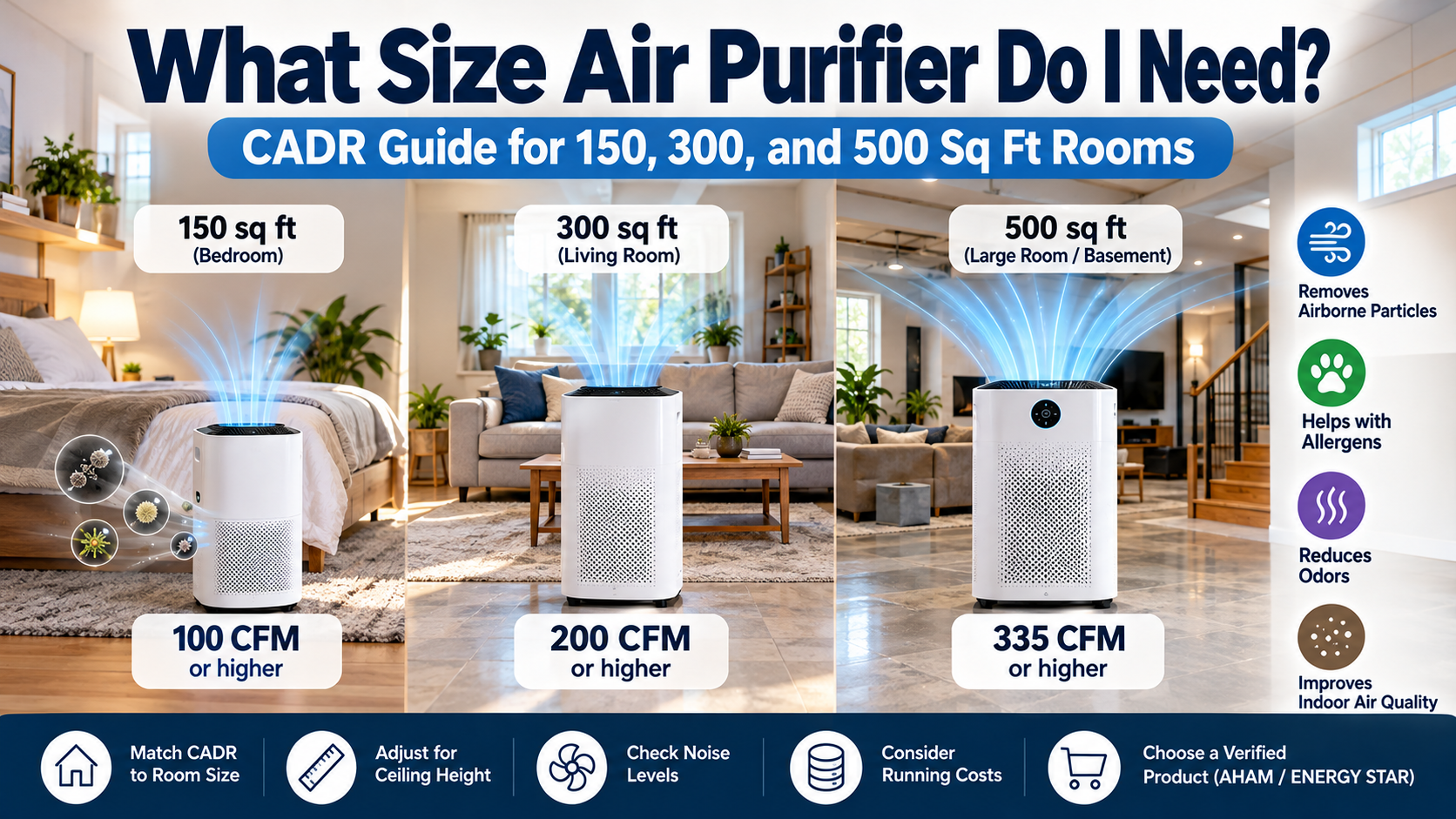
Buying an air purifier for a 150-, 300-, or 500-square-foot room should be simple. Yet product listings often make it surprisingly difficult.
One purifier may advertise coverage of 1,500 square feet, while another claims only 350 square feet—even though their actual clean-air delivery rates are similar.
The difference often comes down to how frequently each product is assumed to clean the air.
The most useful starting point is not the largest room-size claim on the box. It is the purifier’s verified smoke Clean Air Delivery Rate (CADR).
This guide shows how to calculate the CADR your room needs, adjust for ceiling height, understand air changes per hour, and avoid paying for misleading coverage claims.
Quick Answer: What Size Air Purifier Do You Need?
For rooms with standard 8-foot ceilings, the Association of Home Appliance Manufacturers (AHAM) recommends choosing an air purifier with a tobacco-smoke CADR of at least two-thirds of the room’s floor area in square feet.
That gives the following practical buying targets:
| Room size | Minimum smoke CADR using AHAM’s 2/3 rule | Practical buying target |
|---|---|---|
| 100 sq ft | 67 CFM | 70 CFM or higher |
| 150 sq ft | 100 CFM | 100 CFM or higher |
| 200 sq ft | 134 CFM | 135 CFM or higher |
| 250 sq ft | 167 CFM | 170 CFM or higher |
| 300 sq ft | 200 CFM | 200 CFM or higher |
| 350 sq ft | 234 CFM | 235 CFM or higher |
| 400 sq ft | 267 CFM | 270 CFM or higher |
| 500 sq ft | 334 CFM | 335 CFM or higher |
| 600 sq ft | 400 CFM | 400 CFM or higher |
These figures apply AHAM’s simplified two-thirds rule, rounded upward where appropriate. They are screening targets for standard 8-foot ceilings, not guarantees of pollutant removal in every room.
EPA publishes a closely related sizing table with approximate values of 195 CFM for 300 square feet and 325 CFM for 500 square feet. The small differences reflect the use of different approximations.
Living Pick Lab’s buying rule: Start with the room’s dimensions, calculate the required smoke CADR, and then compare verified products.
1. What Is CADR, and Why Does It Matter More Than Advertised Coverage?
CADR stands for Clean Air Delivery Rate.
It indicates how much filtered air a portable air cleaner delivers for particular airborne particles under standardized testing conditions.
CADR is commonly expressed in cubic feet per minute (CFM) in the United States.
A higher CADR generally means the purifier can remove the tested airborne particles more quickly from a given room.
Three different CADR numbers
AHAM’s air-cleaner certification program measures CADR for three particle categories:
- Tobacco smoke
- Dust
- Pollen
A product may have different ratings for each.
For general room sizing, AHAM recommends using the tobacco-smoke CADR.
This matters because a listing that advertises only its highest CADR number may not be presenting the value used for AHAM’s room-size recommendation.
CADR is not the same as fan airflow
A purifier’s fan may move a large volume of air, but not all airflow is equivalent to effectively filtered air.
CADR accounts for particle removal performance under standardized conditions.
When comparing models, look for an identifiable CADR rating rather than an unspecified fan airflow number.
CADR is not an odor-removal rating
A high particle CADR does not establish that an air purifier will effectively remove cooking gases, volatile organic compounds, or musty odors.
Gas and odor control depends on separate filtration capabilities, such as suitable activated-carbon media.
Bottom line: CADR is an essential particle-filtration buying metric, but it does not describe every air-quality problem.
2. The Simple Formula for Choosing Air Purifier Size
Start by measuring the room.
Room area = Length × Width
For example, a bedroom measuring 12 feet by 15 feet has:
12 × 15 = 180 square feet
Next, apply AHAM’s simplified sizing rule:
Minimum smoke CADR (CFM) = Room area (sq ft) × 2 ÷ 3
For the 180-square-foot bedroom:
180 × 2 ÷ 3 = 120 CFM
A purifier with a verified smoke CADR of at least 120 CFM meets this simplified room-sizing guideline for a standard 8-foot ceiling.
If you are comparing two products with similar prices, choosing a somewhat higher CADR may provide additional flexibility.
However, more capacity is not automatically better value if the larger model is expensive, noisy, or costly to maintain.
3. Air Purifier Size for a 150 Sq Ft Bedroom
A 150-square-foot room might measure:
10 feet × 15 feet = 150 square feet
Using AHAM’s rule:
150 × 2 ÷ 3 = 100 CFM
Recommended minimum smoke CADR: approximately 100 CFM.
What should you prioritize?
For a bedroom this size, consider:
- Verified smoke CADR of at least 100 CFM
- Acceptable noise at the speed you will actually use
- Replacement-filter availability and cost
- A suitable mechanical particle filter
- Convenient controls and sleep-mode behavior
A common mistake
Some small bedroom purifiers advertise very large coverage areas based on a low number of air changes per hour.
A claimed 600-square-foot coverage area does not necessarily mean the purifier is appropriate for frequent particle filtration in a 600-square-foot room.
Check the smoke CADR before deciding.
Living Pick Lab verdict: For a typical 150-square-foot bedroom, a verified 100-CFM-or-higher smoke CADR is a sensible starting point. Pay particular attention to nighttime noise.
4. Air Purifier Size for a 300 Sq Ft Room
A 300-square-foot room might measure:
15 feet × 20 feet = 300 square feet
Using AHAM’s simplified rule:
300 × 2 ÷ 3 = 200 CFM
Recommended minimum smoke CADR: approximately 200 CFM.
EPA’s published room-sizing table gives approximately 195 CFM for this area, which is very close.
Why this room size matters
A 300-square-foot room may be a large bedroom, living room, office, or recreation area.
The correct purifier depends on whether the entire space is connected and whether doors usually remain open.
If the room is enclosed, calculate its own floor area.
If it opens directly into another space, consider the connected area that the purifier is expected to serve.
What about buying a 150-CFM purifier?
For a 300-square-foot room with an 8-foot ceiling:
Room volume = 300 × 8 = 2,400 cubic feet
A 150-CFM purifier delivers:
150 × 60 ÷ 2,400 = 3.75 equivalent air changes per hour
A 200-CFM purifier delivers:
200 × 60 ÷ 2,400 = 5 equivalent air changes per hour
These are idealized equivalent-air-change calculations based on CADR, not measured results in your home.
The 200-CFM unit offers more clean-air delivery for the same room volume.
Living Pick Lab verdict: For a standard 300-square-foot room, start around 200 CFM smoke CADR and evaluate noise and replacement-filter costs before choosing a model.
5. Air Purifier Size for a 500 Sq Ft Room
A 500-square-foot space might measure:
20 feet × 25 feet = 500 square feet
Using AHAM’s simplified rule:
500 × 2 ÷ 3 = 333.3 CFM
Round upward to approximately 334 CFM, or use a convenient shopping target of 335 CFM or higher.
EPA’s approximate sizing table lists 325 CFM for a 500-square-foot room.
Why larger spaces are more challenging
A large living room or open basement may have:
- More total air volume
- Longer distances between the purifier and occupants
- Furniture that affects airflow
- Open doorways connecting other spaces
- Higher ceilings
- Multiple sources of airborne particles
A single purifier may be sufficient in some layouts, but not every large or irregular room will be well served by one appliance.
One large purifier or two smaller units?
Consider two units when:
- The room has an L-shaped or divided layout.
- One appliance cannot be placed where air can circulate effectively.
- Noise at the required fan speed would be excessive.
- Different parts of the space are used independently.
Two purifiers with smoke CADRs of 170 CFM each have a combined rated clean-air delivery of 340 CFM.
That total can be useful as a planning comparison, but it does not guarantee identical real-world results to one 340-CFM unit. Placement and air mixing matter.
Living Pick Lab verdict: For a 500-square-foot room, start with approximately 335 CFM of smoke CADR. Compare one appropriately sized purifier with a two-unit arrangement if the layout is difficult.
6. The Coverage-Claim Trap: Why One Purifier Can Advertise Two Room Sizes
This is one of the most important details to understand before buying.
Imagine a purifier with a smoke CADR of 200 CFM.
In a room with an 8-foot ceiling, its equivalent air changes per hour can be estimated using:
Equivalent ACH = CADR × 60 ÷ Room volume
For a 300-square-foot room:
Room volume = 300 × 8 = 2,400 cubic feet
Equivalent ACH = 200 × 60 ÷ 2,400 = 5
Now imagine the same purifier in a 1,500-square-foot space:
Room volume = 1,500 × 8 = 12,000 cubic feet
Equivalent ACH = 200 × 60 ÷ 12,000 = 1
The same appliance can therefore be described as providing approximately five equivalent air changes per hour in 300 square feet, or one equivalent air change per hour in 1,500 square feet.
Both calculations use the same CADR.
The difference is how often the air is theoretically cleaned—not an increase in the purifier’s performance.
What to look for on product listings
Be cautious when a listing says:
- “Covers up to 1,500 sq ft”
- “Whole-home coverage”
- “Cleans large rooms in one hour”
Ask what air-change rate supports the claim.
For more consistent comparisons, use verified smoke CADR and calculate the room size yourself.
Do not assume that every advertised coverage claim follows AHAM’s recommended sizing convention.
7. High Ceilings: Why Square Footage Alone Can Mislead You
AHAM’s simplified two-thirds rule assumes a standard 8-foot ceiling.
A taller ceiling increases the amount of air in the room.
For the same CADR, that means fewer equivalent air changes per hour.
A practical ceiling-height adjustment
For a room with a ceiling above 8 feet, you can estimate a higher CADR target by multiplying the standard target by:
Ceiling height ÷ 8
For example, a 300-square-foot room with a 10-foot ceiling:
Standard target = 200 CFM
Adjusted target = 200 × 10 ÷ 8 = 250 CFM
This is a practical volume-based adjustment, not a separate AHAM certification requirement.
| Room area | 8-foot ceiling | 10-foot ceiling | 12-foot ceiling |
|---|---|---|---|
| 150 sq ft | 100 CFM | 125 CFM | 150 CFM |
| 300 sq ft | 200 CFM | 250 CFM | 300 CFM |
| 500 sq ft | 335 CFM | 419 CFM | 503 CFM |
The table scales the practical 8-foot buying targets by room height and rounds upward. Actual performance depends on airflow, placement, and pollutant conditions.
If your home has vaulted ceilings or a two-story open living area, measuring floor area alone may significantly underestimate the volume being served.
8. What Does ACH Mean, and How Much Do You Need?
ACH stands for Air Changes per Hour.
For a portable air purifier, CADR can be used to estimate equivalent clean-air changes per hour.
It does not mean the purifier brings in fresh outdoor air.
Instead, it describes a theoretical rate of particle-free air delivery relative to the room’s volume.
Example: A 200-CFM purifier in a 300 Sq Ft room
Room volume:
300 × 8 = 2,400 cubic feet
Clean-air delivery per hour:
200 × 60 = 12,000 cubic feet
Equivalent ACH:
12,000 ÷ 2,400 = 5
This is why AHAM’s simplified room-sizing rule corresponds to approximately five equivalent air changes per hour in a room with an 8-foot ceiling.
Does more ACH always mean better?
Higher clean-air delivery can help reduce airborne particles more quickly under suitable conditions.
But actual results also depend on:
- How quickly new pollutants enter the room
- Air mixing and placement
- Whether the purifier runs continuously
- Whether doors and windows are open
- The type of particles involved
- Filter condition and fan speed
A calculated ACH value is a useful comparison tool, not a guarantee of a particular health outcome.
9. Smoke, Dust, and Pollen CADR: Which Number Should You Compare?
AHAM Verifide ratings may provide separate CADR values for smoke, dust, and pollen.
These reflect different particle categories.
For general room sizing, use the smoke CADR as your primary reference.
If your main concern is dust or pollen, you may also compare those specific CADR ratings.
Example
Imagine two hypothetical purifiers:
| Rating | Purifier A | Purifier B |
|---|---|---|
| Smoke CADR | 180 CFM | 220 CFM |
| Dust CADR | 200 CFM | 230 CFM |
| Pollen CADR | 210 CFM | 240 CFM |
For a 300-square-foot room, Purifier B meets the simplified 200-CFM smoke CADR guideline.
Purifier A falls below that target, even though its pollen CADR exceeds 200 CFM.
This example shows why selecting a purifier based on the largest CADR number can be misleading.
The figures above are hypothetical and do not represent actual products.
10. Should You Buy a Larger Air Purifier for Quieter Operation?
Sometimes, but it depends on the model.
A larger purifier may provide adequate clean-air delivery at a lower fan setting, potentially reducing noise.
However, there is an important limitation:
The advertised maximum CADR usually does not tell you the CADR at a quiet or sleep-mode setting.
For example, a purifier rated at 300 CFM on its highest setting may deliver substantially less filtered air on its lowest setting.
Without published low-speed performance data, you cannot assume it still meets your room’s CADR target during quiet operation.
What to compare
Look for:
- Noise ratings in decibels at multiple speeds
- CADR or airflow information at commonly used speeds, if available
- Whether sleep mode significantly reduces fan output
- Filter replacement costs
- Physical size and placement requirements
A model that is powerful but too noisy to run regularly may be a poor choice.
Living Pick Lab’s buying rule: Compare performance at the speed you will actually use, not only the maximum advertised specification.
11. How to Verify an Air Purifier’s CADR Before Buying
Do not rely solely on the largest number displayed in a retailer’s product title.
Use this verification process.
Step 1: Find the exact model number
Similar-looking products may have different motors, filters, or performance ratings.
Record the full model number, including any suffix.
Step 2: Look for AHAM Verifide certification
AHAM maintains a searchable directory of certified room air cleaners.
The directory provides independently verified performance information for participating products.
Official directory:
AHAM Verifide — Certified Room Air Cleaners
Step 3: Confirm smoke CADR
Compare the verified smoke CADR with the target you calculated for your room.
Step 4: Check ENERGY STAR information
ENERGY STAR provides efficiency information for certified room air cleaners.
Certification can help you compare energy efficiency, but it does not replace the need for appropriate CADR.
Official resource:
ENERGY STAR — Room Air Cleaners
Step 5: Compare the cost of ownership
Check the price and availability of replacement filters, expected filter life, electricity use, and warranty terms.
A purifier that meets your CADR target but requires expensive replacement filters may not offer the best long-term value.
12. The True Cost of Running an Air Purifier
Electricity costs depend on power consumption and runtime.
Consider two hypothetical air purifiers operating 24 hours per day.
| Factor | Purifier A | Purifier B |
|---|---|---|
| Power consumption | 30 watts | 60 watts |
| Daily use | 24 hours | 24 hours |
| Daily electricity | 0.72 kWh | 1.44 kWh |
| Monthly electricity at $0.18/kWh | $3.89 | $7.78 |
| Annual electricity at $0.18/kWh | $47.30 | $94.61 |
These are illustrative calculations based on 30 days per month and 365 days per year. They are not measurements of specific products.
The lower-wattage model costs less to operate in this example, but that does not prove it delivers more clean air per dollar.
A better efficiency comparison also considers CADR relative to power consumption.
For ongoing costs, remember to add replacement filters.
Total annual ownership cost
A practical estimate is:
Annual electricity cost + annual replacement-filter cost + other routine maintenance expenses
Do not evaluate a purifier solely by its purchase price.
13. Five Buying Mistakes That Can Waste Your Money
Mistake 1: Trusting advertised coverage without checking ACH
A large coverage claim may assume only one air change per hour.
Use smoke CADR for a more consistent comparison.
Mistake 2: Ignoring ceiling height
A 300-square-foot room with a 12-foot ceiling contains 50% more air than the same room with an 8-foot ceiling.
Its filtration requirement may therefore be higher.
Mistake 3: Choosing by HEPA labeling alone
Filter quality matters, but the entire appliance must move enough filtered air.
A high-efficiency filter in a low-airflow device may not deliver sufficient CADR for a large room.
Mistake 4: Ignoring replacement-filter prices
Some models are affordable initially but expensive to maintain.
Check replacement-filter availability before purchasing.
Mistake 5: Buying an air purifier for a moisture problem
An air purifier does not remove water vapor or repair leaks.
If you are shopping because your basement smells musty, first determine whether humidity or moisture intrusion is responsible.
Read:
Dehumidifier vs Air Purifier for a Musty Basement: Which One Do You Actually Need?
14. A Practical Buying Checklist
Before adding an air purifier to your cart, answer these questions:
- What is the room’s floor area in square feet?
- Is the ceiling higher than 8 feet?
- What is the minimum smoke CADR needed?
- Is the product’s CADR independently verified?
- Does the advertised coverage specify an air-change rate?
- Will the purifier be quiet enough at a useful operating speed?
- What do replacement filters cost?
- Are genuine replacement filters readily available?
- Is the model appropriately energy efficient?
- Does the appliance address your actual air-quality concern?
If a product listing does not provide enough information to answer these questions, compare a better-documented model.
Frequently Asked Questions
What size air purifier do I need for a 150 sq ft room?
For a standard 8-foot ceiling, AHAM’s two-thirds rule gives a minimum smoke CADR of approximately 100 CFM.
What CADR do I need for a 300 sq ft room?
Approximately 200 CFM using AHAM’s simplified rule. EPA’s published approximate table lists 195 CFM.
What CADR do I need for a 500 sq ft room?
Approximately 334 CFM using the exact two-thirds calculation. A practical buying target is 335 CFM or higher.
Is a 1,000 sq ft air purifier too large for a bedroom?
Not necessarily, but the advertised coverage may use a different air-change assumption.
Compare its smoke CADR, noise, dimensions, and operating costs with the bedroom’s actual requirements.
Can one air purifier clean two rooms?
It depends on the layout and airflow between the rooms.
Separate rooms with closed doors are generally better evaluated individually rather than assuming one purifier will serve both effectively.
Is a higher CADR always better?
Higher CADR generally means faster particle removal under standardized conditions, but price, noise, energy consumption, and maintenance also matter.
Does a HEPA filter guarantee a high CADR?
No. CADR reflects the performance of the complete appliance, including airflow and particle removal.
Does an air purifier remove odors?
Some purifiers with suitable gas-phase filtration may reduce certain odors.
Particle CADR does not measure gas or odor removal, and filtration does not replace source control.
Does an air purifier bring fresh air into the room?
Most portable air purifiers recirculate indoor air rather than introducing outdoor ventilation air.
Equivalent ACH from CADR is not the same as ventilation with outdoor air.
Should I choose a larger purifier for wildfire smoke?
AHAM recommends a more demanding sizing approach for wildfire smoke: a smoke CADR at least equal to the room’s square footage.
For a 300-square-foot room, that would mean a smoke CADR of approximately 300 CFM.
This is higher than the general two-thirds guideline. Follow current public-health and local emergency guidance during wildfire smoke events.
Final Verdict: Buy Based on Verified CADR, Not Marketing Claims
Choosing the right air purifier starts with three numbers:
Room area, ceiling height, and smoke CADR.
For standard 8-foot ceilings, practical starting targets are:
- 150 sq ft: At least 100 CFM
- 300 sq ft: At least 200 CFM
- 500 sq ft: At least 335 CFM
For taller ceilings, increase the target to account for the larger room volume.
Then compare verified CADR, noise at realistic operating speeds, energy efficiency, and replacement-filter costs.
A large coverage claim may sound impressive, but it does not tell you how frequently the purifier can clean the air in your actual room.
Living Pick Lab’s final buying rule: Choose the purifier that delivers enough verified clean air for your room at a noise level and ownership cost you can comfortably maintain.
Sources and Further Reading
- U.S. EPA — Guide to Air Cleaners in the Home
- AHAM Verifide — Air Filtration Standards
- AHAM Verifide — Certified Room Air Cleaner Directory
- ENERGY STAR — Room Air Cleaners
- U.S. EPA — Residential Air Cleaners: A Technical Summary
Editorial note: This article provides independent educational buying guidance based on published EPA, AHAM, and ENERGY STAR information. Living Pick Lab has not independently laboratory-tested air purifiers discussed here. The CADR calculations are estimates for comparing products and do not guarantee specific indoor air-quality or health outcomes.