
Heating an entire room and keeping one person warm are not the same task. Understanding that difference can change how much you spend on winter comfort.
When temperatures fall, two affordable-looking solutions often appear at the top of a shopping list: an electric blanket and a portable space heater.
Both convert electricity into heat. Both can make cold evenings more comfortable. And both are available in a wide range of designs and price points.
But they solve fundamentally different problems.
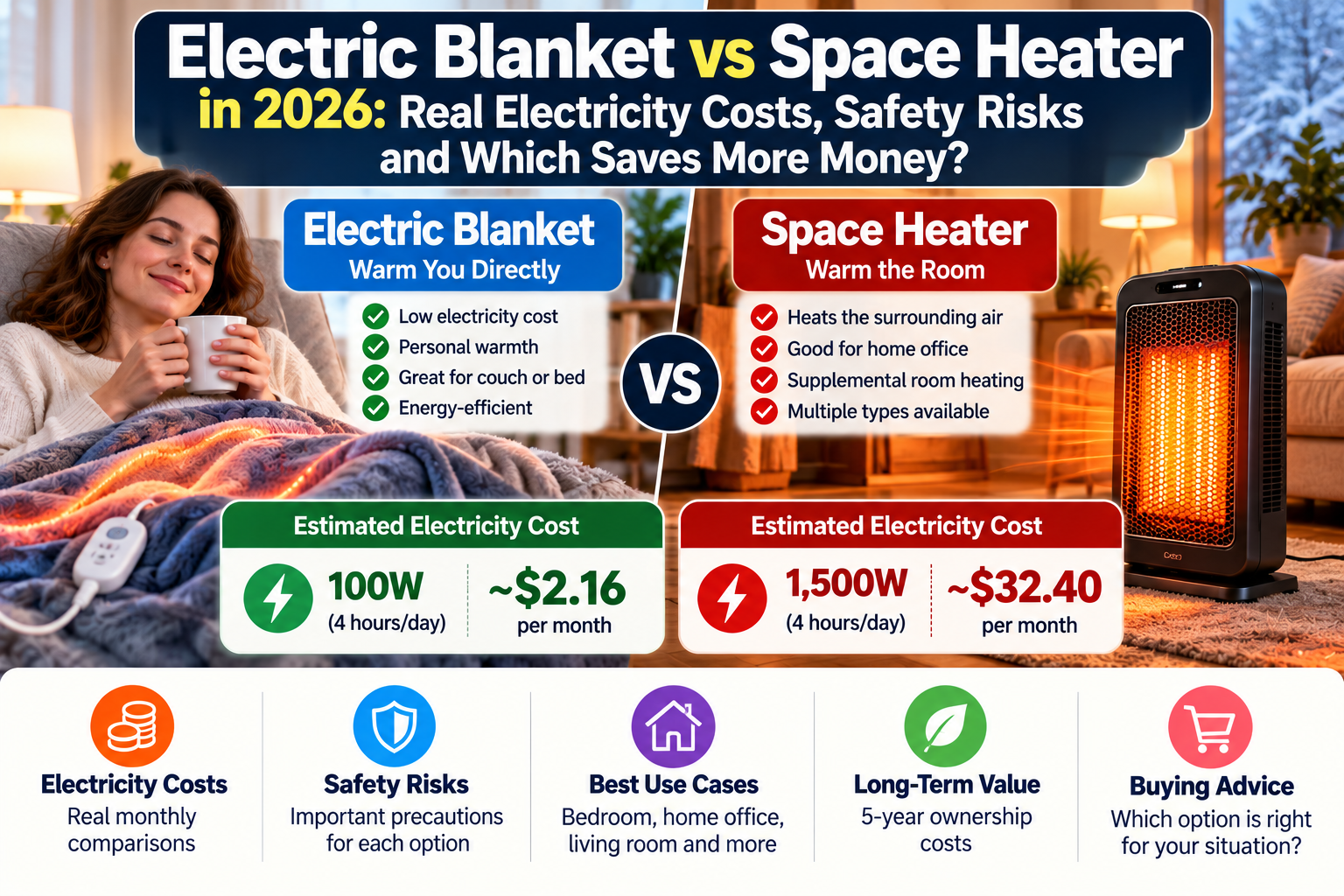
An electric blanket delivers warmth directly to your body. A space heater adds heat to the surrounding room.
That distinction affects electricity consumption, comfort, safety, and whether either product can meaningfully reduce your overall heating bill.
A 100-watt electric blanket, for example, uses one-fifteenth as much electricity as a 1,500-watt space heater when both operate continuously at their rated power.
Yet that does not mean an electric blanket is automatically the better purchase.
If you need to warm an entire home office, a blanket cannot replace room heating. If you only want to feel warmer while sitting on a couch, heating the entire room may be unnecessary.
This guide compares realistic electricity costs, heating performance, safety considerations, and five-year ownership expenses to help you choose the right solution for your situation.
Quick Answer: Is an Electric Blanket Cheaper Than a Space Heater?
Yes, an electric blanket generally costs substantially less to operate than a conventional 1,500W space heater at full power.
However, the comparison is meaningful only when both products can satisfy your actual comfort needs.
| Comparison | Electric Blanket | Space Heater |
|---|---|---|
| Primary purpose | Warm one person directly | Add heat to a room |
| Illustrative rated power | 100W | 1,500W |
| Energy used in one hour at rated power | 0.1 kWh | 1.5 kWh |
| Cost per hour at $0.18/kWh | $0.018 | $0.27 |
| Cost for four hours at rated power | $0.072 | $1.08 |
| Warms surrounding room effectively | No | Yes, within capacity limits |
| Best application | Personal warmth while awake | Supplemental room heating |
| Main limitation | Cannot replace room heating | Higher electrical demand |
The wattages are illustrative examples. Actual products vary, and thermostatic controls may reduce average electricity use.
The most important buying rule: Choose an electric blanket when your primary goal is personal warmth. Choose a space heater when you need to increase room temperature.
Neither should be treated as an unattended overnight heating solution.
1. Why Electric Blankets Use So Much Less Electricity
The difference comes down to the amount of space each appliance is designed to heat.
An electric blanket contains insulated heating elements that distribute warmth across its fabric.
Instead of heating all the air in a room, it supplies heat close to the person using it.
A portable electric space heater has a much larger task.
It must deliver enough heat to offset some or all of the heat escaping through windows, walls, ceilings, floors, and air leakage.
That can require substantially more power.
The basic energy calculation
Electricity consumption is calculated as:
Energy consumption (kWh) = Power (kW) × Operating time (hours)
Consider two hypothetical products:
- Electric blanket: 100W, or 0.1 kW
- Space heater: 1,500W, or 1.5 kW
If each operates at full rated power for four hours:
Electric blanket:
0.1 kW × 4 hours = 0.4 kWh
Space heater:
1.5 kW × 4 hours = 6 kWh
The space heater consumes 15 times as much electricity in this example.
This does not mean it is 15 times less efficient at converting electricity into heat.
Both are electric resistance heating devices. The space heater simply supplies substantially more total heat.
The crucial difference between efficiency and energy use
An electric blanket is not necessarily more efficient in the technical sense of converting electricity into heat.
It is more targeted.
That targeting allows a person to feel comfortable while consuming much less electrical energy.
This is an example of personal heating rather than whole-room heating.
It can be a practical way to reduce unnecessary energy use, provided the surrounding room remains adequately heated for health, comfort, and building protection.
2. Real Electricity Costs: 2, 4, 6 and 8 Hours per Day
To compare operating costs fairly, we need consistent assumptions.
For the calculations below, assume:
- Electricity rate: $0.18 per kWh
- Electric blanket: 100W
- Space heater: 1,500W
- Both appliances operate at full rated power during the stated periods
- Billing month: 30 days
The $0.18/kWh rate is an illustrative calculation assumption, not a guaranteed current U.S. average.
Monthly operating cost comparison
| Daily Operating Time | 100W Electric Blanket | 1,500W Space Heater | Monthly Difference |
|---|---|---|---|
| 2 hours | $1.08 | $16.20 | $15.12 |
| 4 hours | $2.16 | $32.40 | $30.24 |
| 6 hours | $3.24 | $48.60 | $45.36 |
| 8 hours | $4.32 | $64.80 | $60.48 |
At four hours per day, the illustrative monthly electricity cost is:
Electric blanket: $2.16
Space heater: $32.40
The difference is $30.24 per month.
Across a 90-day heating period, that difference becomes $90.72.
But these figures are not predictions of your actual bill.
Both appliances may cycle their heating elements on and off. A space heater may also operate at a lower power setting.
The calculations show the cost of continuous operation at the specified wattages.
What about a 150W electric blanket?
Not every electric blanket uses 100W.
A larger heated blanket or a product with multiple heating zones may have a higher rated power.
At 150W, operating for four hours per day over 30 days:
0.15 kW × 4 × 30 × $0.18 = $3.24 per month
That is still substantially below the $32.40 example for a continuously operating 1,500W space heater.
The exact difference depends on each product’s actual power consumption.
3. Why the Cheapest Appliance to Run Is Not Always the Cheapest Heating Strategy
Electricity consumption alone does not tell the whole story.
Imagine that you work from home in a 65°F office.
You feel cold while sitting at your desk, but the room itself does not need to be significantly warmer for your work.
An electric heated throw may provide enough personal comfort without increasing the room thermostat.
Now imagine a different situation.
Your office is 50°F, the windows are cold, and you need to use the entire room for several hours.
An electric blanket may warm your legs and torso, but it will not adequately heat the room.
You may still need a functioning room-heating system.
The three heating goals
Before choosing either product, identify which of these describes your situation.
Goal A: Personal comfort
You are sitting, reading, watching television, or working at a desk.
A heated throw may be appropriate because you mainly need warmth close to your body.
Goal B: Supplemental room heating
The room is already heated, but you want to increase the air temperature slightly.
A space heater may be useful if the room’s heating demand is within its capacity.
Goal C: Primary room heating
The room has no adequate heating system.
A portable heater may be insufficient or inappropriate, particularly in larger or poorly insulated spaces.
In this case, investigate a properly designed permanent heating solution.
The cheapest product is not necessarily the one that accomplishes the task safely and effectively.
4. The Home Office Test: Which Product Makes More Sense?
A home office is an excellent example of why personal heating and room heating should be evaluated separately.
Suppose you spend four hours each evening working at a desk.
Your central heating system maintains the office at a reasonably comfortable temperature, but your legs and feet feel cold.
You have three options.
Option 1: Use a 1,500W space heater
If the heater runs continuously for four hours:
1.5 kW × 4 hours × $0.18 = $1.08 per evening
Over 30 evenings:
$32.40
The advantage is that the heater adds warmth to the room.
The disadvantage is that you may be paying to heat air, furniture, and surrounding surfaces when your actual goal is simply to feel warmer at your desk.
Option 2: Use a 100W heated throw
At full rated power for four hours:
0.1 kW × 4 hours × $0.18 = $0.072 per evening
Over 30 evenings:
$2.16
The heated throw uses much less electricity in this example.
But it will not warm the entire office.
Option 3: Improve the room before buying either
If cold drafts are responsible for discomfort, weatherstripping or improving insulation may address the underlying problem.
A warmer floor covering, appropriate clothing, and better temperature distribution may also help.
The best financial decision sometimes involves reducing heat loss rather than purchasing another electrical appliance.
The home office verdict
If the room is adequately heated and you mainly want personal warmth, an electric heated throw may be the more economical purchase.
If you need the entire room warmer, a space heater may be more appropriate—but only if its heating capacity and electrical requirements suit the room.
5. The Living Room Test: One Person vs an Entire Family
Now consider a living room.
If one person sits on a couch reading for two hours, a heated throw may deliver warmth exactly where it is needed.
If four people are using different parts of the room, the calculation changes.
Multiple electric blankets may be inconvenient, and not everyone wants to sit under one.
A space heater may offer more useful room-wide comfort.
However, it must be sized appropriately.
Comparing four personal heating devices with one space heater
Assume four separate 100W heated throws operate simultaneously.
Combined power:
4 × 100W = 400W
At $0.18/kWh, two hours of full-power use would cost:
0.4 kW × 2 × $0.18 = $0.144
A 1,500W heater operating for the same two hours would cost:
1.5 kW × 2 × $0.18 = $0.54
The heated throws still use less electricity in this hypothetical example.
But the two arrangements provide different kinds of comfort.
Four heated throws warm four users directly.
The space heater adds heat to the surrounding air and surfaces.
The better choice depends on whether the household needs personal warmth or an increase in the room’s ambient temperature.
6. What Happens When the Space Heater’s Thermostat Cycles?
A common mistake in electricity comparisons is assuming that a 1,500W space heater always consumes 1,500W for every hour it is switched on.
A thermostat-controlled heater may cycle its heating element off when the desired temperature is reached.
Suppose a heater is available for four hours but operates at full power for only half that time.
Its equivalent energy use is:
1.5 kW × 4 hours × 50% = 3 kWh
At $0.18/kWh:
3 × $0.18 = $0.54 per evening
Across 30 evenings:
$16.20
That is half the cost of continuous full-power operation.
However, the heater still consumes more electricity than the 100W blanket in the earlier example.
A more realistic comparison
| Appliance Scenario | Four-Hour Energy Use | Daily Cost |
|---|---|---|
| 100W blanket, continuous rated power | 0.4 kWh | $0.072 |
| 150W blanket, continuous rated power | 0.6 kWh | $0.108 |
| 1,500W heater, 25% full-power duty cycle | 1.5 kWh | $0.27 |
| 1,500W heater, 50% full-power duty cycle | 3.0 kWh | $0.54 |
| 1,500W heater, continuous full power | 6.0 kWh | $1.08 |
These are illustrative scenarios, not measured results from particular products.
A heated blanket may also cycle its elements, reducing actual consumption below the continuous-rated-power calculation.
The most accurate comparison uses measured energy consumption, not just the wattage on a product listing.
7. Does an Electric Blanket Actually Save Money on Central Heating?
Potentially, but the answer depends on how you use it.
If you keep your central heating thermostat unchanged and add an electric blanket, your total electricity use generally increases by the blanket’s consumption.
You gain comfort, not necessarily savings.
The financial opportunity appears when personal heating allows you to reduce some other heating demand.
Example: Lowering the thermostat
Suppose you normally heat your home to 70°F.
You decide to lower the setting slightly while using a heated throw during the evening.
Your overall savings depend on how much energy the central system avoids consuming.
The blanket’s cost is only one part of the calculation.
Net savings = Avoided central-heating cost − Added blanket electricity cost
If the central system saves $0.80 in energy costs during an evening and the blanket costs $0.08, the illustrative net saving is $0.72.
If the central system saves only $0.03, adding an $0.08 blanket would increase total costs by $0.05.
These are hypothetical examples, not guaranteed thermostat savings.
Why heat pumps change the comparison
Modern heat pumps transfer heat rather than producing all of it through electrical resistance.
They can deliver multiple units of heat for each unit of electricity consumed under suitable conditions.
Consequently, reducing heat-pump use and adding resistance heating does not always produce meaningful savings.
Your existing heating system, utility rates, outdoor temperature, and thermostat strategy all matter.
For further guidance on supplemental heating, see the U.S. Department of Energy’s information on small space heaters.
8. Five-Year Ownership Costs: Purchase Price Is Only the Beginning
A product’s purchase price is often the first number shoppers compare.
But operating costs can be more significant over time.
Consider a hypothetical ownership scenario.
Assumptions
| Factor | Electric Blanket | Space Heater |
|---|---|---|
| Illustrative purchase price | $60 | $90 |
| Rated power | 100W | 1,500W |
| Use per day | 4 hours | 4 hours |
| Days used per year | 90 | 90 |
| Electricity rate | $0.18/kWh | $0.18/kWh |
These purchase prices are examples, not verified current retail offers.
Annual electricity costs
Electric blanket:
0.1 kW × 4 × 90 × $0.18 = $6.48
Space heater:
1.5 kW × 4 × 90 × $0.18 = $97.20
Five-year illustrative cost
| Cost Component | Electric Blanket | Space Heater |
|---|---|---|
| Initial purchase | $60.00 | $90.00 |
| Electricity over five years | $32.40 | $486.00 |
| Total | $92.40 | $576.00 |
The illustrative five-year difference is:
$483.60
This comparison assumes both appliances operate at their rated power for all scheduled hours and remain serviceable for five years.
It excludes repairs, replacements, inflation, and changing electricity rates.
It also assumes both products can meet the user’s comfort needs, which may not be true.
What this calculation really tells us
The lesson is not that an electric blanket replaces a space heater.
It is that heating only the person who needs warmth can consume much less electricity than heating an entire room.
If personal heating is sufficient, that difference can accumulate over several winters.
If the room itself must be heated, the comparison is no longer a like-for-like substitute.
9. Safety Comparison: Electric Blanket vs Space Heater
Operating costs are important, but electrical and fire safety should never be sacrificed for lower bills.
Both appliance categories have safety risks.
Those risks are different enough that each requires its own buying checklist.
Space heater safety
Portable space heaters can draw substantial electrical current and create hot surfaces.
The U.S. Consumer Product Safety Commission advises keeping space heaters at least three feet from combustible materials.
They should be plugged directly into suitable wall outlets, not extension cords or power strips.
They should also be turned off before leaving a room or going to sleep.
Look for appropriate independent safety certification and protective features, including overheat shutoff and tip-over protection where applicable.
A safety switch is not permission to leave a heater unattended.
Electric blanket safety
Electric blankets contain heating elements embedded in flexible material.
Damage to wiring, folding during use, improper covering, or product defects can create overheating and burn hazards.
The Electrical Safety Foundation International recommends checking for damaged cords, scorched fabric, and other signs of deterioration.
It also advises against folding electric blankets while operating, covering them with other items, or leaving them running unattended or while sleeping.
Follow the specific manufacturer’s instructions, including restrictions involving bedding, pets, washing, storage, and intended use.
Do not assume automatic shutoff eliminates every risk
An automatic shutoff timer is useful, but it is not a substitute for correct operation.
A product with damaged wiring can still be hazardous.
Likewise, a space heater with tip-over protection can still pose risks if it is placed near combustible materials or connected improperly.
Check recalls before purchasing
Recent product safety actions reinforce the importance of checking model-specific recalls.
In 2026, the CPSC issued warnings and recalls involving certain electric heated blankets and throws because of overheating, fire, and burn hazards.
Before purchasing a heated blanket, especially from an unfamiliar seller, search the product and model number on the official CPSC recall website.
The same precaution applies to portable heaters.
10. Why Heated Throws and Electric Blankets Are Not Always Interchangeable
Product listings often use terms such as electric blanket, heated throw, heated mattress pad, and bed warmer loosely.
But they are not necessarily designed for identical uses.
Heated throw
Typically intended for personal comfort while sitting or relaxing.
A heated throw may be suitable for a couch or chair when used exactly as directed.
Electric blanket
Usually designed as a larger flexible heating product, but intended use varies by model.
Do not assume that every electric blanket is approved for sleeping or overnight operation.
Heated mattress pad
Designed for a different placement and use pattern.
It should not be substituted for a heated throw or electric blanket unless the manufacturer specifically allows that use.
Heating pad
Often intended for localized heat rather than general warmth.
Heating pads have their own safety requirements and should not be treated as interchangeable with electric blankets.
Always select a product intended for the way you plan to use it.
For this guide, the electricity comparisons use a hypothetical 100W personal heating blanket, not a particular mattress pad or medical heating device.
11. Which Is Better for Bedrooms?
Bedrooms require especially careful consideration because people may fall asleep while using heating equipment.
A portable space heater should be turned off before sleeping.
An electric blanket should not be assumed safe for unattended or sleeping use merely because it includes a timer.
Follow the manufacturer’s instructions and applicable safety guidance. ESFI recommends not using electric blankets while sleeping.
A better bedroom heating strategy
If your bedroom is consistently too cold overnight, consider addressing the room’s primary heating, insulation, drafts, and temperature controls.
A properly designed heating system is a more suitable solution for maintaining safe room temperatures while you sleep.
An electric blanket or heated throw may provide temporary comfort while you are awake, but it should not replace necessary overnight room heating.
What about prewarming a bed?
Some products advertise preheating functions.
Whether a particular product may be used for prewarming, and under what conditions, depends on its instructions.
Do not leave it operating unattended or assume that a timer makes an otherwise prohibited use safe.
12. Which Is Better for Apartments?
Apartment residents may face different constraints.
Some cannot control building-wide heating.
Others have limited space, older electrical wiring, or lease restrictions on portable heaters.
Choose personal heating when:
- The apartment is adequately heated overall.
- You mainly feel cold while sitting still.
- You need localized warmth while awake.
- You want to minimize additional electricity consumption.
Consider a space heater when:
- A particular room needs supplemental warmth.
- The building allows portable heaters.
- The electrical circuit can support the load.
- The heater can be operated with required clearances and supervision.
Avoid assuming a space heater can solve inadequate building heat
If an apartment cannot maintain appropriate indoor temperatures, a portable heater may not be a sufficient solution.
The underlying heating problem may need attention from the property manager, building maintenance team, or a qualified professional.
13. The 2026 Buying Checklist: Features Worth Paying For
Neither product category should be purchased on wattage and price alone.
Electric blanket or heated throw
Look for:
- Appropriate independent safety certification
- Clear manufacturer instructions
- Suitable size and intended use
- Adjustable heat settings
- Automatic shutoff as an additional safeguard
- Durable, accessible controls
- Reasonable warranty and return terms
- Clear cleaning and storage instructions
- No applicable unresolved safety recall
Portable space heater
Look for:
- Appropriate independent safety certification
- Overheat protection
- Tip-over protection where appropriate
- A reliable thermostat
- Suitable power settings
- Acceptable operating noise
- Stable placement
- Clear electrical requirements
- Manufacturer warranty and support
- No applicable unresolved safety recall
Features that deserve skepticism
Be cautious of marketing claims such as:
- “Heats a large room for pennies”
- “Uses almost no electricity”
- “Safer than all other heaters”
- “Guaranteed to cut heating bills in half”
- “More heat than a standard 1,500W heater with the same input”
A useful product listing should explain measurable specifications and intended applications rather than rely on vague efficiency claims.
14. The Living Pick Lab Personal Heating Decision Framework
Instead of choosing by product popularity, use this four-step decision.
Step 1: Identify what needs to be warm
If the answer is one person, personal heating may be sufficient.
If the answer is the entire room, consider room heating.
Step 2: Determine whether the room already has adequate heat
An electric blanket is not a substitute for maintaining appropriate indoor conditions.
If the room is dangerously or persistently cold, address the heating system or building conditions.
Step 3: Calculate the electricity cost
Use:
Rated power in kW × Expected full-power hours × Electricity rate
If a thermostat cycles the heating element, use measured consumption or a reasonable operating estimate rather than assuming continuous rated power.
Step 4: Check safety and long-term value
Evaluate certification, product condition, recalls, operating restrictions, and total ownership cost.
Do not choose a cheaper appliance if it cannot perform the required task safely.
Final decision matrix
| Your Situation | Better Starting Point | Why |
|---|---|---|
| One person reading on a couch | Heated throw | Direct personal warmth |
| Working at a desk in an adequately heated office | Heated throw | Low-power localized comfort |
| Entire small room needs supplemental heat | Space heater | Raises room temperature |
| Large, poorly insulated living room | Permanent heating assessment | Portable heater may be undersized |
| Bedroom needs reliable overnight heat | Proper room-heating system | Portable devices are not unattended overnight substitutes |
| Trying to reduce whole-home heating costs | Evaluate zone-heating economics | Savings depend on avoided central heating |
| Electrical circuit has limited spare capacity | Assess electrical safety first | High-power heaters can overload circuits |
15. When Neither Product Is the Right Purchase
There are situations where neither an electric blanket nor a space heater is the best first investment.
Poor insulation
If heat escapes rapidly through the building envelope, improving insulation or air sealing may reduce heating demand.
Inadequate permanent heating
A portable device should not be relied upon to compensate for a malfunctioning or insufficient primary heating system.
Unsafe electrical infrastructure
Loose outlets, repeated breaker trips, damaged wiring, or overloaded circuits require attention before adding heating appliances.
Large areas requiring regular heating
For a room that needs substantial heat throughout winter, a properly sized heat pump or other permanent heating solution may offer better long-term value.
Users who cannot reliably detect excessive heat
People with reduced heat sensation, limited mobility, or other factors affecting safe use may face additional risks from heated bedding and direct-contact heating products.
Follow manufacturer restrictions and obtain individualized professional guidance where appropriate.
Frequently Asked Questions
Is an electric blanket cheaper to run than a space heater?
Usually, yes. A 100W electric blanket consumes far less electricity than a 1,500W space heater when both operate continuously at rated power. However, the products perform different heating tasks.
How much does an electric blanket cost to run for eight hours?
A 100W electric blanket operating continuously for eight hours uses 0.8 kWh. At $0.18/kWh, that costs approximately $0.14. Actual consumption depends on the product and its controls.
This calculation is not a recommendation to operate an electric blanket while sleeping.
How much does a 1,500W space heater cost to run for eight hours?
At continuous full power, it uses 12 kWh. At $0.18/kWh, that costs $2.16. Thermostat cycling may reduce actual electricity use.
Can an electric blanket replace a space heater?
Only when the goal is personal comfort rather than room heating. An electric blanket cannot reliably maintain the air temperature of an entire room.
Does a space heater use more electricity than central heating?
That depends on the central system and how much heating is required. Efficient heat pumps may deliver substantially more heat per unit of electricity than portable resistance heaters.
Can an electric blanket save money on heating bills?
Potentially, if it allows you to reduce other heating expenses by more than the blanket’s electricity cost. Adding a blanket without changing existing heating generally adds energy consumption.
Are electric blankets safer than space heaters?
Neither category is automatically safer in every situation. They have different risks, including electrical faults, overheating, burns, and fire. Product certification, condition, placement, and correct use are essential.
Can I leave a space heater on while sleeping?
No. CPSC safety guidance recommends turning portable space heaters off before sleeping.
Can I sleep with an electric blanket switched on?
Do not assume it is safe. ESFI recommends that electric blankets not be used while sleeping. Follow the product’s instructions and applicable safety guidance.
Is a heated throw better than an infrared heater?
For direct warmth while seated, a heated throw may use substantially less electricity. An infrared heater can provide radiant warmth without requiring direct contact and may be more convenient in some settings.
The best option depends on your intended use and safety requirements.
Is a 100W electric blanket enough to heat a room?
No. A 100W blanket is intended to provide personal warmth, not to replace room heating.
What should I check before buying a heated blanket in 2026?
Verify the product’s intended use, safety certification, power rating, warranty, operating instructions, and recall status. Avoid damaged products and unfamiliar sellers with inadequate safety information.
Final Verdict: Which Saves More Money?
An electric blanket generally wins the direct electricity-cost comparison.
At $0.18/kWh, a 100W electric blanket operating at rated power for four hours per day costs approximately $2.16 over 30 days.
A 1,500W space heater operating at full power for the same period costs approximately $32.40.
That is a substantial difference.
But the most financially sensible choice depends on what you need to heat.
Choose an electric heated throw when you want personal warmth while awake in an adequately heated room.
Choose a properly sized space heater when you need supplemental room heating and can operate it safely.
Choose a permanent heating solution when the room requires reliable, ongoing heating that portable appliances cannot appropriately provide.
The smartest way to save money is not simply to buy the lowest-wattage product.
It is to avoid paying for more heating than you actually need—without compromising safety or essential indoor comfort.
Related Living Pick Lab Guides
For readers comparing portable heating options, these two guides provide additional detail:
Ceramic vs Oil-Filled vs Infrared Space Heaters in 2026: Heating Performance, Electricity Costs, Safety and Which Is Worth Buying?
What Size Space Heater Do I Need in 2026? 150 vs 300 vs 500 Sq Ft, Heating Limits and Electricity Costs
Sources and Further Reading
- U.S. Consumer Product Safety Commission — 2026 Winter Heating Safety Guidance
- Electrical Safety Foundation International — Heating Pads and Electric Blankets Safety
- Electrical Safety Foundation International — Electric Blanket Fire Prevention
- U.S. Department of Energy — Small Space Heaters
- U.S. Department of Energy — Heat Pump Systems
- U.S. Consumer Product Safety Commission — Product Recalls
- U.S. Energy Information Administration — Electricity Data
Editorial methodology: This guide uses illustrative electrical ratings, operating schedules, and purchase prices to demonstrate ownership costs. Calculations are mathematical comparisons, not results from independent product testing. Actual electricity consumption, utility rates, product durability, and heating performance will vary. Always follow current manufacturer instructions and official safety guidance.