
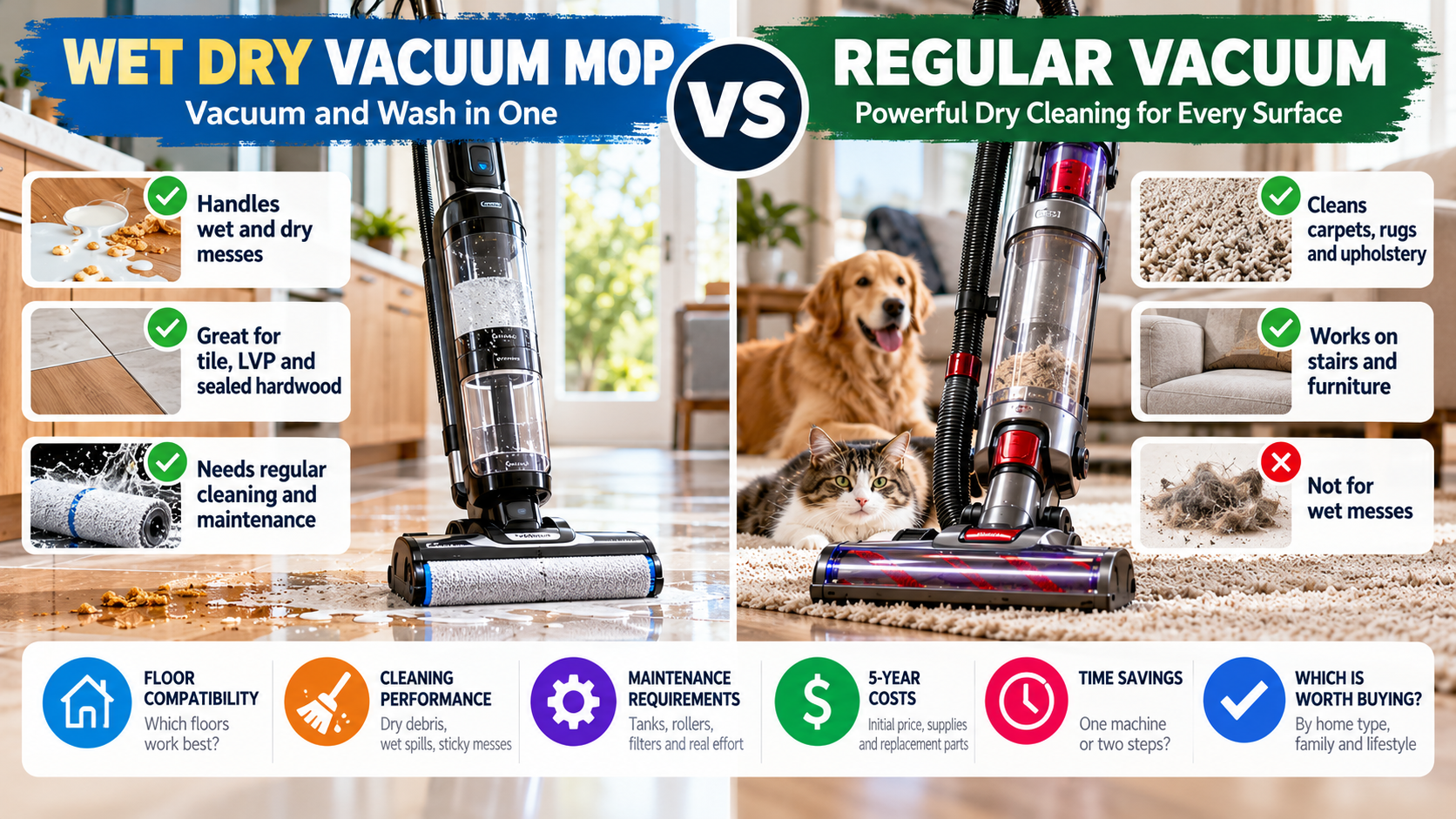
A wet dry vacuum mop promises something appealing: vacuum up crumbs, wash away sticky spills, and leave your floors clean in one pass.
But can it actually replace the regular vacuum you already own?
For most mixed-floor homes, the answer is no. For homes with almost entirely compatible hard flooring, the answer is sometimes.
The difference depends on your floor materials, how much carpet you have, what kinds of messes you clean, and whether you are willing to wash and dry the machine after using it.
This guide compares household wet dry vacuum mops with regular dry vacuums, explains the hidden maintenance work, and provides transparent five-year cost scenarios.
It is designed to help you decide whether to replace, supplement, or skip a wet dry vacuum mop—not simply choose the most expensive model.
Quick Verdict: Which Should You Buy?
| Your home or cleaning need | Better choice | Why |
|---|---|---|
| Mostly carpet and area rugs | Regular vacuum | Wet floor washers generally cannot clean carpet |
| Mostly sealed tile or vinyl | Wet dry vacuum mop may be worthwhile | Combines dry debris pickup and floor washing |
| Hardwood with uncertain finish | Regular vacuum plus manufacturer-approved mop | Moisture compatibility must be confirmed |
| Kids regularly spill food on hard floors | Wet dry vacuum mop | Can handle compatible wet and dry messes together |
| Pets shed heavily onto carpets | Regular vacuum | Carpet pickup requires suitable dry-vacuum tools |
| Small apartment with one or two rugs | Depends on rug-cleaning needs | A floor washer may still leave a vacuuming gap |
| You already own a good vacuum | Consider a floor washer as a supplement | Replacement may create unnecessary expense |
| You dislike cleaning appliances after use | Regular vacuum plus simple mop | Wet machines add tank and roller maintenance |
Best overall buying rule: If you have meaningful amounts of carpet, keep a capable dry vacuum. Consider a wet dry vacuum mop only if hard-floor washing is a frequent, time-consuming chore.
1. First, Make Sure You Are Comparing the Right Machines
The phrase “wet dry vacuum” describes several different products.
They are not interchangeable.
Household wet dry vacuum mop
A household floor-washing vacuum, such as certain Tineco FLOOR ONE, Bissell CrossWave, or Shark HydroVac models, is designed to collect debris while washing compatible floors.
It typically has:
- A clean-water tank.
- A dirty-water recovery tank.
- A motorized cleaning roller.
- A liquid-delivery system.
- A docking or cleaning routine.
Most are intended primarily for sealed hard floors.
Regular dry vacuum
A conventional upright, canister, or cordless stick vacuum is designed to remove dry debris.
Depending on the model, it may clean carpets, rugs, hard floors, upholstery, stairs, and furniture.
It generally should not collect liquid unless the manufacturer specifically approves that use.
Shop wet/dry vacuum
A utility or shop vacuum is a different category. It may collect liquid, sawdust, and larger debris, depending on its setup.
It is not the same as a household floor-washing vacuum mop.
Carpet extractor
A carpet-cleaning machine applies cleaning solution and extracts dirty liquid from carpet fibers.
It is not a substitute for everyday dry vacuuming.
Throughout this article, “wet dry vacuum mop” means a household floor-washing appliance—not a shop vacuum or carpet extractor.
This distinction matters because product names can make different machines sound more similar than they are.
2. Can a Wet Dry Vacuum Mop Replace a Regular Vacuum?
Consumer Reports tested eight combination vacuum-mops and concluded that buyers should not expect them to fully replace a conventional vacuum or mop in every situation.
The main limitation is surface compatibility.
A floor washer designed for sealed hard floors does not necessarily clean carpet, upholstery, stairs, or elevated surfaces.
Source: Consumer Reports — 5 Things to Know About Combo Vacuum-Mops.
The replacement test
Before buying, ask whether your new machine can perform every essential job your current vacuum handles.
| Cleaning task | Wet dry vacuum mop | Regular dry vacuum |
|---|---|---|
| Dry crumbs on compatible hard floors | Usually yes | Yes |
| Wet food spills on compatible hard floors | Usually yes | No |
| Sticky residue on sealed tile | Often effective | Requires separate washing |
| Deep carpet vacuuming | Generally no | Yes, with suitable model |
| Area rugs | Model-dependent; often unsupported | Usually, with suitable floorhead |
| Sofa and upholstery | Usually no | Often, with attachments |
| Stairs | Limited by design | Model-dependent |
| Under furniture | Depends on clearance and design | Depends on vacuum design |
| Washing the floor | Yes, on approved surfaces | No |
| Dry-only quick pickup | Model-dependent | Yes |
A wet dry vacuum mop may replace two steps on one surface without replacing every function of one vacuum.
That is the central distinction buyers should understand.
3. Floor Compatibility: The Decision That Matters Most
The biggest purchasing mistake is assuming that a wet dry vacuum mop works equally well everywhere.
Sealed ceramic and porcelain tile
These are often suitable surfaces for floor-washing vacuums, subject to the manufacturer’s instructions.
A wet dry vacuum mop can be particularly useful for kitchen spills, tracked-in dirt, and sticky residue.
Pay attention to grout lines, textured surfaces, and how effectively the machine recovers dirty water.
Luxury vinyl plank and other vinyl floors
Many models are intended for compatible sealed vinyl flooring.
However, flooring manufacturers may restrict moisture, cleaning solutions, or certain brushes.
Check both the appliance manual and the flooring care instructions.
Sealed hardwood
This is where extra caution is justified.
Even if a machine is marketed for sealed hardwood, that does not mean every wood floor is compatible.
Worn finishes, gaps, exposed edges, or damaged boards may allow moisture to reach vulnerable areas.
Use the flooring manufacturer’s instructions as the final authority.
Laminate
Laminate flooring can be sensitive to moisture entering seams and edges.
Do not assume that a machine’s “hard floor” label automatically makes it suitable for your particular laminate installation.
Carpet and area rugs
Most hard-floor washing vacuums are not appropriate for carpet.
Some crossover products offer specific rug-cleaning modes, but capabilities vary significantly.
A rug-compatible mode is not necessarily equivalent to deep carpet vacuuming or carpet extraction.
Unsealed wood, damaged flooring, and specialty surfaces
Avoid wet cleaning unless the flooring manufacturer explicitly permits it.
When compatibility is uncertain, a conventional dry vacuum and an approved cleaning method are the safer purchasing choice.
4. The Hard-Floor Percentage Test
A practical way to evaluate the purchase is to consider how much of your regularly cleaned floor area is compatible hard flooring.
This is a Living Pick Lab decision heuristic, not a manufacturer standard or experimentally established threshold.
| Compatible hard-floor share | Buying interpretation |
|---|---|
| Below 40% | A wet dry vacuum mop is unlikely to replace your main vacuum |
| 40–70% | Consider it as a second appliance if floor washing is frequent |
| 70–90% | A strong candidate for simplifying routine hard-floor cleaning |
| Above 90% | Potentially useful as a primary floor-cleaning machine, provided other tasks are covered |
These percentages are illustrative guidelines.
For example, a home with 90% tile but carpeted stairs, several rugs, and upholstered furniture may still need a conventional vacuum.
The more useful question is:
What essential cleaning jobs would remain unfinished if you owned only the wet dry vacuum mop?
If the answer includes carpets, furniture, or stairs, budget for another cleaning tool.
5. Wet Messes vs Dry Debris: Where Each Machine Wins
Dry crumbs and cereal
Both machine types can collect ordinary dry debris on compatible hard floors.
A regular vacuum is often simpler for a quick dry-only cleanup because it does not require handling water tanks.
A wet dry vacuum mop may be convenient when the crumbs are mixed with a sticky spill.
Milk, juice, and other liquids
A regular dry-only vacuum should not be used to collect liquid.
A wet dry vacuum mop designed for liquid pickup can handle approved spills on compatible flooring.
Check the manual for restrictions involving large quantities of liquid, foaming substances, and unusual debris.
Dried sticky food
This is one of the stronger use cases for a wet dry vacuum mop.
Consumer Reports tested combination machines on dried food stains and found that many performed well, although stain difficulty varied.
Source: Consumer Reports — Combo Vacuum-Mop Testing.
Pet hair
On sealed hard floors, a floor washer may collect loose pet hair while washing.
On carpets, a conventional vacuum with appropriate brushroll and pickup performance is usually the more relevant tool.
Hair wrapping around a roller can also increase maintenance, so check model-specific cleaning instructions.
Fine dust
A conventional vacuum with effective filtration may be preferable for dry dusting across multiple surfaces.
A wet dry vacuum mop should not automatically be treated as an equivalent substitute for a sealed HEPA dry vacuum.
For filtration and dust-containment considerations, see our Bagged vs Bagless Vacuums for Allergies in 2026 guide.
6. The Maintenance Work Buyers Often Underestimate
A wet dry vacuum mop combines cleaning functions, but it also creates a new maintenance routine.
After cleaning, the machine may contain:
- Dirty water.
- Food residue.
- Hair and lint.
- A damp roller.
- Moisture around internal components.
What you may need to do after every session
Depending on the model:
- Empty the dirty-water tank.
- Remove collected debris from the separator.
- Rinse approved components.
- Run the automatic roller-cleaning cycle if available.
- Check for trapped hair or residue.
- Allow components to dry as directed.
Some premium machines wash and dry their rollers automatically.
That can reduce hands-on work, but it does not necessarily eliminate tank emptying or periodic cleaning.
Why a self-cleaning button is not the same as zero maintenance
Self-cleaning systems may rinse the roller and internal channels.
They generally cannot make accumulated dirty water disappear.
A dock with drying features may also consume electricity and require space.
A realistic ownership question
Would you rather:
- Vacuum and mop separately, then wash the mop; or
- Clean in one pass, then empty and maintain a wet appliance?
The answer depends on the size of your hard-floor area and how often you encounter wet messes.
A machine that saves time during cleaning can still create work afterward.
7. Real Purchase Prices: What the Evidence Supports
Consumer Reports’ January 2026 overview described tested combination vacuum-mops ranging from just under $200 to approximately $450.
That is a useful published reference range, not a guarantee of current retail prices or the full market.
Premium models may cost considerably more.
For example, recent product reviews have covered high-end machines around $800.
Sources: Consumer Reports and Popular Mechanics — Dreame Aero Ultra Review.
For purchase planning, it is more useful to compare three ownership setups than to compare two appliance prices in isolation.
Setup A: Regular vacuum plus basic mop
You own a conventional dry vacuum and a separate mop.
This is flexible, works across more surface types, and can be inexpensive.
Setup B: Wet dry vacuum mop only
You buy one floor-washing machine and rely on it for compatible hard floors.
This setup may work in a nearly all-hard-floor home with few other cleaning needs.
Setup C: Regular vacuum plus wet dry vacuum mop
You retain a conventional vacuum for carpets, rugs, upholstery, and dry pickup, while using the floor washer for frequent hard-floor messes.
This is often the most capable arrangement—but also the most expensive and space-consuming.
8. Five-Year Cost Comparison: Three Ownership Setups
The following calculations are illustrative scenarios, not verified quotes for a specific model.
They are designed to show how costs accumulate.
Actual prices depend on brand, retailer, replacement parts, cleaning frequency, warranty coverage, and whether a machine lasts five years.
Scenario assumptions
| Cost assumption | Regular vacuum + mop | Wet dry mop only | Both machines |
|---|---|---|---|
| Initial equipment | $250 | $350 | $600 |
| Annual cleaning supplies | $15 | $35 | $45 |
| Annual replacement parts allowance | $10 | $25 | $35 |
| Five-year equipment replacements | $0 | $0 | $0 |
The annual allowances are budgeting assumptions, not manufacturer-required maintenance charges.
Electricity and water costs are excluded because usage varies and reliable model-specific consumption figures are not available for this comparison.
Five-year calculation
Formula:
Five-year cost = Initial equipment cost + 5 × (annual supplies + annual replacement-parts allowance)
| Setup | Initial cost | Five-year supplies and parts | Illustrative five-year total |
|---|---|---|---|
| Regular vacuum + mop | $250 | $125 | $375 |
| Wet dry vacuum mop only | $350 | $300 | $650 |
| Regular vacuum + wet dry mop | $600 | $400 | $1,000 |
What these numbers mean
In this example, replacing a vacuum-and-mop setup with a wet dry vacuum mop increases five-year spending by $275.
Owning both machines increases spending by $625 compared with the basic setup.
However, the comparison is not entirely equivalent: the wet dry machine may save labor on compatible hard floors, while the regular vacuum can perform tasks the floor washer cannot.
The more important financial question is whether the convenience is worth the additional expense.
Important limitations
These examples assume all machines remain functional for five years.
They do not include:
- Battery failure.
- Out-of-warranty repairs.
- Shipping or taxes.
- Unexpected roller or filter replacement.
- Water and electricity.
- Resale value.
- The monetary value of cleaning time.
Do not treat the totals as predicted costs for a specific product.
9. When Does the Time Savings Justify the Purchase?
Suppose a wet dry vacuum mop saves time by combining dry pickup and washing.
You can estimate the value of that convenience using your own routine.
Illustrative example
Assume:
- You clean compatible hard floors three times weekly.
- The combined machine saves eight minutes per session.
- The after-use maintenance adds three minutes.
- Net time saved is five minutes per session.
That produces:
5 minutes × 3 sessions × 52 weeks = 780 minutes, or 13 hours annually.
Over five years, that is approximately 65 hours.
This is a hypothetical calculation, not a measured performance claim.
If the additional five-year cost of the wet dry-only setup is $275, the implied cost per net hour saved is:
$275 ÷ 65 hours = approximately $4.23 per hour.
But if you clean only once per week—or spend nearly as long washing the machine as you save during floor cleaning—the value changes sharply.
Your personal break-even formula
Net minutes saved per cleaning = Minutes saved during floor cleaning − Additional maintenance minutes
Five-year hours saved = Net minutes × Weekly sessions × 52 × 5 ÷ 60
Cost per hour saved = Additional five-year ownership cost ÷ Five-year hours saved
If net time saved is zero or negative, there is no time-saving break-even benefit.
This is a better buying calculation than assuming every two-in-one machine automatically cuts cleaning time in half.
10. Five Buying Mistakes to Avoid
Mistake 1: Selling your regular vacuum too soon
Do not get rid of your conventional vacuum until you have confirmed that the wet dry machine covers your actual cleaning needs.
Carpets, rugs, stairs, and upholstery may still require a dry vacuum.
Mistake 2: Assuming every hard floor is water-safe
Check the flooring manufacturer’s guidance.
A compatible cleaning machine does not make damaged or unsealed flooring moisture-resistant.
Mistake 3: Comparing only purchase prices
Include cleaning solution, replacement rollers, filters, and maintenance time.
Mistake 4: Assuming self-cleaning means maintenance-free
Check whether you still need to empty tanks, remove debris, and dry components.
Mistake 5: Confusing floor washing with carpet extraction
A wet dry vacuum mop is not automatically a carpet cleaner.
For carpet-specific equipment, see our Portable Carpet Cleaner vs Full-Size Carpet Cleaner in 2026 comparison.
11. Who Should Buy a Wet Dry Vacuum Mop?
Best fit: A mostly hard-floor home with frequent sticky messes
You have compatible tile or vinyl floors and regularly clean food spills, tracked-in dirt, or pet-related messes.
The one-pass convenience may be valuable.
Good fit: Families with young children
A floor washer can simplify certain kitchen and dining-area messes.
However, evaluate whether its cleaning and maintenance routine fits your schedule.
Conditional fit: Pet owners
It may help with loose hair and muddy paw prints on hard floors.
It is less useful as a replacement for carpet and upholstery cleaning.
Weak fit: Carpet-heavy homes
A regular vacuum remains the priority.
A wet dry vacuum mop may become an expensive secondary machine used only in the kitchen.
Weak fit: Small homes with infrequent wet messes
A conventional vacuum and inexpensive mop may offer better value and easier storage.
Weak fit: Anyone who dislikes washing equipment
Dirty-water tanks and damp rollers require attention.
Convenience during floor cleaning is only part of the experience.
12. The Living Pick Lab Replacement Decision Matrix
Use these questions before purchasing.
| Question | If yes | If no |
|---|---|---|
| Are most floors compatible sealed hard surfaces? | Continue evaluating | Keep a regular vacuum as primary |
| Do you wash those floors at least twice weekly? | Convenience may be valuable | Savings may be limited |
| Do you frequently clean wet or sticky messes? | Stronger case for a floor washer | A simple mop may suffice |
| Can you manage dirty-water and roller maintenance? | Ownership is more practical | Consider a simpler setup |
| Do you have rugs, carpet, stairs, or upholstery? | Keep an appropriate dry vacuum | Replacement may be possible |
| Does the total cost fit your budget? | Compare specific models | Delay or skip the purchase |
Our buying conclusion
Buy a wet dry vacuum mop as a supplement when you have frequent wet messes and a substantial amount of compatible hard flooring.
Consider using one as your main floor cleaner only when your home has almost entirely compatible hard floors and you have a separate solution for furniture, rugs, and other dry-cleaning tasks.
Skip it when your home is carpet-heavy, your hard floors rarely need washing, or the extra maintenance would cancel out the convenience.
Frequently Asked Questions
Can a wet dry vacuum mop replace a cordless vacuum?
Only in some homes. A floor washer may handle routine cleaning on compatible hard floors, but it usually cannot replace a cordless vacuum for rugs, upholstery, stairs, and other dry-cleaning tasks.
Can you use a wet dry vacuum mop on carpet?
Most household hard-floor washers are not designed for carpet. Some models offer limited rug compatibility. Check the exact model’s instructions.
Is a wet dry vacuum mop safe for hardwood floors?
Only when both the appliance and flooring manufacturers approve the cleaning method. Moisture can damage vulnerable wood floors.
Is a wet dry vacuum mop worth it for pet owners?
It may be worthwhile for pet hair and muddy footprints on compatible hard floors. It is not a complete replacement for carpet and upholstery cleaning.
Do wet dry vacuum mops work without water?
Some models have specific dry-only or suction-only modes, while others require water during normal operation. Do not assume every model supports dry-only use.
Can a wet dry vacuum mop pick up cereal and milk together?
Many are designed for mixed wet and dry messes on compatible floors, but capacity and restrictions vary by model.
Do you need special cleaning solution?
Some manufacturers specify approved solutions. Using an incompatible detergent may cause foaming, damage, or warranty concerns. Follow the manual.
Are wet dry vacuum mops more expensive to maintain?
They may require cleaning solution, rollers, filters, and regular tank maintenance. Actual costs depend on the model and usage.
Does self-cleaning eliminate maintenance?
No. Self-cleaning may reduce roller washing, but dirty-water disposal and periodic component care are generally still required.
Is a steam mop better than a wet dry vacuum mop?
They serve different purposes. Steam mops focus on steam-based floor cleaning, while wet dry vacuum mops combine debris pickup and washing. Floor compatibility and manufacturer instructions matter for both.
How long should a wet dry vacuum mop last?
There is no universal guaranteed lifespan. Durability depends on the model, battery, maintenance, and repairability. The five-year examples in this guide are financial scenarios, not lifespan predictions.
Final Verdict: One Machine Can Replace Two Steps, but Not Every Cleaning Tool
A wet dry vacuum mop can be a useful purchase when most of your cleaning happens on compatible hard floors.
It may combine dry debris pickup and floor washing into one routine, particularly for kitchens, dining areas, and homes with frequent sticky messes.
But that convenience has limits.
Carpets, rugs, stairs, upholstery, moisture-sensitive flooring, and appliance maintenance can prevent a floor washer from becoming your only cleaning machine.
The smartest purchase is not necessarily the machine that does the most things. It is the machine that eliminates the most work in your particular home without leaving essential jobs unfinished.
Before buying, compare your floor surfaces, cleaning frequency, after-use maintenance, and total ownership cost.
If the wet dry vacuum mop solves a problem you face several times each week, it may earn its place.
If it would mostly duplicate equipment you already own, keep your money.
Sources and Editorial Methodology
- Consumer Reports — 5 Things to Know About Combo Vacuum-Mops
- Good Housekeeping — Best Vacuum-Mop Combos
- TechRadar — What Is a Wet-and-Dry Vacuum, and Do I Actually Need One?
- Popular Mechanics — Dreame Aero Ultra Steam Vacuum Review
- Dyson — Can a Wet/Dry Vacuum Wash Carpet?
Editorial note: This guide draws on published independent reviews and manufacturer information available in October 2026. Living Pick Lab has not independently tested the products discussed. Cost and time-saving calculations are illustrative, not product-specific forecasts. Always consult the exact appliance manual and flooring care instructions before wet cleaning.