
Updated October 15, 2026 | Living Pick Lab Editorial Team
A steam mop and a wet dry vacuum mop may look like competing solutions, but they solve different cleaning problems—and choosing the wrong one could damage your floor.
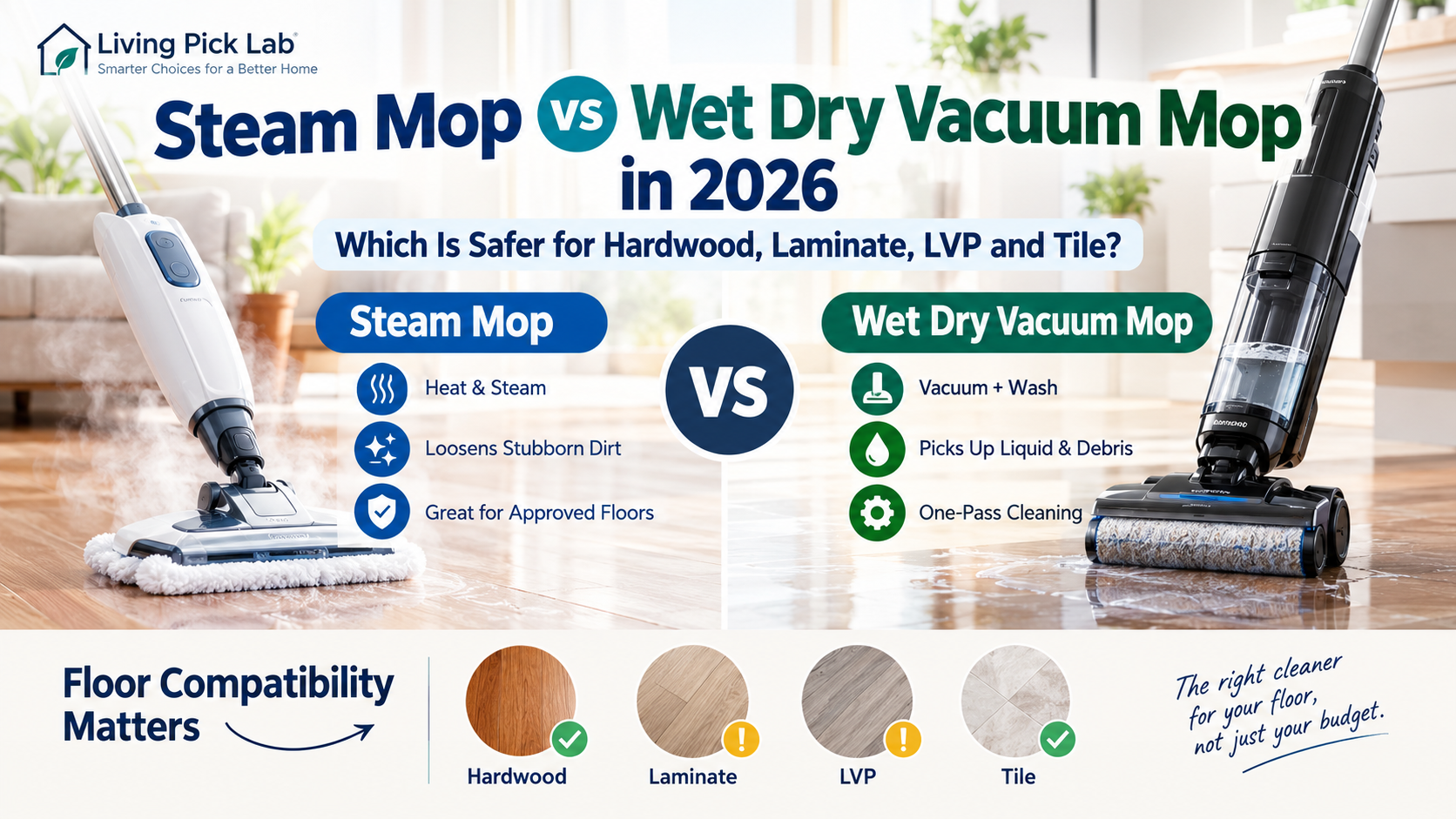
A steam mop uses heat and moisture to loosen dirt on compatible surfaces. A wet dry vacuum mop typically uses a cleaning roller, water or approved solution, and suction to pick up debris and dirty liquid.
The difference matters when your home has hardwood, laminate, luxury vinyl plank (LVP), or tile.
A machine advertised as safe for “sealed hard floors” is not automatically approved for every sealed floor. Your flooring manufacturer’s care instructions can be more restrictive than the cleaner manufacturer’s marketing.
This 2026 guide compares floor compatibility, everyday cleaning performance, maintenance, and three-year ownership costs so you can decide what is worth buying—and what you should avoid.
Quick Answer: Steam Mop or Wet Dry Vacuum Mop?
Choose a steam mop if:
- Your flooring manufacturer explicitly permits steam cleaning.
- You already have a suitable vacuum for loose dirt.
- Your main problem is greasy or dried-on residue.
- You prefer washable pads over a powered brush-roll system.
- You do not need the machine to collect crumbs or spilled liquids.
Choose a wet dry vacuum mop if:
- Your flooring manufacturer permits the specific wet-cleaning method.
- You frequently deal with crumbs, pet hair, and liquid spills.
- You want to vacuum and wash in one pass.
- You are willing to empty and clean a dirty-water tank after use.
- You value convenience more than the lowest purchase price.
Choose neither until you verify compatibility if:
- Your laminate care guide prohibits wet mopping.
- Your hardwood finish is damaged, unsealed, or moisture-sensitive.
- Your floor warranty excludes steam or machine wet-cleaning.
- You cannot identify the flooring product or its care requirements.
The safest choice is not always the most expensive machine.
1. Steam Mop vs Wet Dry Vacuum Mop: What Is the Actual Difference?
| Feature | Traditional steam mop | Standard wet dry vacuum mop |
|---|---|---|
| Main cleaning action | Heated steam and cleaning pad | Water or solution, rotating roller, and suction |
| Picks up loose crumbs | Usually no | Usually yes, within model limits |
| Collects spilled liquid | Usually no | Often yes |
| Removes greasy residue | Can be effective on approved surfaces | Depends on solution and scrubbing performance |
| Heat exposure to flooring | Yes | Usually lower, although heated models exist |
| Moisture exposure | Steam and condensed water | Controlled wetting, but still introduces moisture |
| After-use maintenance | Wash pad, empty tank as directed | Empty dirty tank, clean roller and channels |
| Best fit | Approved hard floors needing steam cleaning | Approved hard floors with mixed wet and dry messes |
| Main limitation | Floor compatibility and no debris pickup | Cleaning effort, dirty-water hygiene, and ongoing consumables |
A third category is emerging: steam vacuum mop hybrids
Some newer machines combine suction, wet cleaning, and steam in one device.
Examples include selected BISSELL HydroSteam and Tineco steam-enabled FLOOR ONE models.
These are not ordinary steam mops, and they should not be treated as identical to standard wet dry vacuum mops.
A hybrid may reduce cleaning steps, but it also adds purchase cost, complexity, and another feature that must be checked against your flooring warranty.
2. Floor Safety Comes Before Cleaning Performance
The most expensive mistake is buying a cleaner that works well but is unsuitable for your flooring.
The table below is a screening guide, not universal permission to use a particular machine.
| Flooring type | Steam mop | Wet dry vacuum mop | Safer starting point |
|---|---|---|---|
| Sealed hardwood | Only if flooring maker explicitly approves | Only if approved for that finish and cleaning method | Dry vacuum and manufacturer-approved damp cleaning |
| Unsealed or damaged hardwood | Avoid | Avoid routine machine wet cleaning | Dry cleaning and flooring-specific care |
| Laminate | Often prohibited; verify exact product | May also be prohibited | Dry vacuum and carefully controlled spot cleaning |
| Luxury vinyl plank (LVP) | Do not assume safe; check warranty | May be allowed with restrictions | Approved low-moisture cleaning |
| Ceramic or porcelain tile | Often suitable if tile, grout, and installation permit | Often suitable if model supports tile | Choose based on mess type |
| Natural stone | Depends on stone, sealant, and manufacturer | Depends on approved cleaner and solution | Stone-specific care instructions |
Hardwood: “sealed” does not mean steam-proof
Hardwood is particularly sensitive to moisture entering seams or damaged finishes.
Heat and moisture can also affect certain finishes.
A cleaner manufacturer may describe a steam mop as suitable for sealed hardwood, while the flooring manufacturer prohibits it.
When those recommendations conflict, follow the flooring care instructions and warranty.
If you cannot verify steam approval, do not use steam as an experiment.
Laminate: the most important warning
Shaw’s laminate care instructions explicitly warn against steam cleaners and wet mops.
The company explains that moisture can penetrate plank joints and cause peeling, bubbling, or swelling.
This means switching from a steam mop to a wet dry vacuum mop does not automatically solve the compatibility problem.
For laminate, the right question is not “Which machine uses less water?” It is “Does my flooring manufacturer permit this cleaning method at all?”
LVP: waterproof does not automatically mean steam-safe
Luxury vinyl plank is often marketed as waterproof or water-resistant.
That does not necessarily mean its wear layer, adhesives, joints, or installation can tolerate high-temperature steam.
Check the exact flooring care guide.
If wet cleaning is permitted, use only approved cleaning methods and solutions, and avoid leaving standing water.
Tile: where both machines may make sense
For many properly installed ceramic or porcelain tile floors, both cleaning methods may be practical.
A steam mop can help loosen greasy or dried-on surface residue.
A wet dry vacuum mop can collect loose debris and wash the floor in one pass.
However, natural stone, damaged grout, specialty coatings, and certain sealers require more caution.
Neither machine should be assumed to clean deeply embedded grout stains without additional tools.
3. Which Cleaner Works Better for Real Household Messes?
Consider what you clean most often.
| Common mess | Better starting choice | Why |
|---|---|---|
| Dry cereal and crumbs | Wet dry vacuum mop | Suction can collect loose debris |
| Pet hair on approved hard floors | Wet dry vacuum mop | Pickup and washing in one routine |
| Fresh juice or milk spill | Wet dry vacuum mop | Liquid recovery, if the model permits it |
| Dried kitchen grease | Steam mop on steam-approved floors | Heat can help loosen residue |
| Sticky footprints | Either, depending on floor and model | Technique and cleaning chemistry matter |
| Fine dust on laminate | Dry vacuum | Avoid unnecessary moisture |
| Area rugs | Conventional vacuum or compatible specialty machine | Most steam mops are not carpet vacuums |
| Dirty grout lines | Targeted grout cleaning | Floor machines may not reach recessed grout effectively |
These recommendations describe typical operating principles, not comparative laboratory test results.
Actual performance depends on the machine, surface, and type of dirt.
Homes with pets
A wet dry vacuum mop may be particularly useful when pet hair, muddy pawprints, and occasional wet spills occur together.
But there is an important limitation: a machine designed primarily for hard floors may not replace a full vacuum for carpets, sofas, stairs, or pet beds.
Before buying, check the machine’s approved surfaces and whether it can operate in a dry-pickup mode.
If you are deciding whether a wet dry vacuum mop can replace your regular vacuum, read our detailed comparison of their floor limitations, maintenance requirements, and five-year ownership costs.
Homes with young children
Frequent food spills and sticky residue can make one-pass wet cleaning attractive.
However, hot steam, cords, and freshly wet floors require care around children.
Do not assume a steam mop provides medically meaningful disinfection in every real-world use.
Any sanitizing claim depends on the exact product, surface, operating procedure, and validated test conditions.
4. Does Steam Clean Better Than a Wet Dry Vacuum Mop?
Not universally.
Steam can be useful for loosening some greasy or stuck-on residue, but it does not necessarily collect the loosened debris.
A conventional steam mop may require you to vacuum first and then wash or change the pad.
A wet dry vacuum mop combines pickup and washing, potentially reducing the number of passes.
The trade-off is that it relies on brushes, tanks, filters, and sometimes proprietary cleaning solutions.
Why a hybrid is not automatically better
A steam-enabled wet dry vacuum may combine these benefits.
But ask four questions before paying more:
- Will I use steam often enough to justify the premium?
- Does my flooring manufacturer allow steam?
- Can I lift, store, and maintain the larger machine?
- Would a separate vacuum and inexpensive mop perform the same jobs adequately?
If steam is prohibited on your floor, paying extra for a steam feature offers little practical value.
5. The Hidden Cost of Ownership
Purchase price is only the beginning.
A useful comparison includes pads, cleaning solution, replacement rollers, filters, and any battery replacement or repair risk.
Illustrative three-year cost model
The following examples are planning assumptions, not quoted prices or measured ownership costs for specific models.
| Cost component | Steam mop | Standard wet dry vacuum mop | Premium hybrid |
|---|---|---|---|
| Initial purchase | $100 | $250 | $750 |
| Pads, rollers, filters over 3 years | $36 | $120 | $150 |
| Approved cleaning solution over 3 years | $0 | $90 | $90 |
| Other assumed maintenance | $15 | $30 | $45 |
| Illustrative 3-year total | $151 | $490 | $885 |
Assumptions: no major repairs, no battery replacement, no sales tax, and no financing cost. The steam mop uses water only according to its manual. Electricity and water costs are excluded because they vary with actual usage and are not measured here.
The premium hybrid’s additional cost may be worthwhile for some households, but not because it is automatically three times better at cleaning.
What about real product prices?
At the time of review, BISSELL’s US store listed its PowerFresh steam mop around $100, while several CrossWave wet dry machines were listed around $200–$250.
Premium steam-enabled systems can cost substantially more.
These are examples of market price ranges, not fixed purchase quotes. Promotions, model availability, and retailer pricing change.
Check the exact product and current price before buying.
6. The Break-Even Test: Is the More Expensive Cleaner Worth It?
Suppose you are comparing:
- A $100 steam mop.
- A $250 wet dry vacuum mop.
The initial difference is $150.
If the wet dry machine saves you eight minutes per cleaning session and you clean three times a week, the theoretical time savings are:
8 minutes × 3 sessions × 52 weeks = 1,248 minutes annually.
That is approximately 20.8 hours per year.
If you value your time at $15 per hour, the theoretical annual convenience value is $312.
But this is not a guaranteed financial return.
It assumes the wet dry machine really saves eight minutes per session and that cleaning its dirty-water tank does not erase those savings.
A more realistic calculation is:
Net time saved = Time eliminated from sweeping and mopping − Additional machine cleaning and setup time
Test this using your own routine before treating a higher purchase price as worthwhile.
7. Maintenance: The Part Product Reviews Often Understate
Steam mop maintenance
A traditional steam mop usually requires:
- Washing or replacing cleaning pads.
- Emptying or maintaining the water tank as directed.
- Following the manufacturer’s guidance on water type.
- Keeping the steam outlet free of buildup.
- Allowing the unit to cool before storage.
For example, Shark advises using water rather than adding cleaning chemicals to certain steam mop tanks.
Wet dry vacuum mop maintenance
A wet dry vacuum mop typically requires:
- Emptying the dirty-water tank after cleaning.
- Removing hair and debris from the roller.
- Rinsing approved removable components.
- Cleaning the dirty-water pathway as directed.
- Drying or replacing filters and rollers when necessary.
- Using only approved cleaning solutions.
Some premium machines automate parts of this process.
However, automatic self-cleaning does not mean the machine never needs manual inspection or maintenance.
The overlooked odor problem
Leaving dirty water inside a tank or leaving a wet roller in a closed machine can create unpleasant odors.
If you dislike cleaning the cleaning machine, factor that into your buying decision.
A simpler mop with washable pads may be more appealing than a complex appliance that requires frequent tank and roller care.
8. Four Buyer Scenarios
Scenario A: Mostly tile, frequent greasy kitchen messes
Best starting choice: Steam mop, provided the tile, grout, and surface treatment allow steam.
Why: You may benefit from heat without paying for a powered suction system.
What to check: Whether you already own a vacuum for loose debris.
Scenario B: LVP flooring, pets, and daily food spills
Best starting choice: A wet dry vacuum mop approved by your flooring manufacturer.
Why: Collecting hair, crumbs, and spills in one routine can save effort.
What to check: Moisture limits, approved solutions, roller maintenance, and floor warranty.
Scenario C: Laminate flooring throughout the home
Best starting choice: Your flooring manufacturer’s approved cleaning method, often a suitable dry vacuum plus controlled spot cleaning.
Why: Some laminate manufacturers prohibit both steam and wet mopping.
What to check: Exact product instructions rather than general online advice.
Scenario D: Mixed carpet, hardwood, and tile
Best starting choice: Keep a versatile conventional vacuum and add a floor-specific cleaning tool only where justified.
Why: Neither a standard steam mop nor a hard-floor wet dry mop necessarily handles every surface.
What to check: How much of your home is carpeted and which rooms actually need wet cleaning.
9. Should You Buy a Premium Steam Vacuum Hybrid?
Newer models combine features that used to require separate appliances.
These may include steam cleaning, debris pickup, dirty-water recovery, automated roller washing, and heated drying.
The appeal is obvious: fewer cleaning steps and potentially less hands-on maintenance.
But there are trade-offs.
Potential advantages
- One machine handles several cleaning functions.
- Dried-on residue may require less manual scrubbing.
- Automated cleaning docks can simplify roller maintenance.
- Some models provide better edge cleaning or under-furniture access.
Potential disadvantages
- Much higher upfront price.
- Larger and heavier equipment.
- More complex parts and possible repair costs.
- Limited usefulness of steam on floors that prohibit it.
- Continued need for a separate carpet or upholstery vacuum.
A recent Popular Mechanics review of the Dreame Aero Ultra Steam praised its cleaning performance but questioned whether its weight and complexity were worthwhile for everyday small messes.
That is a useful reminder: premium features only have value when they solve problems you actually experience.
10. The Floor-First Buying Checklist
Before buying any steam mop or wet dry vacuum mop, answer these questions.
Floor compatibility
- Do I know the exact brand and model of my flooring?
- Does the care guide permit steam?
- Does it permit machine wet-cleaning?
- Are there restrictions on cleaning chemicals or moisture?
- Could the cleaning method affect warranty coverage?
Cleaning needs
- Am I mostly removing dry debris, liquids, or stuck-on residue?
- Do I have rugs or carpet that need a separate vacuum?
- How frequently do I clean?
- Do I need to clean stairs, edges, or under furniture?
Ownership costs
- What do replacement pads or rollers cost?
- Is proprietary cleaning solution required?
- Can filters and rollers be replaced?
- Is the battery serviceable?
- What does the warranty actually cover?
Daily convenience
- How heavy is the machine?
- How long does setup take?
- How long does cleanup take afterward?
- Where will I store it?
- Can I easily empty and dry the dirty-water tank?
If you cannot answer the floor-compatibility questions, postpone the purchase.
11. Common Buying Mistakes
Mistake 1: Assuming all sealed floors are steam-safe
A sealed surface may still have joints, adhesives, or finishes that are sensitive to heat and moisture.
Mistake 2: Assuming a wet dry vacuum mop is safe on every laminate floor
Some flooring manufacturers prohibit wet mopping entirely.
Mistake 3: Buying a steam mop to replace a vacuum
Most traditional steam mops do not collect loose debris.
Mistake 4: Paying for a self-cleaning dock without checking maintenance
Automated washing and drying reduce some tasks, but tanks and removable components still require attention.
Mistake 5: Comparing only the purchase price
Cleaning solution, replacement rollers, pads, and maintenance effort can materially affect long-term value.
Mistake 6: Treating a sanitizing claim as a universal guarantee
A manufacturer’s laboratory claim may apply only under specific test conditions.
Real-world performance depends on the surface and following the required procedure.
Frequently Asked Questions
Is a steam mop safe for luxury vinyl plank flooring?
Not automatically. Check the exact LVP manufacturer’s instructions. Waterproof flooring is not necessarily approved for high-temperature steam.
Can I use a wet dry vacuum mop on laminate?
Only if the flooring manufacturer permits that cleaning method. Some laminate care guides prohibit wet mopping.
Which is better for pet hair?
A wet dry vacuum mop is generally the more practical option for collecting pet hair from compatible hard floors. A traditional steam mop usually does not vacuum.
Do steam mops sanitize floors?
Some products have sanitizing claims supported by specified tests. Those claims do not apply to every floor, mess, or cleaning technique.
Do I need cleaning solution in a wet dry vacuum mop?
It depends on the model. Follow the manufacturer’s approved-solution instructions.
Is a steam vacuum hybrid worth the extra money?
It can be for households with compatible flooring and frequent difficult messes. For homes with steam-restricted flooring or occasional spills, the additional cost may not be justified.
Can one wet dry vacuum mop replace all my cleaning tools?
Usually not. Many are intended primarily for hard floors and may not replace a conventional vacuum for carpets, furniture, or stairs.
Final Verdict: Buy for Your Floor, Not for the Feature List
For steam-approved tile and regular greasy messes: A basic steam mop may provide good value.
For compatible hard floors with frequent crumbs, pet hair, and spills: A wet dry vacuum mop may save more time.
For laminate or moisture-sensitive flooring: Follow the flooring manufacturer’s instructions, even if that means buying neither.
For shoppers considering a premium steam hybrid: Make sure steam is allowed on your floors and the additional functions will be used often enough to justify the price.
The best floor cleaner is not the one with the most cleaning modes.
It is the one that safely handles your everyday messes without adding unnecessary cost, maintenance, or risk to your flooring.
Sources and Editorial Methodology
Flooring manufacturer guidance
Cleaning appliance manufacturer guidance
- BISSELL — Hard Floor Cleaning Recommendation Guide
- BISSELL — Best Hard Floor Cleaners
- Shark — Steam and Scrub Mop FAQ
Product research
Editorial disclosure
This article is based on publicly available manufacturer instructions, product specifications, and independent editorial reviews reviewed in October 2026.
Living Pick Lab has not independently laboratory-tested the products discussed here. The ownership-cost examples are hypothetical and should not be interpreted as verified prices or performance measurements. Always check the exact floor manufacturer’s care guide and the cleaner’s instructions before use.