
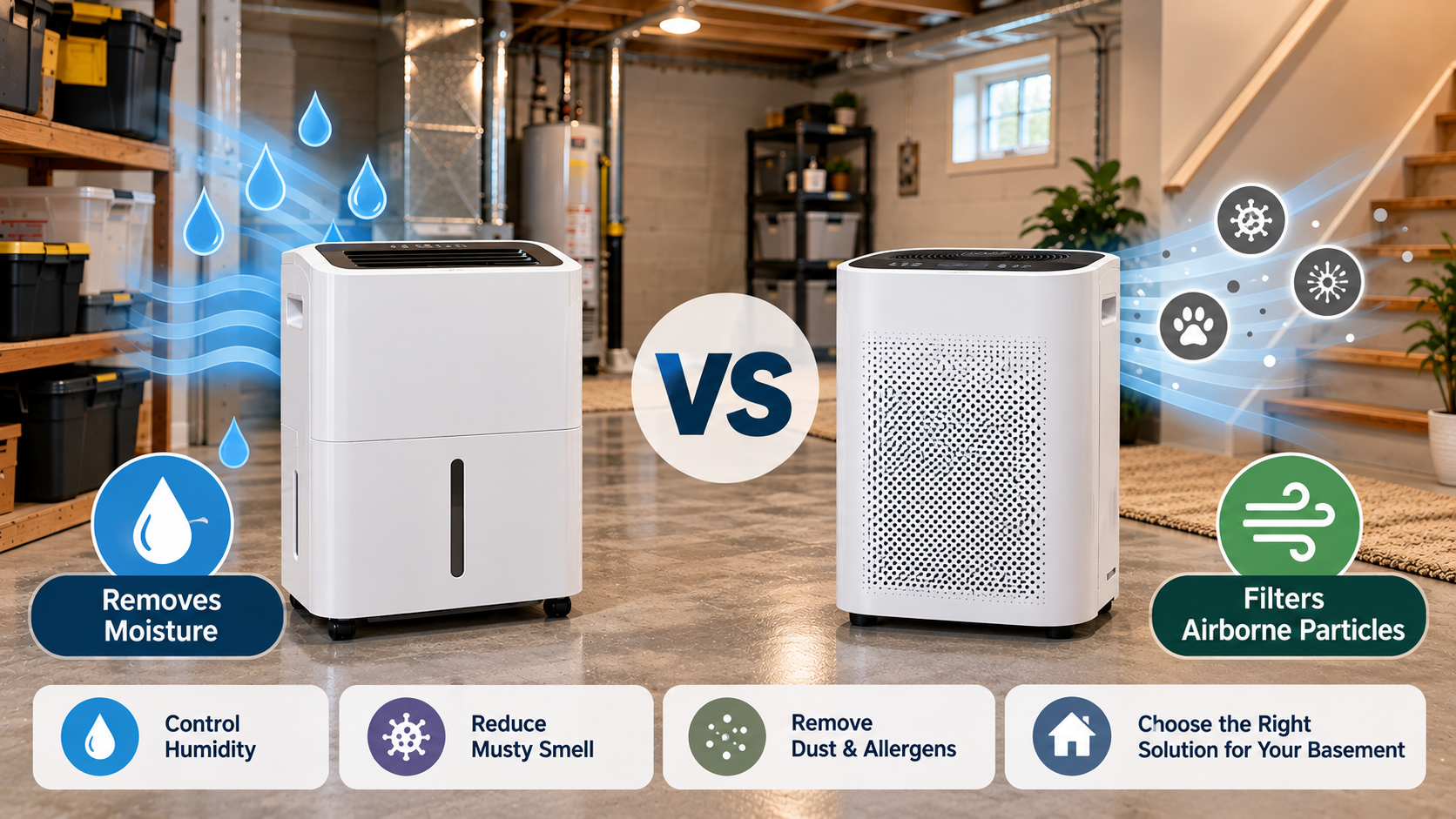
A musty basement can make buying an air purifier or dehumidifier feel like an obvious next step. But choosing the wrong appliance may leave the underlying problem untouched.
A dehumidifier removes moisture from the air. An air purifier removes certain airborne pollutants. Neither appliance repairs a leaking foundation, dries a water-damaged wall, or removes mold growing inside building materials.
If your basement smells musty, the most important question is not which appliance is better. It is what is causing the smell.
This guide helps you make that decision using measurable humidity, visible warning signs, filtration requirements, and practical buying scenarios.
Quick Answer: Dehumidifier or Air Purifier?
For a musty basement with consistently high humidity, a dehumidifier is generally the more relevant first appliance, after identifying and addressing water leaks or other moisture sources.
If humidity is already controlled but the basement has airborne dust, pollen, or other particles, an appropriately sized air purifier may help improve particle filtration.
If the basement has both excess moisture and airborne particles, using both appliances may make sense—but neither replaces mold cleanup or building repairs.
| Your basement problem | First priority | Appliance to consider |
|---|---|---|
| Humidity regularly above 60% | Identify moisture source and lower humidity | Dehumidifier |
| Damp walls, leaks, or standing water | Repair and dry the affected area | Neither appliance is the primary fix |
| Normal humidity but airborne dust | Reduce dust sources and improve filtration | Air purifier |
| Musty smell and visible mold | Fix moisture source and clean up mold safely | Dehumidifier may support moisture control; purifier is secondary |
| High humidity plus airborne particles | Control moisture and reduce particles | Both, if needed |
| Odor persists despite normal humidity | Investigate hidden moisture, materials, and other odor sources | Do not purchase blindly |
Living Pick Lab’s buying rule: Measure the problem before choosing the appliance.
1. What a Dehumidifier Actually Does
A dehumidifier removes water vapor from indoor air.
Most portable residential dehumidifiers draw moist air across cooled coils, collect condensed water, and return drier air to the room.
This makes a dehumidifier particularly useful when a basement has excess indoor humidity caused by seasonal conditions, moisture entering through building materials, or inadequate moisture management.
However, it is not a substitute for fixing water intrusion.
When a dehumidifier makes sense
Consider one when:
- A hygrometer repeatedly shows elevated relative humidity.
- The basement feels damp even without visible standing water.
- Condensation appears on cool pipes or surfaces.
- Stored belongings develop moisture-related odors.
- The basement requires humidity control during humid weather.
The U.S. Environmental Protection Agency recommends keeping indoor relative humidity below 60%, ideally between 30% and 50% where practical.
For many basements, a target around 45%–50% can be a reasonable starting point, provided conditions and the appliance allow it.
What a dehumidifier cannot do
A dehumidifier does not:
- Filter airborne particles the way a dedicated air purifier does.
- Remove established mold growth from walls or furniture.
- Repair plumbing or foundation leaks.
- Guarantee that a musty odor will disappear.
- Replace proper cleanup after flooding.
Reducing humidity can make conditions less favorable for new mold growth, but existing contaminated materials may still require cleaning or removal.
Best use: Controlling excess airborne moisture after the underlying moisture problem has been addressed.
2. What an Air Purifier Actually Does
An air purifier circulates room air through a filtration system designed to capture certain pollutants.
Many portable air purifiers use high-efficiency particulate filters to capture airborne dust, pollen, and some mold-related particles.
Some models also include activated carbon or other materials intended to reduce certain gaseous pollutants and odors.
But the filter type matters.
Particle filtration is not the same as odor removal
A particle filter may capture airborne mold spores and dust, but a musty smell can involve gaseous compounds that ordinary particle filters do not effectively remove.
Activated carbon can help with some gases and odors, but performance depends on the amount and type of carbon, the pollutant, and operating conditions.
An air purifier with a small carbon-coated sheet should not automatically be treated as an effective solution for persistent basement odors.
What an air purifier cannot do
An air purifier does not:
- Lower the room’s relative humidity.
- Stop water from entering a basement.
- Prevent mold growth on damp surfaces.
- Remove all airborne pollutants.
- Eliminate hidden mold inside walls.
- Replace source removal or adequate ventilation.
EPA guidance is clear that air cleaners may reduce some particles and, in certain circumstances, odors, but they do not resolve the moisture problem responsible for mold and musty smells.
Best use: Supplementing source control with appropriately sized airborne-particle filtration.
3. The 10-Minute Basement Diagnosis Before You Buy Anything
Before comparing products, spend a few minutes collecting information about your basement.
This simple process can prevent an unnecessary purchase.
Step 1: Measure humidity
Place a digital hygrometer in the basement, away from direct airflow, windows, and obvious heat or moisture sources.
Check readings at different times over several days.
A single reading may not represent the room’s usual conditions.
Use the following as a practical screening framework, not a medical or building inspection diagnosis:
| Measured relative humidity | What it suggests | Next action |
|---|---|---|
| Below 30% | Air may be unusually dry | Avoid unnecessary dehumidification |
| 30%–50% | Generally within EPA’s preferred range | Investigate other causes of odor |
| 51%–59% | Above the ideal range, but not automatically a serious problem | Monitor trends and inspect moisture sources |
| 60% or higher | Elevated moisture concern | Investigate moisture and consider dehumidification |
Important: Normal room humidity does not rule out a hidden leak or dampness inside a wall, beneath flooring, or behind stored belongings.
Step 2: Look for visible moisture
Check accessible areas around:
- Foundation walls and floor joints
- Plumbing connections
- Basement windows
- Sump pits and nearby surfaces
- HVAC condensate drains
- Storage shelves against exterior walls
- Carpet edges and furniture near cold surfaces
Look for water stains, damp materials, condensation, peeling finishes, or visible mold.
Do not disturb suspicious materials unnecessarily.
Step 3: Identify when the odor appears
Ask yourself:
- Is the smell stronger after heavy rain?
- Does it worsen during humid summer weather?
- Is it concentrated near one wall or storage area?
- Does it return shortly after cleaning?
- Is the smell present even when humidity readings are normal?
These patterns can help determine whether the next step should be moisture repair, humidity control, cleaning, or air filtration.
Step 4: Decide whether the problem is moisture or particles
If the main issue is high humidity, an air purifier will not solve it.
If humidity is controlled but airborne dust remains a concern, a dehumidifier will not replace proper filtration.
If you find active leaks or significant mold growth, prioritize appropriate repairs and remediation before shopping for appliances.
4. Five Real-World Buying Scenarios
Scenario A: The basement smells musty after heavy rain
Likely priority: Investigate water intrusion.
Rain-related odor changes can suggest moisture entering through the building envelope, foundation, or drainage system.
A dehumidifier may help manage residual airborne moisture, but it cannot stop water from entering.
What to buy first: Possibly nothing. Inspect and address the water source before deciding whether supplemental dehumidification is necessary.
Scenario B: Humidity stays around 65% during summer
Likely priority: Moisture control.
If the basement has no unresolved active leak but remains consistently humid, a properly sized dehumidifier may be appropriate.
Choose capacity based on the room’s moisture load and conditions, not just square footage.
What to buy first: A suitable dehumidifier, after checking for water intrusion.
For sizing guidance, read:
What Size Dehumidifier Do I Need for My Basement? A 2026 Sizing Guide
Scenario C: Humidity is 45%, but the basement is dusty
Likely priority: Particle control.
If the room is dry and there is no evidence of a moisture problem, buying a dehumidifier may add cost without addressing the complaint.
An air purifier with an appropriate particle Clean Air Delivery Rate (CADR) may help with airborne dust.
Also consider cleaning, dust-source reduction, and HVAC filtration.
What to buy first: Potentially an appropriately sized air purifier.
Scenario D: Visible mold is growing behind stored boxes
Likely priority: Moisture repair and mold cleanup.
Neither appliance should be presented as a substitute for removing mold and correcting the conditions that allowed it to grow.
The appropriate cleanup method depends on the affected materials, area, contamination, and occupants’ circumstances.
For extensive growth, recurring contamination, or suspected contamination in HVAC systems, professional assessment may be warranted.
What to buy first: Address the source and cleanup needs, not an appliance marketed as a mold cure.
Scenario E: The basement is damp and used as a home gym
Likely priority: Both moisture control and particle management.
A home gym can have additional moisture from occupants, along with dust and other airborne particles.
If measurements show excess humidity and there is a separate need for particle filtration, both appliances may be useful.
What to buy first: Correct moisture problems, then prioritize the appliance that addresses the measured issue. Add filtration if a meaningful particle problem remains.
5. Dehumidifier vs Air Purifier: Side-by-Side Comparison
| Feature | Dehumidifier | Air purifier |
|---|---|---|
| Primary purpose | Remove water vapor | Reduce selected airborne pollutants |
| Lowers relative humidity | Yes | No |
| Captures airborne dust | Not its primary function | Yes, with suitable filtration |
| Captures some airborne mold spores | Not its primary function | Yes, with suitable particle filtration |
| Stops mold growing on wet walls | No | No |
| Fixes leaks or water intrusion | No | No |
| May help with musty odor | Indirectly, by controlling excess moisture | Sometimes, depending on pollutant and filter |
| Requires water disposal | Usually yes | No |
| Requires filter maintenance | Often | Yes |
| Main buying specification | Moisture-removal capacity and efficiency | Particle CADR and filtration type |
This is why the two appliances should not be treated as interchangeable solutions.
They perform different jobs.
6. How to Choose the Right Dehumidifier for a Musty Basement
Once you have established that excess humidity is part of the problem, compare these factors.
Moisture-removal capacity
Portable dehumidifiers are commonly sold in capacity classes such as 20, 35, and 50 pints per day.
These ratings reflect standardized testing conditions rather than a guarantee of identical moisture removal in every basement.
A cooler basement or unusually high moisture load can change real-world performance.
Drainage method
A dehumidifier collects water, which must go somewhere.
Your options may include:
- Manual bucket emptying
- Gravity drainage to a suitable lower drain
- Built-in pump drainage
- A compatible external condensate pump
Do not buy a pump-equipped model unless the drainage setup benefits from it.
Read:
Do You Need a Pump for Your Basement Dehumidifier? A Drainage Decision Guide
Energy efficiency
Compare the exact model’s efficiency information and current ENERGY STAR certification where available.
A higher purchase price is not automatically justified by a small difference in advertised efficiency.
Temperature compatibility
Cool basement conditions can affect refrigerant-based dehumidifiers.
Check the manufacturer’s minimum operating temperature and defrost features.
Maintenance
Look for accessible filters, convenient drainage connections, and clear cleaning instructions.
Living Pick Lab recommendation: Prioritize correct capacity, dependable drainage, and efficiency over unnecessary smart features.
If you are comparing specific 50-pint models, see:
Best 50-Pint Dehumidifiers for Basements in 2026: Compare Pumps, Efficiency, and Value
7. How to Choose an Air Purifier for a Basement
If filtration is the appropriate next step, avoid choosing an air purifier based only on advertised coverage area.
Start with particle CADR
Clean Air Delivery Rate measures how quickly an air cleaner delivers filtered air for particular particles under standardized conditions.
EPA recommends selecting a portable air cleaner with a particle CADR suitable for the room.
Consider the actual room area and ceiling height, especially in open-plan or unusually tall basements.
Check the filtration system
For airborne particles, look for effective mechanical filtration, often including a HEPA filter.
For gases and odors, consider whether the unit has a substantial activated-carbon filter or another appropriately designed gas-phase filter.
Remember that particle CADR does not establish how effectively a purifier removes musty-smelling gases.
Consider noise at the speed you will use
An air purifier may have an impressive maximum CADR but be too noisy for everyday use at its highest setting.
If the basement is used as a bedroom, office, or recreation area, noise and practical operating speed matter.
Calculate replacement-filter costs
A low initial price can be misleading if replacement filters are expensive or difficult to obtain.
Before buying, compare:
- Replacement-filter price
- Recommended replacement interval
- Availability of compatible filters
- Expected daily runtime
- Noise and electricity use
Avoid ozone-generating devices
EPA advises avoiding air cleaners that intentionally produce ozone because ozone can irritate the lungs.
Do not confuse an ozone generator with a conventional mechanical-filter air purifier.
Living Pick Lab recommendation: For a dry but dusty basement, prioritize an appropriately sized particle-filter air purifier with manageable noise and ongoing filter costs.
8. Can an Air Purifier Remove Musty Basement Smells?
Sometimes it may reduce certain odors, but it is not a reliable standalone solution for a moisture-related smell.
There are three separate issues:
1. Airborne particles: A suitable particle filter may capture some airborne mold spores and other particles.
2. Odor-causing gases: An appropriately designed gas-phase filter may reduce certain odors, but effectiveness varies and is not guaranteed.
3. The source of the smell: Damp materials, active mold growth, leaks, or contaminated building components may continue producing odors until the underlying problem is corrected.
A purifier that makes a room smell temporarily better should not be mistaken for evidence that a moisture or mold problem has been resolved.
If the smell persists after humidity is controlled, investigate hidden moisture and affected materials rather than repeatedly purchasing stronger filtration devices.
9. Should You Run a Dehumidifier and Air Purifier Together?
Yes, when both moisture control and airborne-particle filtration are genuinely needed.
They can operate in the same room because they serve different functions.
However, adding a second appliance is not automatically necessary.
A practical setup
- Address leaks and wet materials first.
- Measure humidity and set an appropriate dehumidifier target.
- Arrange reliable water drainage.
- Select an air purifier with suitable particle CADR if filtration is needed.
- Follow each manufacturer’s clearance and placement instructions.
- Maintain filters and water-handling components regularly.
Avoid placing either appliance where its air intake or exhaust is obstructed.
The goal is not to fill the basement with equipment. It is to solve the actual problem with the fewest necessary devices.
10. The Hidden Cost of Buying the Wrong Appliance
The cheapest purchase is not always the least expensive solution.
Imagine two households.
Household A: A basement has consistently high humidity, but the owner buys an air purifier to address the musty smell.
The purifier may filter some airborne particles, yet humidity remains elevated. The owner continues paying for electricity and replacement filters without addressing the moisture problem.
Household B: A basement has normal humidity but airborne dust from regular use. The owner buys a large dehumidifier.
The appliance may consume electricity and collect little water while failing to address the main complaint.
Neither household benefits from choosing a product before identifying the problem.
Compare total ownership costs
| Cost factor | Dehumidifier | Air purifier |
|---|---|---|
| Purchase price | Varies by capacity and features | Varies by CADR and filtration |
| Electricity | Depends on efficiency and runtime | Depends on fan power and runtime |
| Recurring consumables | Filter care and possible pump maintenance | Replacement filters |
| Water handling | Bucket or drain required | Not required |
| Installation considerations | Drain height, hose routing, clearance | Placement, airflow, room size |
A purchase that solves the wrong problem is poor value regardless of the sale price.
11. When Neither Appliance Is the Right First Purchase
Some basement problems require repairs, cleanup, or professional investigation.
Do not rely on a dehumidifier or air purifier as the primary response when you have:
- Active water entering through walls or floors
- Plumbing leaks
- Standing water
- Flood-damaged porous materials
- Extensive or recurring visible mold
- A strong odor whose source remains unidentified
A dehumidifier may assist drying in some circumstances, but electrical safety and appropriate cleanup must come first after flooding.
CDC guidance emphasizes addressing water damage promptly and cleaning up mold rather than merely covering or masking it.
If a musty smell persists despite normal humidity, the correct next step may be inspection rather than another appliance purchase.
12. A Simple Seven-Day Buying Decision Plan
If there is no urgent water damage or obvious safety concern, use this short observation plan.
Day 1: Measure baseline basement humidity and note any visible moisture.
Day 2: Inspect accessible plumbing, foundation surfaces, storage areas, and drainage points.
Day 3: Record humidity after rain, outdoor weather changes, or normal household activities.
Day 4: Identify whether the main complaint is dampness, airborne dust, odor, or a combination.
Day 5: Determine whether source repairs or cleanup are required before appliance shopping.
Day 6: If humidity control is needed, compare dehumidifier capacity and drainage options. If particle filtration is needed, compare CADR and filter costs.
Day 7: Make a purchase decision only if the appliance addresses a problem you have identified.
This plan is not appropriate for active flooding, significant water intrusion, or suspected hazardous conditions. Those require prompt attention.
Frequently Asked Questions
Is a dehumidifier or air purifier better for mold in a basement?
Neither removes the need to correct moisture problems and clean up mold.
A dehumidifier can help manage excess humidity, while an air purifier may capture some airborne mold-related particles. Neither removes established mold from building materials.
Will a dehumidifier get rid of a musty smell?
It may help if excess humidity is contributing to the conditions that cause the smell.
However, existing mold, wet materials, or hidden leaks can continue producing odors even after humidity is reduced.
Can a HEPA air purifier remove mold spores?
An appropriately designed particle filter can capture airborne mold spores passing through it.
It does not remove mold growing on surfaces or eliminate the moisture that allows mold to grow.
Should I use an air purifier if my basement humidity is already 45%?
Possibly, if airborne particles are a genuine concern.
But if the main complaint is a persistent musty smell, investigate hidden moisture or contaminated materials first.
Can I use both appliances in the same basement?
Yes. They perform different functions and can complement each other when both moisture and particle control are needed.
What humidity should I maintain in my basement?
EPA recommends keeping indoor relative humidity below 60%, ideally between 30% and 50% when practical.
Choose a setting appropriate for your home and avoid unnecessarily drying the space.
Does an activated-carbon filter eliminate basement odors?
It may reduce certain odor-causing gases, depending on the filter design and pollutant.
It cannot be relied upon to eliminate every odor, and it does not correct the source of a moisture-related smell.
What should I buy first if I have a musty basement and a limited budget?
Start with an inexpensive hygrometer and an inspection for moisture sources.
If humidity is consistently high and there is no unresolved water intrusion, a dehumidifier may be the appropriate appliance. If humidity is controlled and airborne particles are the main issue, an air purifier may offer better value.
Final Verdict: Choose the Appliance That Solves the Measured Problem
A musty basement does not automatically need an air purifier, a dehumidifier, or both.
Choose a dehumidifier when excess indoor humidity is the problem and underlying water issues have been addressed.
Choose an air purifier when airborne particles are the problem and moisture is already under control.
Consider both when you have separate, identifiable needs for moisture control and air filtration.
Choose repairs or cleanup first when water intrusion, wet materials, or mold growth is present.
The most effective buying decision starts with understanding the room—not with a product ranking.
Living Pick Lab’s final rule: Fix the source, measure the conditions, and buy only the appliance that addresses the remaining problem.
Sources and Further Reading
- U.S. EPA — Guide to Air Cleaners in the Home
- U.S. EPA — Care for Your Air: A Guide to Indoor Air Quality
- U.S. EPA — Mold Course: Humidity
- U.S. EPA — Sources of Indoor Particulate Matter
- CDC — Mold: What You Need to Know
- CDC — 8 Tips to Clean Mold
Editorial note: This article is an independent educational buying guide based on publicly available government guidance and general appliance principles. Living Pick Lab has not conducted hands-on laboratory testing of the appliances discussed. The article does not replace professional assessment of water damage, mold contamination, building defects, or individual health concerns.