
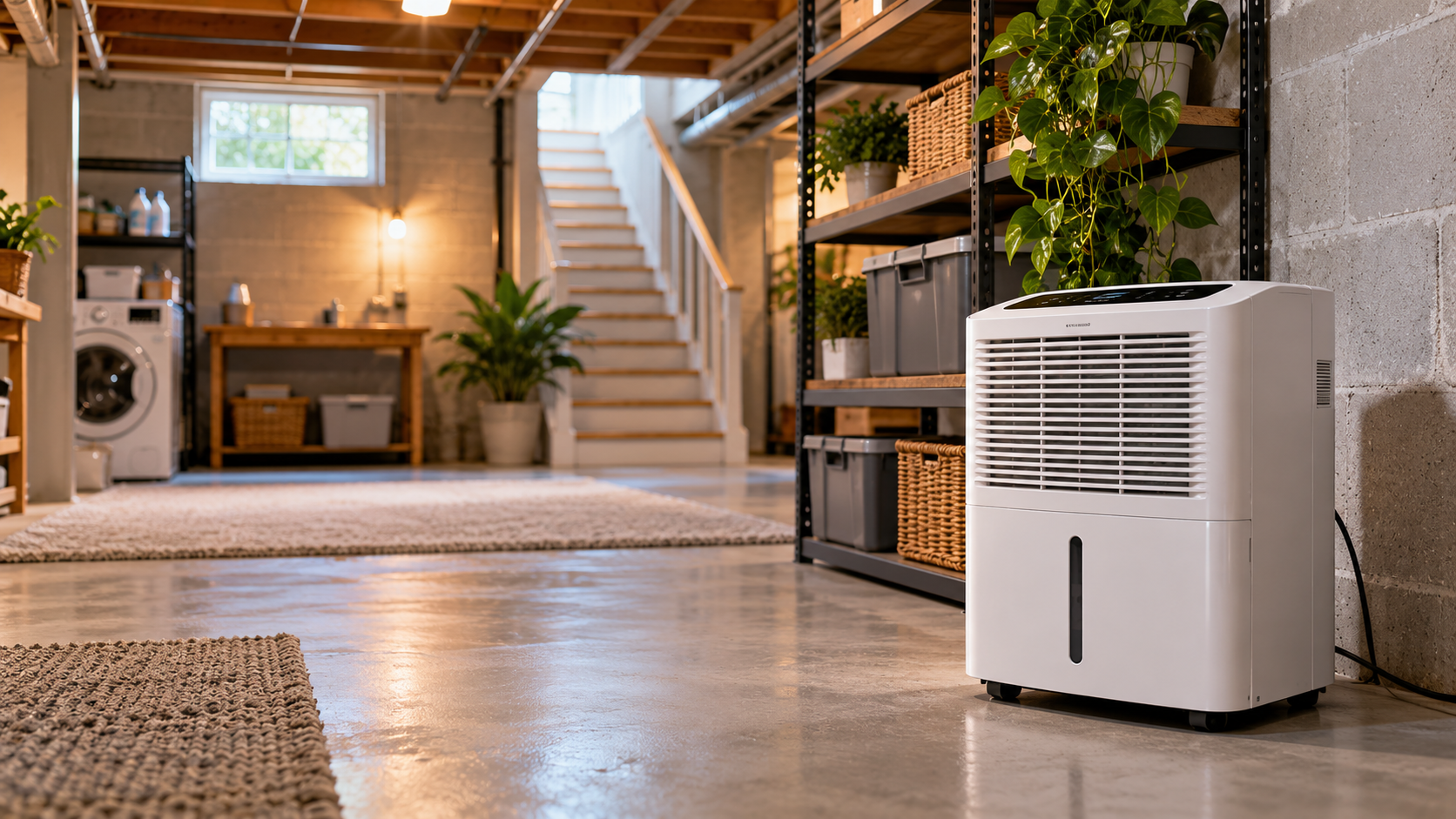
A basement dehumidifier should be sized for the moisture it needs to remove—not simply the square footage printed on the product box.
Two basements can have the same floor area and require different dehumidifiers. One might experience occasional summer humidity. Another might have persistent dampness, cold concrete walls, or moisture that returns after every heavy rain.
The difference matters because a dehumidifier rated for 50 pints per day is not automatically the right purchase for every basement.
Quick answer: For basements under 2,000 square feet, ENERGY STAR recommends starting with approximately 20–30 pints per day for slightly to moderately damp conditions, 25–40 pints for very damp conditions, and 30–50 pints for wet conditions. These are general sizing ranges, not guarantees of real-world performance.
Before choosing a capacity, determine where the moisture is coming from, how humid the basement becomes, and whether the machine can operate and drain reliably in that space.
Start Here: The Basement Dehumidifier Sizing Table
ENERGY STAR bases its portable dehumidifier recommendations on both room size and moisture conditions.
| Basement condition | Under 2,000 sq. ft. | Over 2,000 sq. ft. |
|---|---|---|
| Slightly to moderately damp | 20–30 pints/day | 30+ pints/day |
| Very damp | 25–40 pints/day | 40+ pints/day |
| Wet or unusually high moisture load | 30–50 pints/day | 50+ pints/day |
Source: ENERGY STAR Dehumidifier Buying Guidance.
These ranges describe moisture-removal capacity, not the size of the collection bucket.
A 50-pint dehumidifier does not necessarily have a 50-pint water tank. Its capacity rating describes the amount of moisture it can remove over 24 hours under standardized test conditions.
Actual water removal will depend on temperature, relative humidity, and operating conditions.
Living Pick Lab’s buying rule: Use the official capacity range as your starting point. Then check whether your basement’s moisture source, temperature, drainage arrangement, and operating requirements support that choice.
Step 1: Identify the Moisture Problem Before Buying Anything
The first question is not how large your basement is.
It is why the basement is damp.
Situation A: Seasonal humidity
Your basement becomes humid during warm weather, but the walls and floors remain dry. There is no visible seepage, and the musty smell improves when humidity falls.
This is a situation where a portable dehumidifier may be an appropriate solution.
Situation B: Persistent dampness
The basement frequently smells musty. Humidity remains elevated for extended periods, and the space may contain laundry equipment or other sources of moisture.
A dehumidifier may help, but capacity selection should account for the continuing moisture load.
Situation C: Water entering through walls or floors
Damp patches appear after rainfall. Water collects near a foundation wall, or the floor becomes visibly wet.
This is a different problem.
A dehumidifier removes water vapor from the air. It cannot repair foundation cracks, correct exterior drainage, or prevent groundwater from entering the building.
Decision: Investigate and correct water intrusion before relying on a larger dehumidifier.
The U.S. Environmental Protection Agency emphasizes that controlling the source of moisture is essential to preventing recurring mold problems.
Step 2: Measure Relative Humidity Instead of Guessing
A basement may feel uncomfortable without providing a reliable indication of its actual humidity.
A digital hygrometer gives you a better starting point.
Place it in a representative location, away from direct airflow, heating equipment, and unusually wet surfaces. Record readings over several days, including after rainfall or during humid weather when possible.
Pay attention to whether humidity rises temporarily or remains elevated.
The EPA recommends keeping indoor relative humidity below 60%, ideally between 30% and 50%.
For many basements, approximately 50% relative humidity is a reasonable initial dehumidifier setting, although the appropriate target depends on the building and its conditions.
What your readings can tell you
- Around 40–50% RH: Humidity may already be adequately controlled, assuming there are no hidden moisture problems.
- Consistently above 60% RH: Investigate the moisture source and consider dehumidification.
- Very high humidity with condensation or wet surfaces: Address both the moisture source and the need for drying.
A single humidity reading should not determine your purchase. The pattern over time is more informative.
Step 3: Measure the Space the Dehumidifier Must Control
For a rectangular basement, multiply length by width.
For example:
25 feet × 40 feet = 1,000 square feet
But square footage is only part of the picture.
Consider two basements:
| Feature | Basement A | Basement B |
|---|---|---|
| Floor area | 1,000 sq. ft. | 1,000 sq. ft. |
| Ceiling height | 8 ft. | 10 ft. |
| Approximate volume | 8,000 cu. ft. | 10,000 cu. ft. |
| Moisture conditions | Seasonal humidity | Persistent dampness |
| Laundry drying | No | Yes |
| Visible seepage | No | No |
Basement B has 25% more air volume and additional moisture-producing activity.
That does not mean it automatically needs 25% more dehumidifier capacity. Air volume and moisture-removal demand are not interchangeable.
It does mean that choosing a machine solely because both basements measure 1,000 square feet would overlook important differences.
Also consider whether the basement is open-plan or divided into rooms. Closed doors and restricted airflow can prevent a single portable unit from controlling humidity evenly.
Step 4: Choose Between 20-, 35-, and 50-Pint Classes
Once you understand the moisture conditions, compare the available capacity classes.
When a 20- to 25-pint unit may be enough
A smaller portable unit may be appropriate when the space is relatively small, the moisture load is modest, and humidity can be maintained at the desired level without excessive runtime.
Do not assume a compact model is suitable simply because it costs less.
If humidity remains high despite continuous operation, the machine may not have enough capacity for the conditions.
When a 35-pint unit makes sense
A 35-pint model is worth considering for a basement with moderate to substantial humidity, provided its capacity fits the official sizing range and the manufacturer’s operating requirements.
This class may offer a practical middle ground between purchase cost and moisture-removal capacity.
However, a 35-pint rating is not a promise that the unit will remove 35 pints every day in your particular basement.
When a 50-pint unit may be justified
A 50-pint unit becomes more attractive when the basement has a high moisture load, a larger connected area, or conditions that would make a smaller unit struggle to maintain the target humidity.
Higher capacity may also provide useful headroom during humid weather.
But bigger is not automatically better.
Compare purchase price, energy efficiency, operating noise, physical dimensions, and drainage requirements before paying for additional capacity.
The right question is not, “Which unit removes the most water?”
It is, “Which unit can maintain my target humidity reliably under my basement’s actual conditions?”
Step 5: Check Basement Temperature Before Choosing a Model
Basements are often cooler than upstairs living spaces.
Temperature matters because many portable dehumidifiers use refrigeration-based systems that condense moisture on cold coils.
As conditions become cooler, water-removal performance can change. Frost protection and the manufacturer’s permitted operating temperature range become especially important.
Before buying, check:
- The manufacturer’s minimum operating temperature.
- Whether automatic defrost is included.
- Whether performance information is available for cooler conditions.
- Whether the unit can operate safely in the intended location.
Do not assume that a product advertised for large basements will perform equally well in every basement temperature.
If the space regularly falls below the manufacturer’s operating range, investigate equipment specifically suited to those conditions.
Step 6: Decide How the Water Will Leave the Basement
A dehumidifier can have sufficient moisture-removal capacity and still be inconvenient to own.
Every pint of water removed from the air must go somewhere.
There are three common arrangements.
Option 1: Manual bucket emptying
The machine collects water in a removable tank.
This is simple and may work well when the basement is visited frequently.
However, many portable units stop collecting water when the bucket is full.
Option 2: Gravity drainage
A compatible unit can drain continuously through a hose to a suitable lower drain point.
This can reduce routine maintenance, but the hose must have an appropriate downhill route and be installed according to the manufacturer’s instructions.
Option 3: Pump-assisted drainage
A built-in or external condensate pump may be necessary when water must travel upward to reach a suitable discharge point.
Check the pump’s rated lift, hose restrictions, discharge destination, and failure behavior before installation.
Important: Do not assume every floor drain, sump pit, or household drain is an appropriate discharge destination. Follow local requirements and the equipment manufacturer’s instructions.
Drainage is a separate purchase decision from capacity. A larger machine does not solve an unsuitable drain route.
Step 7: Compare Energy Efficiency, Not Just Capacity
A dehumidifier may operate for long periods during humid weather.
That makes energy efficiency relevant to the total cost of ownership.
ENERGY STAR uses an efficiency metric called the Integrated Energy Factor (IEF), expressed in liters of water removed per kilowatt-hour of electricity.
A higher IEF indicates more water removal per unit of electricity under the specified test conditions.
ENERGY STAR Version 6.0 requirements became effective on October 1, 2025. When comparing current products, check their certification status and published efficiency data rather than relying on older buying guides.
A simple electricity-cost example
Suppose a dehumidifier draws an average of 500 watts while running.
If it operates for eight hours per day over 30 days:
0.5 kW × 8 hours × 30 days = 120 kWh
At an illustrative electricity rate of $0.18 per kWh:
120 kWh × $0.18 = $21.60 per month
This is an example, not a prediction for a particular model.
Actual consumption depends on the machine’s power draw, compressor cycling, fan operation, humidity conditions, and electricity rate.
A more efficient model may justify a higher initial price when it operates frequently, but the savings should be calculated using comparable product data.
Step 8: Make the Final Decision Using Your Basement Conditions
Consider these three hypothetical homes.
Home A: Small basement with occasional summer humidity
- 600 square feet
- No visible water intrusion
- Humidity rises mainly during humid weather
- Suitable nearby gravity drain
Starting decision: Compare models in the lower portion of the applicable ENERGY STAR capacity range. Prioritize reliable humidity control and simple drainage rather than automatically choosing the largest unit.
Home B: Larger basement with persistent humidity
- 1,500 square feet
- Regularly elevated humidity
- Laundry equipment downstairs
- No evidence of active water intrusion
Starting decision: Evaluate the higher portion of the appropriate capacity range, including 35- and 50-pint options as conditions warrant. Compare energy efficiency and continuous drainage capability.
Home C: Basement with wet walls after heavy rain
- 900 square feet
- Damp foundation wall
- Musty odor
- Moisture becomes worse after storms
Starting decision: Investigate the water intrusion first. A dehumidifier may help manage residual humidity, but choosing a larger appliance is not a substitute for correcting the source.
These examples illustrate the selection process. They are not universal capacity prescriptions.
Five Buying Mistakes That Can Cost You More
1. Trusting advertised coverage area without checking humidity
A large square-footage claim does not establish that the product is appropriate for a persistently wet basement.
2. Confusing tank size with daily extraction capacity
A large collection bucket is convenient, but it does not necessarily mean the machine removes more moisture per day.
3. Ignoring drainage until after delivery
An unsuitable drain route can make an otherwise appropriate machine inconvenient or unusable for unattended operation.
4. Comparing older pint ratings directly with newer ratings
Dehumidifier testing procedures and capacity labels have changed over time. Verify that products are being compared using compatible rating methods.
5. Treating a water leak as a dehumidifier-sizing problem
If water is entering the building, source correction is more important than purchasing a higher-capacity appliance.
Frequently Asked Questions
Is a 50-pint dehumidifier too big for a 1,000-square-foot basement?
Not necessarily. The appropriate capacity depends on moisture conditions, not floor area alone. A 50-pint model may be reasonable for a high-load basement, while a smaller unit may be sufficient for a moderately damp space.
Should a basement dehumidifier run all day?
It depends on the humidity load, target setting, and unit performance. A properly functioning humidistat can cycle the equipment as needed. Persistent operation without reaching the target humidity warrants further investigation.
What humidity should I set my basement dehumidifier to?
Around 50% relative humidity is a practical starting point for many basements. The EPA recommends keeping indoor humidity below 60%, ideally between 30% and 50%.
Does a bigger dehumidifier always use more electricity?
Not necessarily over the same moisture-removal task. Power consumption, operating duration, efficiency, and cycling behavior all matter. Compare model-specific energy information rather than assuming capacity alone determines operating cost.
Can one dehumidifier handle an entire basement?
Possibly, especially in an open space with good air circulation. Partitioned rooms, closed doors, and isolated moisture sources can make uniform humidity control more difficult.
Final Verdict: Buy for the Moisture Problem, Not the Marketing Number
The best basement dehumidifier is not necessarily the one with the largest advertised coverage area or the highest pint rating.
It is the one that can maintain an appropriate humidity level in your particular basement, operate within the room’s temperature range, and remove collected water reliably.
Before purchasing, follow this sequence:
Identify the moisture source → measure humidity → assess the space → select a capacity range → verify operating temperature → plan drainage → compare efficiency.
If you remember only one principle, make it this:
Choose the dehumidifier your basement needs—not the one with the biggest number on the box.