
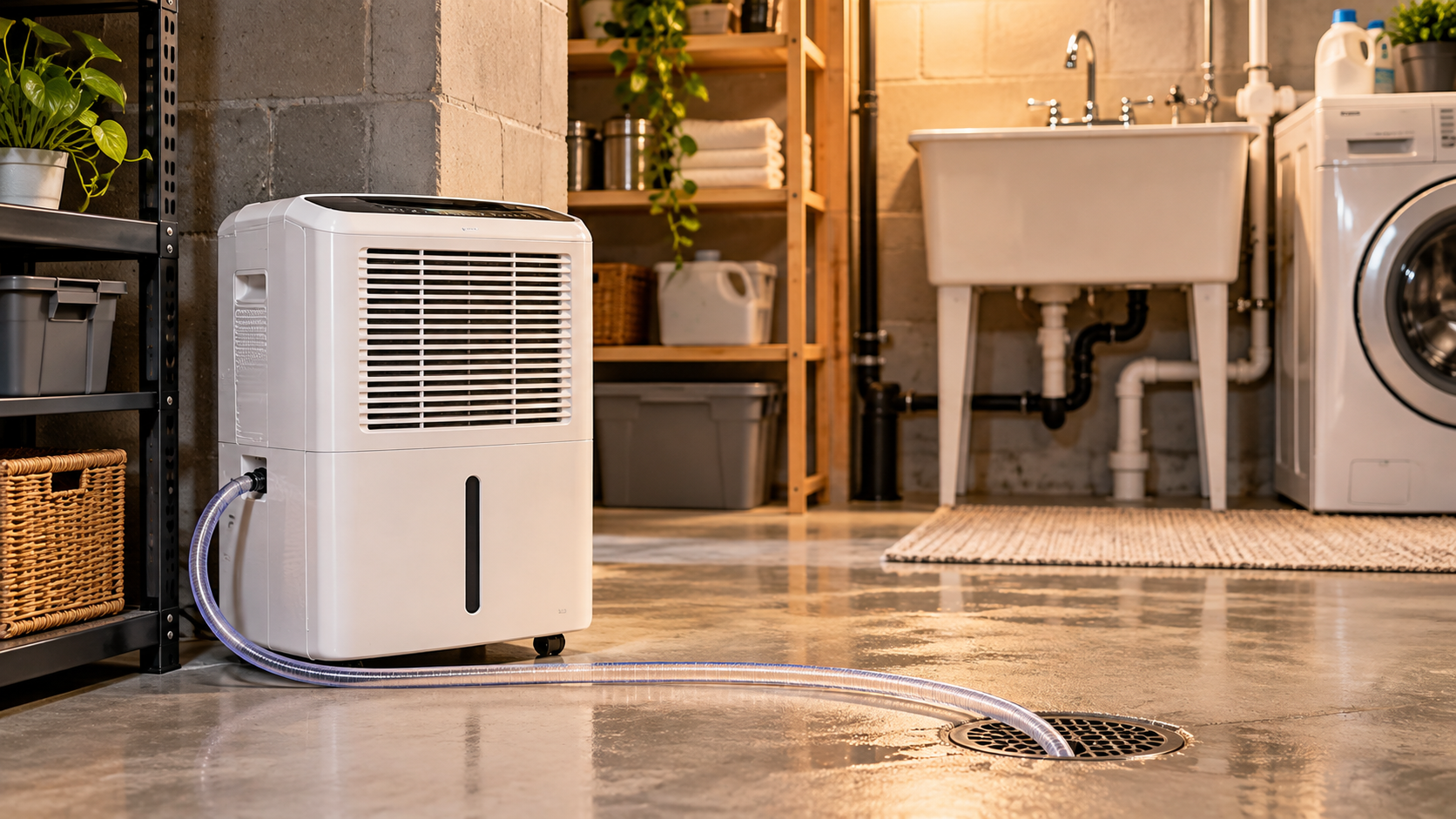
Quick answer: You do not need a pump for your basement dehumidifier if water can flow continuously downhill from the unit’s gravity-drain outlet to a suitable drain. You may need a built-in or external condensate pump if the water must travel uphill to reach a utility sink, standpipe, or another approved discharge point.
The important question is not simply whether your basement has a drain. It is whether the drain is lower than the dehumidifier’s outlet and reachable through a reliable hose route.
Before paying extra for a pump-equipped model, check the drainage path. A simple gravity-drain setup may be sufficient—and it avoids adding another powered component that requires maintenance.
Start Here: The Basement Drainage Decision Table
| Your basement situation | Likely drainage choice | What to check first |
|---|---|---|
| Floor drain below the dehumidifier outlet | Gravity drain | Can the hose run downhill without kinks? |
| Utility sink higher than the dehumidifier | Built-in or external pump | Does the pump support the required lift and hose route? |
| Drain nearby but hose must climb over an obstacle | Pump or a different unit location | Can the obstacle be avoided by moving the dehumidifier? |
| No accessible drain | Manual bucket emptying or a properly designed pumped setup | Where can water be discharged safely and legally? |
| Basement left unattended for long periods | Reliable continuous drainage with safeguards | What happens if the hose clogs or the pump fails? |
| Existing dehumidifier without a pump | Gravity drain if possible; otherwise assess an external pump | Is the model compatible with the proposed setup? |
Living Pick Lab decision rule: Choose the simplest drainage method that works reliably in your actual space. Do not buy a pump solely because a product listing presents it as a premium feature.
1. When Gravity Drainage Is the Better Choice
Gravity drainage allows collected water to leave the dehumidifier through a hose without a separate pump.
It is usually the first option to investigate when you have a suitable floor drain below the machine’s drain connection.
A typical setup involves connecting the manufacturer-approved hose to the gravity-drain outlet and routing it to the drain. The hose needs a continuous downward path, without loops or upward sections that trap water.
GE Appliances advises keeping a gravity-drain hose as short as practical. Frigidaire also recommends keeping the hose below the connection and avoiding kinks.
Why gravity drainage can be attractive
- No separate drainage pump to power or maintain.
- No pump motor noise.
- Fewer mechanical components in the water-removal system.
- Potentially lower upfront cost than buying a pump-equipped dehumidifier.
- Straightforward maintenance when the drain and hose are accessible.
However, gravity drainage is not automatically maintenance-free.
Hoses can become obstructed by debris or biological buildup. Connections can loosen, and an incorrectly routed hose may prevent water from flowing.
When gravity drainage is a poor fit
Avoid assuming a gravity hose will work if it must rise above the outlet, cross a doorway, or travel through a long route with dips and loops.
Moving the dehumidifier closer to a suitable drain may solve the problem more economically than buying a pump. Just make sure the new location still provides adequate airflow and follows the appliance’s clearance requirements.
2. When a Built-In Pump Is Worth Considering
A built-in pump is useful when the water cannot reach the discharge point by gravity alone.
For example, imagine a basement where the only practical discharge point is a laundry sink several feet above the floor. A gravity hose cannot reliably lift water into that sink. A pump-equipped dehumidifier may be the appropriate solution.
Some models can pump water upward through a dedicated hose, but pump lift limits and hose requirements vary by model.
GE Appliances describes a pump-drain system on certain models that uses a supplied 16-foot hose and supports up to 16 feet of vertical lift. Those numbers are not universal specifications for every dehumidifier.
Check the exact owner’s manual before purchasing.
A built-in pump may make sense when:
- Your discharge point is higher than the appliance.
- A gravity-drain route is impractical.
- You want a more integrated system rather than a separate pump assembly.
- The model’s documented lift and tubing limits fit your installation.
- You are comfortable checking the pump and hose periodically.
What buyers often overlook
A built-in pump does not guarantee uninterrupted drainage.
Depending on the model, the pump may need to be activated through the controls, and the collection bucket may need to remain correctly installed. Some pumps start only after the water reaches a particular level.
A clogged hose, disabled pump setting, or pump malfunction can interrupt drainage. Always check the model’s instructions and warning indicators.
3. Built-In Pump vs. External Condensate Pump
If you already own a functioning dehumidifier without a pump, replacing the entire appliance may not be necessary.
An external condensate pump can sometimes collect water from a compatible gravity-drain outlet and move it to a higher discharge point.
But an external pump is not a universal plug-and-play accessory. It requires a suitable collection arrangement, an appropriate power source, compatible tubing, and a safe discharge route.
| Buying consideration | Built-in pump | External condensate pump |
|---|---|---|
| Best starting point | Buying a new dehumidifier | Keeping an existing compatible dehumidifier |
| Installation | Often more integrated | Requires separate pump placement and connections |
| Space required | Usually less external equipment | Additional space for pump and tubing |
| Replacement flexibility | Pump is part of the appliance | Separate pump may be serviceable or replaceable |
| Maintenance | Follow appliance instructions | Maintain both dehumidifier and pump |
| Main risk to investigate | Internal pump or hose failure | Pump, reservoir, tubing, power, or connection failure |
The purchase decision: If your existing dehumidifier works well and supports a suitable gravity-drain connection, investigate whether an external condensate pump is compatible before replacing the entire unit.
If you are buying a new dehumidifier and already know that water must travel uphill, compare models with built-in pumps against non-pump models plus a suitable external pump. Consider the complete installed cost, not just the price shown on the product page.
4. The Five Checks to Make Before Buying Any Pump
Check 1: Where will the water go?
Identify a suitable discharge location before selecting equipment.
A utility sink, floor drain, or other approved drainage point may work, depending on the installation and local requirements.
Do not assume that any nearby pipe or opening is an acceptable drain. If the setup connects to plumbing or involves a sump system, confirm compatibility and applicable local requirements.
Check 2: How high must the water rise?
Measure the vertical difference between the pump and the discharge point.
Then compare that measurement with the manufacturer’s stated maximum lift. Account for the entire proposed hose route and any restrictions specified in the manual.
Do not buy a pump based only on the phrase “automatic drainage.”
Check 3: How far must the hose travel?
The discharge route matters as much as the vertical height.
Check the permitted tubing length, diameter, bends, and installation requirements for the exact product. Avoid substituting longer or narrower tubing without manufacturer approval.
Check 4: What happens if the pump stops?
This is especially important if the basement is finished, contains stored belongings, or is left unattended.
Check whether the proposed system has an overflow switch, alarm, automatic shutdown behavior, or another documented safeguard.
Do not assume that a dehumidifier will always shut down safely when an external pump fails. The response depends on the equipment and how it is connected.
Check 5: Can you maintain the system?
A pump that is difficult to inspect may become a neglected pump.
Choose a setup where you can access the hose, pump reservoir, electrical connection, and discharge point for periodic inspection and cleaning.
5. Three Basement Examples: Which Setup Makes Sense?
Example A: Unfinished basement with a nearby floor drain
The dehumidifier sits near a floor drain. The drain is lower than the appliance’s gravity outlet, and the hose can run downhill without crossing a walkway.
Likely choice: Gravity drainage.
A pump may add cost and complexity without solving a real problem.
Example B: Finished basement with an elevated laundry sink
The nearest suitable discharge point is a utility sink above the dehumidifier. There is no practical downhill hose route.
Likely choice: A pump-based solution.
If buying a new dehumidifier, compare built-in pump models. If keeping an existing unit, assess whether a properly matched external condensate pump is feasible.
Example C: Basement with no obvious drain
The basement has no accessible floor drain or nearby utility sink.
Likely choice: Do not purchase a pump until you identify an acceptable discharge destination.
A pump moves water; it does not eliminate the need for somewhere safe to send it.
Manual bucket emptying may be the simplest temporary option. For a permanent unattended setup, a qualified professional may need to assess the drainage options.
6. The Hidden Cost of a Poor Drainage Setup
When comparing dehumidifiers, buyers often focus on pint capacity, energy efficiency, and purchase price.
Drainage reliability deserves equal attention.
A less expensive unit that requires frequent bucket emptying may be inconvenient. A pump-equipped unit that is poorly installed may introduce maintenance problems. And a gravity-drain system with a loose connection can still leak.
Consider these costs before purchasing:
- Equipment: Pump-equipped model versus standard model and accessories.
- Installation: Hose, tubing, pump, and any professional work.
- Maintenance: Cleaning, inspection, and possible replacement components.
- Interruption risk: What happens if drainage stops while the basement is unattended?
- Water-damage exposure: Whether a leak could affect flooring, furniture, storage, or electrical equipment.
There is no single lowest-cost option for every home. The better choice is the one that meets the actual drainage requirements with acceptable maintenance and failure risk.
7. Why a Dehumidifier May Stop Draining
Before replacing a dehumidifier or buying a pump, check for a simpler problem.
The gravity-drain hose is kinked or too high
Inspect the entire hose route. Look for bends, upward sections, and places where water may collect.
The hose or drain connection is blocked
Dust and residue can accumulate over time. Follow the manufacturer’s cleaning instructions.
The hose connection leaks
Check for a damaged or missing washer and confirm that the connection is properly secured.
The pump setting is not enabled
Some pump-equipped models require the pump function to be turned on separately.
The bucket is not seated correctly
Certain dehumidifiers require the collection bucket to remain in place even when a hose or pump is being used.
Safety note: Disconnect power before cleaning or inspecting components when directed by the manufacturer. Never bypass an appliance’s safety controls to force continuous operation.
8. Our Final Recommendation
Choose gravity drainage when a suitable drain is below the dehumidifier outlet and a reliable downhill hose route is available.
Choose a built-in pump when buying a new unit that must discharge water uphill and the model’s specifications match your installation.
Consider an external condensate pump when your existing dehumidifier is otherwise suitable, its drainage arrangement is compatible, and a separate pump can be installed safely.
Choose manual bucket emptying or professional drainage assessment when no suitable discharge route has been established.
Above all, decide where the water will go before deciding which drainage feature to buy.
Frequently Asked Questions
Can a dehumidifier drain uphill without a pump?
Not through an ordinary gravity-drain connection. If the hose must carry water above the outlet, you generally need an appropriate pump or a different drainage arrangement.
Is a dehumidifier with a pump always better?
No. A pump is valuable when the installation requires it. If a reliable gravity drain is available, a pump may be unnecessary.
Can I add a pump to a dehumidifier I already own?
Possibly. Some existing units can work with an appropriately installed external condensate pump. Check the appliance’s drainage design, the pump’s specifications, and the installation requirements before buying.
Can I drain my dehumidifier into a utility sink?
Potentially, provided the discharge method is suitable, the pump can handle the lift if needed, and the arrangement follows manufacturer instructions and applicable requirements.
Can I leave a dehumidifier draining while I am away?
Continuous drainage can reduce the need to empty a bucket, but it does not remove the risk of hose blockage, leakage, or pump failure. Inspect the setup, follow the manufacturer’s instructions, and consider appropriate safeguards before leaving it unattended.
Does a 50-pint dehumidifier need a stronger drain pump?
Not necessarily. Moisture-removal capacity and pump lift are different specifications. Select the drainage system based on the appliance’s requirements and the actual discharge route.
Related Reading
What Size Dehumidifier Do I Need for My Basement? A 2026 Sizing Guide
Before choosing a drainage setup, make sure the dehumidifier’s moisture-removal capacity suits your basement.
Sources and Further Reading
- ENERGY STAR — Dehumidifiers: https://www.energystar.gov/products/dehumidifiers
- GE Appliances — Dehumidifier Draining Options: https://products.geappliances.com/appliance/gea-support-search-content?contentId=35530
- GE Appliances — Drain Hose Issues: https://products.geappliances.com/appliance/gea-support-search-content?contentId=16820
- GE Appliances — Internal Pump Troubleshooting: https://products.geappliances.com/appliance/gea-support-search-content?contentId=35306
- Frigidaire — Dehumidifier Not Draining: https://owner.frigidaire.com/support-articles/article/1927760-dehumidifier-not-draining
- Frigidaire — Water Leaking Issues: https://owner.frigidaire.com/support-articles/article/1927764-dehumidifier-water-leaking-issues
Editorial note: This guide is based on published manufacturer information and practical installation considerations. It is not a hands-on product test. Always follow the instructions for your specific dehumidifier and drainage equipment.