
Updated October 2026
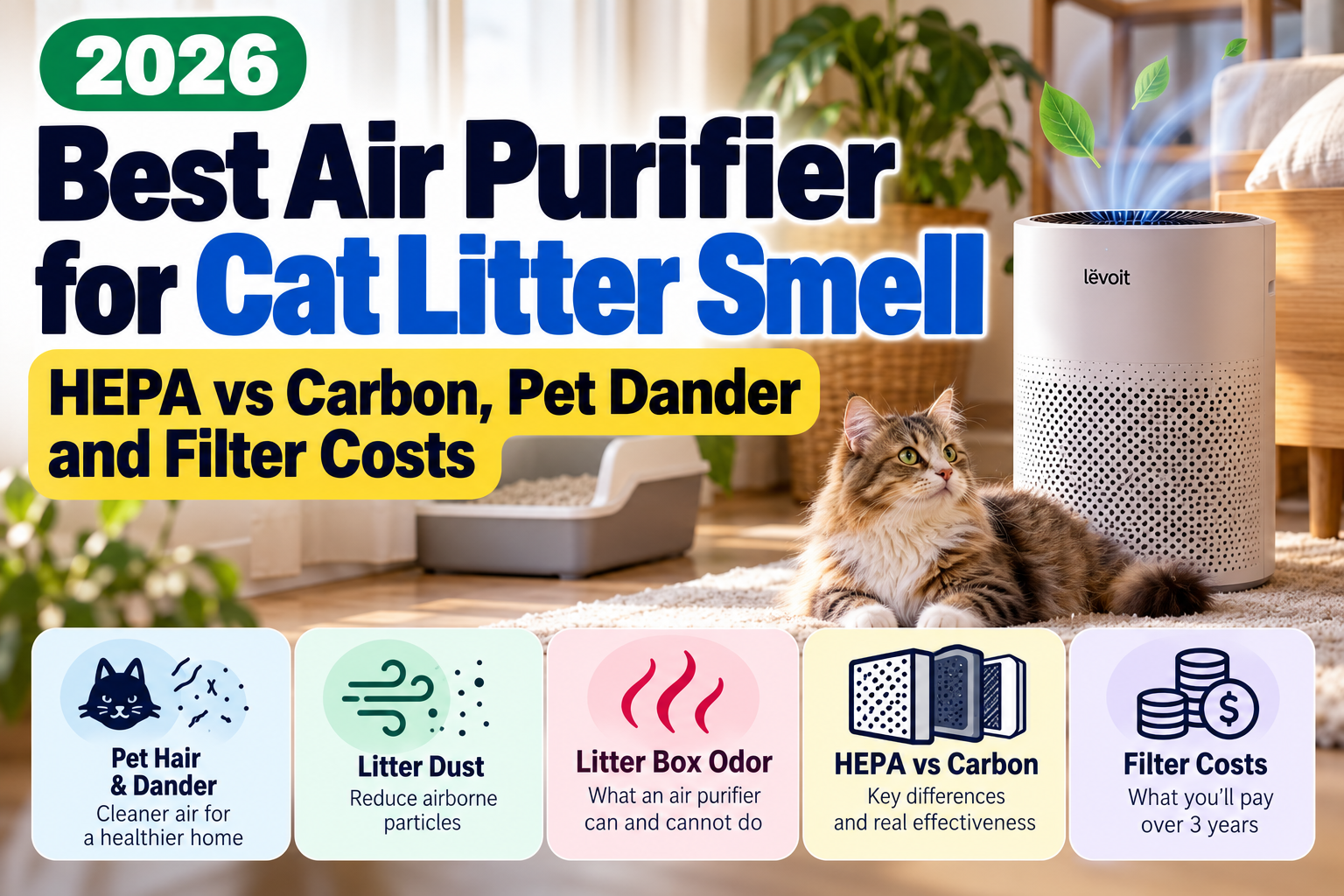
Can an air purifier really get rid of cat litter box smell?
If you have a cat, you probably know the problem. You clean the litter box, but an unpleasant odor still seems to linger in the room. Maybe you also notice floating fur, dust when your cat digs, or allergy symptoms when spending time near the litter area.
Buying an air purifier sounds like an easy solution.
But there is an important catch: an air purifier that removes pet dander effectively may do very little for litter box odors.
That is because airborne particles and odor-causing gases are different types of pollutants. They require different filtration approaches.
In this guide, we’ll explain when an air purifier is worth buying for a cat household, when it isn’t, and which features matter most for litter dust, dander, and odors. We’ll also compare several models and show you how to calculate their long-term filter costs.
Quick Answer: Will an Air Purifier Remove Cat Litter Box Odor?
An air purifier can help reduce airborne litter dust and cat dander if it has effective particle filtration and sufficient airflow for the room.
However, HEPA filtration alone is not designed to remove odor-causing gases.
An activated carbon filter may help with certain odors, but effectiveness depends on the amount and type of carbon, airflow, the gases involved, and how long the air contacts the filter.
Many household air purifiers contain only a thin carbon sheet or a relatively small quantity of carbon. These filters may offer limited odor reduction, particularly when a litter box continues producing strong smells.
For most cat owners, the best approach is:
- Keep the litter box clean and address the odor source.
- Maintain appropriate ventilation.
- Use an adequately sized particle-filtering air purifier for airborne litter dust and dander.
- Consider substantial gas-phase filtration only if odor remains a major concern.
Bottom line: Buy an air purifier primarily for cleaner air—not as a substitute for litter box maintenance.
1. Cat Hair, Dander, Litter Dust and Odor Are Four Different Problems
Before choosing a machine, identify what you actually want to remove.
| Problem | What It Is | Most Useful Approach |
|---|---|---|
| Cat hair | Larger fur strands | Vacuuming, brushing and a washable pre-filter |
| Cat dander | Tiny skin-related particles and allergens | Effective particle filtration and sufficient CADR |
| Litter dust | Airborne particles released by litter | Low-dust litter, cleaning and particle filtration |
| Litter box odor | Gases and odor-causing compounds | Source control, ventilation and appropriate gas filtration |
This distinction is essential because many product descriptions use phrases such as pet odor removal without explaining what the filter can actually capture.
Cat hair
Most visible cat hair settles on furniture, carpets and floors rather than remaining airborne indefinitely.
An air purifier’s pre-filter may capture some floating hair, but a vacuum cleaner and regular grooming remain important.
Cat dander
Pet allergens can be associated with very small airborne particles.
An air purifier with effective particle filtration may help reduce airborne particles, although it cannot remove allergens already embedded in carpets, bedding or upholstery.
Litter dust
Some litter products produce dust when cats dig or when owners pour fresh litter into the box.
A purifier may reduce airborne particles, but choosing a lower-dust litter and handling it carefully can reduce the problem at its source.
Litter box odor
Litter box odors can involve gaseous compounds, including ammonia associated with urine decomposition.
Particle filters do not reliably remove these gases.
This is where activated carbon or other specifically designed gas-phase filtration may matter—but not all carbon filters perform equally.
2. HEPA vs Activated Carbon: Which Filter Actually Helps?
The terms HEPA and activated carbon appear on many air purifier listings, but they describe different filtration functions.
HEPA and other high-efficiency particle filters
A properly specified high-efficiency particle filter is designed to capture airborne particles.
It can be useful for:
- Pet dander
- Fine litter dust
- Pollen
- General household dust
- Some airborne particles associated with pet activity
However, the presence of a HEPA label does not tell you how effectively the entire purifier moves and cleans room air.
You also need adequate airflow and a suitable Clean Air Delivery Rate (CADR).
Activated carbon filters
Activated carbon is designed to adsorb certain gases and odor-causing compounds.
But performance depends on several factors:
- How much carbon the filter contains
- Whether the media is suitable for the target gas
- How air flows through the carbon
- Contact time
- Temperature and humidity
- Whether the carbon is already saturated
A thin carbon-coated sheet is not equivalent to a substantial carbon bed.
Important: Activated carbon does not remove every gas equally well. Ammonia removal in particular depends on the specific media and treatment used, so a generic carbon label should not be interpreted as proof of effective ammonia removal.
According to the U.S. Environmental Protection Agency (EPA), there is no widely used performance rating system for portable air cleaners that remove gases. CADR ratings measure particle removal, not odor removal.
What this means for shoppers
If your biggest concern is dander or litter dust, prioritize independently measured particle-cleaning performance.
If your biggest concern is strong litter box odor, investigate the filter’s actual gas-removal design and evidence—not simply the word carbon on the box.
3. Best Air Purifiers to Consider for Cat Households in 2026
The following models are worth comparing for homes with cats.
They are not guaranteed solutions for litter box odors. Their strongest documented benefits generally relate to airborne particle removal.
Living Pick Lab has not independently laboratory-tested these products. The comparisons below are informed by published third-party testing, including RTINGS, and EPA guidance.
Winix 5530 — Best Starting Point for Many Cat Owners
The Winix 5530 is a practical model to investigate if your primary concerns are pet dander, litter dust and everyday indoor particles.
RTINGS selected it as its best air purifier for pets for most people in its October 2026 update.
Why consider it
- Strong independently measured particle-cleaning performance
- Pre-filter for larger airborne debris
- Suitable for many typical rooms
- Useful combination of performance and value
What to watch
- Its carbon component should not be expected to eliminate persistent litter odors.
- Its optional PlasmaWave ionization feature should be considered separately from particle filtration.
- Check replacement filter availability and current prices.
Best fit: Cat owners who want a capable all-around particle purifier without paying for a premium large-room model.
Levoit Vital 200S — Best to Investigate for Fur and Everyday Pet Particles
The Levoit Vital 200S is another practical option for cat households, especially where pre-filter maintenance and convenient controls matter.
RTINGS includes it among its pet-related recommendations, particularly for pet hair.
Why consider it
- Useful pre-filter design
- Strong everyday particle-filtration potential
- Convenient controls
- Reasonable option for a standard-sized room
What to watch
- It is not a dedicated gas-removal system.
- Low-speed performance is lower than maximum-speed performance.
- Check the exact replacement filter model before purchasing.
Best fit: Homes where floating fur, dander and litter dust are more important than strong chemical odors.
Levoit Core 600S — For Larger Rooms and Open Living Areas
If your litter box is in a large room or an open-plan area, a compact purifier may not provide enough particle-cleaning capacity.
The Levoit Core 600S offers higher airflow than many small bedroom units.
Why consider it
- Higher particle-cleaning capacity
- Better suited to larger areas
- Useful for airborne dust and dander
- No need to rely on a premium-priced model for every large room
What to watch
- It still contains limited carbon media for strong odors.
- Larger filters may cost more.
- The machine occupies more space.
Best fit: Larger cat-friendly living areas where particle removal is the main goal.
Blueair Blue Signature Large — Premium Particle Filtration
The Blueair Blue Signature Large is worth considering when room size and particle-cleaning capacity are major priorities.
Independent testing shows strong particle removal performance.
Why consider it
- High particle-cleaning capacity
- Suitable for larger living areas
- Quiet operation relative to its performance
- Premium design and controls
What to watch
- Higher initial cost
- Not a proven solution for persistent litter box odor
- Its particle-ionization system cannot be disabled, according to RTINGS, which may be a concern for households with sensitive animals.
Best fit: Larger homes prioritizing particle filtration and premium features rather than low purchase cost.
4. Comparison Table: Which Model Fits Your Problem?
| Model | Main Buying Reason | Room Priority | Litter Odor Limitation |
|---|---|---|---|
| Winix 5530 | Balanced particle filtration and value | Typical rooms | Limited carbon capacity |
| Levoit Vital 200S | Fur, dander and convenient maintenance | Standard rooms | Not dedicated to gas removal |
| Levoit Core 600S | Higher particle airflow | Larger rooms | Limited odor-removal evidence |
| Blueair Blue Signature Large | Premium high-capacity particle filtration | Large rooms | Not a substitute for odor-source control |
Our recommendation: Do not select any of these machines solely because a retailer claims it removes litter box smells.
Choose based on room size and particle filtration first, then separately evaluate whether you need a genuinely capable gas-removal solution.
5. How Much CADR Do You Need Near a Litter Box?
CADR stands for Clean Air Delivery Rate.
It describes how much particle-cleaned air a purifier delivers, typically in cubic feet per minute (CFM).
The EPA provides approximate room-sizing guidance for spaces with 8-foot ceilings.
| Room Area | Approximate Minimum Particle CADR |
|---|---|
| 100 sq ft | 65 CFM |
| 200 sq ft | 130 CFM |
| 300 sq ft | 195 CFM |
| 400 sq ft | 260 CFM |
| 500 sq ft | 325 CFM |
These values are approximate sizing guidance for particle removal, not odor removal.
For example, a 200-square-foot room generally calls for a purifier with an appropriate particle CADR of about 130 CFM or more under the EPA’s sizing approach.
However, an open-plan living area requires considering the larger connected space, not just the few square feet occupied by the litter box.
Also remember that published CADR is commonly measured at higher fan speeds.
If you plan to run the machine quietly, actual cleaning performance may be lower.
For a more detailed explanation, see our existing guide:
What Size Air Purifier Do I Need? CADR Guide for 150, 300 and 500 Sq Ft Rooms
6. Why Your Air Purifier May Not Remove Litter Box Smell
If you’ve already purchased an air purifier and the odor remains, the machine may not be defective.
The problem may be a mismatch between the pollutant and the filtration technology.
Reason 1: The odor source is still present
An air purifier cannot prevent a dirty litter box from continuing to produce odors.
Source control is usually the first and most effective intervention.
Reason 2: The carbon filter is too small
Many consumer air purifiers use thin carbon sheets or modest amounts of carbon.
Such filters may not contain enough suitable media to substantially reduce persistent gases.
Reason 3: The filter is not designed for ammonia
Different gases require different adsorption characteristics.
Some gas-removal products use specially treated media, but buyers should look for credible evidence supporting specific ammonia-removal claims.
Reason 4: Ventilation is inadequate
An enclosed space with poor air exchange may retain odors even when a particle purifier is operating.
Safe, appropriate ventilation can be important.
Reason 5: The filter needs replacement
Gas-removal media can become exhausted, and particle filters can accumulate debris.
Follow the manufacturer’s instructions and replace filters when appropriate.
7. Five Things to Try Before Buying an Air Purifier
A new appliance should not be your first response to every litter box problem.
1. Remove waste regularly
Promptly removing solid waste and urine clumps helps reduce odor sources.
2. Keep the litter box clean
Follow the litter manufacturer’s instructions and use pet-safe cleaning practices.
Avoid combining household cleaning chemicals, especially bleach with ammonia-containing substances, because hazardous gases can form.
3. Consider litter type
Some litter products produce more dust or manage odors differently.
Choose a litter that works for your cat and your household rather than relying solely on fragrance.
4. Improve placement and ventilation
Avoid placing the litter box in a completely stagnant, poorly ventilated area when possible.
At the same time, keep it in a location your cat can access comfortably.
5. Investigate unusually strong odors
A sudden change in urine odor, urination habits or litter box use can sometimes indicate a health or behavioral issue.
If your cat shows concerning symptoms, contact a veterinarian rather than attempting to mask the smell with an appliance.
Buying principle: Fix the source first, then use filtration for the airborne pollutants that remain.
8. Where Should You Place an Air Purifier Near a Litter Box?
Placement matters for both effectiveness and your cat’s comfort.
A purifier should be close enough to help circulate air through the area, but not positioned so that it blocks access to the litter box or frightens the cat.
Follow these guidelines:
- Keep the air intake and outlet unobstructed.
- Avoid placing the machine where litter can be kicked directly into its openings.
- Do not point strong airflow directly into the litter box.
- Follow the manufacturer’s clearance recommendations.
- Keep cords secure and away from curious pets.
- Avoid placing the unit where it can be tipped over easily.
If the litter box is in a bathroom or laundry room, verify that the purifier is approved for the room’s humidity and electrical conditions.
Do not use a standard indoor air purifier in an unsuitable wet location.
9. Filter Replacement Costs: The Hidden Expense
For a household with cats, filter maintenance can be a meaningful long-term expense.
Airborne fur, dust and litter particles may increase the amount of debris collected by a pre-filter.
However, filter life depends on the specific model, environment, fan speed and manufacturer’s guidance.
A three-year ownership cost example
Consider two hypothetical models.
| Cost | Purifier A | Purifier B |
|---|---|---|
| Initial price | $140 | $220 |
| Replacement filter price | $35 | $50 |
| Assumed replacement interval | 6 months | 12 months |
| Replacement filters over 3 years | 6 | 3 |
| Purchase + filter total | $350 | $370 |
These are illustrative figures, not verified current prices for any model discussed in this article.
Electricity, shipping, taxes and other expenses are excluded.
The lesson is that a lower purchase price does not necessarily guarantee lower long-term costs.
Before purchasing, verify:
- Genuine replacement filter price
- Filter model number
- Manufacturer’s replacement interval
- Availability from reliable retailers
- Whether carbon media is replaced separately
- Whether the pre-filter is washable or simply cleanable
A reusable pre-filter may reduce maintenance hassle, but it does not eliminate the need to replace the main filter when required.
10. Is a More Expensive Carbon Air Purifier Worth It?
A specialized gas-phase filtration system may make sense if you have a persistent odor problem that remains after source control and ventilation improvements.
But before spending significantly more, ask three questions.
First: Is the media actually designed for the odor-causing gases?
The phrase activated carbon is not enough by itself.
Second: Is there meaningful evidence of gas-removal performance?
A high particle CADR does not establish ammonia or odor-removal capability.
Third: Can you afford the replacement media?
Large or specialized gas filters may have higher ongoing costs.
If your main problem is litter dust and dander rather than odor, a conventional particle-focused air purifier may offer better value.
11. Which Air Purifier Should You Buy? A Practical Decision Guide
If your main problem is litter dust
Choose an appropriately sized air purifier with strong measured particle filtration.
Also consider switching to a lower-dust litter.
If your main problem is cat dander
Prioritize effective particle filtration, adequate CADR and regular cleaning of floors and fabrics.
If your main problem is visible fur
A vacuum cleaner, grooming routine and accessible pre-filter may provide more immediate benefits than paying extra for premium air-cleaning features.
If your main problem is persistent litter box odor
Start with cleaning, source control and ventilation.
Do not assume that a standard HEPA purifier with a small carbon sheet will solve the problem.
If you have both dust and odor problems
Consider a particle purifier for dust and dander while separately evaluating whether additional gas filtration is justified.
This approach avoids paying for features that may not address your actual problem.
12. Frequently Asked Questions
Do HEPA air purifiers remove cat litter smell?
HEPA filtration primarily removes airborne particles. It is not designed to capture odor-causing gases, so a HEPA label alone does not establish odor-removal performance.
Does activated carbon remove ammonia?
Certain carbon-based or specially treated gas-filtration media may help with ammonia under appropriate conditions. Effectiveness varies, and generic activated carbon filters should not be assumed to remove ammonia efficiently.
Can an air purifier help with cat allergies?
A purifier with effective particle filtration may reduce some airborne allergens, but it cannot eliminate allergens throughout the home or guarantee symptom relief.
Should I run an air purifier all day near a litter box?
Many models are designed for extended use when operated according to their instructions. Longer run times generally increase particle filtration, but they do not eliminate the need for litter box cleaning.
Are ionizing air purifiers safe for cats?
Some ionization technologies may produce ozone. The EPA recommends avoiding air-cleaning devices that intentionally produce ozone and notes that certain electronic technologies can emit it. Consider your pet’s sensitivity and the device’s design before purchasing.
Is a small desktop air purifier enough?
A small purifier may be adequate for a very small enclosed space if its particle CADR is appropriate. It should not be expected to clean an entire large living area or solve strong litter odors.
Will a more expensive air purifier automatically remove more odor?
No. Price and maximum particle CADR are not reliable measures of gas-removal effectiveness. Filter design and evidence for the specific gases matter more.
Final Verdict: Buy for the Problem You Actually Have
The best air purifier for a cat household depends on whether you are trying to reduce litter dust, airborne dander, visible fur or unpleasant odors.
For many households, the Winix 5530 is a strong starting point for particle filtration and everyday value.
The Levoit Vital 200S is worth investigating for practical pet-hair and dander management, while the Levoit Core 600S and Blueair Blue Signature Large may suit larger rooms.
But none of these models should be treated as a guaranteed solution for persistent cat litter box odors.
The most important buying rule is simple:
HEPA-style particle filtration helps with dust and dander. Odor control requires source management and, when appropriate, effective gas-phase filtration.
Before purchasing, compare room size, measured particle performance, filter design, maintenance costs and the specific problem you want to solve.
That is how you avoid buying an expensive air purifier that performs well on paper but fails to address the reason you bought it.
Sources and Further Reading
U.S. Environmental Protection Agency (EPA)
Guide to Air Cleaners in the Home
https://www.epa.gov/indoor-air-quality-iaq/guide-air-cleaners-home
EPA — Air Cleaners and Air Filters in the Home
https://www.epa.gov/indoor-air-quality-iaq/air-cleaners-and-air-filters-home
RTINGS — Best Air Purifiers for Pets (Updated October 2026)
https://www.rtings.com/air-purifier/reviews/best/pets
RTINGS — Air Purifier Reviews and Testing
https://www.rtings.com/air-purifier/reviews
Editorial disclosure: Living Pick Lab has not independently tested the products mentioned in this guide. Recommendations are based on published third-party testing and publicly available technical guidance. Product specifications, prices and filter availability may change. This article is informational and does not replace veterinary advice.