
Updated October 2026 | Living Pick Lab Buying Guide
Wildfire smoke does not have to be visible outside your window to become an indoor air-quality concern. Fine particles can enter homes through gaps, ventilation systems, and everyday movement between indoor and outdoor spaces.
When smoke levels rise, many households turn to portable air purifiers. But choosing the right one involves more than finding a product labeled “True HEPA” or “large-room coverage.”
The most important question is whether an air purifier can deliver enough clean air to your actual room—at a fan speed you can realistically use.
A purifier may perform impressively in a small bedroom yet struggle in a large open-plan living area. Another may remove smoke particles effectively but offer limited protection against the gases responsible for smoke odors.
And a seemingly affordable machine can become expensive once replacement filters and electricity are included.
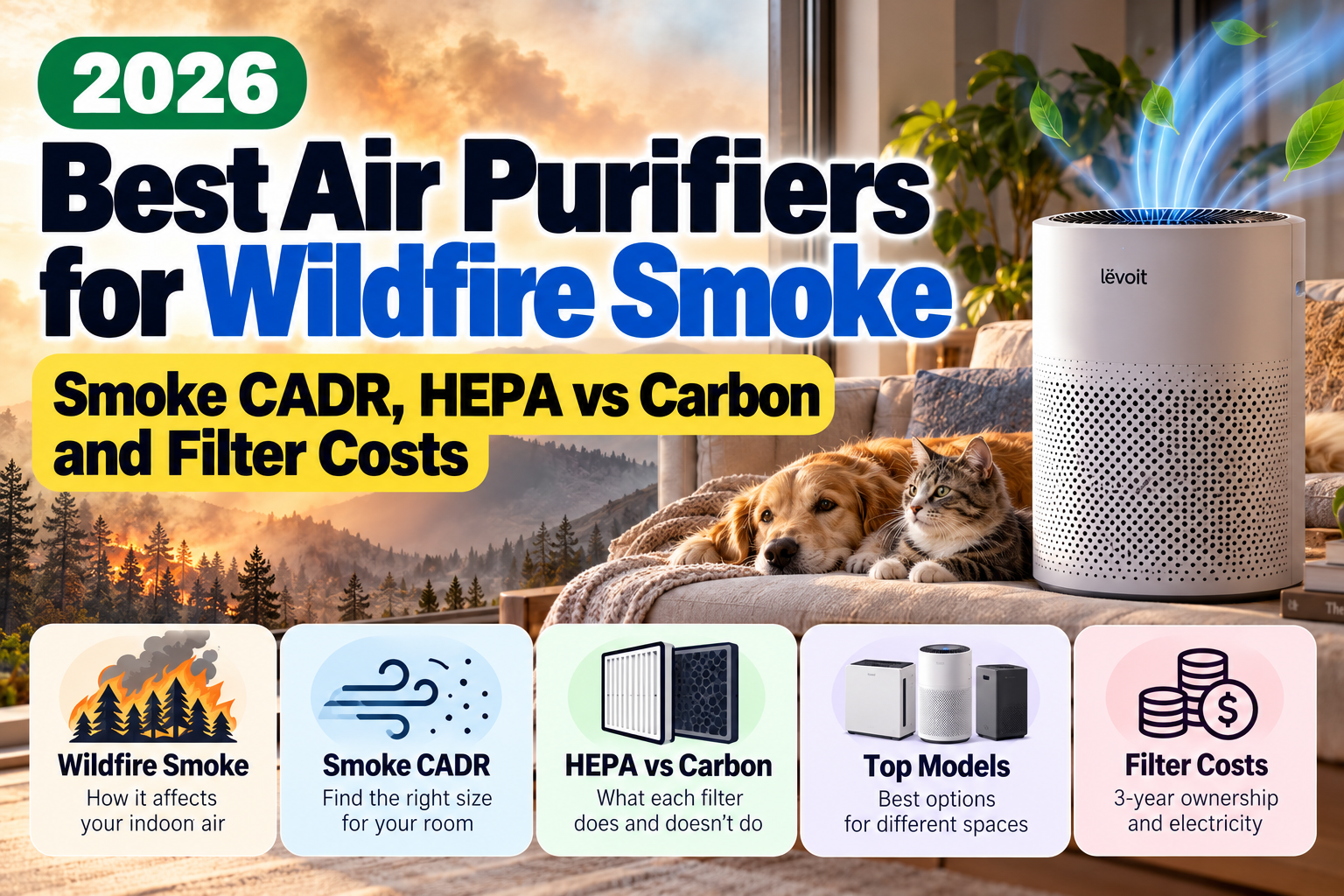
This guide explains how to choose an air purifier for wildfire smoke in 2026, which models deserve consideration, how to compare smoke CADR, and how to avoid paying for features that do not address your primary concern.
Quick Answer: What Is the Best Air Purifier for Wildfire Smoke?
For most households, the best choice is a portable air purifier with:
- A verified smoke CADR appropriate for the room
- Effective high-efficiency particle filtration
- Low or no ozone emissions
- Reasonable noise at useful fan speeds
- Readily available replacement filters
- Manageable long-term operating costs
Our practical buying recommendation: Prioritize smoke CADR and verified particle-removal performance before app connectivity, appearance, or advertised coverage claims.
Models worth investigating include the Coway Airmega ProX for very large spaces, Blueair Blue Pure 311i+ Max for many larger rooms, and compact or budget-oriented options from independent testing sources such as HouseFresh.
However, no single model is the best choice for every room or budget.
The U.S. Environmental Protection Agency (EPA) recommends choosing a portable air cleaner with a tobacco-smoke CADR of at least two-thirds of the room’s area in square feet, assuming a standard ceiling height.
For example, a 300-square-foot room calls for a smoke CADR of approximately 200 CFM or higher under this guidance.
That calculation is a more useful starting point than a large coverage number printed on a product box.
1. Why Wildfire Smoke Requires a Different Buying Strategy
Wildfire smoke is a mixture of airborne particles and gases.
The most important distinction for air purifier shopping is between fine particulate matter and gaseous pollutants.
Fine smoke particles
Wildfire smoke contains fine particles, including PM2.5—particulate matter with diameters of 2.5 micrometers or smaller.
These particles can remain suspended in air and enter buildings even when windows are closed.
Portable air purifiers with effective particle filters can reduce indoor particle concentrations when properly sized and operated.
Smoke odors and gases
Wildfire smoke also contains gaseous compounds that can contribute to unpleasant odors and other air-quality concerns.
A conventional particle filter is not designed to remove all these gases.
Activated carbon or other gas-phase filtration media may help with certain compounds, but performance depends on filter design, the amount of media, and the particular gases involved.
Key distinction: A purifier can substantially reduce smoke particles without eliminating the smell of smoke.
That does not necessarily mean the purifier is failing. It may be removing one class of pollutants while leaving another largely untreated.
2. Smoke CADR Explained: The Number That Matters Most
CADR stands for Clean Air Delivery Rate.
It measures the volume of cleaned air a purifier delivers for a specified particle type, generally expressed in cubic feet per minute (CFM) in the United States.
Air purifiers may have separate CADR ratings for smoke, dust, and pollen.
For wildfire smoke, smoke CADR is particularly relevant.
EPA room-sizing guidance
The EPA recommends a smoke CADR of at least approximately two-thirds of the room’s square footage for typical 8-foot ceilings.
| Room Size | Approximate Minimum Smoke CADR |
|---|---|
| 150 sq ft | 100 CFM |
| 200 sq ft | 133 CFM |
| 300 sq ft | 200 CFM |
| 400 sq ft | 267 CFM |
| 500 sq ft | 333 CFM |
| 600 sq ft | 400 CFM |
These values are calculated from the EPA’s sizing guideline. They are not measurements of specific products.
Example: A 12-by-15-foot bedroom
A bedroom measuring 12 feet by 15 feet has an area of:
12 × 15 = 180 square feet
Using the EPA guideline:
180 × 2/3 = 120 CFM
A purifier with a verified smoke CADR of at least approximately 120 CFM would meet that baseline recommendation for an 8-foot ceiling.
However, a higher-capacity model may be useful when smoke is severe, the ceiling is taller, or you want meaningful filtration without operating the fan at maximum speed.
Why higher ceilings matter
A room with a 10-foot ceiling contains more air than the same floor area with an 8-foot ceiling.
The EPA advises selecting a larger-capacity purifier for spaces with ceilings higher than 8 feet.
Why advertised coverage can be misleading
Some manufacturers advertise extremely large coverage areas based on relatively infrequent air cleaning.
That number may not reflect the performance you want during a wildfire smoke event.
Compare verified CADR values and the conditions behind any coverage claim rather than assuming that “covers 2,000 square feet” means the purifier is suitable for a 2,000-square-foot smoke-exposed space.
For a broader explanation, see our Living Pick Lab guide:
What Size Air Purifier Do I Need? CADR Guide for 150, 300 and 500 Sq Ft Rooms
3. HEPA vs Activated Carbon: What Each Filter Actually Does
Many air purifiers combine particle filtration with a carbon component, but these systems serve different purposes.
HEPA filtration: Primarily for particles
A genuine HEPA filter is designed to capture a high proportion of fine airborne particles passing through the filter.
This makes high-efficiency particle filtration especially relevant for wildfire smoke.
However, filter efficiency alone does not determine whole-room performance.
A highly efficient filter paired with weak airflow may clean the room more slowly than a well-designed purifier with stronger clean-air delivery.
That is why CADR matters.
Activated carbon: Potentially useful for some gases
Activated carbon can adsorb certain gaseous pollutants.
But not all carbon filters are equivalent.
A thin carbon-coated sheet may have much less gas-removal capacity than a substantial carbon bed designed for that purpose.
The EPA advises looking for a meaningful quantity of appropriate sorbent material when gas removal is a priority.
Can activated carbon remove wildfire smoke smell?
It may reduce some odor-causing compounds, depending on the filter and the pollutants involved.
But buyers should not assume that a purifier containing carbon can eliminate wildfire smoke odors or all hazardous gases.
A high smoke CADR measures particle removal, not gas removal.
Which should you prioritize?
If your main goal is reducing fine airborne smoke particles, prioritize verified particle-cleaning performance.
If you are also concerned about odors or gases, investigate whether the manufacturer provides credible gas-removal evidence and what replacement media will cost.
Buying rule: Do not sacrifice adequate smoke CADR merely to obtain a thin carbon filter marketed as an odor-control feature.
4. Best Air Purifiers to Consider for Wildfire Smoke in 2026
The following models represent different buying priorities.
They are not ranked by a single universal score, because room size, fan noise, operating cost, and availability can change which model makes sense.
Living Pick Lab has not independently laboratory-tested these products. Our discussion draws on published testing and technical guidance, including Consumer Reports, HouseFresh, and the EPA.
Coway Airmega ProX — Best to Consider for Very Large Spaces
The Coway Airmega ProX is a high-capacity option for households seeking powerful particle filtration in an extra-large room.
Consumer Reports includes it among its leading air purifiers and reports strong smoke-particle removal performance at both higher and lower fan settings.
Why it deserves consideration
- Strong independently tested particle-removal performance
- Designed for large indoor spaces
- High-capacity filtration
- Useful option where smaller purifiers may be underpowered
Potential drawbacks
- Substantial upfront investment
- Large physical size and weight
- Meaningful annual operating costs
- May be excessive for a small bedroom
Consumer Reports has estimated approximately $259 per year in filter replacement and energy costs for this model under its assumptions.
That is an estimate from a third-party testing organization, not a current retail quote or a guarantee of your household’s expenses.
Best fit: Large living areas where strong particle-cleaning capacity is more important than compact size or minimum ownership cost.
Blueair Blue Pure 311i+ Max — Best to Consider for a Larger Everyday Living Room
The Blueair Blue Pure 311i+ Max is a practical option to investigate if you want strong particle filtration without moving into the largest and most expensive appliance category.
Consumer Reports reports strong smoke removal on high and good performance at lower speeds.
Why it deserves consideration
- Strong tested particle-cleaning performance
- Relatively portable design
- Automatic controls
- Useful for many larger living areas
Potential drawbacks
- Noise can increase at higher fan speeds
- Replacement filters remain an ongoing expense
- Its carbon component should not be assumed to eliminate all smoke gases
Consumer Reports estimates approximately $136 per year in maintenance and electricity under its published methodology.
Best fit: Households seeking a balance of smoke-particle filtration, convenience, and everyday usability.
AirFanta 3Pro — Best to Investigate for Value-Focused Particle Filtration
The AirFanta 3Pro is an unconventional option featured in HouseFresh’s 2026 wildfire smoke recommendations.
Rather than emphasizing premium styling, its design focuses on delivering particle filtration through a compact, fan-based configuration.
Why it deserves consideration
- Appears in independent wildfire-smoke testing comparisons
- Value-oriented approach to particle filtration
- Alternative to conventional tower-style purifiers
- Potentially appealing for buyers prioritizing performance over appearance
Potential drawbacks
- Less conventional appearance and design
- Noise and comfort should be evaluated at useful fan speeds
- Replacement-filter availability should be confirmed
- Not a dedicated gas-removal solution
Best fit: Buyers willing to consider a less traditional purifier design in exchange for a performance-focused value proposition.
A Properly Sized Bedroom Purifier — Best for a Dedicated Cleaner Air Room
A smaller air purifier may be the most practical purchase when your immediate goal is to create one cleaner indoor room.
Instead of buying a single premium purifier for an entire home, consider concentrating effective filtration where household members will spend the most time.
The right bedroom model should have sufficient smoke CADR, manageable noise, and affordable replacement filters.
Best fit: Bedrooms, home offices, or dedicated cleaner-air rooms where a verified smoke CADR can be matched to a defined space.
For more detail on noise and sleep-mode trade-offs, read:
Best Air Purifier for Bedrooms in 2026: Quiet Sleep Modes, CADR and Filter Costs
5. Side-by-Side Buying Comparison
| Option | Main Strength | Most Suitable Situation | Main Trade-Off |
|---|---|---|---|
| Coway Airmega ProX | High-capacity particle filtration | Extra-large rooms | Purchase and operating cost |
| Blueair Blue Pure 311i+ Max | Strong all-around performance | Larger living rooms | Filter costs and higher-speed noise |
| AirFanta 3Pro | Value-oriented particle filtration | Budget-conscious shoppers | Unconventional design and maintenance considerations |
| Appropriately sized bedroom purifier | Focused room protection | Cleaner-air room or bedroom | Limited coverage outside that room |
| DIY fan-and-filter cleaner | Potentially lower upfront cost | Limited budgets or product shortages | Variable performance, assembly and noise |
Important: Verify each model’s current smoke CADR, certification, replacement-filter compatibility, and price before purchasing.
A product’s inclusion here does not mean that it is equally suitable for every room size.
6. One Large Air Purifier or Two Smaller Ones?
This is a purchasing decision that many product rankings overlook.
Suppose you have a 500-square-foot living area.
Using the EPA’s baseline sizing rule, you would look for approximately 333 CFM of smoke CADR.
One suitably sized purifier may be sufficient for a single open room.
But two smaller units can sometimes offer more flexible placement, especially in irregular spaces.
When one large purifier makes sense
- The room is open and unobstructed.
- You want fewer machines to maintain.
- The unit has sufficient verified smoke CADR.
- Noise at effective operating speeds is acceptable.
When two smaller purifiers may make sense
- Air circulation is obstructed by furniture or room layout.
- You want filtration in separate occupied rooms.
- You prefer flexibility during changing household routines.
- Two units provide adequate combined capacity at a reasonable cost.
Do not simply add two CADR figures and assume perfect whole-room performance. Placement and air mixing affect results.
And if two rooms are separated by closed doors, each room should be assessed individually.
7. The Hidden Cost: Three-Year Air Purifier Ownership
The purchase price is only the beginning.
A wildfire-smoke purifier may need to run for extended periods, and filters can require more frequent replacement during heavy smoke exposure.
Before buying, calculate the total cost of ownership.
The basic formula
Three-Year Cost = Purchase Price + Replacement Filters + Electricity
Additional costs, such as shipping and taxes, may apply.
Example: Two hypothetical purifiers
These figures are illustrative, not current prices for the models discussed above.
| Expense | Purifier A | Purifier B |
|---|---|---|
| Purchase price | $180 | $300 |
| Replacement filter cost | $45 | $70 |
| Assumed replacement interval | Every 6 months | Every 12 months |
| Filter purchases over 3 years | 6 | 3 |
| Filter spending | $270 | $210 |
| Electricity assumption | 45 W | 35 W |
| Electricity over 3 years | $177.39 | $137.97 |
| Estimated 3-year total | $627.39 | $647.97 |
Electricity calculations assume continuous operation, 24 hours per day, 365 days per year, at $0.15 per kilowatt-hour.
Actual electricity use depends on fan speed, operating hours, and the power draw of the specific machine.
This example demonstrates why a purifier that costs $120 more initially can end up having a similar three-year ownership cost.
How to calculate electricity expense
Use this formula:
Electricity Cost = (Watts ÷ 1,000) × Hours Used × Electricity Rate
For example, a 45-watt purifier operating continuously for one year at $0.15/kWh costs:
0.045 × 8,760 × $0.15 = $59.13 per year
For three years:
$59.13 × 3 = $177.39
These calculations exclude taxes, changing utility rates, and standby power differences.
What to verify before purchasing
Check the exact replacement-filter model, official replacement schedule, local filter availability, electricity use, and whether the manufacturer offers genuine replacement media.
A cheap purifier with expensive or hard-to-find filters may not be a good long-term purchase.
8. How to Create a Cleaner Air Room During Wildfire Smoke
The EPA recommends preparing a cleaner-air room before a smoke event whenever possible.
This can be a bedroom or another room large enough for household members to remain comfortable.
Step 1: Choose the room
Select a room with doors and windows that can be closed and enough space for the people who will use it.
A bedroom with access to a bathroom may be practical.
Step 2: Reduce smoke entry
Close windows and exterior doors when outdoor smoke levels are elevated.
Do not obstruct emergency exits.
If your air-conditioning system has a fresh-air intake option, follow appropriate guidance for limiting outdoor smoke intake while maintaining safe indoor temperatures and ventilation.
Step 3: Run effective filtration
Use a properly sized portable air purifier or an appropriate high-efficiency HVAC filter.
The EPA recommends operating a portable cleaner continuously at its highest setting during a smoke event, when practical.
Step 4: Avoid generating more indoor particles
During a smoke event, reduce activities that add pollutants indoors.
Examples include:
- Burning candles
- Smoking or vaping indoors
- Spraying aerosols
- High-heat cooking
- Vacuuming without suitable high-efficiency filtration
Use damp cleaning methods to remove settled dust.
Step 5: Manage heat and comfort
A sealed room can become dangerously hot.
Do not compromise heat safety in an attempt to keep smoke out.
Follow public-health advice for your area, particularly during simultaneous wildfire smoke and extreme heat.
Step 6: Monitor official air-quality information
Use local air-quality advisories and resources such as AirNow in the United States.
An air purifier is a supplemental indoor protection measure, not a replacement for evacuation instructions or medical guidance.
9. DIY Air Purifier vs Commercial Air Purifier
During major smoke events, commercial air purifiers can become expensive or difficult to find.
A do-it-yourself air cleaner may be an alternative.
One common approach combines a box fan with high-efficiency furnace filters.
More elaborate configurations, including multi-filter designs, may improve airflow and filtration performance.
Advantages of DIY filtration
- Potentially lower initial cost
- Commonly available components
- Flexible filter configurations
- Useful when commercial models are unavailable
Limitations
- Performance depends on construction
- Noise may be higher
- Assembly takes time
- Safety and maintenance require attention
- Filter fit and airflow may vary
The EPA recommends using a newer box fan made since 2012 with a UL or ETL safety mark and high-efficiency filters, preferably MERV 13 or higher.
The EPA also emphasizes proper airflow direction, secure filter attachment, and replacing filters when dirty or odorous.
Our recommendation: A verified commercial purifier is generally the simpler choice when affordable. A carefully constructed DIY cleaner can be a valuable alternative when cost or availability is a barrier.
10. Seven Mistakes to Avoid When Buying for Wildfire Smoke
Mistake 1: Choosing by advertised room coverage alone
Coverage claims can use different assumptions.
Verify smoke CADR and compare it with the actual room area.
Mistake 2: Assuming all HEPA-labeled purifiers perform equally
Filter efficiency does not establish the entire machine’s clean-air delivery.
Airflow and tested performance matter.
Mistake 3: Expecting a thin carbon sheet to remove every smoke gas
Gas removal requires suitable media and adequate capacity.
Mistake 4: Buying a small purifier for a large open-plan home
A compact bedroom model may be underpowered for a much larger connected space.
Mistake 5: Ignoring noise
A purifier that is too loud to operate at an effective fan speed may not deliver the practical performance you expected.
Mistake 6: Forgetting replacement-filter costs
Heavy smoke can increase filter loading.
Budget for maintenance before choosing the machine.
Mistake 7: Overlooking ozone emissions
The EPA warns against air cleaners that intentionally produce ozone.
Check applicable safety and emissions certifications, including California Air Resources Board (CARB) certification where relevant.
11. Our Buying Decision Framework
Rather than choosing the most expensive machine, match your purchase to your specific circumstances.
If you live in a wildfire-prone region
Prioritize high particle-cleaning capacity, dependable filter availability, and a model you can operate for extended periods.
Buying replacement filters before wildfire season may reduce the risk of shortages.
If you need to protect one bedroom
Calculate the room’s smoke CADR requirement.
Choose a model that can deliver sufficient filtration at a noise level you can tolerate.
If your home has a large open living area
Consider a high-capacity purifier or multiple appropriately placed units.
Do not assume a small machine can protect the entire connected space.
If you are on a limited budget
Prioritize smoke CADR over smart-home features.
Compare independently tested value-oriented models and properly built DIY alternatives.
If smoke odor is your main concern
Understand the difference between particle removal and gas filtration.
Investigate substantial, appropriately designed gas-phase media rather than relying on marketing language.
12. Frequently Asked Questions
Do air purifiers really work for wildfire smoke?
Properly sized and operated air purifiers with effective particle filtration can reduce airborne smoke particles indoors. They cannot remove every pollutant or eliminate the need to follow public-health guidance.
Is HEPA enough for wildfire smoke?
High-efficiency particle filtration is valuable for fine smoke particles. It does not, by itself, remove all smoke-related gases or odors.
What smoke CADR do I need for a 300-square-foot room?
The EPA’s baseline recommendation is approximately 200 CFM for a 300-square-foot room with a standard 8-foot ceiling.
Should I leave my air purifier running all day?
During a smoke event, the EPA recommends continuous operation at the highest practical setting in a cleaner-air room. Follow the device’s safety instructions.
Can an air purifier remove wildfire smoke smell?
Some gas-phase filters may reduce certain odor-causing compounds, but ordinary particle filters do not reliably remove gases. A carbon label alone is not proof of effective odor removal.
Do air purifiers make ozone?
Some air-cleaning technologies can produce ozone. Choose products with appropriate emissions certifications and avoid devices intended to generate ozone.
Is one large air purifier better than two small ones?
It depends on the layout, combined cleaning capacity, placement, and whether the spaces are connected. Separate rooms often benefit from separate filtration.
How often should I replace filters during wildfire season?
Follow manufacturer guidance and inspect filters as recommended. Heavy smoke exposure may shorten filter life. Do not assume the standard replacement interval will always be sufficient.
Can I use a DIY box-fan air purifier?
Yes, a properly built DIY air cleaner can reduce airborne particles. Follow EPA safety and construction guidance, including appropriate fan and filter selection.
Will an air purifier make my home completely safe during a wildfire?
No. Air purifiers reduce certain indoor pollutants but do not make a building smoke-proof or replace evacuation orders, medical advice, or other emergency measures.
Final Verdict: Buy Clean-Air Performance, Not Marketing Promises
The best air purifier for wildfire smoke in 2026 is not necessarily the one with the highest price, the most features, or the largest advertised coverage area.
It is the one that can deliver enough verified particle-cleaning capacity for your room, operate at a tolerable noise level, and remain affordable to maintain.
For very large spaces, the Coway Airmega ProX is worth investigating.
For many larger living rooms, the Blueair Blue Pure 311i+ Max offers a compelling combination of tested performance and everyday usability.
For value-focused shoppers, independent comparisons of alternatives such as the AirFanta 3Pro and properly constructed DIY cleaners are worth reviewing.
But regardless of the model, follow three rules:
- Size by smoke CADR, not marketing coverage.
- Distinguish particle filtration from gas and odor removal.
- Calculate filter and electricity costs before buying.
If wildfire smoke is a recurring concern where you live, preparing a cleaner-air room before smoke arrives can be more useful than making a rushed purchase during an emergency.
A carefully selected air purifier is one part of a broader indoor-air protection plan—not a substitute for official air-quality and emergency guidance.
Sources and Further Reading
U.S. Environmental Protection Agency — How to Create a Cleaner Air Room at Home
https://www.epa.gov/wildfires/how-create-cleaner-air-room-home
U.S. Environmental Protection Agency — Indoor Air Filtration
https://www.epa.gov/wildfires/indoor-air-filtration
U.S. Environmental Protection Agency — Guide to Air Cleaners in the Home
https://www.epa.gov/indoor-air-quality-iaq/guide-air-cleaners-home
Consumer Reports — 5 Best Air Purifiers for Wildfire Smoke (July 2026)
https://www.consumerreports.org/air-purifiers/best-air-purifiers-for-wildfire-smoke/
HouseFresh — The Best Performing Air Purifiers for Wildfire Smoke (+ DIY Units), July 2026
https://housefresh.com/air-purifiers-for-wildfire-smoke/
AirNow — Air Quality Information
https://www.airnow.gov/
Editorial disclosure: Living Pick Lab has not independently laboratory-tested the products discussed in this article. Product assessments reference published third-party testing and government guidance. Illustrative cost calculations are not live retail prices. Product specifications, certifications, availability, and replacement-filter costs may change. This article is informational and does not replace emergency instructions or professional medical advice.