
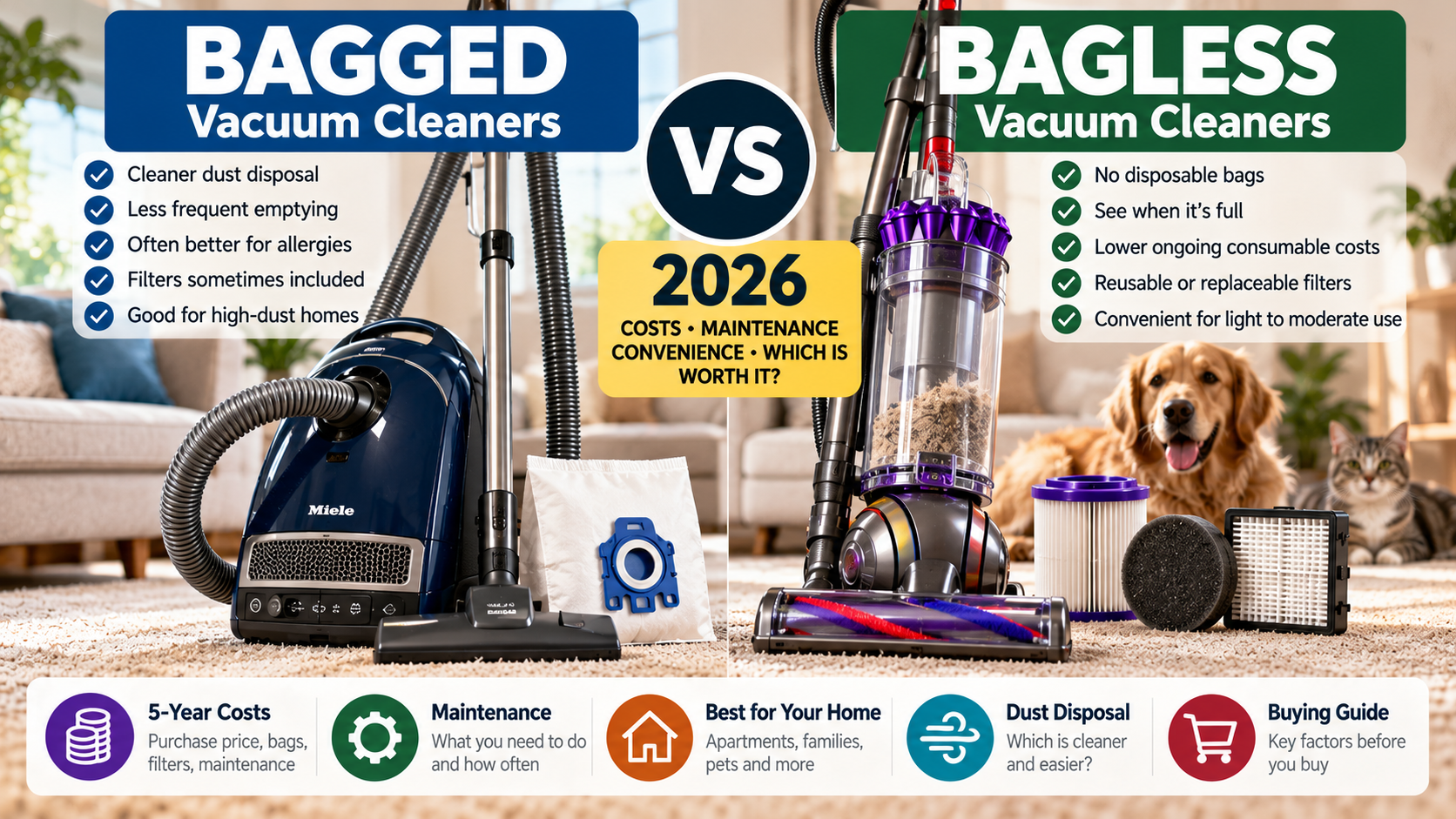
A bagless vacuum cleaner can look like the obvious money-saving choice. There are no disposable dust bags to buy, and you can see exactly when the dirt container needs emptying.
A bagged vacuum, meanwhile, creates a recurring expense every time you replace a full bag.
But the long-term economics are more complicated.
Some bagless vacuums need replacement filters. Some bagged models include filters with their replacement bags. Premium machines can have expensive consumables regardless of how they collect dirt.
And a vacuum that costs less to maintain is not necessarily the one that cleans your carpets most effectively.
The smartest buying decision comes from comparing five-year ownership costs, maintenance requirements, cleaning performance, and the amount of debris your household produces.
This guide uses published US manufacturer prices and transparent cost scenarios to help you choose.
Quick Verdict: Bagged or Bagless?
| Your priority | Better starting point | What to check |
|---|---|---|
| Avoid buying disposable dust bags | Bagless | Replacement filter costs |
| Less frequent debris disposal | Bagged | Actual bag capacity |
| Lowest five-year cost | Depends on model | Purchase price plus consumables |
| Lots of pet hair | Either | Brushroll performance and debris capacity |
| Easy disposal of collected dirt | Bagged | Self-sealing bag design |
| Small apartment with light debris | Bagless may be economical | Bin size and ease of cleaning |
| Long-term ownership | Either | Repairability and parts availability |
| Carpet cleaning performance | Neither automatically wins | Floorhead design and independent tests |
Bottom line: Bagless vacuums eliminate disposable bag purchases, but that does not guarantee lower total ownership costs. Bagged vacuums create recurring bag expenses, but some systems bundle replacement filters with the bags.
The right answer depends on the exact models being compared.
1. How Bagged and Bagless Vacuum Cleaners Work
Bagged vacuum cleaners
A bagged vacuum collects dirt inside a removable bag.
The bag also typically serves as part of the filtration system.
When full, the bag is removed and replaced.
Modern bags may include a sealing mechanism designed to reduce dust escaping during disposal.
Bagless vacuum cleaners
A bagless vacuum collects debris in a reusable container.
Many use cyclonic separation to move larger particles out of the airflow before air passes through additional filters.
When the container fills, you empty it into a trash receptacle.
The machine does not need disposable dust bags, but filters and the dust container still require maintenance.
Does one type clean better?
Not automatically.
RTINGS’ bagged versus bagless vacuum analysis found that floorhead design plays a major role in pickup performance.
A poorly designed bagged vacuum can struggle on carpet. A well-designed bagless vacuum can perform very well.
Choose the right cleaning system for your floors first. Then compare the cost of maintaining it.
2. The Real Cost of Vacuum Bags in 2026
Replacement bags are the most visible recurring expense for a bagged vacuum.
However, prices vary by brand, bag type, capacity and compatibility.
Two official US manufacturer examples illustrate the range.
Miele GN HyClean Air bags
Miele’s US website lists a package containing:
- Four GN HyClean Air dust bags.
- One pre-motor filter.
- One exhaust filter.
The listed price is $27.99.
That works out to approximately $7.00 per bag, although this calculation assigns the entire package price to the bags and does not separately value the included filters.
Source: Miele USA — GN HyClean Air Dust Bags.
SEBO replacement bags
SEBO’s US accessories store lists an eight-bag package for compatible X, G, C, 300, 350 and 370 series machines at $41.99.
That equals approximately $5.25 per bag.
Source: SEBO USA — Compatible Filter Bags.
These products are not interchangeable, and the comparison does not establish that one brand is cheaper to own overall.
Different models have different capacities, filters and maintenance schedules.
3. Five-Year Vacuum Bag Costs
How often you replace a bag depends on:
- Household size.
- Carpeted floor area.
- Number of pets.
- Frequency of vacuuming.
- Bag capacity.
- Type and volume of debris collected.
A household with several shedding pets may use more bags than a small apartment with mostly hard floors.
Five-year cost scenarios
The following table uses the official package prices above.
| Bags used annually | Five-year bag use | Miele package spending | SEBO package spending |
|---|---|---|---|
| 2 | 10 | $83.97 | $83.98 |
| 4 | 20 | $139.95 | $125.97 |
| 6 | 30 | $223.92 | $167.96 |
| 8 | 40 | $279.90 | $209.95 |
Calculation method: The table rounds purchases up to complete packs of four Miele bags or eight SEBO bags. Any unused bags remain available for future use.
For example, using 30 Miele bags requires purchasing eight four-packs:
8 × $27.99 = $223.92.
Using 30 SEBO bags requires purchasing four eight-packs:
4 × $41.99 = $167.96.
These are purchase-spending scenarios, not forecasts of actual household bag usage.
The included filters in the Miele packages also make the two costs imperfectly comparable.
The surprising result
A bagged vacuum does not necessarily cost hundreds of dollars per year in disposable bags.
For households that use only a few bags annually, the expense may be relatively modest.
But the cost can become substantial when bags are small, expensive or replaced frequently.
Before buying, check the price per compatible bag and estimate how many you will realistically use.
4. Bagless Vacuums: No Bags Does Not Mean No Consumables
Bagless vacuum marketing often emphasizes freedom from disposable dust bags.
That is a genuine advantage.
But bagless vacuums still rely on filters to prevent fine particles from circulating through the machine and exiting with the airflow.
Depending on the model, these may include:
- Washable pre-motor filters.
- Replaceable pre-motor filters.
- Post-motor exhaust filters.
- HEPA filters.
- Additional filtration components.
Some washable filters can be reused for an extended period if properly maintained.
Others must be replaced according to the manufacturer’s instructions.
A realistic filter-cost comparison
Consider three hypothetical bagless vacuums.
| Filter arrangement | Illustrative cost | Five-year spending |
|---|---|---|
| Reusable filters, no replacements needed | $0 | $0 |
| $20 replacement filter every year | $20/year | $100 |
| $40 replacement filter every year | $40/year | $200 |
These figures are examples for planning, not verified filter prices or manufacturer schedules for specific models.
The purpose is to show why bagless ownership costs vary.
A bagless vacuum with long-lasting washable filters may have very low consumable expenses.
A model requiring expensive replacement filters can narrow or eliminate that advantage.
Never assume washable means permanent
Follow the specific model’s instructions.
Washing a filter that is not designed to be washed can damage it.
Reinstalling a washable filter before it is completely dry can also create problems.
Check whether the manufacturer recommends washing, replacement or both.
5. Five-Year Ownership Cost: Bagged vs Bagless
The most useful comparison includes more than consumables.
A basic five-year ownership model is:
Five-year cost = Purchase price + bags + replacement filters + maintenance and repairs.
Electricity, taxes and resale value can be added when reliable model-specific information is available.
Scenario A: Midrange bagged vacuum
Assumptions:
- Purchase price: $250.
- Four bags used annually.
- Replacement bags: Miele GN package-price example.
- Additional maintenance and repairs allowance: $50 over five years.
- No separately purchased filters beyond those bundled with the bag packages.
| Expense | Five-year amount |
|---|---|
| Purchase | $250 |
| Dust bag packages | $139.95 |
| Additional maintenance allowance | $50 |
| Total | $439.95 |
Scenario B: Midrange bagless vacuum
Assumptions:
- Purchase price: $250.
- Replacement filter spending: $20 annually.
- Additional maintenance and repairs allowance: $50 over five years.
- No disposable bags.
| Expense | Five-year amount |
|---|---|
| Purchase | $250 |
| Replacement filters | $100 |
| Additional maintenance allowance | $50 |
| Total | $400 |
Under these assumptions, the bagless vacuum costs $39.95 less over five years.
That is a relatively small difference spread across five years.
Important limitation
These are hypothetical, similarly priced machines—not an actual comparison of a $250 Miele with a specific $250 bagless model.
The example uses Miele’s official consumable package price to illustrate bag spending, while the purchase and bagless filter costs are disclosed assumptions.
Actual cleaning performance, lifespan, filter schedules and repair costs may differ.
6. When Does Bagless Become Cheaper?
Assume both vacuums cost the same initially and have equal maintenance expenses other than bags and filters.
The financial comparison becomes:
Bagged consumable spending vs bagless filter spending.
Suppose the bagless model needs $100 in replacement filters over five years.
Using Miele’s $27.99 four-pack example:
| Bags used per year | Five-year bag-package spending | Compared with $100 bagless filter budget |
|---|---|---|
| 2 | $83.97 | Bagged costs $16.03 less |
| 3 | $111.96 | Bagless costs $11.96 less |
| 4 | $139.95 | Bagless costs $39.95 less |
| 6 | $223.92 | Bagless costs $123.92 less |
In this simplified comparison, the crossover occurs between two and three bags per year.
That is not a universal break-even point.
It changes with the price and capacity of compatible bags, filter costs, purchase-price differences and replacement schedules.
A bagless machine with reusable filters and no replacement expense would have a different result.
So would a bagged vacuum that uses inexpensive high-capacity bags.
7. The Purchase-Price Difference Can Matter More Than Bag Costs
Imagine choosing between:
- A bagged vacuum costing $200.
- A bagless vacuum costing $300.
The bagless model starts with a $100 disadvantage.
Even if it saves $30 annually in consumables, it would take more than three years to recover that difference, assuming equal maintenance and comparable performance.
Now reverse the prices.
If the bagless model costs $100 less initially, the bagged model must offer some other advantage—such as lower maintenance spending, longer service life, better cleaning performance or easier disposal—to justify its premium.
Better buying question
Instead of asking:
“Are bags expensive?”
Ask:
“How much more will this particular vacuum cost me over five years compared with the alternative?”
That includes the initial price and all expected recurring expenses.
8. Pet Owners: Capacity, Hair Management and Consumables
Pet hair can change both maintenance frequency and cleaning performance.
A household with multiple shedding animals may fill a vacuum more quickly.
But choosing bagged or bagless is only part of the decision.
Prioritize these features
Brushroll design: Can the vacuum handle long hair without frequent tangling?
Carpet pickup: Does it remove embedded hair rather than merely collecting visible surface debris?
Dust capacity: How often will you need to stop and empty or replace the container?
Replacement parts: Can you buy brushes, belts and filters without replacing the entire machine?
Floor compatibility: Does the cleaner work on your combination of rugs, carpet and hard flooring?
A large bag may reduce disposal frequency.
A transparent bagless bin may make it easier to see when the machine needs emptying.
Neither design automatically guarantees superior pet hair removal.
Independent testing remains essential.
9. Dust Disposal: An Important Practical Difference
Bagged and bagless vacuums handle collected debris differently.
A well-designed bagged system can allow you to remove a sealed bag with relatively little direct contact with loose dust.
A bagless system requires emptying a reusable container, which can release some collected particles into the surrounding air.
Consumer Reports highlights this practical distinction in its 2026 bagged-versus-bagless comparison.
RTINGS has also published independent air-quality testing of vacuum filtration and disposal.
However, dust exposure depends on the specific vacuum, filtration system, seals and disposal method.
A bagged vacuum is not automatically well sealed, and a bagless vacuum is not automatically poorly filtered.
What about allergies?
For households particularly concerned about dust or allergens, filtration quality and the process of emptying collected debris deserve closer examination.
A separate Living Pick Lab guide will examine HEPA filtration, sealed systems and dust exposure in detail.
For this buying guide, the key point is simple:
Consider the cleanliness of debris disposal alongside the cost of replacement bags and filters.
10. Maintenance: Which Type Is Easier to Live With?
Bagged vacuum maintenance
Typical tasks include:
- Replacing full dust bags.
- Checking airflow and blockages.
- Maintaining the brushroll.
- Cleaning or replacing filters according to instructions.
- Inspecting hoses and attachments.
Bagless vacuum maintenance
Typical tasks include:
- Emptying the dust container.
- Cleaning the container when appropriate.
- Maintaining washable filters.
- Replacing filters when required.
- Removing hair from the brushroll.
- Checking cyclones and air passages for blockages.
Which takes less time?
It depends on how often the bagless container fills and how often the bagged model needs a replacement bag.
For a high-debris household, frequent bin emptying may become an inconvenience.
For a small home with minimal debris, the difference may be negligible.
There is no reliable universal maintenance-time advantage without comparing specific machines and usage patterns.
11. The Replacement-Parts Test Before Buying
Consumables can become difficult to find as a vacuum ages.
This is especially important when purchasing a machine you hope to keep for five years or longer.
Before buying, search the manufacturer’s official accessories catalog for the exact model.
Check:
- Are replacement bags or filters currently available?
- Are they compatible with the specific model number?
- What do they cost in multipacks?
- Can you replace the brushroll, belt or hose?
- Are parts available from more than one legitimate seller?
- Does the manufacturer provide clear maintenance instructions?
A low purchase price is less attractive if a damaged hose or unavailable filter forces you to replace the entire vacuum.
Why exact model numbers matter
A product family may include multiple generations with different bags, filters or accessories.
For example, Miele’s GN bag compatibility list specifies particular Complete and Classic series models.
Do not buy replacement bags based solely on the brand name.
12. Environmental Considerations
Bagged vacuums create disposable bag waste.
Many vacuum bags are not recyclable through ordinary household recycling programs.
Bagless vacuums avoid that recurring waste but still use plastic components and may require replacement filters.
There is also the environmental impact of the machine itself.
A durable vacuum that can be repaired and used for many years may be preferable to frequently replacing an inexpensive machine.
However, it would be misleading to declare one collection system universally more environmentally friendly without a full life-cycle comparison.
Consider durability, repairability, packaging, consumables and disposal together.
13. Bagged vs Bagless for Different Homes
Small apartment, mostly hard floors
A compact bagless vacuum with manageable filter requirements may be economical.
But maneuverability and floorhead suitability matter more than bag type alone.
Large carpeted home
A higher-capacity bagged vacuum may reduce the frequency of debris disposal.
Look for independent carpet pickup tests and compatible replacement bags.
Home with multiple shedding pets
Either design can work.
Prioritize hair pickup, brushroll maintenance and consumable costs at your expected usage rate.
Budget-conscious household
Compare complete five-year costs.
Do not assume that the machine with the lowest sticker price is the cheapest to own.
Household planning to keep a vacuum for many years
Repairability and replacement-part availability deserve significant weight.
A vacuum with readily available bags, filters and parts may be a stronger long-term purchase.
14. Should You Replace a Working Vacuum?
If your current vacuum still cleans effectively, switching from bagged to bagless—or the reverse—may not save enough money to justify purchasing another machine.
For example, spending $250 on a new vacuum to avoid $30 per year in bag purchases would take more than eight years to recover through bag savings alone.
That simple calculation excludes filter expenses and assumes the old vacuum would otherwise continue working.
If your existing machine has poor pickup, damaged components or unusually high repair costs, replacement may make more sense.
The correct comparison is the cost of keeping your current vacuum versus the full cost of replacing it.
For households also considering a robotic cleaning system, see our Robot Vacuum vs Cordless Vacuum in 2026 guide.
If your main concern is replacing an aging cordless machine, our Cordless Vacuum Battery Replacement Costs in 2026 article explains the repair-versus-replacement calculation.
15. The Living Pick Lab Five-Year Buying Checklist
Before choosing between bagged and bagless, answer these questions.
| Question | Why it matters |
|---|---|
| What is the actual purchase price? | Establishes the starting cost |
| How many bags might I use annually? | Estimates recurring bag spending |
| Which filters require replacement? | Reveals bagless and bagged filter costs |
| Are filters included with bag purchases? | Prevents double counting |
| How well does the vacuum clean my floors? | Performance matters more than collection type |
| How often must debris be emptied? | Affects convenience |
| Are replacement parts available? | Supports longer ownership |
| Can I maintain it easily? | Reduces inconvenience |
| Is the machine repairable? | May lower long-term replacement costs |
Calculate your own five-year cost
For a bagged vacuum:
Purchase price + five-year bag purchases + separately purchased filters + maintenance and repairs.
For a bagless vacuum:
Purchase price + replacement filters + maintenance and repairs.
Add electricity, taxes and other relevant costs if they materially differ between the models.
When comparing bags sold in multipacks, calculate the actual number of complete packages you would need to purchase.
When filters come bundled with bags, avoid charging for those same filters again.
Frequently Asked Questions
Are bagged vacuums more expensive to maintain?
Not necessarily. Bagged vacuums require replacement bags, but bagless models may require replacement filters. Total cost depends on the exact models and usage patterns.
How much do vacuum cleaner bags cost in 2026?
Official US examples include $27.99 for a four-bag Miele GN HyClean Air package with included filters and $41.99 for a compatible eight-bag SEBO package. Prices and compatibility vary.
Do bagless vacuums need replacement filters?
Many do, although replacement schedules differ. Some models use washable filters that can be reused according to manufacturer instructions.
Do bagged vacuums clean carpets better?
Not automatically. Independent testing indicates that floorhead design and the vacuum’s overall performance are important factors.
Are bagless vacuums cheaper over five years?
They can be, particularly when replacement filters are inexpensive and the purchase price is competitive. But some bagged systems have modest recurring costs, especially when bags last a long time.
Are vacuum bags reusable?
Disposable vacuum bags should generally be replaced as directed by the manufacturer. Reusing a disposable bag can compromise its intended performance and sealing.
Which type is better for pet hair?
Either can work well. Compare brushroll design, carpet pickup, capacity and maintenance rather than relying on bag type alone.
Is a HEPA filter more important than bag type?
Filtration performance involves the filter, machine seals and the overall airflow system. The effect of emptying collected debris is another consideration. These issues deserve a separate, model-specific evaluation.
Final Verdict: Compare the Whole Vacuum, Not Just the Dust Container
Bagless vacuums offer a clear convenience: no disposable dust bags to purchase or store.
Bagged vacuums can make debris disposal simpler and may require less frequent emptying.
But neither design guarantees better cleaning performance or lower ownership costs.
The difference over five years may be substantial—or surprisingly small—depending on the machines and consumables involved.
The best choice is the vacuum that cleans your floors effectively, fits your maintenance preferences, has readily available replacement parts, and offers the lowest reasonable long-term cost for your household.
Before buying, compare the actual purchase price, compatible bag and filter prices, and expected replacement frequency.
That is a more reliable decision than assuming bagged is always expensive or bagless is always cheaper.
Sources and Editorial Methodology
- Consumer Reports — Should You Get a Bagged or Bagless Vacuum?
- RTINGS — Bagged Vacuums vs Bagless Vacuums
- RTINGS — Vacuum Filtration and Air Quality Research
- Miele USA — GN HyClean Air Replacement Bags
- SEBO USA — Compatible Filter Bags and Accessories
- SEBO USA — Filtration System
- RTINGS — Best Bagged Vacuums
- RTINGS — Best Bagless Vacuums
Editorial note: Manufacturer-listed US accessory prices were checked in October 2026 and may change. Five-year calculations distinguish official consumable prices from illustrative purchase prices, usage frequencies and maintenance assumptions. Models with different cleaning capabilities are not represented as performance-equivalent. Living Pick Lab has not independently tested the vacuums discussed.