
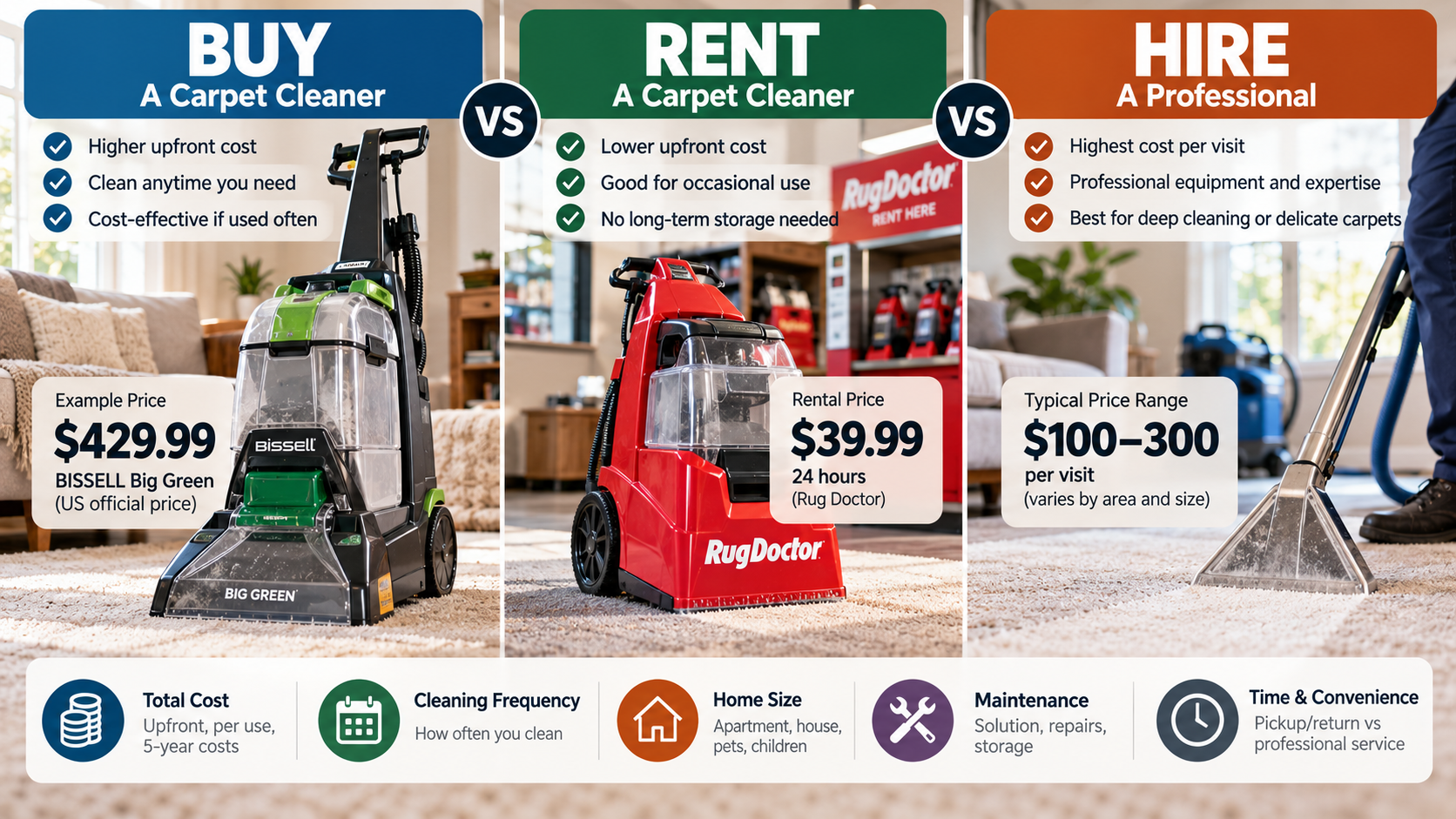
Buying a carpet cleaner sounds economical when you have pets, children, or carpeted rooms that need regular attention. Renting sounds smarter when you only deep-clean once or twice a year.
But the real difference is not simply the purchase price versus a one-day rental fee.
You also need to account for cleaning solution, rental pickup and return trips, machine maintenance, storage, and the number of times you will actually use the equipment.
And there is a third option: hiring a professional.
The smartest choice depends on how often you clean, how much carpet you have, and whether the machine you can afford is capable of handling the job.
This guide uses published US rental and manufacturer prices, transparent break-even calculations, and five-year ownership scenarios to help you decide.
Quick Answer: Should You Buy, Rent or Hire a Carpet Cleaner?
| Your situation | Best starting option | Why |
|---|---|---|
| Small apartment, one annual deep clean | Rent | Avoid purchasing and storing a large machine |
| Family with carpeted rooms cleaned several times yearly | Buy | Repeated rental fees can exceed ownership costs |
| Multiple pets and frequent accidents | Own a spot cleaner; evaluate full-size needs separately | Immediate stain response matters |
| Large home with occasional deep cleaning | Rent or hire a professional | Avoid storing a large machine for infrequent use |
| Expensive, delicate or warranty-sensitive carpet | Professional cleaning | Correct methods and warranty requirements matter |
| Moving out of a rental property | Compare a rental with professional quotes | Timing, lease terms and documentation matter |
| No convenient transportation for a rental machine | Buy or hire | Pickup and return can be significant burdens |
| Limited mobility or time | Hire a professional | Avoid physically demanding DIY cleaning |
The most important distinction: the cheapest cleaning method is not always the lowest-risk method for your carpet.
1. What Does Renting a Carpet Cleaner Cost in 2026?
Rug Doctor by BISSELL currently publishes the following recommended US rental prices:
| Rental item | Published price |
|---|---|
| Carpet cleaner, 24 hours | $39.99 |
| Carpet cleaner, 48 hours | $49.99 |
| Optional upholstery attachment | $5.99 |
| Example 48-ounce pet cleaning solution | $17.99 |
Prices vary by retailer and location. The 48-hour option is not universally available.
Source: Rug Doctor by BISSELL — Official Rental Prices.
The rental price is not the complete cleaning cost
A $39.99 rental may also involve:
- Cleaning solution.
- An optional upholstery attachment.
- Transportation to and from the rental location.
- Time spent collecting and returning the machine.
- Potential charges for late return or inadequate cleaning.
Rug Doctor states that some locations may require a refundable $40 deposit. Its published guidance also identifies possible $40 cleaning or late fees.
These are potential charges, not costs that every customer will pay.
Example: A realistic one-day rental budget
| Expense | Illustrative amount |
|---|---|
| 24-hour rental | $39.99 |
| Cleaning solution purchased | $17.99 |
| Transportation allowance | $8.00 |
| Total cash outlay | $65.98 |
The $8 transportation allowance is an assumption. Your actual cost may be zero or substantially higher.
Also, you might not use the entire bottle of cleaning solution in one session.
That distinction becomes important when comparing recurring costs.
2. How Much Does Buying a Carpet Cleaner Cost?
Buying creates a larger initial expense but removes future rental fees.
There is no single purchase price that represents every carpet cleaner.
For a documented example, BISSELL’s US website lists its Big Green Professional Carpet Cleaner at $429.99.
Source: BISSELL — Big Green Carpet Cleaners.
Consumer Reports has also evaluated lower-priced residential carpet cleaners, demonstrating that buyers can choose from substantially different price tiers.
Source: Consumer Reports — Rent, Hire or Buy?.
Three purchase-budget scenarios
To avoid presenting changing retail prices as fixed facts, our break-even model uses three illustrative purchase budgets.
| Ownership tier | Assumed purchase price | Typical decision |
|---|---|---|
| Budget residential machine | $150 | Lower-cost entry into occasional DIY cleaning |
| Midrange residential machine | $250 | Regular household cleaning |
| Heavy-duty machine | $430 | Larger jobs and frequent use, subject to model suitability |
These are budgeting assumptions, not verified prices for three equivalent machines.
A $150 cleaner should not automatically be considered equal in performance, tank capacity, durability or cleaning coverage to a $430 machine.
The break-even calculation only works if both options can adequately perform the cleaning job.
3. The Break-Even Formula Most Buyers Need
The simplest formula is:
Break-even cleaning sessions = Purchase price ÷ Rental cost avoided per session
But this is only a rough starting point.
A more useful formula is:
Break-even sessions = (Purchase price + ownership-only costs) ÷ (Rental-only cost per session − ownership-only variable cost per session)
Cleaning solution used in both methods generally belongs on both sides of the comparison.
You should not charge the renter for detergent while pretending an owner cleans with water alone.
A cleaner comparison
Assume:
- 24-hour rental fee: $39.99.
- Rental pickup and return transportation: $8 per session.
- Owned-machine maintenance allowance: $10 per year.
- Cleaning solution: equal for both methods.
- No resale value or financing costs.
- No major breakdowns during the analysis period.
Under these assumptions, each rental session avoids $47.99 in rental-specific cash costs when you own the machine.
For a five-year comparison, the owned machine also carries $50 in assumed maintenance costs.
Five-year break-even points
| Purchase budget | Purchase + 5-year maintenance | Approximate break-even rental sessions |
|---|---|---|
| $150 | $200 | 5 sessions |
| $250 | $300 | 7 sessions |
| $430 | $480 | 11 sessions |
Break-even sessions are rounded up to the next whole cleaning session.
For example, a $250 machine with $50 in five-year maintenance costs needs to replace seven rental sessions:
7 × $47.99 = $335.93.
That exceeds the modeled $300 ownership-specific cost.
At one cleaning per year, renting can remain competitive. At three or four cleanings per year, buying often becomes financially attractive—assuming comparable cleaning results.
4. Five-Year Cost Comparison: One, Two or Four Cleanings Per Year
Now compare the choices over five years.
For this model:
- Rental-specific cost: $47.99 per session.
- Midrange purchase: $250.
- Owned-machine maintenance: $50 over five years.
- Cleaning solution is excluded from both totals because the assumed usage cost is identical.
- Taxes, financing, repairs beyond the allowance, electricity, storage and labor are excluded.
| Cleaning frequency | Total sessions over 5 years | Rent | Buy |
|---|---|---|---|
| Once per year | 5 | $239.95 | $300 |
| Twice per year | 10 | $479.90 | $300 |
| Four times per year | 20 | $959.80 | $300 |
| Six times per year | 30 | $1,439.70 | $300 |
These are illustrative financial outcomes, not predictions of how long a specific machine will last.
The ownership scenario assumes the purchased cleaner remains usable throughout the five-year period.
If it breaks and requires replacement, the economics change.
What if you have free transportation?
Remove the $8 transportation allowance.
The rental-specific cost becomes $39.99 per session.
A $300 five-year ownership cost would then require eight rental sessions to break even rather than seven.
This is why personal circumstances matter more than a universal statement such as “buy after three uses.”
5. The Cost of Cleaning Solution: Avoid Double Counting
Both rented and owned carpet cleaners typically require compatible cleaning solution.
Therefore, detergent is generally a shared expense—not a cost unique to renting.
For example, suppose a cleaning session consumes $12 of compatible solution.
Over ten cleaning sessions:
10 × $12 = $120.
That $120 would be added to both the renting and buying scenarios if usage were identical.
Ten-session example
| Cost | Renting | Owning |
|---|---|---|
| Rental fees and assumed travel | $479.90 | $0 |
| Machine purchase | $0 | $250 |
| Maintenance allowance | $0 | $50 |
| Cleaning solution | $120 | $120 |
| Total | $599.90 | $420 |
The difference remains $179.90 because the common detergent expense cancels out.
However, machines may use different quantities or formulations of cleaning solution.
When comparing specific models, use the actual manufacturer-recommended products and dosing instructions.
6. Small Apartments: Why Renting May Be Smarter
For a small apartment with one or two rugs and a limited carpeted area, a full-size carpet cleaner may be unnecessary.
A large machine takes up storage space all year, even if you only use it for a few hours.
Consider the following questions:
- How much carpet actually needs wet cleaning?
- Are the rugs machine washable?
- Is there a convenient rental location?
- Can you transport the equipment?
- Does your building have space for the carpet to dry properly?
If your main problem is an occasional spill rather than full-room cleaning, a compact spot cleaner may be more appropriate.
For a detailed comparison of equipment types, read our Portable Carpet Cleaner vs Full-Size Carpet Cleaner in 2026.
A small spot cleaner and a full-size rental machine perform different jobs. They should not be treated as interchangeable merely because both extract dirty water.
7. Families With Children: Convenience Changes the Equation
Families with young children may face frequent food spills, muddy footprints and accidental stains.
Owning a carpet cleaner allows immediate access without a rental trip.
That convenience can be valuable even before the financial break-even point.
But distinguish two types of cleaning:
Spot cleaning: Treating a limited stain or spill as soon as practical.
Whole-room extraction: Cleaning an entire carpeted area, usually requiring more time, water management and drying.
A family might reasonably own a compact spot cleaner while renting a larger machine for periodic deep cleaning.
This hybrid approach can avoid buying a bulky appliance that is rarely used.
8. Pet Owners: When Owning Makes Sense—and When It Doesn’t
Pet owners often have the strongest argument for keeping cleaning equipment at home.
A fresh accident is easier to address promptly than a stain discovered days later.
However, repeated wet cleaning is not a substitute for identifying the source of persistent odor.
For occasional pet accidents
A portable spot cleaner may be the most practical first purchase.
For regularly soiled carpeted rooms
A full-size owned cleaner may become economical if used frequently and maintained properly.
For recurring urine odor beneath the carpet
Professional assessment may be necessary.
Urine can penetrate carpet backing or underlay. Cleaning the visible surface does not guarantee that the source of the odor has been removed.
The Carpet and Rug Institute recommends prompt treatment of pet accidents and warns against using heat on urine spots because it can set stains and odors.
It also emphasizes that portable extractors do not replace periodic deep cleaning.
9. When Hiring a Professional Is the Better Decision
Professional carpet cleaning is usually the most expensive option per visit, but it can be appropriate when the cleaning job is complex or physically demanding.
Consumer Reports’ 2024 comparison of a substantial carpet-cleaning project found markedly different professional quotes for Kansas City and New York City.
That variation illustrates why a single nationwide professional-cleaning price can be misleading.
For this reason, request a written quote for your actual carpet area.
Professional cleaning is worth considering when:
- Your carpet is delicate or expensive.
- You have severe embedded soil.
- You are dealing with recurring odors or difficult stains.
- You cannot safely move or operate the equipment.
- Your carpet warranty specifies professional service.
- You need a documented cleaning service for a property handover.
Compare quotes carefully
Ask whether the price includes:
- The total carpeted area.
- Pretreatment.
- Routine stain treatment.
- Stairs and hallways.
- Furniture moving.
- Additional odor treatments.
- Any minimum service charge.
The Carpet and Rug Institute recommends professional deep cleaning approximately every 12 to 18 months and advises homeowners to check their carpet’s specific warranty requirements.
Source: Carpet and Rug Institute — Hiring a Professional.
Buying a machine does not automatically replace professional cleaning required by your carpet warranty.
10. Hidden Costs That Can Change the Decision
Rental pickup and return
A one-day rental may involve two trips to the store.
If you have no car, the inconvenience can outweigh the rental savings.
Late and cleaning fees
Rug Doctor publishes possible additional charges for late returns and machines returned dirty.
Check your local rental agreement before taking the machine home.
Storage space
An owned machine occupies space throughout the year.
For apartment dwellers, that can be a meaningful nonfinancial cost.
Machine maintenance
After cleaning, tanks and removable parts need proper rinsing and drying.
Poor maintenance can lead to odors, blockages or reduced performance.
Equipment reliability
A purchased cleaner may require repairs or replacement before five years.
Our model includes a modest maintenance allowance, not a guarantee against breakdowns.
Labor
Renting and owning both require DIY labor.
Professional cleaning shifts much of the physical work to a service provider, though preparation and scheduling may still be necessary.
Drying time
A carpet that remains wet longer than expected can disrupt room use.
Drying time depends on extraction performance, carpet construction, humidity, ventilation and cleaning technique.
Independent testing from Good Housekeeping evaluates drying behavior alongside stain removal and ease of use.
11. A Fourth Option: Own a Spot Cleaner and Rent a Full-Size Machine
The choice does not have to be exclusively buy or rent.
For many households, the most efficient setup is:
Own a small spot cleaner for immediate accidents, then rent a full-size machine for occasional whole-room cleaning.
This approach may be particularly attractive when:
- You have pets but little wall-to-wall carpeting.
- Most messes affect furniture, stairs or small areas.
- You lack storage space for a large upright machine.
- You deep-clean entire rooms only once a year.
Illustrative hybrid budget
Assume:
- Portable spot cleaner purchase: $120.
- Full-size rental once per year: $39.99.
- Five-year period.
- No transportation, detergent or maintenance included.
Five-year total:
$120 + (5 × $39.99) = $319.95.
Compare that with buying a $430 heavy-duty machine before maintenance or consumables.
The hybrid option may cost less while providing immediate spot-cleaning access.
However, the two setups are not functionally identical.
A spot cleaner cannot replace a full-size machine for efficient cleaning of large carpeted areas.
12. Carpet Type and Warranty: Check Before You Clean
Not every carpet or rug should be cleaned using a consumer extraction machine.
Before buying or renting:
- Identify the carpet fiber and construction.
- Check the manufacturer’s cleaning instructions.
- Confirm whether wet extraction is permitted.
- Review warranty conditions.
- Test cleaning products in an inconspicuous area where appropriate.
Specialty rugs, antique textiles, delicate fibers and carpets with moisture-sensitive backings may need specialist care.
The lowest-cost DIY option is not economical if it damages the carpet.
13. The Living Pick Lab Decision Framework
Use this sequence before spending money.
Step 1: Count your realistic annual cleaning sessions
Do not count every small spill as a full-room cleaning session.
Separate spot treatment from deep extraction.
Step 2: Determine whether the machine can do the job
Compare cleaning coverage, carpet compatibility, tank capacity and independently tested performance.
Step 3: Calculate five-year costs
For renting:
Rental fee × sessions + rental-specific travel and fees + cleaning solution.
For owning:
Purchase price + maintenance + repairs or replacement + cleaning solution.
For hiring:
Quoted service price × visits + any add-ons.
Step 4: Account for inconvenience
Consider storage, physical effort, pickup trips and drying time.
Step 5: Check warranty requirements
If professional cleaning is required, budget for it regardless of whether you own a consumer machine.
Step 6: Choose the least expensive suitable method
The best option is the one that handles your actual cleaning needs without creating unnecessary costs or carpet-damage risks.
14. Frequently Asked Questions
Is it cheaper to buy or rent a carpet cleaner?
Renting usually has the lower upfront cost. Buying can be cheaper over several years if you clean frequently and the machine lasts long enough. The break-even point depends on the purchase price, rental fee and ownership costs.
How much does a Rug Doctor rental cost in 2026?
Rug Doctor by BISSELL publishes recommended prices of $39.99 for 24 hours and $49.99 for 48 hours, with regional variation and limited availability of the longer rental option.
How many times do I need to use a carpet cleaner to justify buying one?
In our illustrative five-year model, a $250 cleaner with $50 in maintenance costs breaks even after seven rental sessions when each rental would otherwise cost $47.99 including assumed transportation.
Is a rented carpet cleaner as good as a professional service?
Not necessarily. Results depend on equipment, cleaning methods, carpet condition and operator technique. Professional services may be more appropriate for complex stains, delicate materials or warranty requirements.
Should pet owners buy a carpet cleaner?
Frequent accidents can make ownership convenient. However, a compact spot cleaner may be a better first purchase than a full-size machine if most messes are localized.
Do I still need professional cleaning if I own a carpet cleaner?
Possibly. The Carpet and Rug Institute recommends periodic professional deep cleaning, and individual carpet warranties may specify particular methods or providers.
Is a 48-hour rental worth the extra $10?
It may be worthwhile for larger homes or households that need extra time. Confirm availability and the rental terms before booking.
Can I use any cleaning solution in a carpet cleaner?
Use products approved for the machine and suitable for your carpet. Incorrect formulations can cause residue, excessive foaming or other problems.
Final Verdict: Buy for Frequency, Rent for Occasional Use, Hire for Complexity
Renting is often the most sensible choice for occasional whole-room cleaning.
Buying becomes more attractive as the number of cleaning sessions increases, particularly for households with children, pets or extensive carpeting.
Professional cleaning deserves consideration when the job requires expertise, specialized equipment or compliance with carpet-care requirements.
And for many smaller homes, a hybrid approach—owning a portable spot cleaner while renting a full-size extractor occasionally—may be more practical than either extreme.
Before making a purchase, calculate how many full-size cleaning sessions you realistically expect over the next five years.
That number, rather than a promotional discount or a generic product ranking, should guide your decision.
Sources and Editorial Methodology
- Rug Doctor by BISSELL — Official Rental Prices
- Rug Doctor by BISSELL — Rental FAQs
- BISSELL — Big Green Carpet Cleaner Product Range
- Consumer Reports — When It Comes to Carpet Cleaning: Rent, Hire or Buy?
- Good Housekeeping — Best Carpet Cleaner Reviews
- Carpet and Rug Institute — Cleaning and Maintenance
- Carpet and Rug Institute — Hire a Carpet Cleaning Professional
Editorial note: Manufacturer and rental prices reflect published US listings reviewed in October 2026 and may change. Break-even tables use disclosed illustrative assumptions and are not predictions of equipment reliability or cleaning performance. Living Pick Lab has not independently tested the machines mentioned in this article.