
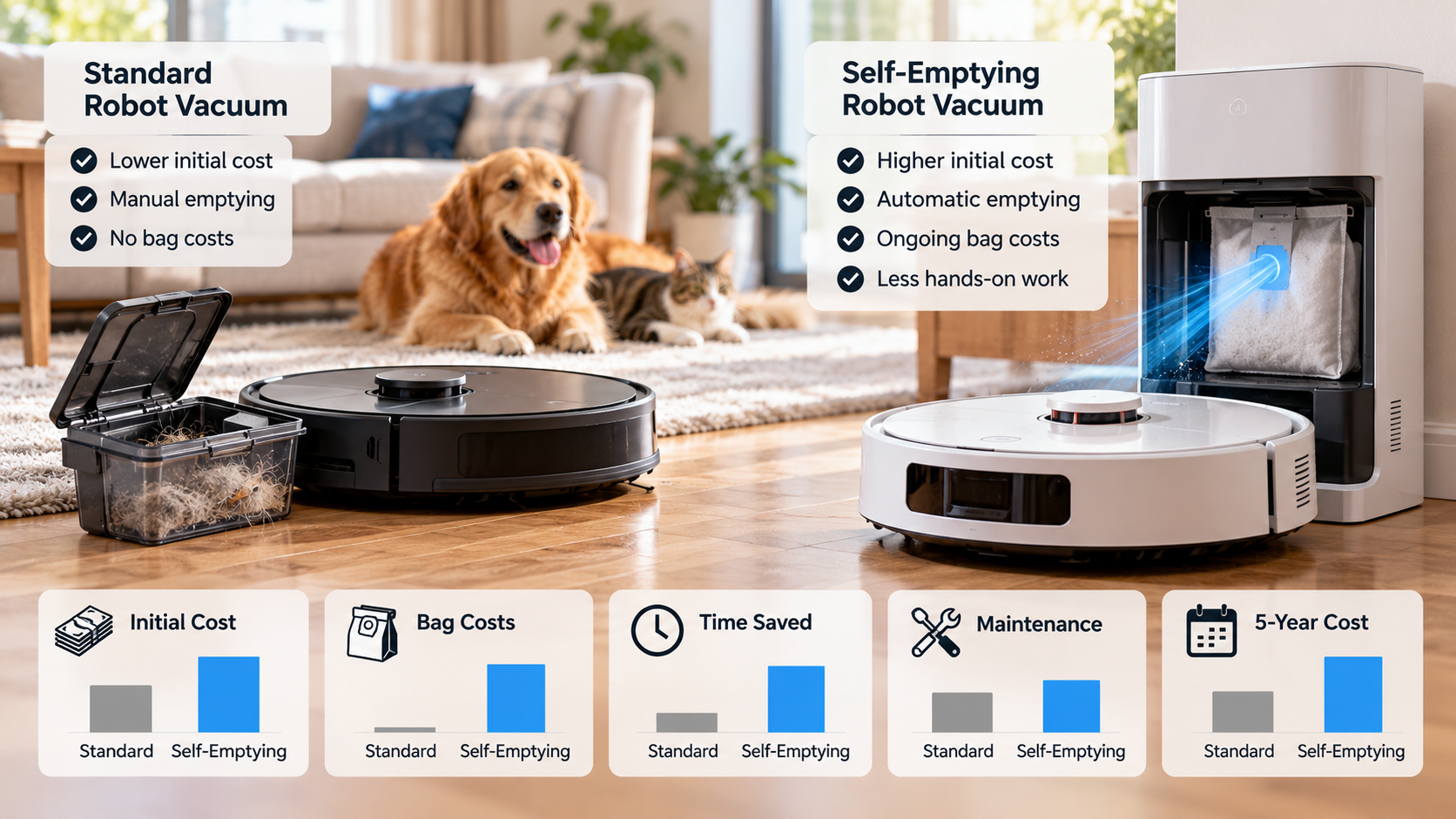
A self-emptying robot vacuum promises something appealing: cleaner floors without having to empty a tiny dustbin after every cleaning session.
But how much is that convenience actually worth?
Some self-emptying robots use disposable dust bags. Others use reusable bagless containers. Premium models may also wash mop pads, refill water, and dry cleaning components.
These features can reduce hands-on work, but they introduce additional costs, maintenance tasks, noise, and potential repair points.
The real question is not whether automatic emptying is convenient. It is whether that convenience justifies the extra cost over five years.
This guide compares self-emptying and standard robot vacuums, real replacement-bag prices, bagged versus bagless docks, maintenance requirements, and the financial value of time saved.
1. Quick Verdict: Is Self-Emptying Worth Paying For?
| Your household | Recommendation | Reason |
|---|---|---|
| Two or more shedding pets | Usually worth considering | Frequent debris makes manual emptying repetitive |
| Large home with daily robot cleaning | Often worthwhile | More debris and cleaning sessions |
| Small apartment, no pets | Optional | Manual bin emptying may take little time |
| Household sensitive to dust exposure | Consider a sealed bagged dock | Less direct contact with loose debris |
| Tight budget | Standard robot vacuum | Lower initial cost may matter more |
| Home office beside the charging dock | Check dock noise first | Auto-empty cycles can be disruptive |
| Existing robot works well | Usually keep it | A dock upgrade alone may not justify replacement |
| Household wanting automated mopping | Compare multifunction docks separately | Mop washing and drying are additional features |
Bottom line: Self-emptying is most valuable when it eliminates a frequent chore. It is less compelling when you only empty your robot’s dustbin occasionally.
2. What Does a Self-Emptying Robot Vacuum Actually Do?
A standard robot vacuum collects debris in a small onboard dustbin.
When the bin fills, the owner must empty it manually.
A self-emptying robot uses a compatible docking station to transfer collected debris from the robot into a larger container.
Depending on the system, the dock stores debris in:
- A disposable dust bag.
- A reusable bagless container.
Some premium docks also handle water management and mop cleaning.
These systems should not be confused.
A robot that empties dust automatically does not necessarily wash its mop pads, refill water, or clean its own brushroll.
Three types of robot vacuum systems
| System | Main automation | What you still do |
|---|---|---|
| Standard charging dock | Charging | Empty onboard bin, maintain robot |
| Self-emptying dock | Charging and debris transfer | Empty dock, maintain filters and brushes |
| Multifunction cleaning dock | Debris transfer plus selected mop tasks | Maintain tanks, dock, mop components and robot |
A more expensive dock does not automatically produce better carpet cleaning or pet hair pickup.
Independent testing from RTINGS’ robot vacuum reviews shows that cleaning performance, navigation, and maintenance vary significantly between models.
3. The Hidden Cost of Disposable Dust Bags
Disposable bags are one of the clearest ongoing expenses associated with self-emptying robots.
As of October 2026, iRobot’s official US accessories store lists compatible three-packs of replacement dirt-disposal bags for $19.99.
That equals approximately:
$19.99 ÷ 3 = $6.66 per bag.
This is a specific manufacturer-listed example, not a universal price across robot vacuum brands.
Bag compatibility varies by dock generation.
Five-year bag cost calculator
Suppose your household uses bags at the following rates.
| Bag usage | Bags over 5 years | Approximate bag cost |
|---|---|---|
| 2 bags per year | 10 | $66.63 |
| 4 bags per year | 20 | $133.27 |
| 6 bags per year | 30 | $199.90 |
| 12 bags per year | 60 | $399.80 |
The table calculates the proportional cost of bags at $19.99 per three-pack. Actual purchase spending may differ when bags must be purchased in complete packs.
For example, using 20 bags requires buying seven three-packs, costing $139.93 before taxes and shipping, rather than the proportional $133.27 shown above.
These are usage scenarios, not manufacturer-promised replacement schedules.
A household with two heavily shedding dogs may use bags faster than a one-person apartment with mostly hard floors.
Bag capacity, floor area, cleaning frequency, and debris volume all matter.
4. Bagged vs Bagless Self-Emptying Docks
A bagless dock eliminates disposable dust bags, but it does not eliminate maintenance.
Bagged self-emptying docks
Advantages
- Convenient disposal of collected debris.
- Less direct handling of loose dust when properly sealed.
- Potentially useful for households seeking to reduce dust exposure.
Disadvantages
- Recurring bag purchases.
- Model-specific compatibility.
- Dependence on replacement-bag availability.
Bagless self-emptying docks
Advantages
- No disposable dock bags to purchase.
- No recurring bag inventory to manage.
- Potentially lower consumable spending.
Disadvantages
- Emptying the reusable container may release dust.
- Dock filters still need maintenance.
- The container may require more frequent hands-on cleaning.
In its Shark AI Ultra review, RTINGS notes that the bagless station reduces bag-related expenses but can be messier to empty.
Which is better for allergies?
A well-sealed bagged system may reduce direct dust contact during disposal.
However, a bag alone does not guarantee low allergen exposure.
Overall filtration, seals, maintenance, room conditions, and how the dock is emptied also matter.
Consumers with dust sensitivities should evaluate the entire vacuum and disposal process rather than relying solely on the term “HEPA” or “self-emptying.”
5. Five-Year Ownership Cost: Standard vs Self-Emptying Robot
To understand the financial impact, compare two hypothetical robots with similar cleaning capabilities.
The figures below are illustrative planning assumptions, not current quotations for a specific pair of products.
Scenario A: Standard robot vacuum
| Cost category | Five-year assumption |
|---|---|
| Initial purchase | $300 |
| Filters and brushes | $120 |
| Maintenance or repair allowance | $80 |
| Dock bags | $0 |
| Five-year total | $500 |
Scenario B: Bagged self-emptying robot
| Cost category | Five-year assumption |
|---|---|
| Initial purchase | $450 |
| Filters and brushes | $120 |
| Maintenance or repair allowance | $100 |
| Dock bags, approximately 4/year | $139.93 |
| Five-year total | $809.93 |
In this example, the self-emptying robot costs $309.93 more over five years.
The difference comes from:
- $150 additional initial purchase cost.
- $20 additional repair allowance.
- $139.93 in dust-bag purchases.
These assumptions do not predict product failures, battery replacements, or the resale value of either machine.
They also exclude electricity, taxes, and any additional costs not modeled here.
What if you choose a bagless dock?
If the same hypothetical self-emptying system used a bagless dock and had otherwise identical costs, removing the $139.93 bag expense would reduce the modeled total to $670.
That would leave a $170 premium over the standard robot.
However, this is a mathematical sensitivity test—not a claim that equivalent bagged and bagless products sell at the same price.
6. Break-Even Analysis: How Much Time Does Self-Emptying Save?
This is the most important calculation.
Self-emptying does not eliminate the time spent cleaning floors with a robot. A standard robot already automates floor movement.
The additional time saved comes primarily from reducing manual dustbin emptying.
Example: Three minutes saved per week
Assume:
- Self-emptying costs $309.93 more over five years.
- The dock saves a net three minutes of manual work per week.
- The robot remains in service for five years.
Total time saved:
3 minutes × 52 weeks × 5 years = 780 minutes.
780 ÷ 60 = 13 hours.
Cost per additional hour saved:
$309.93 ÷ 13 = $23.84 per hour.
This is the effective cost of the convenience under those assumptions, not an amount of money earned.
How the calculation changes
| Net time saved each week | Five-year hours saved | Cost per hour saved |
|---|---|---|
| 1 minute | 4.33 | $71.52 |
| 3 minutes | 13 | $23.84 |
| 5 minutes | 21.67 | $14.30 |
| 10 minutes | 43.33 | $7.15 |
These are illustrative scenarios, not measured time savings.
Net time must account for dock maintenance and bag or container disposal.
The break-even formula
Cost per hour saved = additional five-year ownership cost ÷ net hours saved over five years.
If you value avoided hands-on chores at $15 per hour, the example $309.93 premium would require approximately 20.7 hours of net savings over five years.
That equals roughly 4.8 minutes per week.
The $15 figure is a personal valuation assumption, not a wage estimate or guaranteed financial benefit.
7. Pet Owners: When Self-Emptying Makes the Biggest Difference
Pet ownership can substantially change the convenience calculation.
Loose hair accumulates on floors, around furniture, and along baseboards.
A robot used daily may collect enough debris to require frequent manual emptying.
A self-emptying dock can reduce this interruption.
But it does not solve every pet-related cleaning problem.
What self-emptying helps with
- Reducing manual emptying frequency.
- Allowing repeated cleaning sessions without checking the robot bin as often.
- Consolidating debris in a larger dock container.
What it does not solve
- Hair tangled around brushrolls.
- Weak carpet pickup.
- Poor obstacle avoidance.
- Pet waste accidents.
- Dirty sensors or clogged airways.
The Shark AI Ultra, for example, has self-emptying capability but receives mixed results for pet hair and carpet cleaning in RTINGS’ independent testing.
Do not pay extra for a self-emptying dock if the underlying robot cannot clean your floors effectively.
For a broader decision about cleaning systems, see our Robot Vacuum vs Cordless Vacuum in 2026: Pet Hair, Carpets and Real 5-Year Costs comparison.
8. The Maintenance Tasks Self-Emptying Does Not Remove
The phrase “hands-free cleaning” can create unrealistic expectations.
Even sophisticated robot vacuums require periodic attention.
Brushroll maintenance
Hair, threads, and fibers may wrap around brushes and bearings.
Self-emptying does not automatically remove these tangles unless the specific product includes an effective separate mechanism.
Filter maintenance
Robot and dock filters may require cleaning or replacement.
Follow the manufacturer’s model-specific schedule.
Sensor cleaning
Dirty navigation sensors can interfere with movement and obstacle detection.
Dock maintenance
Bagless containers need emptying and cleaning.
Bagged docks require replacement bags and may need inspection for blocked debris channels.
Battery and repair costs
A self-emptying dock does not eliminate battery aging or other mechanical failures.
The cost of maintaining the robot itself remains important.
If you are evaluating an aging cordless vacuum as an alternative cleaning tool, our Cordless Vacuum Battery Replacement Costs in 2026 guide explains when repairing an existing machine makes more sense than replacing it.
9. Noise and Storage: Two Often-Overlooked Tradeoffs
Automatic emptying can be loud
The dock uses a separate suction system to transfer debris from the robot.
This process can create a noticeable burst of noise, even when the robot itself operates relatively quietly.
Check independent noise testing for the exact model if you work from home, have sleeping children, or own noise-sensitive pets.
Larger docks require more room
A basic charging station may occupy little floor space.
Self-emptying docks need room for debris storage and internal components.
Multifunction docks can be considerably larger because they also accommodate water tanks and mop-cleaning systems.
Before buying, measure:
- Available floor space.
- Dock height and width.
- Required clearance around the station.
- Access for bag or container removal.
- Nearby power outlet availability.
A robot that fits beneath your sofa may still require a docking station too large for your preferred storage location.
10. Should You Upgrade an Existing Robot Vacuum?
If you already own a reliable robot vacuum, replacing it solely to gain automatic emptying may not be financially attractive.
Ask three questions:
- How often do you currently empty the onboard dustbin?
- How much time and inconvenience does that task create?
- What is the total additional cost of changing systems?
If you empty the bin once or twice a week and the task takes only seconds, a new self-emptying robot may offer limited value.
If your current robot repeatedly stops because the bin fills during cleaning, the convenience benefit could be more substantial.
Can you add a self-emptying dock to your current robot?
Only if the manufacturer explicitly supports that combination.
Do not assume that any dock from the same brand will work.
Automatic debris transfer requires compatible hardware, docking alignment, and software behavior.
Check the exact model and accessory part numbers before purchasing a dock separately.
11. Who Should Skip Self-Emptying?
A standard robot vacuum may be the better purchase when:
- You live in a small apartment with low debris levels.
- You do not mind emptying a dustbin.
- You have limited space for a large dock.
- Your budget is better spent on improved navigation or cleaning performance.
- You already own a functional robot.
- Automatic emptying noise would be disruptive.
Self-emptying is a convenience feature, not a substitute for strong fundamental cleaning performance.
12. Final Buying Decision Matrix
| Priority | Best starting point |
|---|---|
| Lowest initial cost | Standard robot |
| Daily cleaning with multiple shedding pets | Self-emptying robot |
| Lower direct dust contact during disposal | Sealed bagged dock |
| Avoiding disposable bag purchases | Bagless dock |
| Small apartment, limited storage | Compact standard robot |
| Frequent automated vacuuming and mopping | Evaluate multifunction dock |
| Existing robot still works well | Keep current robot unless upgrade economics justify replacement |
| Best carpet cleaning performance | Prioritize independent pickup tests over dock features |
13. Frequently Asked Questions
How often do self-emptying robot vacuum bags need replacing?
It depends on the model, debris volume, pets, floor area, and cleaning frequency. Manufacturer capacity claims are estimates, not guarantees. Check the actual fill level and model instructions.
How much do robot vacuum dust bags cost?
For one verified US example, iRobot lists compatible three-packs at $19.99, approximately $6.66 per bag before taxes and shipping. Other brands and dock models may differ.
Are bagless self-emptying docks cheaper?
They eliminate disposable dock-bag purchases but may require additional container cleaning. Total cost depends on the purchase price, filters, maintenance, and repairs.
Is a self-emptying robot vacuum better for pet hair?
It can make frequent debris disposal easier, but pet hair pickup depends on the robot’s brushes, suction system, navigation, and floor-cleaning performance.
Do self-emptying robot vacuums still need maintenance?
Yes. Brushes, filters, sensors, wheels, batteries, and docking components still require attention.
Is self-emptying worth it for a small apartment?
It may be convenient, but the financial benefit is often less compelling when debris volume is low and manual bin emptying is infrequent.
Can I use generic replacement dust bags?
Compatibility and quality vary. Check the manufacturer’s guidance and exact dock model. Poorly fitting bags can interfere with sealing or debris collection.
Should I replace my working robot vacuum just to get self-emptying?
Usually not without comparing the upgrade cost against the actual inconvenience and time spent emptying your current machine.
14. Final Verdict: Pay for Less Work, Not More Features
A self-emptying robot vacuum can be worth the extra cost for households that clean frequently, have shedding pets, or find manual dustbin emptying inconvenient.
But it is not automatically a better investment.
Disposable bags add recurring costs. Bagless docks still need cleaning. Larger stations occupy more space, and automatic emptying can create noticeable noise.
Most importantly, a self-emptying dock cannot compensate for weak carpet cleaning, poor navigation, or unreliable debris pickup.
Before paying a premium, compare the five-year ownership cost with the actual minutes of hands-on work you expect to save.
For a busy pet-owning household, the convenience may be worth the difference.
For a small, low-debris home with an existing reliable robot, keeping the simpler system may be the smarter financial decision.
Sources and Further Reading
- iRobot — Official US Accessories and Replacement Dust Bags
- RTINGS — Best Robot Vacuums
- RTINGS — Shark AI Ultra Robot Review
- RTINGS — Roborock Q5+ Review
- RTINGS — Robot Vacuum Automation Testing Methodology
Editorial methodology: This article uses manufacturer-listed US accessory prices and independent published vacuum reviews. The five-year comparisons are explicitly labeled illustrative scenarios, not tested reliability forecasts or model-specific purchase quotations. Living Pick Lab has not independently tested the products discussed. Prices and product availability may change.