
Updated October 2026 | Living Pick Lab
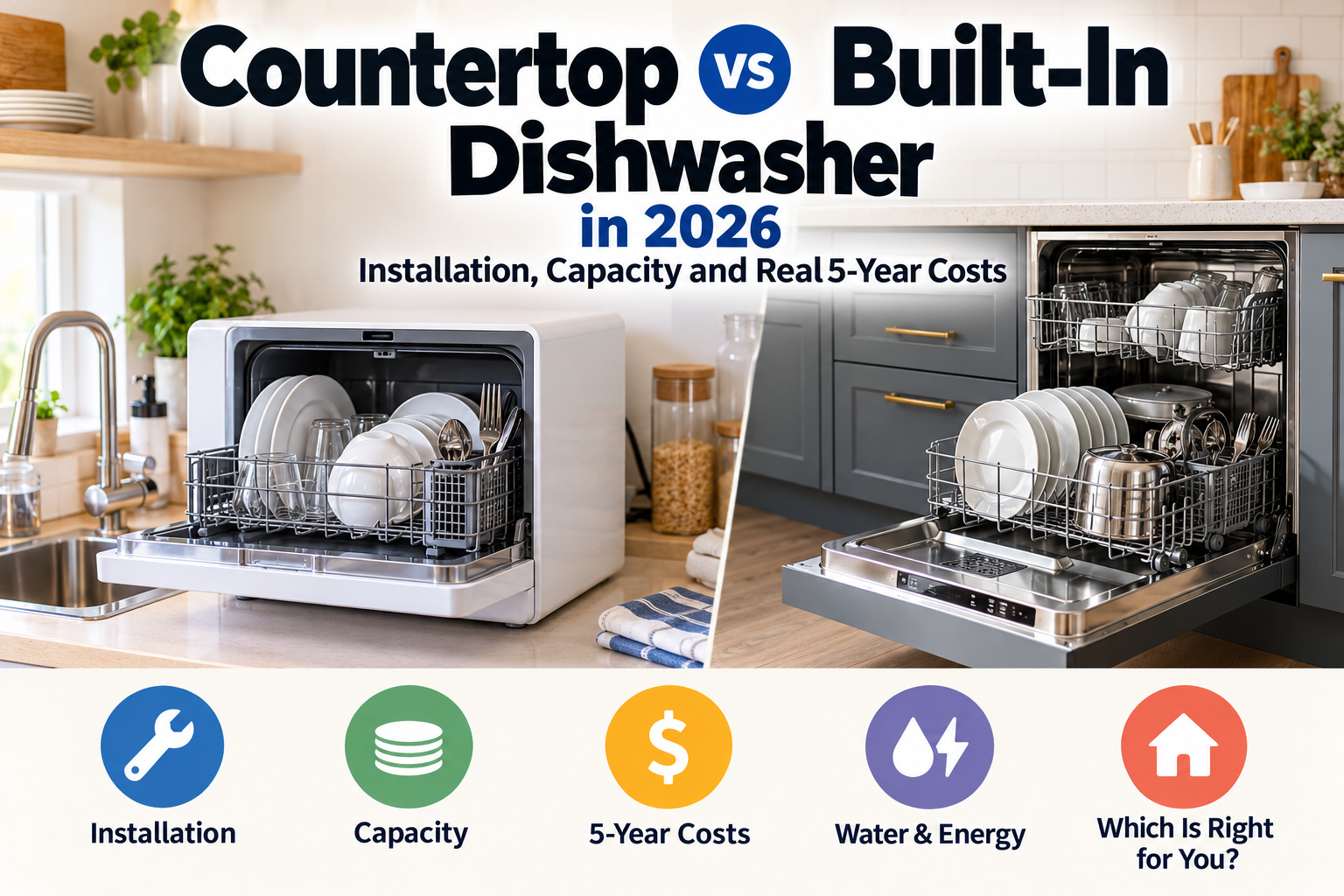
A countertop dishwasher can cost less to buy, but a built-in dishwasher may cost less per full load of dishes. The right choice depends on your kitchen, plumbing, household size, and how often you run the machine.
For a renter with a small kitchen, a countertop dishwasher may be the only practical option. For a family cooking at home every day, a full-size built-in can offer substantially more capacity without occupying valuable counter space.
But there is a catch: a countertop machine may not connect safely to your existing faucet, while installing a built-in dishwasher for the first time can require expensive changes to cabinets, plumbing, and electrical connections.
This guide compares both types using real installation restrictions, manufacturer specifications, ENERGY STAR efficiency criteria, and clearly labeled five-year cost scenarios.
Quick Verdict: Which Dishwasher Should You Buy?
| Your situation | Better starting choice | Main reason |
|---|---|---|
| Renter without permission to modify cabinets | Countertop | Avoids permanent kitchen alterations |
| One person with a compatible faucet | Countertop | Smaller loads and lower upfront cost |
| Couple with limited counter space | Built-in, if installation is feasible | Preserves working surface |
| Family of four cooking daily | Built-in | Greater capacity per load |
| Existing built-in dishwasher needs replacement | Built-in | Existing opening and connections may reduce installation complexity |
| Pull-down faucet and no separate water connection | Neither until compatibility is resolved | Some faucet manufacturers prohibit portable dishwasher connections |
| Very small kitchen with no usable counter or cabinet space | Reconsider both | Physical fit matters more than features |
Our recommendation: Check installation feasibility before comparing brands. A highly rated dishwasher is a poor purchase if it cannot connect safely or fit your kitchen.
1. Countertop vs Built-In Dishwasher: The Differences That Matter
| Feature | Countertop dishwasher | Built-in dishwasher |
|---|---|---|
| Location | Countertop or approved supporting surface | Under kitchen counter |
| Typical capacity | Small loads; often 2–6 place settings | Commonly 12–16 place settings, depending on model |
| Water supply | Compatible faucet connection, fill tank, or model-specific setup | Permanent plumbing connection |
| Drainage | Sink or approved drain connection | Permanent drain connection |
| Installation | Usually simpler, but compatibility checks required | Often professional installation |
| Counter space | Occupies work surface | Preserves counter surface |
| Large cookware | Limited by internal dimensions | Usually more flexible |
| Rental flexibility | Often easier to move | Generally remains with the property |
| Main ownership risk | Limited capacity and connection restrictions | Installation, repair, and replacement expense |
These are typical differences, not specifications that apply to every product.
2. The Installation Test: Can Your Kitchen Actually Support It?
Before shopping, complete these five checks.
Check 1: Measure the available space
For a countertop dishwasher, measure:
- Width and depth of the available work surface.
- Vertical clearance below upper cabinets.
- Door-opening clearance.
- Distance to the water source and drain.
- Safe access to a suitable electrical outlet.
Do not measure only the machine’s exterior dimensions. You also need room to load it, connect hoses, and ventilate it according to the manual.
For example, Midea lists its six-place-setting countertop dishwasher at approximately 21.7 inches wide, 19.7 inches deep, and 17.2 inches high.
That is a substantial footprint in a small apartment kitchen.
Check 2: Inspect the faucet
Many countertop dishwashers use a quick-connect adapter that attaches where the faucet aerator normally sits.
However, compatibility is not universal.
Delta specifically warns against connecting portable dishwashers to its pull-out and pull-down kitchen faucets because pressure fluctuations could damage the hose.
Do not assume that purchasing a third-party adapter makes an otherwise prohibited connection safe.
If your faucet is incompatible, consider a dishwasher with a manufacturer-approved manual-fill tank or another approved installation method.
Check 3: Confirm drainage
A countertop dishwasher may discharge water into the sink.
The drain hose must be positioned and secured according to the product manual.
An unsecured hose can create a leak or water-damage risk.
A built-in dishwasher requires a properly configured drain connection, often involving an air gap or high loop depending on local plumbing rules and the manufacturer’s instructions.
Check 4: Check electrical requirements
Dishwashers may require a grounded outlet, dedicated circuit, or other specific electrical provisions.
Never assume an extension cord or power strip is acceptable.
Follow the exact installation manual and applicable local electrical requirements.
Check 5: Determine whether you are replacing or installing
There is a major financial difference between:
Replacement installation: Removing an old built-in dishwasher and connecting a new one to an existing suitable opening.
First-time installation: Creating cabinet space and potentially adding plumbing, drainage, electrical service, and other required components.
The second situation can cost much more.
3. Capacity: Why Place Settings Can Be Misleading
A place setting is a standardized way to describe dishwasher capacity.
But your real dishes may not resemble a standardized test load.
Large dinner plates, mixing bowls, frying pans, reusable water bottles, and food-storage containers can consume space quickly.
Example: A couple who cooks twice a day
Imagine two adults who use:
- Four dinner plates.
- Four bowls.
- Several cups and glasses.
- Cutlery.
- Two cooking utensils.
- One large pan and a mixing bowl.
A countertop machine advertised for six place settings may not accommodate all those items in one load.
You might still wash cookware by hand or run a second cycle.
A full-size built-in dishwasher generally offers more flexibility.
The practical capacity test
Before buying, check the product’s internal rack dimensions and load examples.
Ask:
- Will my largest dinner plate fit?
- Will my most frequently used pan fit?
- Can I load bowls without blocking the spray arms?
- How many daily loads will my household need?
- Can the rack accommodate my reusable containers?
A lower-capacity dishwasher can be a great purchase if your dishes fit. A larger advertised place-setting count does not guarantee that your particular cookware will fit.
4. Does a Countertop Dishwasher Use Less Water and Electricity?
It may use less water and electricity per cycle.
But per-cycle efficiency and per-dish efficiency are different measurements.
Under current ENERGY STAR criteria:
| Certified dishwasher category | Maximum annual energy use | Maximum water use per cycle |
|---|---|---|
| Standard | 240 kWh | 3.2 gallons |
| Compact | 155 kWh | 2.0 gallons |
These are qualification limits, not the actual consumption of every certified model.
ENERGY STAR’s annual energy estimates use standardized test assumptions, including approximately 215 cycles annually.
Actual household consumption depends on the selected model, wash cycle, load size, and usage frequency.
Why the smaller dishwasher may not save money
Consider an illustrative household with enough dishes to require:
- One standard dishwasher load.
- Or two compact dishwasher loads.
If a standard machine used 3.0 gallons per load, while the compact machine used 1.8 gallons per load, then:
- Standard: 3.0 gallons for the complete load.
- Compact: 3.6 gallons for two loads.
In that scenario, the larger machine uses less water to clean the same total quantity of dishes.
These numbers are hypothetical. They illustrate the calculation rather than represent measured product performance.
The important question is how many cycles your household actually needs.
5. Five-Year Ownership Costs: Three Realistic Buying Scenarios
A dishwasher’s purchase price is only one part of its total cost.
Include:
- Machine purchase.
- Installation or approved accessories.
- Electricity.
- Water and sewer charges.
- Detergent.
- Routine cleaning supplies.
- Expected maintenance allowance.
The following scenarios use illustrative US-dollar assumptions, not live retailer quotes or predictions of repair expenses.
Scenario A: One-person rental apartment
Assume a $300 countertop dishwasher, $25 in compatible installation accessories, 200 cycles per year, $0.18 per kWh, and $0.015 per gallon of water and sewer service.
For illustration, assume each cycle consumes 0.60 kWh and 1.8 gallons, with detergent costing $0.20 per load.
| Five-year cost component | Countertop |
|---|---|
| Purchase | $300 |
| Accessories | $25 |
| Electricity | $108 |
| Water and sewer | $27 |
| Detergent | $200 |
| Maintenance allowance | $50 |
| Total | $710 |
This scenario favors the countertop dishwasher primarily because no major installation work is needed.
Scenario B: Family with an existing built-in opening
Assume a $650 built-in dishwasher, $200 for a straightforward replacement installation, 300 cycles per year, 0.90 kWh and 3.0 gallons per cycle, with the same utility rates and $0.25 detergent per load.
| Five-year cost component | Built-in |
|---|---|
| Purchase | $650 |
| Replacement installation | $200 |
| Electricity | $243 |
| Water and sewer | $67.50 |
| Detergent | $375 |
| Maintenance allowance | $100 |
| Total | $1,635.50 |
The total is higher than Scenario A because it describes a different household with more cleaning cycles and a different machine.
It is not a like-for-like claim that built-in dishwashers cost more to operate.
Scenario C: First-time built-in installation
Use the same built-in dishwasher and operating assumptions as Scenario B, but assume $1,200 in installation and kitchen modifications instead of $200.
| Five-year cost component | Built-in |
|---|---|
| Purchase | $650 |
| Installation and modifications | $1,200 |
| Electricity | $243 |
| Water and sewer | $67.50 |
| Detergent | $375 |
| Maintenance allowance | $100 |
| Total | $2,635.50 |
This is why first-time installation costs should never be mixed with simple replacement costs.
Important limitations
These models exclude taxes, financing, major repairs, residual value, and inflation. They also assume the quoted per-cycle electricity figures cover the relevant energy consumption; actual EnergyGuide values may include water-heating energy that differs from simplified assumptions.
A real purchase decision should use the exact model’s EnergyGuide label, current retailer price, local utility rates, and written installation quote.
6. The Same-Household Break-Even Test
A fair comparison must use the same household and the same quantity of dishes.
Suppose a household produces 1,000 standard-load-equivalent dish loads over five years.
Assume:
- A built-in completes each load in one cycle.
- A countertop requires two cycles to handle the same dishes.
- Each built-in cycle costs $0.45 in variable operating expenses.
- Each countertop cycle costs $0.32.
The five-year operating costs become:
| Machine | Cycles | Operating cost |
|---|---|---|
| Built-in | 1,000 | $450 |
| Countertop | 2,000 | $640 |
The built-in saves $190 in operating costs under these assumptions.
If its purchase and installation cost is $500 higher, that operating-cost difference alone does not repay the premium within five years.
However, the built-in may still be preferable because it saves loading time, accommodates cookware, and preserves counter space.
A better dishwasher is not necessarily the one with the lowest calculated utility bill.
7. The Counter Space Cost Nobody Puts on the Price Tag
A countertop dishwasher may save cabinet space but consume the surface you use to prepare meals.
Consider a machine occupying roughly 22 inches by 20 inches.
That is approximately 3.1 square feet of counter footprint before allowing for working clearance.
For a small kitchen, this can mean losing space for a cutting board, coffee machine, or food preparation.
If you frequently move the dishwasher to reclaim the counter, consider its weight, safe lifting requirements, and whether the manufacturer allows the intended storage arrangement.
A compact machine that must be moved daily may become less convenient than expected.
8. Maintenance and Repair: Which Is Easier to Own?
Countertop dishwasher maintenance
Typical tasks include:
- Cleaning the filter.
- Checking spray arms for blockages.
- Inspecting water connections.
- Removing mineral deposits according to the manual.
- Keeping the door and seals clean.
- Emptying and drying a manual-fill tank when instructed.
A small appliance can still require meaningful maintenance.
Built-in dishwasher maintenance
Typical tasks include:
- Cleaning filters.
- Inspecting spray arms.
- Checking door seals.
- Using manufacturer-approved dishwasher cleaners.
- Monitoring drainage problems.
- Addressing leaks promptly.
A built-in dishwasher may have more extensive repair costs because components can require service access and labor.
But repairability, parts availability, and warranty terms vary by manufacturer and model.
Hard water considerations
Hard water can contribute to spotting and mineral buildup.
Depending on the dishwasher, local water conditions, and detergent formulation, rinse aid or an approved water-softening approach may help.
Do not assume that a drinking-water filter automatically solves dishwasher hard-water problems.
Water-filter certification, drinking-water contaminant reduction, and water softening are different issues.
9. Who Should Buy a Countertop Dishwasher?
A countertop dishwasher makes sense when:
- You rent and cannot modify cabinetry.
- Your household generates relatively small dish loads.
- Your faucet or fill-tank setup is approved.
- You have sufficient safe counter space.
- You expect to move within a few years.
- You accept that large cookware may require hand-washing.
Avoid buying one solely because it is cheaper. Verify the physical fit, faucet connection, and practical capacity first.
10. Who Should Buy a Built-In Dishwasher?
A built-in dishwasher makes sense when:
- You own the home or have permission for installation.
- Your household generates large daily dish loads.
- You frequently wash pots and pans.
- You want to preserve counter space.
- A suitable opening and utility connections already exist.
- You plan to remain in the property long enough to benefit from the installation.
For a first-time installation, obtain a detailed quote before deciding.
A good quote should distinguish the dishwasher itself, labor, plumbing, electrical work, cabinetry changes, permits where applicable, and old-appliance removal.
11. What About an 18-Inch Built-In or a Portable Rolling Dishwasher?
The decision is not limited to countertop and 24-inch built-in machines.
An 18-inch built-in dishwasher can preserve counter space while fitting a narrower cabinet opening.
A rolling portable dishwasher may offer more capacity than a countertop model without requiring the same permanent cabinet installation.
Both deserve consideration when your kitchen does not fit the two conventional options.
However, a rolling portable model still requires an approved water connection, drainage arrangement, electrical supply, and storage space.
These alternatives are worth evaluating before making irreversible kitchen modifications.
12. Common Buying Mistakes
Mistake 1: Buying before measuring the door clearance
The dishwasher may fit on the counter but leave no room to open the door.
Mistake 2: Assuming any faucet adapter will work
Some faucet designs are explicitly unsuitable for portable dishwasher connections.
Mistake 3: Comparing only advertised place settings
Real pots, bowls, and oversized plates can reduce usable capacity.
Mistake 4: Treating a compact cycle as automatically cheaper
Two compact loads can use more resources than one appropriately loaded standard cycle.
Mistake 5: Ignoring installation modifications
A first-time built-in installation can cost much more than replacing an existing machine.
Mistake 6: Assuming countertop means maintenance-free
Filters, seals, hoses, and water tanks still need attention.
Mistake 7: Paying for features you rarely use
Wi-Fi connectivity, specialty drying modes, and premium displays may not justify a higher price for every household.
13. Before You Buy: A 10-Minute Decision Checklist
Kitchen fit
- Measure width, depth, height, and door clearance.
- Confirm safe placement and ventilation.
- Check whether losing counter space is acceptable.
Connections
- Identify faucet type.
- Verify manufacturer-approved adapters or tank filling.
- Confirm drainage requirements.
- Check electrical requirements.
Household use
- Estimate loads per week.
- Check your largest cookware.
- Decide whether one or multiple cycles are necessary.
Financial comparison
- Get a real installed price.
- Compare EnergyGuide labels.
- Calculate detergent and utility costs using expected cycles.
- Include maintenance and replacement parts.
Long-term value
- Consider how long you will live in the home.
- Review warranty coverage.
- Check local service and parts availability.
- Avoid paying for features that do not solve a recurring problem.
Frequently Asked Questions
Is a countertop dishwasher worth it for two people?
Often, yes—if your typical dishes fit and your kitchen supports a safe connection. Couples who cook frequently with large pans may find the capacity limiting.
Can a countertop dishwasher connect to a pull-down faucet?
Do not assume it can. Some faucet manufacturers, including Delta, prohibit portable dishwasher connections to pull-down or pull-out models. Check both manufacturers’ instructions.
Is a built-in dishwasher cheaper to run?
Not automatically per cycle. But if it handles in one load what a countertop machine requires two loads to clean, it may be more efficient for that household.
Do countertop dishwashers need plumbing?
Some connect to compatible faucets. Others have manual-fill tanks. All still require an approved way to drain wastewater.
Is a six-place-setting dishwasher enough for a family of four?
It may be restrictive, particularly when cooking utensils, pans, and large dishes are included.
Does ENERGY STAR mean the machine is always cheaper to operate?
No. ENERGY STAR certification identifies models meeting specified efficiency criteria. Actual cost depends on usage, load size, cycles, and utility rates.
Should I install a built-in dishwasher in a rental?
Only with the property owner’s permission and an appropriate installation plan. Permanent alterations can create financial and lease-related obligations.
Final Verdict: Choose Based on Your Kitchen, Not the Sticker Price
A countertop dishwasher is often the practical choice for renters, small households, and kitchens without a permanent dishwasher opening.
A built-in dishwasher generally offers more capacity, better flexibility for large cookware, and less pressure on counter space.
But neither is automatically the cheapest long-term option.
Before spending money, verify the installation, calculate how many cycles your household will need, and compare five-year costs using actual product specifications.
The best dishwasher is the one that fits your kitchen, handles your real dishes, and costs an amount you are comfortable paying—not simply the one with the most features.
Related Living Pick Lab Guide
Kitchen cleaning decisions do not end at the sink. If you are comparing ways to handle food spills and hard-floor messes, read our Steam Mop vs Wet Dry Vacuum Mop in 2026 guide for floor compatibility, maintenance, and ownership-cost considerations.
Sources and Research Methodology
This article uses published manufacturer specifications, federal efficiency guidance, installation instructions, and independent product research. Living Pick Lab has not independently tested the dishwashers discussed.
- ENERGY STAR — Dishwashers Key Product Criteria
- ENERGY STAR — Dishwasher Buying Guidance
- ENERGY STAR — Certified Residential Dishwasher Database
- Delta Faucet — Portable Dishwasher Faucet Compatibility
- Midea — Portable Countertop Dishwasher Specifications
- Whirlpool — Installing a Portable Dishwasher
- Angi — Dishwasher Installation Cost, 2026
- Serious Eats — Best Countertop Dishwashers
Editorial note: All five-year examples are hypothetical calculations designed to demonstrate purchase decisions, not verified product ownership costs. Prices, utility rates, installation requirements, and appliance performance vary by model and location.