
Updated October 2026 | Living Pick Lab
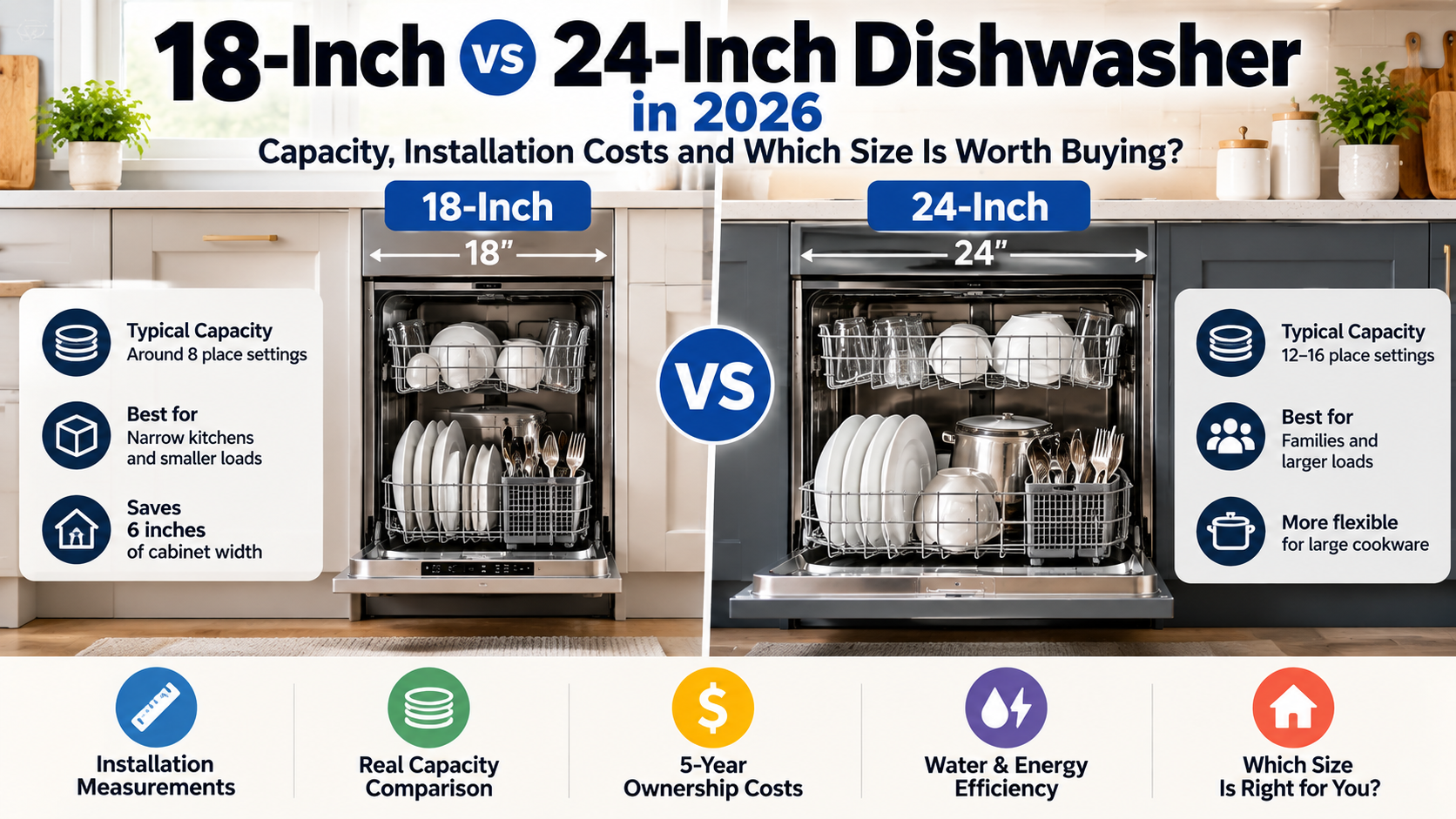
An 18-inch dishwasher saves approximately six inches of cabinet width, but a 24-inch dishwasher can offer substantially more usable capacity. The smaller machine is not automatically cheaper to own—and choosing the wrong size can turn a simple appliance purchase into an expensive kitchen modification.
If you have a narrow apartment kitchen, an 18-inch built-in dishwasher may be a practical solution. If you cook daily, wash large pans, or already have a standard 24-inch dishwasher opening, the full-size option may offer better long-term value.
The important question is not simply how many people live in your home.
It is how many dishes you generate, how much cabinet space you have, what your installation requires, and whether the smaller machine will force you to run additional cycles.
This guide compares 18-inch and 24-inch built-in dishwashers using manufacturer guidance, ENERGY STAR efficiency information, installation constraints, and transparent five-year cost examples.
Quick Verdict: 18-Inch or 24-Inch?
| Your situation | Better starting choice | Why |
|---|---|---|
| Existing 18-inch dishwasher opening | 18-inch | Usually avoids widening the cabinet opening |
| Existing 24-inch dishwasher opening | 24-inch | Avoids reducing capacity and adding filler cabinetry |
| Small kitchen without a dishwasher | Depends on measured layout | Installation feasibility comes first |
| One person who cooks occasionally | 18-inch may be enough | Lower capacity may not be a limitation |
| Couple cooking most meals at home | Compare actual dish loads | Pots and pans can change the decision |
| Family of four | Usually 24-inch | Greater loading flexibility |
| Frequent large cookware | Usually 24-inch | More usable rack space |
| Kitchen where six inches of cabinet space is critical | Consider 18-inch | Cabinet storage may be worth more than extra dishwasher capacity |
Living Pick Lab recommendation: If your kitchen already has a properly sized 24-inch opening and you regularly wash substantial loads, a 24-inch replacement is usually the more practical starting point.
Choose an 18-inch dishwasher when the smaller opening genuinely improves your kitchen layout or avoids costly modifications—not merely because the appliance looks compact.
1. The Actual Difference Between 18-Inch and 24-Inch Dishwashers
Both sizes are commonly available as under-counter built-in appliances.
Their primary difference is width, although height, depth, rack layout, noise, features, and capacity vary by model.
| Feature | 18-inch dishwasher | 24-inch dishwasher |
|---|---|---|
| Nominal width | 18 inches | 24 inches |
| Typical capacity | Often around 8 place settings | Often around 12–16 place settings |
| Best use | Narrow kitchens and smaller loads | Larger or more frequent loads |
| Large cookware | More restrictive | Generally more flexible |
| Cabinet opening | Narrower opening required | Standard-width opening required |
| Counter space | Does not occupy countertop | Does not occupy countertop |
| Installation | Permanent built-in connections | Permanent built-in connections |
| Energy use | Depends on model and usage | Depends on model and usage |
| Purchase price | Not necessarily lower | Not necessarily higher |
| Long-term advantage | Preserves cabinet width | More capacity per cycle |
Capacity figures are representative ranges, not guaranteed specifications.
A particular 18-inch dishwasher may accommodate more or fewer place settings than another model with the same nominal width.
What does six inches actually save?
The difference in nominal width is six inches, or half a foot.
In a kitchen renovation, that can create room for a narrow pull-out storage cabinet or help preserve a small amount of otherwise valuable cabinet space.
But an 18-inch dishwasher does not automatically save counter space compared with a 24-inch built-in dishwasher. Both are installed under the countertop.
The real benefit is cabinet-layout flexibility.
2. The First Buying Test: Measure Your Opening
The most expensive sizing mistake is assuming that the label “18-inch” or “24-inch” describes the exact width of the machine.
These labels describe nominal appliance classes.
Actual exterior dimensions and required cabinet openings differ by model.
Measure these five things
- Opening width: Measure at the front and back where accessible.
- Opening height: Measure from the finished floor to the underside of the countertop.
- Available depth: Account for the appliance body and required connection clearances.
- Door clearance: Check whether the open door blocks an island or opposite cabinet.
- Utility access: Identify the water, drain, and electrical connections.
Use the installation drawing for the exact model rather than a generic dimension chart.
The raised-floor problem
Older kitchens may have received new tile or vinyl flooring after the cabinets were installed.
That can reduce the usable opening height.
A dishwasher that fits the nominal width may still be too tall to install—or difficult to remove for future repairs.
Can an 18-inch dishwasher fit in a 24-inch opening?
Not as a straightforward replacement.
The narrower machine leaves approximately six inches of unused width that must be addressed with properly supported cabinetry, trim, or a suitable filler arrangement.
That work can add expense and complexity.
Do not assume an 18-inch dishwasher is an economical replacement for a failed 24-inch machine.
Can a 24-inch dishwasher replace an 18-inch model?
Only if the kitchen can accommodate the wider opening and the necessary cabinet changes are feasible.
You may need to remove or modify cabinets and adjust connections.
A professional installation estimate is particularly important before making this decision.
3. Capacity: How Many Dishes Can You Really Wash?
Manufacturers describe dishwasher capacity using place settings.
A place setting is useful for standardized comparisons, but it does not fully represent how people cook.
Your dishwasher also needs to accommodate:
- Mixing bowls
- Frying pans
- Saucepan lids
- Cutting boards approved for dishwashing
- Food-storage containers
- Large mugs and reusable bottles
- Serving utensils
A household of two people who cooks three meals daily may generate more dishwasher demand than a household of four that frequently eats outside the home.
Example: One-person household
A single adult might use two plates, two bowls, several glasses, and a small amount of cookware each day.
An 18-inch dishwasher may accommodate that routine comfortably, depending on the model and cookware.
Example: Two adults cooking daily
Two adults might generate six plates, multiple bowls, utensils, mugs, a frying pan, and food-storage containers.
An 18-inch machine could still work, but loading flexibility becomes more important.
Example: Family of four
A family may generate a large quantity of dishes plus cooking equipment in a single day.
A 24-inch machine is often more convenient because it can reduce the need for multiple loads or separate hand-washing.
The capacity test that matters most
Before purchasing, look at the manufacturer’s rack photos and specifications.
Then compare them with your largest dinner plates, mixing bowls, and most frequently used cookware.
Do not pay for a dishwasher based solely on the number of place settings printed on the product listing.
4. Is an 18-Inch Dishwasher More Energy-Efficient?
Not necessarily.
A smaller dishwasher may consume less energy or water per cycle, but it may also require more cycles to clean the same quantity of dishes.
ENERGY STAR specifically cautions that smaller-capacity dishwashers can use more energy over time because of their capacity limitations.
An important ENERGY STAR distinction
ENERGY STAR classifies standard and compact residential dishwashers according to tested capacity—not simply their exterior width.
Under the current ENERGY STAR Version 7.0 criteria:
| ENERGY STAR classification | Annual energy limit | Water-use limit |
|---|---|---|
| Standard capacity | 240 kWh/year | 3.2 gallons/cycle |
| Compact capacity | 155 kWh/year | 2.0 gallons/cycle |
These are maximum certification limits, not actual consumption figures for every product.
An 18-inch dishwasher advertised with eight or more place settings may fall into the standard-capacity classification for ENERGY STAR purposes.
Never assume every 18-inch dishwasher qualifies as an ENERGY STAR compact model.
To compare actual products, use the exact model’s EnergyGuide label and ENERGY STAR listing.
Compare energy per useful load
Suppose one 24-inch dishwasher can clean a quantity of dishes in one cycle, while an 18-inch dishwasher needs two cycles.
Even if the smaller machine uses less electricity per cycle, the two-cycle total may be higher.
The same principle applies to water and detergent.
5. Five-Year Ownership Costs: A Fair Comparison
The most useful financial comparison uses the same household and the same amount of dishwashing.
The following examples are hypothetical planning models, not measured product costs or live retailer quotes.
Scenario A: Small household, equal cycle frequency
Assume both dishwashers can handle the household’s dishes in 200 cycles per year.
| Assumption | 18-inch | 24-inch |
|---|---|---|
| Appliance price | $650 | $700 |
| Straightforward installation | $200 | $200 |
| Electricity per cycle | 0.70 kWh | 0.85 kWh |
| Water per cycle | 2.5 gallons | 3.0 gallons |
| Detergent per cycle | $0.22 | $0.22 |
| Annual cycles | 200 | 200 |
Assume electricity costs $0.18/kWh and combined water and sewer service costs $0.015/gallon.
Over five years:
| Five-year cost | 18-inch | 24-inch |
|---|---|---|
| Purchase and installation | $850 | $900 |
| Electricity | $126 | $153 |
| Water and sewer | $37.50 | $45 |
| Detergent | $220 | $220 |
| Maintenance allowance | $75 | $75 |
| Five-year total | $1,308.50 | $1,393 |
In this scenario, the smaller dishwasher costs $84.50 less over five years.
That is a modest difference relative to the purchase price.
It also assumes the smaller machine handles the same dish volume without additional cycles.
Scenario B: Larger household, more cycles for the 18-inch model
Now assume the same household generates enough dishes to require:
- 200 cycles annually with the 24-inch dishwasher.
- 300 cycles annually with the 18-inch dishwasher.
Keep the same prices, consumption assumptions, and maintenance allowance.
| Five-year cost | 18-inch | 24-inch |
|---|---|---|
| Purchase and installation | $850 | $900 |
| Electricity | $189 | $153 |
| Water and sewer | $56.25 | $45 |
| Detergent | $330 | $220 |
| Maintenance allowance | $75 | $75 |
| Five-year total | $1,500.25 | $1,393 |
Under these assumptions, the 24-inch dishwasher becomes $107.25 cheaper over five years.
The larger machine is financially preferable despite its higher initial purchase price.
What changes the result?
The calculation is sensitive to:
- Actual appliance prices
- Number of cycles required
- Utility rates
- Detergent cost
- Wash and dry settings
- Installation changes
- Maintenance and repair costs
These examples exclude sales taxes, financing, inflation, major repairs, and residual value.
The energy assumptions are simplified and should be replaced with actual EnergyGuide information when comparing specific products.
6. The Hidden Cost: Extra Dishwasher Cycles
Running an additional cycle has costs beyond electricity and water.
You also use detergent and spend time loading and unloading the machine.
Consider an illustrative household where choosing an 18-inch dishwasher creates 100 additional cycles per year.
Over five years, that is 500 extra cycles.
If the smaller machine’s variable operating cost is:
- Electricity: $0.126 per cycle
- Water and sewer: $0.0375 per cycle
- Detergent: $0.22 per cycle
Then 500 additional cycles represent approximately $191.75 in variable operating expenses at those assumed rates.
That figure is the cost of the 500 cycles themselves, not necessarily the net difference between the two dishwashers; a proper comparison also accounts for the cycles and costs avoided on the larger machine.
Additional loading and unloading time may matter even more.
For households that already struggle to keep up with dishes, capacity can be more valuable than a small reduction in appliance width.
7. Installation Costs: Replacement vs Kitchen Renovation
Installation is often the deciding factor.
Replacing an existing 18-inch dishwasher
A same-size replacement may be relatively straightforward if the cabinet opening, plumbing, drainage, and electrical service remain suitable.
But verify the new model’s height and depth.
Replacing an existing 24-inch dishwasher
A same-size replacement generally avoids major cabinet modifications when the existing opening and connections are suitable.
This can make a 24-inch replacement financially attractive even for a small household.
Installing an 18-inch dishwasher in a new kitchen
The narrower appliance may preserve six inches of cabinet width.
However, a new installation may still require:
- Water supply connections
- Drain connections
- Electrical work
- Cabinet modifications
- Required permits or professional labor
Converting from 18 inches to 24 inches
This can require more extensive cabinetry changes.
The cost depends on whether adjacent cabinets can be moved or replaced, whether countertops need support or modification, and where the utilities are located.
Installation-cost planning example
| Installation situation | Illustrative budget assumption |
|---|---|
| Straightforward same-size replacement | $200 |
| Replacement with minor cabinet work | $400 |
| Conversion requiring cabinet modifications | $1,000 |
| Complex conversion with additional utility work | $1,800 |
These are hypothetical budgeting scenarios, not verified national installation averages or contractor quotes.
Request a written local estimate before making a final decision.
8. Which Size Is Better for Small Kitchens?
The obvious answer is 18 inches—but only when those six inches create a meaningful benefit.
When an 18-inch dishwasher makes sense
Choose the narrower model if:
- Your kitchen has limited cabinet width.
- A 24-inch unit would eliminate essential storage.
- Your typical loads are small.
- You do not regularly wash large cookware.
- The installation layout is already designed for 18 inches.
When a 24-inch dishwasher may still be better
Choose the wider model if:
- You have an existing 24-inch opening.
- Your household cooks frequently.
- You regularly wash large bowls or pans.
- You want fewer dishwasher cycles.
- The extra width does not materially compromise storage.
The six-inch storage question
Ask yourself:
Would I rather have six inches of additional cabinet space or more room inside the dishwasher?
That is often the real decision in a small kitchen.
9. Features Worth Paying For in 2026
Not every feature adds equal value.
Adjustable racks
Useful when you frequently wash tall glasses, large plates, or mixing bowls.
Third rack
Can improve utensil organization and free up space in the lower basket, although its usefulness depends on the design.
Soil-sensing wash cycles
Can adjust washing behavior based on detected soil conditions.
Quiet operation
Important for open-plan kitchens, studio apartments, and households that run the dishwasher at night.
Compare manufacturer-rated decibel levels using the same stated test conditions where possible.
Drying performance
Consider how the dishwasher dries plastics and whether the drying system adds energy consumption or cycle time.
Leak protection
A useful feature, especially in apartments and kitchens with expensive surrounding cabinetry.
Smart connectivity
Potentially convenient, but usually less important than capacity, reliability, cleaning performance, and repairability.
Buying rule: Pay first for the capacity and features you will use every week.
10. Is a More Expensive 18-Inch Dishwasher Worth It?
A narrow dishwasher may carry a price premium relative to a similarly equipped 24-inch model.
That does not necessarily make it a poor purchase.
If the 18-inch unit avoids costly cabinet reconstruction or makes an otherwise impossible kitchen layout workable, the smaller machine may provide greater overall value.
However, if you already have a 24-inch opening, paying more for an 18-inch machine while also losing capacity and adding filler cabinetry is usually difficult to justify.
The exception is when the freed cabinet width provides a specific, valuable benefit.
11. Four Real-World Buyer Scenarios
Scenario 1: Studio apartment with an 18-inch opening
Recommended starting point: 18-inch built-in.
A same-size installation is likely to be more practical than reconstructing the kitchen for a wider appliance.
Prioritize quiet operation, suitable rack design, and verified installation dimensions.
Scenario 2: Couple replacing a 24-inch dishwasher
Recommended starting point: 24-inch built-in.
Even if the couple rarely fills the machine completely, replacing the existing appliance with the same nominal size can avoid unnecessary cabinet changes.
Compare actual energy labels rather than assuming the narrower machine will save money.
Scenario 3: Family of four renovating the kitchen
Recommended starting point: 24-inch built-in.
The additional capacity may reduce the number of cycles and improve cookware loading.
Choose 18 inches only if kitchen layout constraints outweigh those advantages.
Scenario 4: Small kitchen with no existing dishwasher
Recommended starting point: measure before choosing.
If a permanent built-in installation is difficult, a countertop or portable dishwasher may deserve consideration.
For that broader decision, see our Countertop vs Built-In Dishwasher in 2026: Installation, Capacity and Real 5-Year Costs guide.
12. Common Dishwasher Size Buying Mistakes
Mistake 1: Assuming 18 inches means lower operating costs
The smaller machine may need additional cycles.
Mistake 2: Comparing appliance width instead of opening dimensions
Nominal product width and actual required installation space are different.
Mistake 3: Ignoring door clearance
A dishwasher can fit the cabinet opening but interfere with a kitchen island or walkway when opened.
Mistake 4: Treating place settings as real cookware capacity
Large pans and bowls may determine whether the machine works for your household.
Mistake 5: Buying an 18-inch machine for an existing 24-inch opening without considering cabinetry
A smaller machine can create extra installation work.
Mistake 6: Assuming all 18-inch models are ENERGY STAR compact-class appliances
ENERGY STAR classifications depend on tested capacity.
Mistake 7: Comparing purchase prices without installation quotes
A cheaper machine may create a more expensive project.
13. The Final Buying Checklist
Before ordering, confirm the following.
Space and installation
- Exact cabinet opening width, height, and depth
- Door-open clearance
- Finished-floor height
- Water, drain, and electrical requirements
- Written installation quote
Capacity and cleaning
- Real place-setting capacity
- Fit for large plates and cookware
- Adjustable rack configuration
- Expected cycles per week
- Cleaning and drying features
Ownership costs
- Current purchase price
- EnergyGuide consumption estimate
- Local electricity and water rates
- Detergent costs
- Maintenance and replacement-part availability
- Warranty coverage
Long-term fit
- Household size and cooking habits
- Future family needs
- Cabinet storage priorities
- Likelihood of moving or remodeling
Frequently Asked Questions
Is an 18-inch dishwasher big enough for two people?
Often, yes. But couples who cook frequently or use large pans may benefit from a 24-inch model. Compare actual dishes and rack dimensions.
Is a 24-inch dishwasher cheaper to operate?
Not automatically per cycle. It can be more economical for a household that would otherwise need additional cycles in an 18-inch model.
Can an 18-inch dishwasher replace a 24-inch dishwasher?
It can be installed in a wider opening only with a suitable installation plan, including properly supported filler cabinetry or other modifications. It is not generally a direct replacement.
Are 18-inch dishwashers quieter?
Not necessarily. Noise depends on the specific model and design rather than width alone.
Do 18-inch dishwashers use less water?
Some use less per cycle, but total water use depends on how many cycles are required to clean the same amount of dishes.
Are all 18-inch dishwashers considered compact by ENERGY STAR?
No. ENERGY STAR distinguishes standard and compact dishwashers by tested capacity, not simply nominal width.
Should I choose an 18-inch dishwasher for a rental apartment?
Only if the landlord permits the installation and the kitchen can safely support it. Countertop or portable alternatives may be more appropriate when permanent changes are not allowed.
Is a 24-inch dishwasher too large for one person?
Not necessarily. If the opening already exists, a 24-inch model can still be practical. Compare cycle options, energy consumption, and your typical dish load.
Final Verdict: Choose the Size That Fits Your Kitchen and Your Dishwashing Routine
Choose an 18-inch dishwasher when cabinet space is genuinely limited, your loads are manageable, and the narrower appliance avoids costly kitchen modifications.
Choose a 24-inch dishwasher when you have the space, regularly wash cookware, or want greater flexibility and fewer cleaning cycles.
If you already have an opening for one size, changing to the other should be justified by a meaningful benefit—not simply by a small difference in advertised appliance price.
The smartest dishwasher purchase is the one that fits your actual kitchen, handles your daily dishes, and avoids unnecessary installation and ownership costs.
Related Living Pick Lab Guides
Still deciding whether a built-in dishwasher is right for your kitchen? Start with our Countertop vs Built-In Dishwasher in 2026 comparison for installation restrictions, capacity, and five-year costs.
If your next project involves cleaning kitchen floors safely, our Steam Mop vs Wet Dry Vacuum Mop in 2026 guide explains floor compatibility and cleaning-machine ownership costs.
Sources and Editorial Methodology
This article uses published manufacturer guidance, ENERGY STAR efficiency criteria, and installation information reviewed in October 2026.
- ENERGY STAR — Dishwashers Key Product Criteria
- ENERGY STAR — Dishwasher Buying Guide
- ENERGY STAR — Certified Residential Dishwasher Database
- Whirlpool — Apartment-Sized Dishwasher Buying Guide
- Whirlpool — How to Choose a Small Dishwasher
- SureFit Dimensions — Dishwasher Sizes and Opening Measurements
Editorial disclosure: Living Pick Lab has not independently tested the dishwashers discussed here. Prices, operating costs, and installation allowances in the examples are hypothetical and should not be interpreted as current retailer quotes or verified ownership costs. Use exact manufacturer specifications and local contractor estimates before buying.