
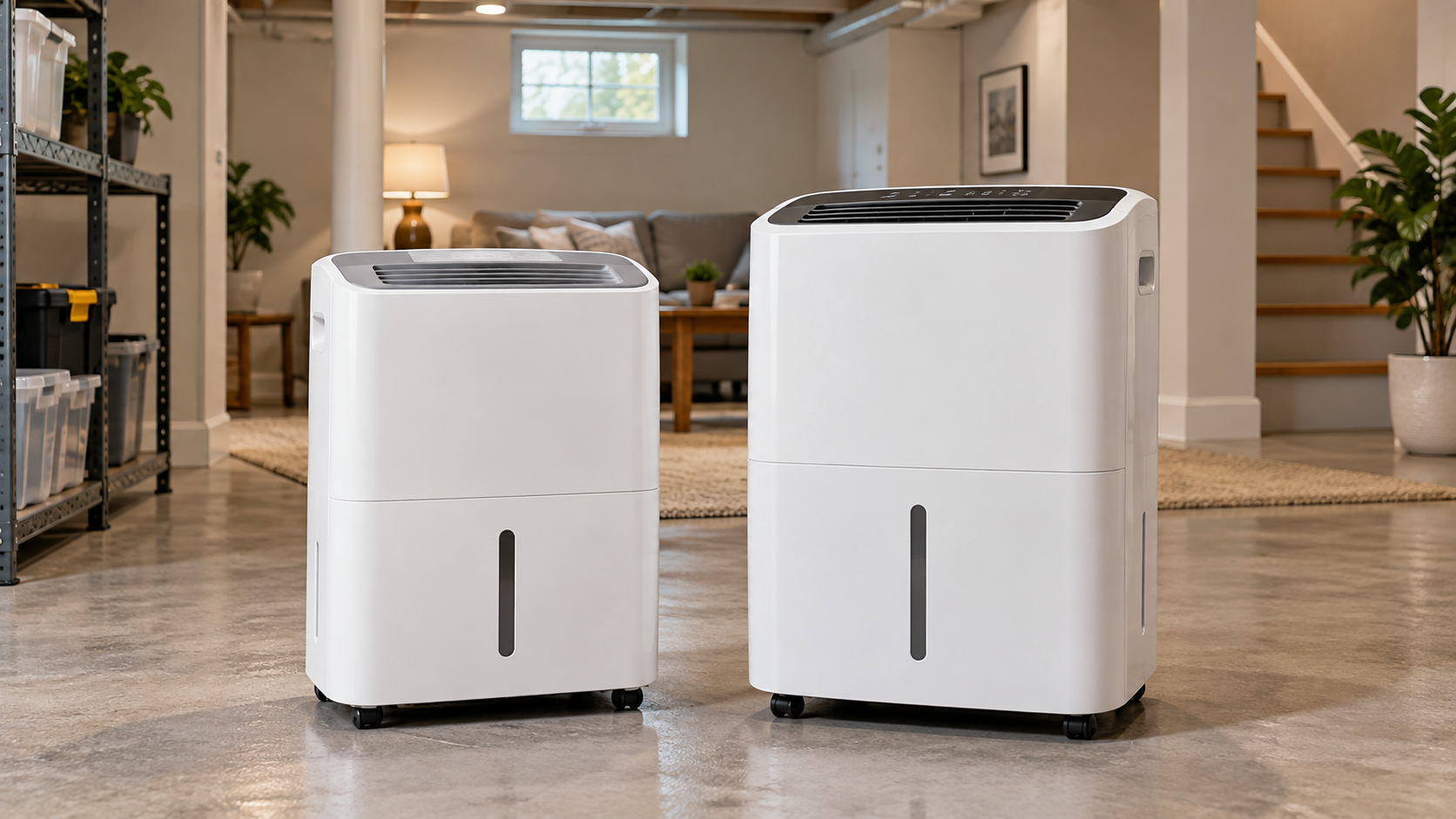
A 50-pint dehumidifier can remove more moisture per day than a 35-pint model under standardized test conditions. But that does not automatically make it the better purchase for your basement.
The real question is whether the additional capacity will solve a moisture problem that a 35-pint unit cannot handle reliably—or whether you will simply pay more for performance you rarely need.
For some basements, a 35-pint dehumidifier is the more sensible choice. For others, especially spaces with persistent moisture, a 50-pint model may offer valuable extra capacity during humid weather.
This guide compares both sizes through five practical questions:
- How much moisture does your basement actually produce?
- Can a 35-pint unit maintain your target humidity?
- Does a 50-pint model justify its higher purchase price?
- How will efficiency, runtime, and drainage affect ownership costs?
- When is neither size the right solution?
The goal is not to recommend the larger machine by default. It is to help you buy the capacity your basement can genuinely use.
Quick Answer: 35-Pint vs 50-Pint Dehumidifier
Choose a 35-pint dehumidifier when your basement has moderate humidity, no active water intrusion, and a moisture load that the unit can manage without running continuously.
Consider a 50-pint dehumidifier when humidity rises substantially during wet weather, the space has a higher moisture load, or a smaller unit struggles to bring humidity back under control.
Do not choose either size as a substitute for fixing leaks, standing water, or significant groundwater intrusion. A dehumidifier removes moisture from the air; it does not repair the source of a water problem.
A 50-pint unit has approximately 43% more rated daily moisture-removal capacity than a 35-pint unit:
50 ÷ 35 ≈ 1.43
That is a comparison of standardized capacity ratings—not a promise that the larger unit will dry your particular basement 43% faster.
Actual performance depends on temperature, relative humidity, airflow, moisture entering the space, and the specific equipment.
1. The 35-Pint vs 50-Pint Decision Table
| Buying consideration | 35-pint dehumidifier | 50-pint dehumidifier |
|---|---|---|
| Rated moisture removal | 35 pints per day | 50 pints per day |
| Best starting point | Moderate, manageable moisture loads | Higher or recurring moisture loads |
| Purchase price | Often lower within comparable product lines | Often higher within comparable product lines |
| Physical size | Model-dependent | Model-dependent |
| Electricity use | Depends on efficiency and operating time | Depends on efficiency and operating time |
| Humidity recovery | May be sufficient for moderate conditions | Greater rated capacity for heavier conditions |
| Drainage requirements | Bucket or supported continuous drainage | Bucket or supported continuous drainage |
| Main buying risk | Insufficient capacity for persistent moisture | Paying for capacity you do not need |
Living Pick Lab decision rule: Buy the smallest capacity that can maintain your target humidity reliably under the conditions your basement actually experiences—not merely on its driest day.
This means evaluating the worst recurring moisture conditions, not choosing solely from square footage.
2. When a 35-Pint Dehumidifier Is Enough
A 35-pint dehumidifier deserves serious consideration when the moisture problem is manageable rather than severe.
Your basement is humid but not consistently wet
Imagine a finished basement that becomes uncomfortable during summer but has no visible water intrusion.
A hygrometer shows elevated humidity on muggy days, yet the space responds reasonably well when a dehumidifier operates.
In this situation, a 35-pint model may provide sufficient capacity without requiring the additional purchase cost of a larger unit.
The important test is not whether the machine can lower humidity once. It is whether it can maintain an appropriate level as moisture continues entering the space.
The moisture problem is seasonal
Some basements experience noticeable humidity during warmer months but remain relatively dry for the rest of the year.
A 50-pint model may still be appropriate, but seasonal use alone does not justify it.
Consider how quickly humidity rises, how long the humid season lasts, and whether the smaller unit can recover after particularly damp days.
Your existing dehumidifier is already keeping up
If a properly functioning 35-pint unit consistently maintains your target humidity, replacing it with a 50-pint model may produce little practical benefit.
Before upgrading, check whether your current machine is operating correctly:
- Is the filter clean?
- Is airflow unobstructed?
- Is the humidity setting appropriate?
- Is the unit stopping because its bucket is full?
- Is the basement receiving moisture from an unresolved source?
A drainage problem or maintenance issue can make an otherwise adequate dehumidifier appear undersized.
When not to assume 35 pints is sufficient
A basement can be relatively small and still have a serious moisture problem.
Wet foundation walls, repeated seepage, or persistently elevated humidity can create a higher moisture load than floor area alone suggests.
Do not select 35 pints simply because your basement is small.
For a broader introduction to sizing, read our guide:
What Size Dehumidifier Do I Need for My Basement? A 2026 Sizing Guide
3. When a 50-Pint Dehumidifier Is Worth the Extra Cost
The strongest argument for a 50-pint dehumidifier is not that bigger is inherently better.
It is that the basement has enough moisture demand to benefit from the additional removal capacity.
Your basement takes too long to recover after humid weather
Suppose a basement becomes noticeably damp after several rainy days.
A smaller dehumidifier runs for extended periods, yet relative humidity remains above the desired range.
If the machine is functioning properly and the moisture source has been assessed, a 50-pint model may offer a meaningful improvement.
Its higher rated capacity provides more potential moisture removal under comparable test conditions.
However, a higher capacity rating does not guarantee a specific recovery time in your home.
Moisture enters the basement continuously
A basement with persistent dampness may require ongoing dehumidification rather than occasional humidity correction.
In that environment, the additional capacity of a 50-pint unit can be useful.
But distinguish between two situations:
Manageable humidity: Moisture enters the space gradually, and dehumidification keeps conditions under control.
Water intrusion: Liquid water enters through cracks, walls, flooring, or plumbing.
The second situation requires addressing the underlying problem. Buying a larger dehumidifier without fixing the source may leave the basement vulnerable to damage and mold.
Your current 35-pint unit cannot maintain the target
This is one of the clearest practical reasons to consider upgrading.
If a correctly installed and maintained 35-pint dehumidifier operates extensively yet cannot control humidity during normal recurring conditions, additional capacity may be justified.
Before replacing it, verify that the issue is truly insufficient moisture-removal capacity rather than:
- A full bucket that repeatedly shuts off the machine
- Restricted airflow
- An unsuitable temperature range
- A defective humidity sensor
- An ongoing leak
- Excessive outside-air infiltration
A larger dehumidifier cannot compensate for every installation or building problem.
4. Does a 50-Pint Dehumidifier Use More Electricity?
Not necessarily in the way buyers expect.
A larger dehumidifier may draw more power while operating, but it may also remove moisture more quickly under some conditions.
A smaller model may use less power at a given moment yet operate longer to manage the same moisture load.
Neither observation establishes which machine will cost less to run.
The correct comparison is model-specific energy efficiency and actual operating behavior—not capacity alone.
Understand Integrated Energy Factor
ENERGY STAR uses a metric called Integrated Energy Factor (IEF), expressed in liters of water removed per kilowatt-hour of electricity consumed (L/kWh).
A higher IEF indicates greater moisture-removal efficiency under the applicable standardized test procedure.
For example:
- Model A: IEF of 2.0 L/kWh
- Model B: IEF of 2.2 L/kWh
Under the standardized rating framework, Model B removes more water per unit of electricity.
That does not mean Model B will always produce a lower household electricity bill. Actual moisture demand, operating conditions, and control behavior also matter.
ENERGY STAR’s current dehumidifier specification took effect on October 1, 2025. When shopping, use current certified-product information and compare the exact models under consideration.
Official reference: ENERGY STAR — Dehumidifiers
A practical electricity-cost example
Consider two hypothetical operating scenarios:
| Variable | Example 35-pint unit | Example 50-pint unit |
|---|---|---|
| Assumed average operating power | 400 watts | 550 watts |
| Assumed daily operating time | 12 hours | 8 hours |
| Electricity consumed per day | 4.8 kWh | 4.4 kWh |
| Cost at $0.18/kWh | $0.86/day | $0.79/day |
| Approximate 30-day cost | $25.92 | $23.76 |
These are illustrative assumptions, not measured specifications or predicted performance for particular products.
The calculations use:
Electricity cost = Power in kW × Operating hours × Electricity rate
The example demonstrates an important principle: a higher-power appliance can sometimes use less total electricity if its operating time is sufficiently shorter.
But the reverse can also happen.
If both units operate for the same number of hours, the higher-power unit in this example consumes more electricity.
And if the basement’s moisture load is low, the larger unit may not deliver a meaningful runtime advantage.
Buying recommendation: Compare actual model ratings, published annual energy-use information where available, and your own electricity rate. Do not assume a 50-pint unit is cheaper—or more expensive—to operate solely because of its capacity.
5. The Hidden Cost: Buying Too Small vs Buying Too Large
Purchase price is only one part of the decision.
The cost of buying too small
An undersized dehumidifier may struggle to maintain humidity during recurring damp conditions.
Potential consequences include:
- Longer periods of uncomfortable humidity
- Extended operating time
- More frequent intervention if drainage is not continuous
- Dissatisfaction that leads to replacing the unit prematurely
A lower upfront price is not a good deal if the product cannot perform the job.
The cost of buying too large
An unnecessarily large unit may cost more to purchase without providing a proportional benefit.
Depending on the model, it may also occupy more space or have different noise characteristics.
However, larger capacity does not automatically mean excessive drying or wasted electricity. A properly functioning humidistat should control operation according to the selected humidity setting.
The financial question is whether the added capacity provides enough practical value to justify its cost.
Calculate the upgrade premium
Before choosing a larger unit, compare:
50-pint purchase price − 35-pint purchase price = Upgrade premium
Then ask:
- Does the basement actually need more removal capacity?
- Are both models similarly efficient?
- Does the larger model include useful drainage or control features?
- Would improving drainage make the smaller model sufficient?
- Could repairing a moisture source reduce the need for either unit?
If the 35-pint model already meets the moisture load, the upgrade premium may be difficult to justify.
If the 35-pint model consistently falls short, the larger unit may be worth considerably more than the initial price difference.
6. Do Not Confuse Older Capacity Ratings With Current Ratings
One of the most misleading comparisons in dehumidifier shopping involves older capacity labels.
The U.S. Department of Energy changed the dehumidifier test procedure associated with the ratings used beginning in 2019.
Older and newer capacity figures may therefore reflect different testing conditions.
An older dehumidifier labeled 50 pints should not automatically be treated as equivalent to a current model labeled 50 pints.
This matters when:
- Replacing an older basement dehumidifier
- Reading reviews published before the rating changes
- Comparing secondhand equipment with new products
- Using an old buying guide to select a current model
When replacing an older machine, look up its model number and original specifications rather than relying on the capacity label alone.
Official reference: ENERGY STAR — Dehumidifier Testing and Capacity
7. Three Basement Scenarios: Which Size Makes More Sense?
The following examples are decision scenarios, not measured product tests.
Scenario A: A finished basement with occasional summer humidity
Situation: The basement becomes humid during warm weather but has no known water intrusion. Humidity responds well to dehumidification.
Likely starting choice: 35 pints.
Why: Moderate moisture demand may not justify paying extra for a 50-pint unit.
Check before buying: Humidity readings during the most humid recurring conditions, rather than on a dry day.
Scenario B: A basement with recurring heavy dampness
Situation: Humidity rises repeatedly after wet weather. A smaller, properly functioning dehumidifier struggles to maintain the target.
Likely starting choice: Consider 50 pints.
Why: Additional removal capacity may improve the machine’s ability to manage a higher moisture load.
Check before buying: Whether the basement has leaks, seepage, or other moisture sources requiring repair.
Scenario C: A basement with a drain above the dehumidifier
Situation: The moisture load may be manageable with either size, but the available utility sink is higher than the machine’s gravity-drain outlet.
Likely starting choice: Determine drainage requirements before choosing capacity.
Why: A 50-pint dehumidifier without a suitable drainage arrangement may be less convenient than a properly configured 35-pint unit.
A larger water-removal rating does not automatically mean a better drainage system.
Read our related guide:
Do You Need a Pump for Your Basement Dehumidifier? A Drainage Decision Guide
8. Five Features That May Matter More Than the Capacity Difference
Once you know approximately how much moisture-removal capacity you need, compare the actual models.
1. Verified energy efficiency
Look for ENERGY STAR certification and compare IEF ratings for the exact models.
Do not rely on broad claims such as “energy-saving” without checking published specifications.
2. Continuous drainage options
A dehumidifier that stops when its bucket fills cannot remove more moisture until it is emptied.
If the basement requires frequent or unattended operation, reliable drainage may matter more than the difference between 35 and 50 pints.
Check whether the model supports gravity drainage, an internal pump, or a compatible external pump.
3. Operating temperature
Basements can be cooler than other rooms.
Some refrigerant-based dehumidifiers lose effectiveness or require defrost cycles at lower temperatures.
Check the manufacturer’s specified operating-temperature range and defrost features.
4. Noise and placement
A finished basement used as an office, bedroom, or living area may place greater importance on operating noise.
Compare published noise information where available, but remember that manufacturers may use different measurement methods.
Do not assume the larger unit is always louder.
5. Maintenance and serviceability
Consider filter access, bucket removal, hose connections, warranty terms, and availability of replacement parts.
A product that is difficult to maintain may become inconvenient regardless of its rated capacity.
9. What to Check Before Spending More on a 50-Pint Model
Use this checklist before purchasing.
- Measure humidity: Use a hygrometer and observe conditions over several days, including damp weather when possible.
- Inspect moisture sources: Check for leaks, seepage, condensation, and poor drainage outside the foundation.
- Review current performance: If you already own a dehumidifier, determine whether it maintains your target humidity.
- Compare exact models: Check rated capacity, IEF, drainage features, noise information, operating-temperature limits, and warranty.
- Calculate total ownership cost: Consider purchase price, likely electricity use, drainage accessories, and maintenance.
A reasonable starting humidity target for many homes is around 45%–50% relative humidity, adjusted for comfort, condensation risk, and building conditions. Avoid treating any single setting as a guarantee against moisture problems.
If significant water intrusion or visible mold is present, address the source and seek appropriate professional help rather than relying solely on dehumidification.
10. Frequently Asked Questions
Is a 50-pint dehumidifier always better than a 35-pint model?
No. A 50-pint unit has greater rated moisture-removal capacity, but a 35-pint model may be sufficient for a basement with moderate moisture demand.
The better purchase is the one that maintains the desired humidity reliably at a reasonable total cost.
Will a 50-pint dehumidifier lower humidity faster?
It may under suitable conditions because it has a higher rated removal capacity.
However, actual recovery time depends on room conditions, moisture entering the space, equipment efficiency, airflow, and controls.
The capacity difference alone cannot predict the time required.
Is a 50-pint dehumidifier more expensive to run?
Not necessarily.
The larger unit may consume more power while operating, but total electricity use depends on how long and how often it runs.
Compare model-specific efficiency and energy-use information rather than assuming operating cost from capacity.
Can I use a 50-pint dehumidifier in a small basement?
Potentially, yes, if the model is appropriate for the space and its operating requirements are met.
But a small basement does not automatically need 50-pint capacity. Moisture conditions matter more than size alone.
Should I buy a 50-pint model if my basement has standing water?
No dehumidifier should be treated as the primary solution to standing water.
Identify and correct the source of water intrusion. Dehumidification may support drying after the underlying problem has been addressed.
Does a 50-pint dehumidifier have a larger water bucket?
Not necessarily.
The pint rating describes moisture-removal capacity over a standardized 24-hour test period. It does not describe the collection bucket’s volume.
Check bucket capacity separately.
Is an older 50-pint dehumidifier equivalent to a new 50-pint model?
Not necessarily. Changes to U.S. testing procedures mean older and newer capacity ratings may not be directly comparable.
Verify the original rating standard and model specifications before making a replacement decision.
Final Verdict: When Is the Bigger Size Worth Paying For?
A 35-pint dehumidifier can be a smart purchase when basement humidity is moderate, the moisture source is manageable, and the unit has enough capacity to maintain the desired conditions.
A 50-pint dehumidifier becomes more attractive when moisture demand is consistently higher or a properly functioning smaller unit cannot keep up.
The larger model is not automatically more efficient, more reliable, or more economical.
Living Pick Lab’s final buying rule: Pay for additional capacity when you have evidence that your basement needs it—not simply because 50 pints sounds more powerful than 35.
Before buying, compare the exact models’ efficiency, drainage requirements, operating conditions, and total cost.
The best dehumidifier is not necessarily the one with the highest number on the box. It is the one that controls moisture reliably in your actual basement.
Sources and Further Reading
- ENERGY STAR — Dehumidifiers
- ENERGY STAR — Dehumidifier Testing and Capacity
- ENERGY STAR — Dehumidifiers Key Efficiency Criteria
- U.S. Department of Energy — Consumer Dehumidifiers
Editorial note: This guide is based on published government energy-efficiency information and practical buying considerations. The electricity-cost examples and basement scenarios are illustrative, not results of hands-on product testing. Always verify current specifications for the exact model you intend to purchase.