
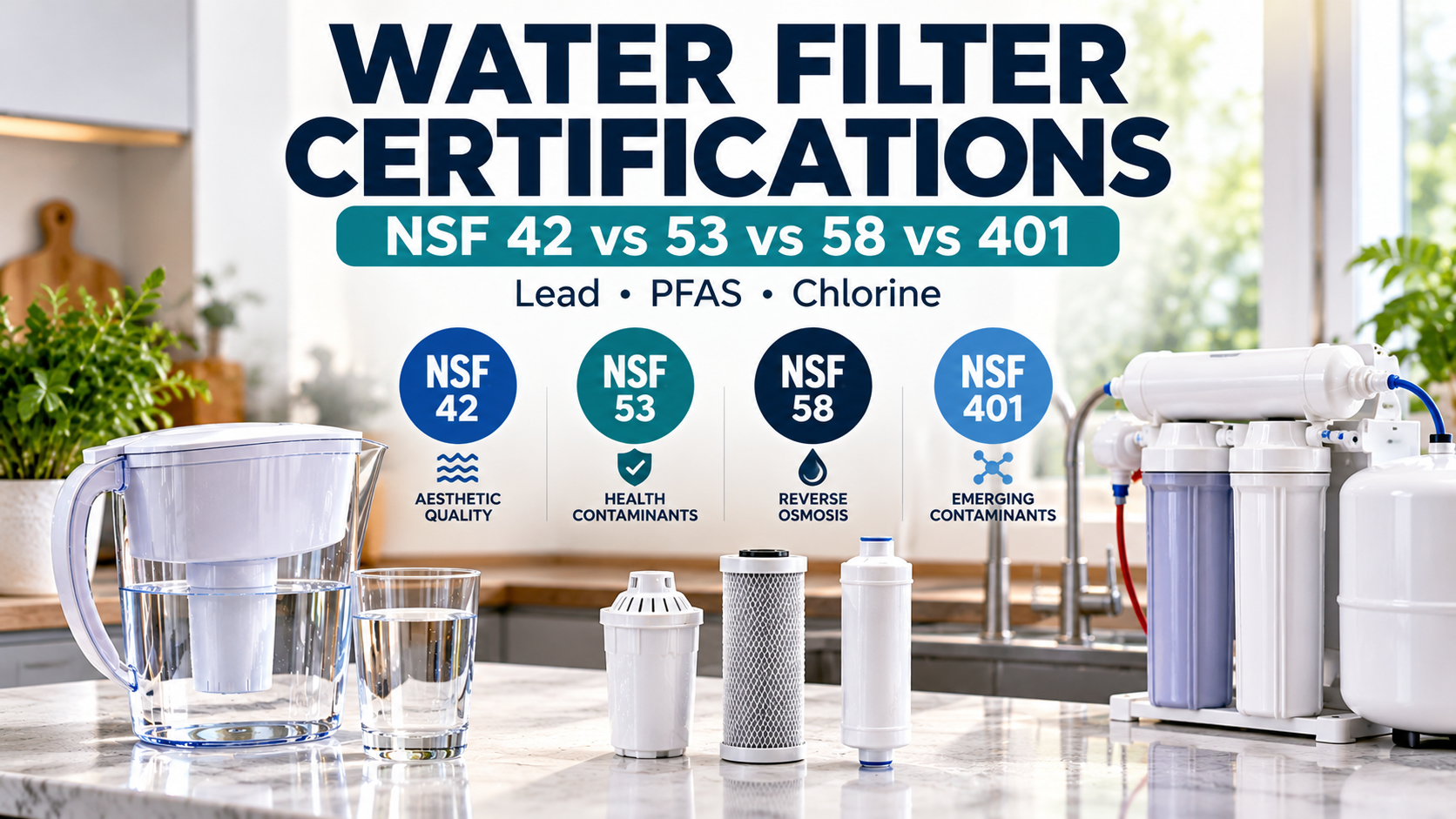
Buying a water filter for lead, PFAS, chlorine, or other contaminants? Learn what NSF/ANSI 42, 53, 58, and 401 actually mean, how to verify a filter’s claims, and which certification matters for your drinking water.
A water filter box might advertise “NSF certified,” “tested to NSF standards,” or “removes 99% of contaminants.”
Those statements can sound reassuring. But they do not necessarily mean the filter reduces the specific substance you’re worried about.
A filter certified to improve chlorine taste may not be certified to reduce lead. A reverse-osmosis system certified under NSF/ANSI 58 may have a different set of verified claims from another RO system. And a product tested by a laboratory is not automatically the same as one certified by an accredited third-party organization.
The most important buying rule is simple: Match the contaminant in your water to a specific certified reduction claim on the exact filter model.
This guide explains how to do that before spending money.
Quick Answer: NSF 42 vs 53 vs 58 vs 401
| Standard | Main purpose | Typical reason to look for it | Important limitation |
|---|---|---|---|
| NSF/ANSI 42 | Aesthetic water quality | Chlorine taste and odor | Does not automatically establish lead or PFAS reduction |
| NSF/ANSI 53 | Health-related contaminant reduction | Lead, certain PFAS, or other specified contaminants | You must verify the exact contaminant claim |
| NSF/ANSI 58 | Reverse-osmosis treatment systems | RO filtration and specific certified reduction claims | Not every RO system is certified for every contaminant |
| NSF/ANSI 401 | Certain emerging or incidental contaminants | Specified pharmaceuticals and other listed substances | Does not mean the filter removes all emerging contaminants |
These standards are not a ranking from weakest to strongest.
A higher number does not mean better filtration. Each standard covers a different purpose.
A filter may carry several certifications, but each one needs to be understood separately.
1. NSF/ANSI 42: When Your Main Problem Is Chlorine Taste or Odor
NSF/ANSI 42 covers aesthetic effects.
That includes claims related to the way water tastes, smells, or appears.
For many households using treated municipal water, the main complaint is an unpleasant chlorine taste.
A properly certified filter with the relevant chlorine-reduction claim may help address that problem.
Who Should Consider NSF 42?
This standard is particularly relevant when:
- Your water utility reports compliant drinking water.
- You want to improve taste or odor.
- Chlorine flavor is your main concern.
- You are not relying on the filter to address a known health-related contaminant.
However, a filter carrying NSF/ANSI 42 should not be assumed to reduce lead, PFAS, arsenic, or other substances unless it has additional verified claims.
Best buying question: Is this exact model certified for the specific taste, odor, or aesthetic issue I want to improve?
2. NSF/ANSI 53: When You Need a Specific Health-Related Reduction Claim
NSF/ANSI 53 is particularly important when a household wants to reduce certain contaminants associated with health effects.
Possible claims under this standard include lead and certain PFAS, among other substances.
But here’s the distinction that many shoppers miss:
Certified to NSF/ANSI 53 does not mean certified to remove every contaminant covered by NSF/ANSI 53.
Manufacturers choose which reduction claims to pursue.
One model may be certified for lead. Another may be certified for PFOA/PFOS. A third may carry both claims.
Shopping for a Lead Filter
If your concern is lead in drinking water, look for:
- An exact model number.
- Certification by an accredited third-party organization.
- NSF/ANSI 53 with an explicit lead reduction claim.
- The applicable product instructions and replacement cartridge requirements.
The U.S. Environmental Protection Agency also provides guidance for identifying pitcher and point-of-use filters certified for lead reduction, including the importance of particulate reduction under NSF/ANSI 42, Class I.
Do not treat a generic “heavy metal filtration” claim as equivalent to independently verified lead reduction.
Shopping for a PFAS Filter
For PFAS, EPA advises looking for filters certified to NSF/ANSI 53 or NSF/ANSI 58 with an applicable PFAS-reduction claim.
The exact wording matters.
A listing for PFOA and PFOS is not necessarily a claim covering every PFAS compound.
Some listings may use a broader “Total PFAS” designation. Check which compounds and testing conditions that designation covers.
EPA has also cautioned that PFAS filter certifications may not demonstrate reduction to every level established under its drinking-water regulations.
Best buying question: Does the exact certified model list the contaminant I am trying to reduce?
3. NSF/ANSI 58: What Reverse-Osmosis Certification Actually Means
NSF/ANSI 58 covers reverse-osmosis drinking-water treatment systems.
RO systems use a semipermeable membrane to separate water from various dissolved substances.
They commonly include additional prefilters or postfilters.
Because these systems are more complex than basic pitcher filters, shoppers should examine both treatment claims and ownership requirements.
What NSF 58 Does Not Automatically Tell You
It does not establish that every RO system removes every contaminant.
You still need to verify the relevant reduction claims for the exact model.
You should also check:
- Rated daily water production
- Water efficiency or recovery information
- Installation requirements
- Prefilter replacement intervals
- Membrane replacement intervals
- Ongoing maintenance costs
An RO system may be appropriate for some water-quality problems, but it can be unnecessarily expensive or complicated when the only concern is chlorine taste.
RO vs Carbon Filtration
A certified carbon-based filter may meet a household’s specific needs without an RO membrane.
For another household, an appropriately certified RO system may offer useful treatment capabilities.
The better choice depends on the water-quality problem, not on the assumption that more filtration stages always mean safer water.
We will examine this in greater detail in our upcoming reverse-osmosis comparison guide.
4. NSF/ANSI 401: What About Pharmaceuticals and Emerging Contaminants?
NSF/ANSI 401 addresses specified emerging or incidental contaminants that may be present at low levels in drinking water.
These can include certain pharmaceutical compounds and other chemicals.
The standard is not a universal certification for every medication, pesticide, chemical, or emerging concern.
A filter certified under NSF/ANSI 401 must still be evaluated by the individual reduction claims listed for that product.
Does NSF 401 Mean a Filter Removes PFAS?
No. Do not assume that NSF/ANSI 401 certification establishes PFAS reduction.
For PFAS, look for the applicable specific claim under NSF/ANSI 53 or 58, as recommended by EPA.
Does NSF 401 Mean a Filter Removes Microplastics?
Some filters may carry specific microplastics-reduction claims, but a shopper should verify the actual claim and certification listing rather than assuming that every NSF/ANSI 401 product has identical capabilities.
Best buying question: Which named substances or particle-reduction claims are included in this product’s certification?
5. Which Water Filter Certification Do You Actually Need?
Start with the problem you are trying to solve.
| Your main concern | What to verify before buying |
|---|---|
| Chlorine taste or odor | NSF/ANSI 42 with the applicable chlorine-reduction claim |
| Lead | NSF/ANSI 53 with an explicit lead-reduction claim; consult EPA guidance |
| PFOA/PFOS or other PFAS | NSF/ANSI 53 or 58 with the relevant PFAS-reduction claim |
| Reverse-osmosis treatment | NSF/ANSI 58 plus the exact contaminant claims needed |
| Certain pharmaceuticals or emerging chemicals | NSF/ANSI 401 with the specific relevant reduction claims |
| Bacteria or viruses | A treatment system specifically evaluated for the relevant microbiological hazards; ordinary carbon filtration should not be assumed sufficient |
| Water hardness | A treatment approach designed for hardness, potentially involving NSF/ANSI 44 rather than a basic drinking-water filter |
Important: This table is a starting point, not a substitute for testing your water or checking a product’s certified claims.
A household with multiple contaminants may need a filter certified for several different reduction claims.
6. How to Verify a Water Filter Certification Before Buying
You do not need to rely solely on the manufacturer’s advertising.
Use this five-step process.
Step 1: Find the Exact Model Number
Look for the full model number of the filtration system.
Similar-looking products from the same brand can have different certifications.
The name of a product family is not always specific enough.
Step 2: Identify the Certification Organization
Look for a recognized third-party certification mark.
Organizations with relevant drinking-water certification programs include NSF, WQA, IAPMO R&T, CSA Group, and UL Solutions.
The phrase “tested to NSF standards” should not be treated as automatically equivalent to current third-party certification.
Step 3: Search the Certifier’s Product Directory
Use the official listing maintained by the certifying organization.
For NSF-certified products, start with NSF’s certification resources.
If a product is certified by another accredited body, use that body’s directory.
Step 4: Read the Contaminant Reduction Claims
Check the exact substances listed.
For example, if you’re buying for lead and PFAS, verify both claims rather than assuming one covers the other.
Look for the precise wording, not just the standard number.
Step 5: Confirm the Replacement Cartridge and Conditions
Read the performance data sheet and operating instructions.
Check the rated capacity, replacement schedule, approved cartridges, flow rate, and any operating restrictions.
A certified system must also be used and maintained as instructed.
7. Three Marketing Claims That Can Mislead Buyers
“Removes 99% of Contaminants”
Ninety-nine percent of what?
A meaningful claim identifies the contaminant, test conditions, and evidence supporting the result.
A broad percentage without those details is not enough to choose a drinking-water filter.
“NSF Tested”
Testing and certification are not necessarily the same thing.
A laboratory report may provide useful evidence, but it does not automatically establish ongoing third-party certification for the marketed product.
Check the certification directory.
“Five-Stage Filtration”
More stages do not automatically mean better performance against your target contaminant.
A certified single-cartridge system with the right reduction claim may be more appropriate than a multi-stage system without it.
Buy verified performance, not impressive-sounding terminology.
8. Certification Is Only Half the Buying Decision: Calculate the Cost
Once you have identified filters with the appropriate certified claims, compare their ownership costs.
Two filters may both be certified for lead reduction but have very different cartridge prices and replacement schedules.
Consider these hypothetical examples:
| Filter | Initial purchase | Annual replacements | Annual cartridge expense |
|---|---|---|---|
| Certified pitcher example | $40 | 4 × $25 | $100 |
| Certified under-sink example | $180 | 2 × $45 | $90 |
| Certified RO example | $300 | Varies by component | Requires a full maintenance calculation |
These are illustrative scenarios, not verified current product prices or model specifications.
The most expensive system upfront may not always cost the most to maintain.
But the lowest annual replacement cost is not a bargain if the system lacks the contaminant-reduction claim you need.
For a detailed calculation of cartridges, gallon capacity, and time-based replacement limits, read:
Water Filter Replacement Costs in 2026: When to Change Filters and What You Really Pay Per Gallon
If you are still choosing between a pitcher and a permanently installed system, see:
Water Filter Pitcher vs Under-Sink Filter in 2026: Which Costs Less Over 3 Years?
These guides help you compare the cost of owning and maintaining different filtration formats.
9. What to Check Before Buying a Filter for Your Home
Before spending money, determine what is actually in your water.
Municipal Water
Request or review your water utility’s Consumer Confidence Report.
If you have concerns about plumbing-related lead exposure, remember that a utility report may not fully describe conditions at an individual faucet.
Appropriate household testing can provide additional information.
Private Wells
Private-well owners should use suitable testing to identify relevant contaminants.
The right treatment may depend on bacteria, nitrates, metals, hardness, or other local water-quality conditions.
A standard carbon pitcher should not be assumed to make microbiologically unsafe water safe.
When a Filter May Not Be Necessary
If your water meets applicable drinking-water requirements and your only concern is taste, you may not need an expensive multi-stage system.
An appropriately certified taste-and-odor filter could be a more economical choice.
Conversely, if testing identifies a contaminant of concern, choose treatment based on verified reduction claims rather than price or appearance.
10. A Practical Pre-Purchase Checklist
Before checking out, make sure you can answer these questions:
- What contaminant or water-quality issue am I trying to address?
- Do I have a reliable water-quality report or test result?
- What is the exact filter model number?
- Which independent organization certified it?
- Does its listing name my target contaminant?
- Is the required replacement cartridge clearly identified?
- How frequently must it be replaced?
- What will the system cost over three years?
- Does it require installation or additional maintenance?
- Are there any limitations on the water conditions it can treat?
If a seller cannot provide basic certification and performance information, consider a product with clearer documentation.
Frequently Asked Questions
Is NSF 53 Better Than NSF 42?
Not universally. NSF/ANSI 42 primarily addresses aesthetic claims, while NSF/ANSI 53 addresses specified health-related contaminant reduction claims. Choose the standard and individual claim that match your needs.
Does NSF 42 Remove Lead?
NSF/ANSI 42 certification alone does not establish lead reduction. Look for NSF/ANSI 53 with a specific lead-reduction claim.
Does NSF 53 Remove PFAS?
Some filters certified under NSF/ANSI 53 have PFAS-reduction claims. Others do not. Verify the exact model and named PFAS claim.
Is NSF 58 Better Than NSF 53?
They cover different treatment technologies and requirements. NSF/ANSI 58 applies to reverse-osmosis systems. NSF/ANSI 53 addresses specific health-related reduction claims for relevant filtration systems. Neither number is a universal performance ranking.
Does NSF 401 Mean a Filter Removes All Pharmaceuticals?
No. It covers specified emerging or incidental contaminants. Check the exact reduction claims in the certification listing.
Is a Filter That Is “Tested to NSF Standards” Certified?
Not necessarily. A testing statement may not establish third-party certification. Confirm the product in the relevant certification organization’s directory.
Can One Water Filter Be Certified Under Several Standards?
Yes. A system may carry multiple certifications, each associated with different requirements and claims.
Do Certified Water Filters Need Regular Replacement?
Yes. Follow the manufacturer’s replacement instructions. Certification does not mean the filter performs indefinitely without maintenance.
Final Verdict: Choose the Claim, Not Just the Certification Number
NSF/ANSI certification can make water-filter shopping more transparent, but the number on the package is only the starting point.
For chlorine taste and odor, look for the appropriate NSF/ANSI 42 claim.
For lead or certain PFAS, verify the applicable contaminant-reduction claim under NSF/ANSI 53 or 58.
For reverse-osmosis systems, review NSF/ANSI 58 certification alongside the specific contaminants addressed and the system’s maintenance requirements.
For certain emerging compounds, examine the claims associated with NSF/ANSI 401.
The smartest water-filter purchase is not necessarily the most expensive system or the one with the most certification logos. It is the system whose verified performance matches your water, your household, and your maintenance budget.
Editorial Sources and Further Reading
- NSF — Standards for Water Treatment Systems
- NSF — NSF/ANSI 42, 53 and 401 Filtration Systems Standards
- NSF — Product Label and Literature Claims
- EPA — Reducing PFAS in Your Drinking Water With a Home Filter
- EPA — Identifying Drinking Water Filters Certified to Reduce PFAS
- EPA — Consumer Tool for Identifying Filters Certified to Reduce Lead
Editorial note: This article is based on publicly available EPA and NSF guidance. Living Pick Lab has not independently laboratory-tested filtration products. Product certifications, contaminant claims, regulations, and model availability may change. Always confirm the latest certification listing and manufacturer instructions before purchasing.