
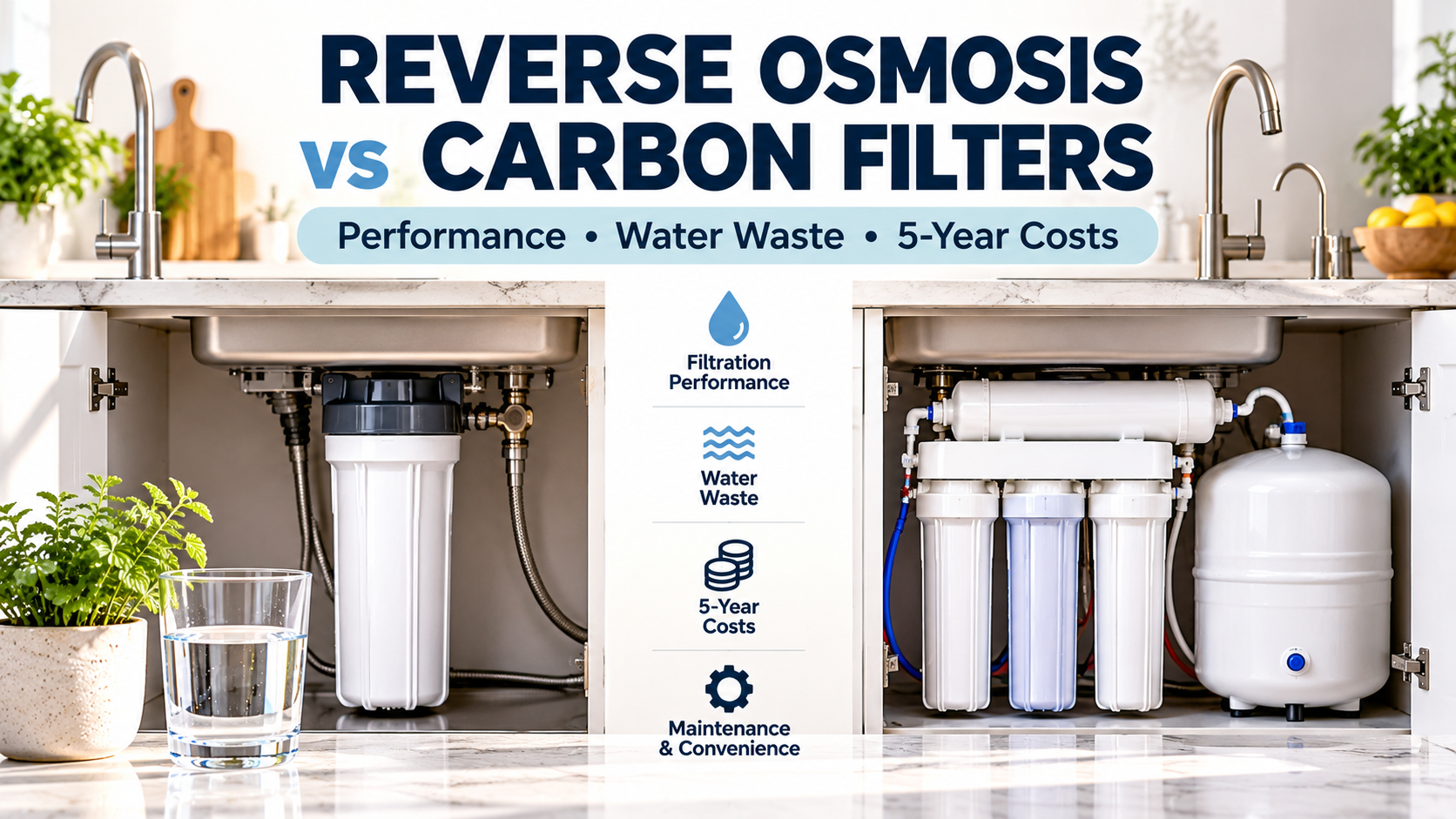
Reverse osmosis and carbon filtration can both improve drinking water—but they solve different problems. Compare contaminant reduction, installation, wastewater, filter replacement schedules, and five-year ownership costs before choosing an under-sink system.
A reverse-osmosis system can cost several times more than a basic carbon filter. It may also require extra plumbing, additional replacement components, and water discharged to a drain.
So why do people buy one?
Because a properly selected RO system can address certain dissolved contaminants that ordinary carbon filtration may not reliably reduce.
But that doesn’t mean every household needs reverse osmosis.
If your main concern is chlorine taste, odor, or a specific contaminant already covered by a certified carbon filter, an RO system may introduce expense and complexity without providing a meaningful additional benefit for your particular situation.
The smartest choice is not the filtration technology that removes the most substances in theory. It’s the system certified to address your actual water-quality concerns at a cost you can sustain.
This guide compares the two technologies through four practical questions:
- What is in your water?
- Which treatment claims are independently verified?
- How much water and maintenance will the system require?
- What will you actually pay over five years?
Quick Verdict: Reverse Osmosis vs Carbon Filtration
| Buying consideration | Carbon filtration | Reverse osmosis |
|---|---|---|
| Chlorine taste and odor | Often a strong choice with the right certification | Often addressed by included carbon stages |
| Lead | Possible with a specific certified reduction claim | Possible with a specific certified reduction claim |
| PFAS | Certain certified products can reduce specified PFAS | Certain certified RO systems can reduce specified PFAS |
| Nitrate | Ordinary carbon filtration is generally not the appropriate treatment | A suitable RO system with verified nitrate reduction may be appropriate |
| Fluoride | Standard carbon filtration is generally not reliable for fluoride reduction | Some certified RO systems have fluoride-reduction claims |
| Dissolved solids | Typically limited | RO is designed to reduce dissolved solids |
| Water sent to drain during treatment | Generally none for conventional carbon filtration | Yes, amount varies considerably |
| Installation | Often simpler | Usually more involved |
| Maintenance | Usually fewer components | Prefilters, postfilters, membrane, and sometimes other parts |
| Five-year cost | Often lower, depending on cartridge schedule | Often higher, but varies by model and efficiency |
Bottom line: Choose carbon filtration when a verified carbon-filter claim meets your needs. Consider RO when testing identifies contaminants requiring treatment that an ordinary carbon filter cannot provide.
Never rely on technology type alone as proof of a specific contaminant-reduction result.
1. How Carbon Filters and Reverse Osmosis Actually Work
Carbon Filtration: Adsorption Instead of Membrane Separation
Activated carbon has a porous structure that provides surface area for substances to attach to.
This process, called adsorption, can be effective for certain chemicals and compounds that affect taste and odor.
Some carbon-based systems also use additional filtration media or specialized designs to address specific health-related contaminants.
However, performance varies significantly between products.
A basic carbon pitcher, a carbon block under-sink system, and a multi-media certified filter should not be treated as equivalent simply because all contain carbon.
Reverse Osmosis: Separating Water From Dissolved Substances
Reverse osmosis uses pressure to push water through a semipermeable membrane.
The system produces two streams:
Permeate: The treated water you collect and drink.
Concentrate: The reject stream carrying substances separated from the treated water.
Many residential RO systems also include carbon prefilters and postfilters.
This means the comparison is often between a carbon-only system and a system combining carbon filtration with an RO membrane.
The additional membrane can be useful for dissolved substances that are not effectively addressed by conventional carbon filtration.
But it also adds maintenance requirements and creates a wastewater stream.
2. Which Removes More Contaminants: RO or Carbon?
This is the most important part of the buying decision.
The answer depends on the specific contaminant, filter design, and independent performance certification.
| Water-quality concern | Carbon filtration | Reverse osmosis | What to check |
|---|---|---|---|
| Chlorine taste | Often effective | Carbon stages often handle this | NSF/ANSI 42 chlorine-reduction claim |
| Lead | Certain certified systems | Certain certified systems | Explicit lead-reduction claim |
| PFOA/PFOS and other PFAS | Certain certified systems | Certain certified systems | Exact PFAS-reduction claim under NSF/ANSI 53 or 58 |
| Nitrate | Not typically removed effectively by ordinary carbon | Can be reduced by appropriate RO systems | Specific nitrate/nitrite-reduction claim |
| Fluoride | Not reliably reduced by standard carbon | Can be reduced by appropriate RO systems | Specific fluoride-reduction claim |
| Arsenic | Ordinary carbon is generally not sufficient | Certain RO systems may be appropriate | Certified arsenic claim and water chemistry |
| Dissolved salts/TDS | Usually limited | Significant reduction is a core RO function | NSF/ANSI 58 and product specifications |
| Microbial contamination | Ordinary carbon is not a reliable disinfection method | Do not assume a residential RO unit makes unsafe water microbiologically safe | Appropriate microbiological treatment and public-health guidance |
For Chlorine Taste, Carbon May Be All You Need
If your municipal water meets applicable drinking-water requirements and you mainly dislike its chlorine taste, a certified carbon filter can be a straightforward solution.
An RO system would usually add cost, maintenance, and wastewater to solve a problem that a simpler filter may already address.
For Lead, Compare Certified Claims—Not Technology Names
Both certain carbon filters and certain RO systems can be certified for lead reduction.
If two systems have the relevant verified claim, you can compare their replacement costs, convenience, and other performance characteristics.
Do not assume every RO system or every carbon block filter is certified for lead.
For PFAS, Certification Is More Important Than Marketing
PFAS are a group of chemicals, not one single contaminant.
EPA recommends looking for filters certified to NSF/ANSI 53 or 58 with the relevant PFAS-reduction claims.
A certification for PFOA/PFOS does not necessarily mean the filter has been verified for every PFAS compound.
Check the precise claims in the product’s certification listing and performance data sheet.
For Nitrate or Fluoride, RO May Have a Clearer Role
Conventional activated carbon is generally not the preferred technology for removing nitrate or fluoride.
A properly selected RO system can address these substances, but the exact model should have the relevant verified performance claims.
For private-well water, appropriate testing is particularly important before choosing treatment.
The key distinction: RO can provide broader dissolved-contaminant treatment, but only model-specific evidence tells you what a particular product has been verified to reduce.
3. The Hidden Tradeoff: How Much Water Does RO Waste?
Conventional carbon filtration generally does not send a separate reject stream down the drain during normal treatment.
Reverse osmosis does.
The amount varies widely by system design, pressure, operating conditions, and efficiency.
EPA notes that a typical point-of-use RO system can generate five gallons or more of reject water for every gallon of treated water.
Some inefficient systems may produce as much as ten gallons of reject water per treated gallon.
By contrast, an EPA WaterSense-labeled point-of-use RO system must meet a maximum waste-to-treated-water ratio of 2.3:1.
What Does That Mean for Your Household?
Suppose you use two gallons of treated drinking water per day.
That equals approximately 730 gallons per year.
| RO system scenario | Reject water per gallon treated | Annual reject water |
|---|---|---|
| Inefficient RO example | 5 gallons | 3,650 gallons |
| WaterSense maximum-ratio example | 2.3 gallons | 1,679 gallons |
| Higher-efficiency hypothetical example | 0.5 gallon | 365 gallons |
These are mathematical scenarios, not performance claims for particular products.
The WaterSense figure represents the program’s maximum permitted ratio, not the performance of every labeled model.
A WaterSense system may perform better than that limit.
Calculate Your Own RO Wastewater
Use this formula:
Annual reject water = daily treated-water use × 365 × waste-to-treated ratio
For a household using three gallons per day with a 3:1 waste-to-treated ratio:
3 × 365 × 3 = 3,285 gallons of reject water annually
This matters for both water conservation and household utility costs.
If you live in a drought-prone area or pay relatively high water and sewer rates, efficiency deserves serious attention.
Don’t Confuse a 2:1 Pure-to-Drain Claim With a 2:1 Waste-to-Pure Ratio
Marketing descriptions can use ratios in opposite directions.
2:1 pure-to-drain means approximately two gallons of treated water for one gallon of reject water.
2:1 waste-to-pure means approximately two gallons of reject water for one gallon of treated water.
Those are very different results.
Always confirm which direction the manufacturer is using.
For standardized comparisons, EPA’s WaterSense product listings provide efficiency information for labeled models.
4. Five-Year Ownership Cost: Carbon vs Reverse Osmosis
The initial purchase price tells you only part of the story.
A realistic five-year calculation should include:
Total five-year cost = system price + installation + replacement filters + membrane replacements + additional maintenance + water-related operating costs
The following examples use hypothetical budgets to demonstrate how the calculation works.
They are not current verified prices for specific products.
Scenario A: Under-Sink Carbon System
Assume:
- System purchase: $180
- Installation: $0, because the homeowner installs it
- Replacement cartridge set: $45
- Cartridge schedule: every six months
- Additional maintenance: excluded from this simplified example
If the original purchase includes a cartridge that lasts the first six months, nine paid replacement sets are needed to cover the remainder of five years.
| Expense | Five-year cost |
|---|---|
| Initial system | $180 |
| Nine replacement sets × $45 | $405 |
| Installation | $0 |
| Total | $585 |
If installation costs $150, the five-year total becomes $735.
Scenario B: Conventional Under-Sink RO System
Assume:
- System purchase: $320
- Installation: $180
- Annual replacement-filter bundle: $60
- RO membrane replacement: $100 every two years
- Original filters and membrane included with the system
- Additional repairs and water costs calculated separately
For a five-year period, assume four paid annual filter bundles after the initial set and two membrane replacements.
| Expense | Five-year cost |
|---|---|
| Initial RO system | $320 |
| Installation | $180 |
| Four annual filter bundles × $60 | $240 |
| Two membrane replacements × $100 | $200 |
| Subtotal before water and other costs | $940 |
The actual number and timing of replacement purchases depend on the model and whether replacement schedules are based on months, gallons, or both.
Scenario C: Add RO Water Costs
Suppose the household produces two gallons of treated water per day.
Over five years, that is approximately 3,650 gallons of treated water.
If the RO system generates 2.3 gallons of reject water per gallon treated:
3,650 × 2.3 = 8,395 gallons of reject water
At an illustrative combined marginal water-and-sewer cost of $0.01 per gallon:
8,395 × $0.01 = $83.95
The RO scenario would then total approximately $1,024, excluding electricity, repairs, and other expenses.
This is not a prediction of your utility bill. Water and sewer tariffs vary, and not all water use is billed the same way.
Five-Year Cost Comparison
| Example system | Initial + scheduled filter costs | Installation | Illustrative RO reject-water cost | Five-year total |
|---|---|---|---|---|
| DIY carbon | $585 | $0 | $0 | $585 |
| Professionally installed carbon | $585 | $150 | $0 | $735 |
| Professionally installed RO | $760 | $180 | $84 | $1,024 |
All figures are illustrative and rounded. The comparison assumes the original system includes initial filters and uses the specified replacement schedules. It excludes electricity, repairs, and optional upgrades.
The purpose is not to prove that every RO system costs more.
It is to show why a buyer should calculate the full maintenance schedule before comparing purchase prices.
For a closer look at cartridge replacement economics, see:
Water Filter Replacement Costs in 2026: When to Change Filters and What You Really Pay Per Gallon
5. When Does the Extra Cost of RO Make Sense?
RO does not necessarily pay for itself through cheaper filtration.
Its value may come from addressing a specific water-quality problem that another system cannot adequately solve.
Consider two households.
Household A: Chlorine Taste Is the Only Concern
The household receives municipal water that meets applicable standards.
Its main complaint is taste.
A certified carbon filter may provide the desired improvement without requiring a membrane, drain connection, or RO maintenance.
The extra cost of RO may offer little practical benefit for this particular goal.
Household B: A Water Test Shows Elevated Nitrate
The household uses a private well.
Testing identifies a nitrate concern.
A basic carbon filter is not the appropriate treatment for nitrate.
A properly selected and verified RO system may be a more suitable option, potentially alongside other professional recommendations.
In this case, the additional expense is justified by the treatment need—not by a lower cost per gallon.
Never let a lower price override a necessary contaminant-reduction requirement.
6. Installation: What Buyers Often Overlook
Carbon and RO systems differ in their installation requirements.
Carbon Under-Sink Systems
Many conventional carbon systems connect to the cold-water supply and a dedicated or existing faucet, depending on the design.
They often require less space than traditional tank-based RO systems.
Some installations are relatively simple, although plumbing configurations vary.
Tank-Based RO Systems
A traditional RO system may require:
- A cold-water supply connection
- A drain connection
- A separate drinking-water faucet
- Space for filters and a storage tank
- Suitable water pressure
- Periodic access for servicing
Tankless RO Systems
Tankless designs eliminate the large storage tank but may require electricity and have different pressure, flow, and installation requirements.
They can also have proprietary replacement filters that affect long-term costs.
Do not assume that tankless automatically means cheaper, more efficient, or easier to install.
Verify the exact product specifications.
Renters and Small Kitchens
If you rent or have limited under-sink space, installation constraints can determine which system is practical.
A countertop filter or removable system may be easier to accommodate.
Before buying, check lease restrictions, available outlets, cabinet dimensions, and plumbing requirements.
7. Does RO Remove Healthy Minerals From Water?
Reverse osmosis reduces many dissolved substances, including some minerals.
That is part of how the technology works.
But lower total dissolved solids do not automatically mean water is healthier, and a high TDS reading does not automatically mean water is unsafe.
TDS measures dissolved material collectively; it does not identify individual harmful contaminants.
The nutritional significance of minerals in drinking water depends on the person’s diet and other factors.
Some RO systems offer remineralization stages to change taste or mineral content.
Treat these as product features to evaluate, not proof that a more expensive system is medically necessary.
8. How to Verify Carbon and RO Certifications
A filter’s technology does not replace the need for independent certification.
Relevant standards include:
NSF/ANSI 42: Aesthetic effects such as specified chlorine taste and odor reduction.
NSF/ANSI 53: Specific health-related contaminant reduction claims, potentially including lead or PFAS.
NSF/ANSI 58: Reverse-osmosis drinking-water treatment systems, including required TDS-reduction performance and optional contaminant-specific claims.
An NSF/ANSI 58 certification does not mean every optional contaminant-reduction claim applies.
Likewise, NSF/ANSI 53 certification does not mean every possible health-related contaminant is reduced.
To avoid purchasing the wrong system, read our complete guide:
A Four-Step Certification Check
- Find the exact product model.
- Identify the certifying organization.
- Search the organization’s official product directory.
- Confirm the specific contaminant claim and approved replacement components.
A statement such as “tested to NSF standards” should not automatically be treated as current third-party certification.
9. What About Water Filter Pitchers?
A pitcher can be a sensible alternative when your needs are modest and you prefer minimal installation.
But pitcher performance varies by cartridge and certification.
A certified pitcher may address particular contaminants, while another pitcher may primarily improve taste.
Before comparing a pitcher with an under-sink carbon or RO system, consider:
- Household filtered-water consumption
- Available storage space
- Replacement frequency
- Specific certified reduction claims
- Convenience and refill requirements
- Three- to five-year ownership costs
For a direct comparison of two common filtration formats, read:
Water Filter Pitcher vs Under-Sink Filter in 2026: Which Costs Less Over 3 Years?
10. The Five-Year Buying Checklist
Before ordering an RO or carbon filtration system, answer these questions.
Water quality
- Have I reviewed a water-quality report or obtained suitable testing?
- Which specific contaminants am I trying to reduce?
- Does the exact system have verified claims for those contaminants?
Installation
- Will the system fit beneath my sink?
- Does it need a drain connection or electrical outlet?
- Can I install it myself, or do I need a professional?
- Are there pressure or water-quality limits?
Operating costs
- What replacement cartridges are required?
- Does the RO system need membrane replacements?
- What are the calendar and gallon-capacity limits?
- What is the verified water-efficiency rating?
- Are replacement parts proprietary?
Long-term value
- What is the full five-year cost?
- Can I obtain replacement parts reliably?
- Does the system solve a documented problem?
- Would a simpler certified filter do the same job?
If a product listing does not provide enough information to answer these questions, look for a system with clearer documentation.
Frequently Asked Questions
Is Reverse Osmosis Better Than a Carbon Filter?
RO can address a broader range of dissolved substances, but a properly certified carbon filter may be the better value when it meets your specific water-quality needs.
Does Carbon Filtration Remove PFAS?
Some carbon-based systems have verified PFAS-reduction claims. Others do not. Check the exact model’s certification and named PFAS claims.
Does Reverse Osmosis Remove Fluoride?
Some RO systems can reduce fluoride. Look for a model with the appropriate verified fluoride-reduction claim.
How Much Water Does Reverse Osmosis Waste?
It depends on the system. EPA reports that typical point-of-use systems may generate five or more gallons of reject water per gallon treated. WaterSense-labeled systems must meet a maximum ratio of 2.3:1.
Is a Tankless RO System More Efficient?
Not necessarily. Tankless design alone does not establish water efficiency. Compare independently verified efficiency information for the specific models.
Is RO Water Safe to Drink?
Water produced by a properly selected, installed, and maintained RO system can be suitable for drinking. However, no treatment system should be assumed to address every hazard, particularly when the source water may be microbiologically unsafe.
Can I Install an RO System Myself?
Some products are designed for homeowner installation, but installation complexity depends on plumbing, drainage, electricity, and manufacturer requirements.
Which Is Cheaper Over Five Years?
Carbon filtration often has a cost advantage when its certified performance meets the household’s needs. RO systems can involve higher purchase, installation, membrane, and water costs. Calculate using the exact products rather than relying on generic averages.
Final Verdict: Buy the Treatment You Need, Not the Most Complicated System
Reverse osmosis is not automatically the best choice for every kitchen.
It can be valuable when water testing identifies dissolved contaminants that a conventional carbon filter is not equipped to address.
But when a certified carbon filter already solves your specific problem, paying for an RO membrane, drain connection, and additional maintenance may be unnecessary.
Choose carbon when its verified claims match your water. Choose RO when its additional treatment capabilities address a real need.
Then compare the five-year cost—not just the price on the box.
That approach protects your budget, avoids unnecessary water waste, and makes your purchase more defensible than choosing a system based on marketing claims alone.
Editorial Sources and Further Reading
- U.S. EPA — Point-of-Use Reverse Osmosis Systems and WaterSense
- U.S. EPA — WaterSense-Labeled Reverse Osmosis Product Search
- NSF — Standards for Water Treatment Systems
- NSF — NSF/ANSI 58: Reverse Osmosis Drinking Water Treatment Systems
- NSF — PFAS in Drinking Water
- U.S. EPA — Overview of Drinking Water Treatment Technologies
Editorial methodology: Living Pick Lab has not independently tested the products discussed. The five-year cost scenarios are hypothetical calculations, not verified product quotes. Contaminant reduction depends on the exact certified model, water conditions, and maintenance. Always consult current certification listings, manufacturer instructions, and appropriate water-quality testing before purchasing.