
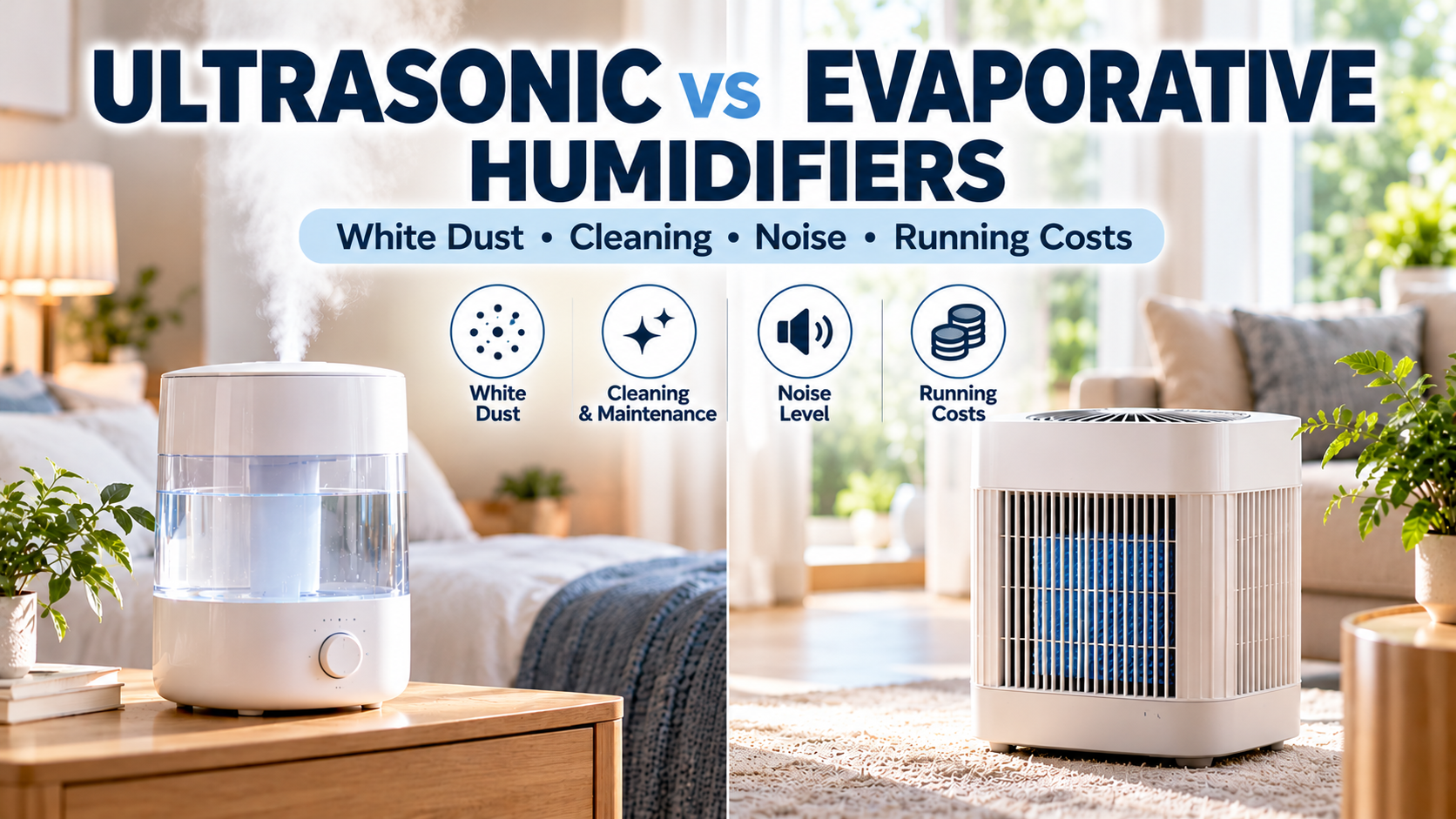
Ultrasonic and evaporative humidifiers both add moisture to dry indoor air, but they differ in ways that can significantly affect your daily routine and long-term costs. Here’s how to choose the right technology for your water quality, bedroom, maintenance habits, and budget.
A humidifier can look like a simple purchase.
You choose a tank size, compare a few prices, and find a model that promises enough mist for your room.
But two humidifiers with similar prices can be very different to own.
One might operate almost silently but require a steady supply of distilled water to minimize mineral dust. Another might work comfortably with ordinary tap water but need regular wick replacements and produce noticeable fan noise.
Neither is automatically the better choice.
The best humidifier is the one that delivers the moisture you need without creating a water-quality, cleaning, noise, or maintenance problem you didn’t anticipate.
This guide compares ultrasonic and evaporative humidifiers beyond their marketing claims, including realistic annual operating-cost examples and a practical decision framework.
Quick Verdict: Ultrasonic vs Evaporative Humidifiers
| Buying factor | Ultrasonic humidifier | Evaporative humidifier |
|---|---|---|
| How it works | Vibrates water into fine droplets | Fan moves air through a wet wick |
| Visible mist | Usually yes | Usually no |
| Operating noise | Often quieter | Fan noise is common |
| White dust with mineral-rich water | Greater concern | Generally much less |
| Distilled water | Often beneficial, particularly with hard water | Usually less necessary for mineral-dust control |
| Replacement wick | Often none, though some models use cartridges | Usually required |
| Daily water care | Important | Important |
| Regular deep cleaning | Essential | Essential |
| Typical maintenance expense | Water treatment or mineral-control supplies | Wick replacements |
| Best suited to | Quiet rooms and users willing to manage water quality | Households prioritizing reduced mineral aerosol and convenient tap-water use |
Our recommendation: If you have hard water and don’t want to buy distilled water regularly, start by comparing evaporative models. If low noise is your top priority and you can consistently use suitable low-mineral water, an ultrasonic model may be a better fit.
Neither technology eliminates the need for cleaning.
1. How Do Ultrasonic and Evaporative Humidifiers Work?
Understanding how moisture enters the air explains most of the practical differences.
Ultrasonic Humidifiers: Tiny Water Droplets
An ultrasonic humidifier uses a rapidly vibrating component to break water into microscopic droplets.
Those droplets are released into the surrounding air as a visible or nearly invisible mist.
The advantage is that the system can operate without a conventional fan, although some models include one.
That often makes ultrasonic humidifiers appealing for bedrooms, home offices, and other spaces where sound matters.
However, the mist originates from the water in the tank.
When the water contains dissolved minerals, those minerals can travel with the droplets and eventually appear as deposits on nearby surfaces or contribute to airborne particulate matter.
Evaporative Humidifiers: Moisture Through a Wick
An evaporative humidifier uses a fan to move air through a wet wick or filter.
Water evaporates from the wick into the airflow.
Most dissolved minerals remain behind rather than being released as part of a mist.
This design makes evaporative humidifiers especially attractive in homes where tap water contains substantial mineral content.
The tradeoffs are usually fan noise, wick maintenance, and potentially larger equipment.
The key distinction: Ultrasonic systems disperse droplets from the tank. Evaporative systems encourage water to enter the air through evaporation.
That difference matters more than whether the product is marketed as “cool mist.”
2. White Dust: Why Your Water Quality Matters
White dust is one of the most important reasons to compare humidifier technologies before purchasing.
If you have noticed a powdery residue on furniture after using a humidifier, the minerals in your water may be responsible.
Why Ultrasonic Humidifiers Produce White Dust
Tap water contains varying amounts of dissolved minerals.
When an ultrasonic humidifier releases water droplets, mineral content can accompany those droplets.
After the water evaporates, mineral particles may remain.
The U.S. Environmental Protection Agency notes that ultrasonic and impeller humidifiers can efficiently disperse minerals from tap water into indoor air.
This is particularly relevant in areas with hard water.
Are Evaporative Humidifiers Free of Mineral Problems?
Not entirely.
An evaporative system generally releases far fewer waterborne minerals into the air because evaporation leaves most minerals behind.
But those minerals can accumulate in the wick or reservoir.
The result may be a stiff, discolored, or clogged filter that needs replacing.
So the tradeoff is not simply “minerals versus no minerals.”
It’s more accurately:
Ultrasonic: Manage the minerals before they enter the mist.
Evaporative: Manage the minerals accumulating inside the system.
Does White Dust Mean Your Home Is Unsafe?
White dust is evidence that mineral-containing droplets may be entering the air.
However, a visible deposit alone cannot establish an individual’s health risk or quantify exposure.
The prudent response is to reduce unnecessary aerosolized minerals, follow the manufacturer’s water recommendations, and maintain the humidifier properly.
Independent testing by RTINGS has demonstrated how the water used in ultrasonic humidifiers can affect airborne particle concentrations.
For buyers with mineral-rich water, this is a meaningful consideration—not merely a cosmetic issue.
3. Can You Use Tap Water in a Humidifier?
The answer depends on the type of humidifier and the manufacturer’s instructions.
Tap Water in Ultrasonic Humidifiers
Tap water may be permitted by some manufacturers, but mineral-rich water can produce more white dust and scaling.
EPA recommends considering water with low mineral content, such as distilled water, to reduce mineral dispersion.
Demineralization cartridges may help, but their performance and lifespan vary.
A cartridge advertised as reducing white dust should not be assumed to remove all dissolved minerals.
Tap Water in Evaporative Humidifiers
Evaporative models are often more practical with ordinary tap water because their wicks retain much of the mineral content.
That does not mean tap water is free of maintenance consequences.
Hard water can accelerate mineral buildup, shorten wick life, and increase cleaning needs.
Always check whether the specific manufacturer permits tap water and whether the wick is designed for your local water conditions.
What About Filtered Water?
“Filtered water” is not a single water-quality category.
A basic carbon filter may improve chlorine taste and odor without substantially reducing dissolved minerals.
Reverse osmosis generally reduces dissolved solids, but actual mineral reduction depends on the system and its condition.
Distilled water is typically the clearest low-mineral option for reducing ultrasonic white dust.
Do not assume that water from an ordinary pitcher filter is equivalent to distilled water.
4. The Hidden Cost: Distilled Water vs Replacement Wicks
This is where a seemingly inexpensive humidifier can become expensive to operate.
A useful comparison should include:
- Initial humidifier price
- Distilled-water purchases
- Replacement wicks or mineral-control cartridges
- Electricity
- Cleaning supplies
- The amount of water actually used
Rather than presenting unverifiable averages, let’s calculate several transparent examples.
Scenario A: Ultrasonic Humidifier Using Distilled Water
Assume a household uses:
- 0.5 gallon of water per day
- 120 days per year
- Distilled water costing $1.50 per gallon
Annual water use:
0.5 × 120 = 60 gallons
Annual distilled-water cost:
60 × $1.50 = $90
Over three humidifying seasons:
$90 × 3 = $270
That’s before the purchase price and electricity.
The exact cost will vary with your local water price, daily consumption, and operating season.
Scenario B: Evaporative Humidifier With Replacement Wicks
Assume:
- Replacement wick price: $18
- Two wick replacements per season
- Four-month humidifying season
- Tap water used as permitted by the manufacturer
Annual wick cost:
$18 × 2 = $36
Three-year wick cost:
$36 × 3 = $108
This excludes water, electricity, cleaning products, and the original humidifier.
The calculation also assumes the initial wick is included and the two purchased replacements cover the selected seasonal schedule.
Scenario C: Ultrasonic Humidifier With a Mineral-Control Cartridge
Assume:
- Cartridge price: $15
- Three cartridges purchased per season
Annual cartridge cost:
$15 × 3 = $45
Three-year cartridge cost:
$45 × 3 = $135
This scenario assumes the cartridge is compatible with the humidifier and provides adequate mineral control for the household’s water.
It does not establish that cartridges perform as well as distilled water.
Three-Year Consumable Cost Comparison
| Illustrative scenario | Annual cost | Three-year cost |
|---|---|---|
| Ultrasonic with purchased distilled water | $90 | $270 |
| Evaporative with replacement wicks | $36 | $108 |
| Ultrasonic with mineral-control cartridges | $45 | $135 |
Important: These are hypothetical consumable-cost examples, not verified market-price comparisons. They do not include initial purchase price, electricity, cleaning supplies, or unexpected replacements.
The lowest-cost option for one household may not be the lowest-cost option for another.
The Break-Even Question
If your ultrasonic humidifier uses 60 gallons of distilled water per season, the water cost can exceed the price of replacement wicks for an evaporative model.
But if you use very little water or have a reliable, low-cost source of suitable low-mineral water, that calculation changes.
This is why the right buying question is:
What will my humidifier cost to operate with the water I actually have?
5. Electricity Costs: Is Ultrasonic Cheaper?
Ultrasonic humidifiers often consume less electricity than fan-driven evaporative models, but exact power use varies by product.
Some evaporative models have efficient fans, while certain ultrasonic models include additional features that increase power consumption.
For a meaningful comparison, use the wattage of the exact products.
Example: 25-Watt vs 45-Watt Humidifier
Assume:
- Ultrasonic model: 25 watts
- Evaporative model: 45 watts
- Daily runtime: 8 hours
- Operating season: 120 days
- Electricity rate: $0.18 per kWh
Ultrasonic electricity consumption:
0.025 kW × 8 × 120 = 24 kWh
24 × $0.18 = $4.32 per season
Evaporative electricity consumption:
0.045 kW × 8 × 120 = 43.2 kWh
43.2 × $0.18 = $7.78 per season
Difference:
Approximately $3.46 per season
In this example, electricity costs matter less than distilled water or wick replacement costs.
Your result may differ substantially, especially with high-output systems, warm-mist functions, or different electricity rates.
Buying lesson: Don’t focus exclusively on wattage while overlooking consumables.
6. Noise: Which Humidifier Is Better for Bedrooms?
Ultrasonic humidifiers are often quieter because they do not require a large fan to move air through a wick.
That can be useful for:
- Light sleepers
- Quiet home offices
- Bedrooms where steady fan noise is unwelcome
- Nighttime operation at low output
However, ultrasonic models are not necessarily silent.
Some produce occasional bubbling, dripping, or electronic sounds.
Evaporative humidifiers typically generate fan noise, which increases at higher output settings.
Some users find a consistent fan sound acceptable or even preferable to intermittent water noises.
What to Check Before Buying
Don’t rely on the word “quiet.”
Look for:
- Measured decibel ratings, where available.
- Noise at the setting you expect to use.
- Whether the display can be dimmed.
- Reports of bubbling or mechanical sounds.
- The ability to maintain humidity at a lower fan speed.
A model’s quietest setting may not deliver enough moisture for your room.
7. Cleaning: Neither Type Is Maintenance-Free
This is the biggest mistake buyers make when choosing between ultrasonic and evaporative humidifiers.
A filter is not a substitute for cleaning.
Both designs hold water, and neglected reservoirs can allow microorganisms or deposits to accumulate.
EPA recommends emptying, drying, and refilling portable humidifiers daily and cleaning them every third day.
Manufacturer instructions may provide additional model-specific requirements.
A Practical Daily Routine
- Turn off and unplug the humidifier before handling it.
- Empty leftover water from the portable tank.
- Wipe accessible surfaces dry.
- Refill with appropriate fresh water.
- Check for visible film, deposits, or unusual odors.
A Regular Cleaning Routine
- Follow the manufacturer’s cleaning procedure.
- Remove scale and deposits from accessible surfaces.
- Use only cleaning products permitted for the model.
- Rinse thoroughly after cleaning agents.
- Inspect wicks, cartridges, and other replaceable parts.
Do not mix cleaning chemicals or add disinfectants to the operating water unless the manufacturer specifically directs their use.
Is an Evaporative Wick a Cleaning Shortcut?
No.
A wick helps with evaporation and mineral retention, but it can accumulate deposits and become unsuitable for continued use.
Replacing a dirty wick does not automatically clean the reservoir.
Likewise, using distilled water in an ultrasonic humidifier does not eliminate the need for routine cleaning.
8. Humidity Control: More Moisture Isn’t Always Better
The purpose of a humidifier is to correct overly dry indoor air—not to maximize humidity.
EPA generally recommends maintaining indoor relative humidity around 30% to 50%.
Excess moisture can contribute to condensation and conditions that support biological growth.
Why a Hygrometer Matters
A separate digital hygrometer can help you determine whether a humidifier is needed and whether it is operating appropriately.
A built-in humidistat is useful, but accuracy varies by model.
Place the hygrometer away from the direct mist stream and follow its positioning instructions.
Warning Signs of Too Much Humidity
Watch for:
- Condensation on windows
- Damp walls or furnishings
- Moisture collecting around the humidifier
- A persistent musty smell
- Indoor humidity readings above your intended range
If these occur, reduce output, reposition the unit, or stop using it until the moisture issue is resolved.
A more powerful humidifier is not necessarily better for a small room.
9. Which Humidifier Should You Choose for Hard Water?
Hard water is one of the clearest reasons to consider evaporative technology.
If you live in an area with mineral-rich tap water and want to avoid buying distilled water, an evaporative humidifier may simplify your routine.
The wick generally retains mineral deposits instead of dispersing them as mist.
However, harder water can increase wick replacement frequency.
Before buying, check:
- Replacement wick availability
- Current wick prices
- Expected replacement intervals
- Whether the model allows tap water
- How easily mineral deposits can be removed
- Whether the reservoir is accessible for cleaning
If you prefer ultrasonic technology, budget for an appropriate low-mineral water source and review the manufacturer’s mineral-control options.
10. What About Humidifiers for Babies and Children’s Rooms?
The same basic considerations apply, but placement, cleaning, and safe operation become especially important.
A cool-mist humidifier avoids the hot-water and steam-burn hazards associated with steam vaporizers.
However, cool mist does not automatically mean the device is clean or that the room’s humidity is appropriate.
For a child’s room:
- Keep the humidifier and electrical cord out of reach.
- Prevent direct mist from wetting bedding or walls.
- Follow daily water-care and regular cleaning instructions.
- Monitor indoor humidity.
- Avoid unnecessary additives or fragrances.
- Select a stable, appropriately sized device.
If a child has respiratory symptoms or a diagnosed condition, seek individualized advice from a qualified healthcare professional rather than relying on a humidifier as treatment.
11. Seven Buying Mistakes to Avoid
Mistake 1: Choosing the Largest Tank
A large tank can reduce refilling frequency, but it can also encourage water to remain in the unit longer if daily water care is neglected.
Choose a tank you can comfortably empty, clean, and refill.
Mistake 2: Assuming Filterless Means Maintenance-Free
A filterless ultrasonic model may eliminate wick purchases, but water quality and cleaning still matter.
Mistake 3: Ignoring Replacement-Wick Availability
An inexpensive evaporative humidifier becomes a poor long-term purchase if compatible wicks are difficult to find or unusually expensive.
Mistake 4: Assuming All Filtered Water Is Low-Mineral
Ordinary carbon filtration does not necessarily remove dissolved minerals.
Mistake 5: Comparing Noise Only at Minimum Output
A very quiet setting may not produce enough moisture for the intended room.
Mistake 6: Believing More Humidity Is Always Healthier
Excess humidity can create moisture-related problems.
Mistake 7: Comparing Purchase Prices Instead of Ownership Costs
Distilled water, wicks, cartridges, and electricity can change the economics over multiple seasons.
12. The Living Pick Lab Buying Decision Framework
Rather than choosing a brand first, start with your household conditions.
| Your priority | Start by considering | Why |
|---|---|---|
| Very quiet bedroom operation | Ultrasonic | Often lower fan noise |
| Hard tap water | Evaporative | Less mineral aerosol from normal operation |
| Avoiding purchased distilled water | Evaporative | Often more practical with tap water |
| Avoiding replacement wicks | Ultrasonic | Many models are wick-free |
| Lowest long-term cost | Calculate both | Water and wick costs vary |
| Easy cleaning | Compare exact designs | Tank access matters more than type alone |
| Consistent humidity control | Models with reliable humidistats | Prevents unnecessary over-humidification |
| Small apartment | Compact models with suitable output | Size and placement may be decisive |
The Five Questions That Matter Most
Before purchasing, ask:
1. What kind of water will I use?
If the answer is hard tap water, pay particular attention to mineral dispersion and wick costs.
2. How much noise can I tolerate?
If quiet operation is essential, investigate ultrasonic models and independently measured noise.
3. Will I actually clean it regularly?
Choose a tank design you can easily access and maintain.
4. What will replacement supplies cost?
Calculate your likely seasonal distilled-water, wick, or cartridge expense.
5. Can the unit maintain appropriate humidity without wetting nearby surfaces?
Look for adjustable output, reliable humidity controls, and suitable room coverage.
The best humidifier is not necessarily the one with the longest feature list.
It is the one whose operating requirements fit your daily life.
Frequently Asked Questions
Is an Ultrasonic or Evaporative Humidifier Better?
Neither is universally better. Ultrasonic models often offer quieter operation, while evaporative models are generally more practical for reducing mineral-dust concerns when using tap water.
Do Evaporative Humidifiers Produce White Dust?
They generally release far less mineral-containing mist than ultrasonic humidifiers. However, minerals can accumulate in their wicks and reservoirs.
Can I Use Tap Water in an Ultrasonic Humidifier?
Follow the manufacturer’s instructions. Mineral-rich tap water can increase white dust and scale. Distilled water is commonly recommended to reduce mineral dispersion.
Is Distilled Water Necessary for Evaporative Humidifiers?
Not always. Many evaporative models are designed for tap-water use, although hard water may shorten wick life. Follow the specific product instructions.
Are Ultrasonic Humidifiers Cheaper to Run?
They may use less electricity, but purchased distilled water or mineral-control supplies can offset that advantage. Calculate all recurring expenses.
How Often Should I Clean a Humidifier?
EPA recommends daily emptying and drying of portable humidifiers and cleaning every third day. Follow any additional manufacturer instructions.
Are Evaporative Humidifiers Noisier?
They often produce more fan noise. Actual sound levels depend on the model and operating setting.
Can a Humidifier Help With Dry Indoor Air?
Yes. A humidifier adds moisture to the air, but it should be used only when needed and should not push indoor humidity beyond an appropriate range.
Final Verdict: Choose Based on Water, Noise and Maintenance
The ultrasonic-versus-evaporative debate is often presented as a contest between modern technology and traditional design.
That misses the practical question.
Which type can you operate consistently, clean properly, and afford to maintain?
Choose an ultrasonic humidifier if you value quiet operation, can manage the water-quality requirements, and are comfortable with its cleaning routine.
Choose an evaporative humidifier if you want to minimize mineral aerosol from tap water and are willing to manage a fan and replacement wicks.
For many households, the cost of consumables and the realities of daily maintenance matter more than a small difference in purchase price.
Before buying, calculate one full humidifying season of water, filter, and electricity costs.
Then choose the design that fits your actual home.
Sources and Editorial References
- U.S. EPA — Use and Care of Home Humidifiers
- U.S. EPA — Sources of Indoor Particulate Matter
- U.S. EPA — Home Humidifier Use and Care Guide (PDF)
- Consumer Reports — Humidifier Buying Guide
- RTINGS — Humidifier White Dust: Causes and Prevention
Editorial note: Living Pick Lab has not independently tested the humidifiers discussed in this article. All cost examples are hypothetical and use clearly stated assumptions rather than verified current retail prices. Product performance, maintenance schedules, and water requirements vary by model. Always consult manufacturer instructions and current authoritative guidance.