
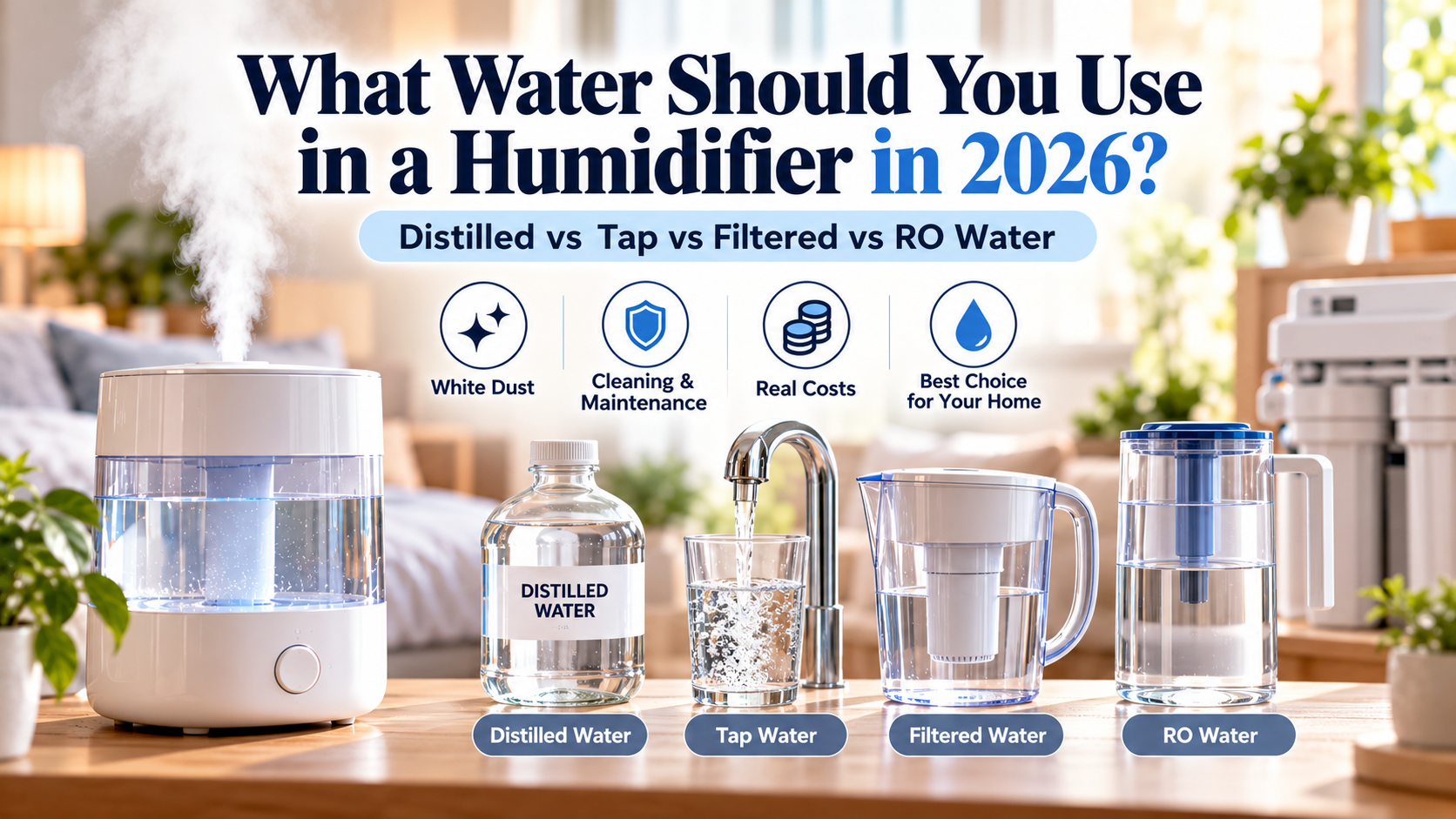
The best water for your humidifier depends on how the machine works, what your household water contains, and how much you are willing to spend over an entire heating season.
For most ultrasonic humidifiers, distilled water is the most straightforward choice for minimizing mineral-related white dust. Reverse osmosis (RO) water can also be a practical low-mineral option, although its performance depends on the system. Ordinary pitcher-filtered water is not necessarily equivalent to either one.
For evaporative humidifiers, the decision is different. Because these machines evaporate water through a wick rather than spraying droplets into the air, they generally release far fewer dissolved minerals into the room. Tap water may therefore be a reasonable option when the manufacturer permits it, although mineral buildup and wick maintenance still matter.
The important distinction is this: water that is suitable for drinking is not automatically the best water for an ultrasonic humidifier.
This guide compares six water options, explains what actually causes white dust, calculates seasonal water costs, and provides a practical decision framework without assuming that every home needs expensive water treatment equipment.
Quick Answer: Which Water Is Best for Your Humidifier?
| Water type | Ultrasonic humidifier | Evaporative humidifier | Main consideration |
|---|---|---|---|
| Distilled water | Usually the most straightforward low-mineral choice | Generally suitable if allowed | Recurring purchase cost |
| Reverse osmosis water | Often a practical low-mineral alternative | Generally suitable if allowed | RO performance and existing system cost |
| Deionized water | Can be low in dissolved ions when appropriately produced | Usually unnecessary | Product purity and intended use vary |
| Ordinary pitcher-filtered water | Do not assume it prevents white dust | Often usable if permitted | Most filters are not designed primarily for mineral removal |
| Tap water | More likely to create white dust, particularly with hard water | Often acceptable if permitted | Scale, wick wear, and cleaning |
| Bottled spring or mineral water | Usually not a good solution to white dust | Typically offers little advantage | May contain substantial dissolved minerals |
Bottom line: Choose distilled water when minimizing mineral aerosols is the priority and you do not have a verified low-mineral alternative. Consider RO water if you already own a suitable system. For an evaporative humidifier, check the manual before paying for specialty water.
1. Why the Type of Water Matters More Than Many Buyers Realize
Two households can buy the same ultrasonic humidifier and have very different experiences.
In one home, the unit runs for weeks without visible residue. In another, a powdery film appears on dark furniture after only a few days.
The difference may be the mineral content of the water.
Tap water contains varying amounts of dissolved substances, including calcium and magnesium. When an ultrasonic humidifier turns water into fine droplets, some of those substances can travel into the surrounding air.
As the droplets evaporate, minerals may remain suspended as particles or settle on nearby surfaces.
This is commonly called humidifier white dust.
The U.S. Environmental Protection Agency explains that ultrasonic and impeller humidifiers can disperse minerals and microorganisms from their tanks. It recommends using water with low mineral content to reduce mineral release.
White dust is not necessarily proof that a humidifier is defective. It may indicate that the water and humidifier technology are a poor match.
It is also important not to confuse white dust with mold. Mineral residue and microbial contamination are different problems, and using low-mineral water does not eliminate the need for cleaning.
2. Distilled Water: The Simple Benchmark
Distilled water is produced by evaporating water and collecting the condensed vapor. The process removes most dissolved minerals.
That makes it particularly useful for ultrasonic humidifiers.
Advantages
- Generally produces much less mineral-related white dust than typical tap water.
- Does not require installing a home filtration system.
- Offers a relatively predictable starting point for users troubleshooting white residue.
- Can reduce mineral scale accumulation compared with mineral-rich water.
Limitations
The biggest drawback is ongoing cost.
A humidifier that uses a gallon of water per day can consume a substantial amount of distilled water over a winter.
Buying and carrying multiple jugs is also inconvenient, particularly for households operating several humidifiers.
Distilled water is not a substitute for cleaning. Once a container is opened or water sits in a humidifier tank, microbial contamination can still occur.
Best for
Households with ultrasonic humidifiers, visible white dust, or high-mineral tap water that want a straightforward solution without buying a water treatment system.
3. Tap Water: Convenient, but Not Universally Appropriate
Tap water is inexpensive, readily available, and usually the most convenient option.
However, its mineral content varies significantly by location.
Water hardness is especially relevant because hard water contains higher concentrations of calcium and magnesium.
What happens in an ultrasonic humidifier?
The machine creates tiny droplets from the water inside the tank. Those droplets can carry dissolved minerals into the air.
The more mineral-rich the water, the greater the potential for visible residue and mineral aerosol emissions, although the actual amount depends on the machine and operating conditions.
Independent testing published by RTINGS has demonstrated substantial differences in particle output when ultrasonic humidifiers operate with different water mineral concentrations.
What happens in an evaporative humidifier?
An evaporative humidifier passes air across a wet wick or similar material.
Water evaporates into the air, while much of the mineral content stays behind in the wick or reservoir.
That reduces the white-dust problem, but it introduces a different maintenance concern: mineral deposits can accumulate in the wick and reduce performance.
Important: Always follow the manufacturer’s water requirements. Some models specify particular water types or maintenance procedures.
Best for
Evaporative humidifier owners whose manufacturers permit tap water and who are comfortable maintaining the wick and reservoir.
4. Filtered Water: Why a Pitcher Filter May Not Solve White Dust
One of the most common assumptions is that filtered drinking water must be better for a humidifier.
Sometimes it is. But the answer depends on what the filter actually removes.
A typical activated-carbon pitcher filter may be designed primarily to improve taste, reduce chlorine, or address certain certified contaminants.
That does not automatically mean it removes enough dissolved calcium, magnesium, or total dissolved solids to prevent white dust.
Two filters that both advertise cleaner drinking water can have very different mineral-removal capabilities.
The critical question
Do not ask only:
Does this filter make water cleaner?
Ask:
Does this specific filter substantially reduce dissolved minerals in the water?
Look for independent performance information and the manufacturer’s specifications rather than relying on broad marketing phrases.
If the filter does not significantly reduce mineral content, the water may behave much like ordinary tap water inside an ultrasonic humidifier.
Best for
Users who have confirmed that their particular filtration system reduces dissolved minerals sufficiently for their humidifier.
For a deeper look at the differences among drinking-water technologies, see our guide to reverse osmosis vs carbon water filters.
5. Reverse Osmosis Water: A Practical Alternative if You Already Own an RO System
Reverse osmosis systems use a membrane to reduce many dissolved substances in water.
A properly functioning RO system can substantially lower mineral content, making its output a practical option for some ultrasonic humidifiers.
But there are important qualifications.
First, RO systems vary in performance. Membrane condition, incoming water quality, maintenance, and system design all affect the result.
Second, some drinking-water systems add minerals back into the water after RO treatment. This may be desirable for drinking-water taste but counterproductive if your goal is minimizing mineral-related humidifier dust.
Third, RO systems generate wastewater during treatment. The amount depends on the equipment.
Should you buy an RO system just for a humidifier?
Not necessarily.
If you already have a suitable RO system, using its water may reduce the need to purchase distilled water.
If you do not own one, compare the full installation and maintenance cost against your expected humidifier water use before investing.
A whole new RO system may be difficult to justify for a single small humidifier.
Best for
Households that already own and maintain an RO system and can verify that its output is low in dissolved minerals.
6. What About Boiled Water, Softened Water, and Bottled Spring Water?
These options often create confusion because they can sound similar to purified water.
Boiled tap water
Boiling water does not turn it into distilled water.
Some temporary hardness may precipitate during boiling, but many dissolved substances remain. As water evaporates during boiling, remaining minerals may become more concentrated.
Boiling is therefore not a reliable substitute for distillation when your goal is preventing white dust.
Water-softener water
A conventional ion-exchange water softener typically replaces calcium and magnesium ions with sodium or potassium ions.
It reduces hardness, but it does not necessarily reduce total dissolved solids.
That means softened water is not automatically a low-mineral solution for an ultrasonic humidifier.
Bottled spring or mineral water
Bottled water marketed as spring water or mineral water may contain appreciable dissolved minerals.
The word bottled does not mean distilled.
If you are purchasing water specifically to minimize white dust, read the processing description on the label.
Deionized water
Deionization can remove dissolved ions, but product purity and intended use vary. Deionized water is not inherently sterile.
For most households, clearly labeled distilled water is the simpler benchmark unless the humidifier manufacturer recommends another option.
7. The Real Cost of Humidifier Water Over One Winter
Water selection becomes a financial decision when you run a humidifier every night.
Consider a hypothetical household using one gallon of water per day for 120 days.
The humidifier would consume:
1 gallon × 120 days = 120 gallons per season
The following table uses illustrative prices, not verified national averages or current store quotes.
| Water option | Illustrative water cost per gallon | 120-day seasonal water cost |
|---|---|---|
| Purchased distilled water | $1.25 | $150 |
| Purchased distilled water | $1.75 | $210 |
| Existing RO system, marginal water cost | $0.10 | $12 |
| Tap water | $0.01 | $1.20 |
The apparent advantage of RO water requires careful interpretation.
The $0.10 figure is an illustrative marginal operating cost, not the full cost of owning an RO system. It excludes initial equipment, installation, replacement filters, membrane maintenance, and other potential expenses.
Similarly, the tap-water example excludes humidifier cleaning supplies, replacement wicks, and any additional maintenance caused by mineral deposits.
A three-year illustration
Suppose the humidifier operates for 120 days each year.
At $1.50 per gallon, purchased distilled water costs:
120 × $1.50 × 3 = $540 over three seasons
At an illustrative $0.10 marginal cost per gallon, water from an existing RO system costs:
120 × $0.10 × 3 = $36 over three seasons
The difference is $504 in water expenses under these assumptions.
But that is not a guaranteed $504 saving from installing an RO system. The comparison assumes the RO system is already installed and does not account for its fixed costs.
For a household that would need to buy a new system, the economics could look very different.
How to calculate your own cost
Use this formula:
Seasonal water cost = gallons used per day × days used × cost per gallon
Then add the relevant maintenance and equipment costs.
For buyers comparing filtration equipment, our water filter replacement cost guide explains why consumables matter more than the initial price alone.
8. Can You Eliminate White Dust Without Buying Distilled Water?
There are several approaches, but they are not equally reliable.
Option A: Switch to an evaporative humidifier
If buying distilled water is inconvenient or expensive, changing the humidifier technology may be more practical than changing your household water supply.
Evaporative humidifiers generally release far fewer dissolved minerals into the air because their operation does not depend on aerosolizing the tank water.
However, their wicks require maintenance and periodic replacement.
Option B: Use verified low-mineral RO water
If you already have a suitable RO system, this may be an economical alternative to buying jugs.
Check whether the system includes a remineralization stage and whether its output is actually low in dissolved minerals.
Option C: Try the manufacturer’s demineralization cartridge
Some ultrasonic humidifiers support cartridges designed to reduce minerals.
Their effectiveness and service life vary.
The EPA cautions that these products do not all perform equally, so monitor for continuing white dust and follow the replacement schedule.
Option D: Reduce unnecessary humidifier operation
A humidifier should address actual dry-air conditions, not simply run continuously because it is winter.
Use a hygrometer to monitor relative humidity and adjust operation accordingly.
The EPA recommends avoiding indoor relative humidity above 50 percent because excessive moisture can encourage biological growth.
Reducing unnecessary runtime may lower water use, but it is not a substitute for using appropriate water.
9. Does White Dust Mean Your Indoor Air Is Unsafe?
White dust deserves attention, but it should be discussed accurately.
Ultrasonic humidifiers can release mineral-containing particles into indoor air. Laboratory research and consumer testing have documented this effect.
However, the presence of visible residue does not by itself establish an individual’s exposure level or predict a particular medical outcome.
Particle concentration depends on water chemistry, humidifier output, ventilation, room size, and other conditions.
The EPA advises minimizing mineral dispersal, particularly when using ultrasonic or impeller humidifiers.
For households concerned about mineral aerosols, using distilled water or choosing an evaporative model is a practical precaution.
Do not assume that an air purifier solves the underlying problem. Preventing unnecessary mineral emissions at the humidifier is generally a more direct first step.
10. Clean Water Does Not Replace a Clean Humidifier
Even excellent low-mineral water can become contaminated after sitting in a tank.
A humidifier requires both suitable water and routine maintenance.
According to EPA guidance, portable humidifier users should:
- Empty the tank, wipe surfaces dry, and refill with fresh water daily.
- Clean the humidifier every third day to limit scale and microorganism buildup.
- Follow the manufacturer’s cleaning instructions.
- Rinse thoroughly after using cleaning or disinfecting products.
- Avoid operating the unit in a way that causes excessive room humidity.
Do not add fragrances, disinfectants, essential oils, or other chemicals to the water unless the manufacturer specifically authorizes them for that device and use.
Never mix household cleaning chemicals.
A low-mineral water supply may reduce scale, but it does not sterilize the tank.
11. Which Water Should You Choose? A Practical Decision Guide
If you own an ultrasonic humidifier and see white dust
Start with clearly labeled distilled water.
If the white dust diminishes, mineral content was likely contributing to the problem.
If you already have RO water, consider it as an alternative after checking the system’s output and any remineralization stage.
If you own an ultrasonic humidifier and use a pitcher filter
Do not assume the pitcher removes enough dissolved minerals.
Check the specific filter’s capabilities. If mineral reduction is not established, distilled water remains the more predictable option.
If you own an evaporative humidifier
Check the manufacturer’s water instructions.
Tap water may be practical, but hard water can shorten wick life and increase scale maintenance.
Compare the cost of replacement wicks against the recurring expense of specialty water.
If you are shopping for a new humidifier
Think about water availability before comparing app controls, display features, or advertised coverage.
An ultrasonic model may be quiet and compact, but its ownership experience can be less convenient if you must purchase distilled water constantly.
An evaporative model may cost more in replacement wicks but be easier to live with if tap water is your preferred supply.
For a complete comparison of these two technologies, read our ultrasonic vs evaporative humidifier guide.
12. Seven Mistakes That Make Humidifier Ownership More Expensive
Mistake 1: Assuming all filtered water is low-mineral water.
A filter designed for taste or selected contaminants may leave most dissolved minerals behind.
Mistake 2: Buying bottled spring water instead of distilled water.
Spring water may still contain substantial mineral content.
Mistake 3: Treating boiling as equivalent to distillation.
Boiling does not reliably remove dissolved minerals.
Mistake 4: Installing an expensive RO system without calculating annual usage.
The savings depend on how much water you use and whether you already own the system.
Mistake 5: Ignoring the cost of evaporative replacement wicks.
Avoiding distilled water does not mean an evaporative model has no recurring expenses.
Mistake 6: Using low-mineral water but neglecting cleaning.
Mineral reduction and microbial control are separate responsibilities.
Mistake 7: Running a humidifier without monitoring room humidity.
More moisture is not always better. Excessive humidity can create problems of its own.
Frequently Asked Questions
Is distilled water necessary for every humidifier?
No. It is particularly useful for ultrasonic and impeller humidifiers because these technologies can disperse minerals from the tank. Evaporative humidifiers generally behave differently, although manufacturer instructions still apply.
Can I use Brita-filtered or other pitcher-filtered water in an ultrasonic humidifier?
You may be able to use it if the manufacturer allows it, but you should not assume it will prevent white dust. The result depends on the filter’s actual dissolved-mineral reduction performance.
Is reverse osmosis water as good as distilled water for a humidifier?
RO water can be a useful low-mineral alternative, especially when the system is properly maintained. However, mineral levels vary by system, and some units deliberately add minerals back into drinking water.
Does boiling tap water remove the minerals that cause white dust?
Not reliably. Boiling is not the same as distillation and does not remove all dissolved minerals.
Is humidifier white dust mold?
Not necessarily. White dust is commonly associated with mineral residue from water, particularly in ultrasonic humidifiers. Mold and bacterial growth are separate concerns that require appropriate cleaning and maintenance.
Does a demineralization cartridge eliminate white dust?
It may reduce mineral emissions, but performance varies by cartridge, water quality, and replacement interval. The EPA recommends monitoring for continued white dust.
Can I use water from a refrigerator dispenser?
That depends on the filter. Many refrigerator filters improve taste and reduce specific contaminants without removing most dissolved minerals. Check the filtration specifications rather than assuming the water is suitable for an ultrasonic humidifier.
What is the cheapest long-term option?
There is no universal answer. For someone who already owns a suitable RO system, using its water may be inexpensive. For someone buying a new humidifier, an evaporative model using manufacturer-approved tap water may offer better overall economics. Compare equipment, water, filter, and maintenance costs together.
Final Verdict: Match the Water to the Machine
The smartest humidifier water choice is not necessarily the most expensive or the most heavily marketed.
For an ultrasonic humidifier, distilled water is the simplest benchmark for minimizing mineral-related white dust. Suitable RO water may offer a convenient alternative, especially if a household already owns the system.
For an evaporative humidifier, manufacturer-approved tap water may be entirely practical, provided you maintain the reservoir and replace the wick when necessary.
For ordinary pitcher-filtered water, the key question is whether the specific filter removes dissolved minerals—not whether it makes drinking water taste better.
And regardless of the water source, clean the humidifier regularly and keep indoor humidity under control.
The best long-term purchase is the one whose water requirements, maintenance routine, and operating costs fit your household—not just its advertised features.
Sources and Editorial Notes
This guide is based on published agency guidance and independent consumer research. Living Pick Lab did not conduct original laboratory testing for this article. Cost scenarios are illustrative calculations rather than live retailer quotations.
- U.S. Environmental Protection Agency — Use and Care of Home Humidifiers
- Consumer Reports — Humidifier Buying Guide
- RTINGS — Humidifier White Dust: What Causes It & How to Prevent It
- Consumer Reports — How to Clean Your Humidifier
Editorial disclosure: This article is educational and is not medical advice. Always follow your humidifier manufacturer’s instructions.