
Updated October 2026 | Living Pick Lab
A modern dishwasher can use far less water than washing dishes under a continuously running faucet. But does that make buying a dishwasher the cheaper choice? Not always.
The answer depends on how you wash dishes, how much hot water you use, whether you already own a dishwasher, and how often you run it.
A household replacing an existing dishwasher faces a different financial decision from a renter who would need to purchase and install one for the first time. Likewise, someone who washes dishes in a carefully filled sink should not be compared with someone who leaves the hot-water faucet running throughout the process.
Those distinctions matter more than most dishwasher-versus-hand-washing comparisons acknowledge.
In this guide, we compare three dishwashing methods using the same annual workload:
- A modern dishwasher
- Efficient hand washing using a controlled amount of water
- Hand washing under a continuously running faucet
We then calculate electricity, hot water, detergent, five-year operating expenses, and the financial consequences of buying a new machine.
The goal is not to declare one method universally superior. It is to help you identify which method makes the most sense for your household.
Quick Verdict: Which Method Actually Saves More?
| Your situation | Best starting choice | Main reason |
|---|---|---|
| You already own an efficient dishwasher | Use the dishwasher for suitable loads | Low water consumption and convenient cleaning |
| You frequently wash dishes under running hot water | Consider a dishwasher | Water-heating costs can become substantial |
| You wash dishes efficiently in two basins | Compare actual costs | Efficient hand washing can be competitive |
| You live alone and wash very few dishes | Depends on your routine | A new appliance may be difficult to justify financially |
| You cook daily for a family | Usually a dishwasher | Capacity and time savings become more valuable |
| You must install new plumbing and cabinetry | Calculate the full investment | Installation can outweigh operating savings |
| You already have a dishwasher but run it half-empty | Improve loading habits first | More efficient use may reduce costs without buying anything |
Living Pick Lab verdict: If you already have an efficient dishwasher, using it properly is generally a sensible choice. If you are considering your first dishwasher, calculate the purchase and installation costs separately from the operating savings.
And if you hand-wash efficiently using a limited amount of water, the financial advantage of buying a dishwasher may be smaller than advertising suggests.
1. How Much Water Does a Dishwasher Use?
Water consumption is one of the clearest advantages of a modern efficient dishwasher.
Under the ENERGY STAR Version 7.0 specification, a qualifying standard-capacity dishwasher must use no more than 3.2 gallons per cycle under the applicable test conditions.
That is a certification ceiling, not the consumption figure for every dishwasher or every wash setting.
Actual water use varies by model, selected cycle, soil level, and operating conditions.
What about hand washing?
There is no single accurate figure for hand washing.
Someone who keeps the faucet running may use considerably more water than someone who fills a basin, turns off the tap, and rinses carefully.
For a meaningful comparison, we need to distinguish these behaviors.
Three illustrative washing methods
| Method | Water per equivalent dish load | What the assumption represents |
|---|---|---|
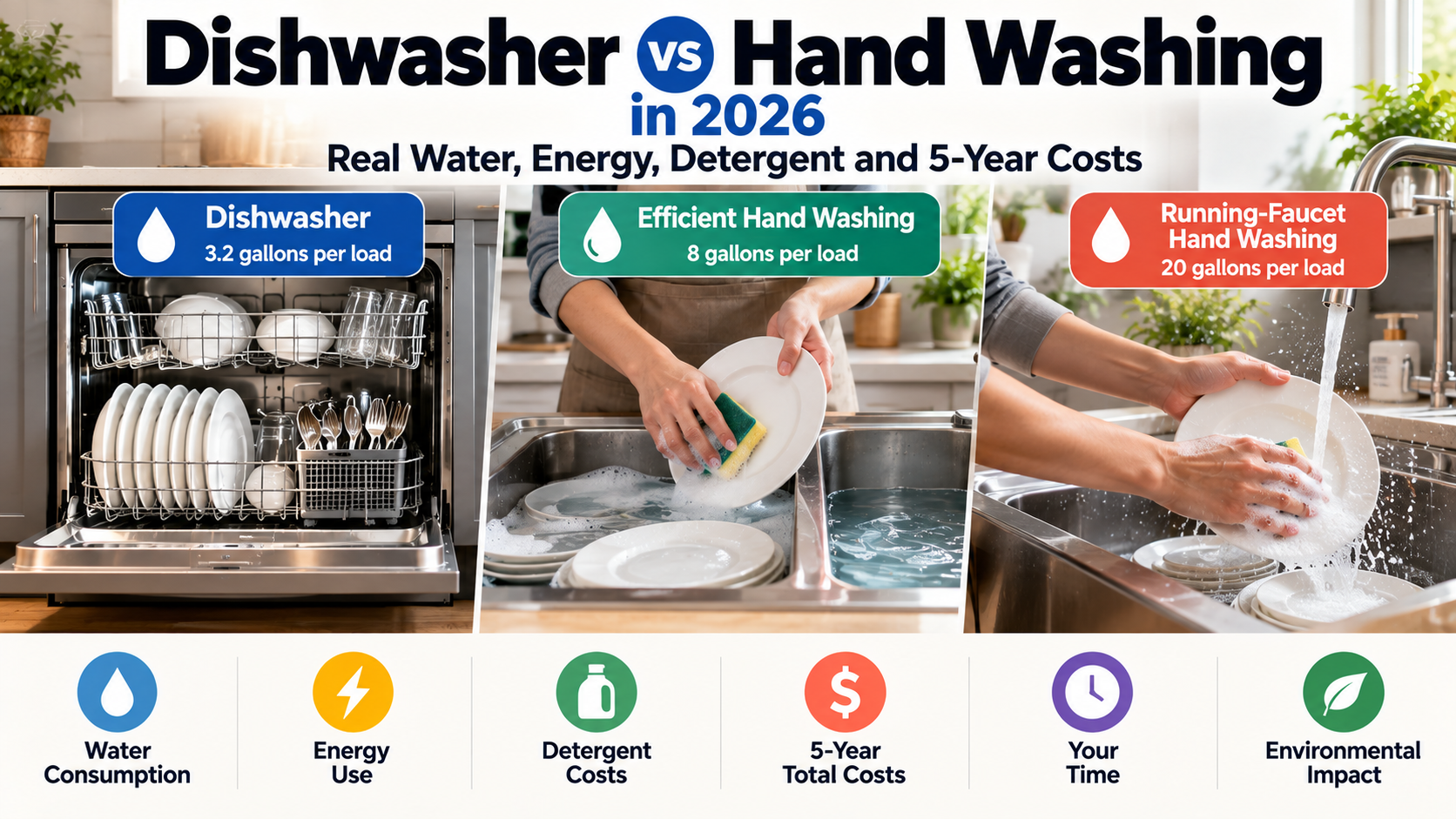
| Efficient dishwasher | 3.2 gallons | Illustrative ENERGY STAR qualifying standard-size cycle |
| Controlled hand washing | 8 gallons | Water measured into basins and used for rinsing |
| Running-faucet hand washing | 20 gallons | Faucet used throughout much of the process |
Important: The 8-gallon and 20-gallon hand-washing figures are illustrative household scenarios, not universal measured averages. The 3.2-gallon dishwasher figure is the ENERGY STAR certification maximum for a standard-capacity model, not a guaranteed result for any specific machine.
These assumptions are useful because they show how strongly behavior affects the comparison.
Annual water consumption
Assume the household washes the same amount of dishes 260 times per year, equivalent to five standard dish loads per week.
| Method | Gallons per load | Gallons per year |
|---|---|---|
| Dishwasher | 3.2 | 832 |
| Controlled hand washing | 8 | 2,080 |
| Running-faucet hand washing | 20 | 5,200 |
Under these assumptions, the dishwasher uses:
- 1,248 fewer gallons annually than controlled hand washing.
- 4,368 fewer gallons annually than running-faucet hand washing.
But water volume is only one part of the financial calculation.
Heating the water may cost more than the water itself.
2. The Overlooked Expense: Heating Dishwashing Water
Dishwashing often requires warm or hot water.
That creates an energy expense whether the water is heated by a dishwasher, an electric water heater, or a gas water heater.
The important distinction is that dishwasher energy consumption is typically measured as an appliance system under standardized testing, while hand-washing hot-water energy depends heavily on household conditions.
What determines hot-water cost?
Four variables matter:
- The number of gallons heated
- The temperature rise between incoming and used water
- The efficiency of the water-heating system
- The local electricity or gas rate
A useful physical relationship is:
Thermal energy (kWh) = gallons × 8.34 × temperature rise (°F) ÷ 3,412
For example, heating one gallon of water by 50°F requires approximately 0.122 kWh of thermal energy before accounting for equipment losses.
At an electricity rate of $0.18/kWh, that is approximately 2.2 cents per gallon for an idealized electric-heating calculation.
Actual cost can be higher or lower depending on the heating system, efficiency, water temperature, and energy tariff.
Why gas and electric water heaters should not be treated identically
A gas water heater and an electric resistance water heater do not necessarily have the same cost per gallon of heated water.
A heat-pump water heater can produce a different result again.
Therefore, any article that applies a single hot-water cost to every American household is oversimplifying the problem.
Buying insight: Before deciding whether a dishwasher will save money, determine whether your largest potential savings come from water volume, water heating, or the time spent washing dishes.
3. Dishwasher Electricity vs Hand-Washing Hot Water
Dishwashers use electricity for pumps, controls, water heating where applicable, and drying functions.
Hand washing generally does not use an electric washing motor, but it may require substantial energy to heat water.
That means comparing only the dishwasher’s electricity consumption with zero electricity for hand washing is not a fair energy comparison.
An illustrative electric-water-heating scenario
For the next calculation, assume:
- 260 equivalent dish loads per year
- Electricity at $0.18/kWh
- Dishwasher electricity use of 0.85 kWh per cycle
- Controlled hand washing uses 8 gallons of heated water
- Running-faucet hand washing uses 20 gallons of heated water
- Electric water heating requires 0.11 kWh per gallon of hot water delivered
The 0.11 kWh/gallon assumption represents a simplified effective heating scenario. It is not a national average.
For the dishwasher, the 0.85 kWh figure is treated as the total electricity consumption for the washing cycle, including its own water-heating demand. We do not add separate hot-water heating costs to that figure.
| Method | Energy per equivalent load | Annual energy |
|---|---|---|
| Dishwasher | 0.85 kWh | 221 kWh |
| Controlled hand washing | 0.88 kWh | 228.8 kWh |
| Running-faucet hand washing | 2.20 kWh | 572 kWh |
In this example, the dishwasher and controlled hand washing have similar energy requirements.
The running-faucet method uses substantially more.
These are scenario calculations, not laboratory measurements.
The actual result may change considerably if the home uses gas or heat-pump water heating, if much of the hand-washing water is cold, or if the dishwasher’s drying settings consume additional energy.
4. Detergent Costs: Dishwasher Pods vs Dish Soap
Dishwasher detergent is often more expensive per wash than the amount of liquid dish soap used for efficient hand washing.
However, detergent cost is not simply the price of a container.
It depends on how much product is used per load.
Illustrative detergent assumptions
| Detergent type | Cost per equivalent load | Annual cost at 260 loads |
|---|---|---|
| Dishwasher detergent | $0.32 | $83.20 |
| Hand-washing liquid | $0.12 | $31.20 |
These are assumed per-load prices, not current verified retail prices.
Your actual cost will depend on the brand, package size, dose, local sales prices, and whether you use pods, powder, gel, or liquid detergent.
Why detergent costs matter
In the model above, dishwasher detergent costs $52 more annually than hand-washing liquid.
That extra expense may offset some water and energy savings when hand washing is already efficient.
On the other hand, it is unlikely to eliminate the financial benefit of avoiding very large quantities of heated running water.
Do you need premium dishwasher pods?
Not necessarily.
Cleaning performance depends on water hardness, machine design, detergent formulation, soil level, and the selected cycle.
Compare cost per dose and actual cleaning performance rather than assuming the most expensive pod is automatically best.
5. The Real Annual Cost Comparison
Now combine water, energy, and detergent.
Our cost assumptions
| Variable | Assumption |
|---|---|
| Equivalent dish loads per year | 260 |
| Electricity | $0.18/kWh |
| Combined water and sewer | $0.015/gallon |
| Dishwasher water per load | 3.2 gallons |
| Controlled hand-washing water | 8 gallons |
| Running-faucet hand-washing water | 20 gallons |
| Dishwasher energy per load | 0.85 kWh |
| Controlled hand-washing energy | 0.88 kWh |
| Running-faucet hand-washing energy | 2.20 kWh |
| Dishwasher detergent | $0.32/load |
| Hand-washing detergent | $0.12/load |
All three methods are assumed to clean the same quantity of dishes per equivalent load.
Annual operating expenses
| Annual expense | Dishwasher | Controlled hand washing | Running faucet |
|---|---|---|---|
| Water and sewer | $12.48 | $31.20 | $78.00 |
| Energy | $39.78 | $41.18 | $102.96 |
| Detergent | $83.20 | $31.20 | $31.20 |
| Annual total | $135.46 | $103.58 | $212.16 |
The results are revealing.
Under these assumptions:
- The dishwasher costs about $31.88 more per year than controlled hand washing.
- The dishwasher saves about $76.70 per year compared with running-faucet hand washing.
The dishwasher uses less water in both comparisons, but that does not automatically make it the least expensive method overall.
Detergent costs matter, and efficient hand washing can be financially competitive.
This is why comparing a dishwasher only with inefficient running-faucet washing produces an incomplete answer.
6. Five-Year Operating Costs: What Happens Over Time?
Using the same assumptions and 260 equivalent dish loads annually:
| Five-year expense | Dishwasher | Controlled hand washing | Running faucet |
|---|---|---|---|
| Water and sewer | $62.40 | $156.00 | $390.00 |
| Energy | $198.90 | $205.92 | $514.80 |
| Detergent | $416.00 | $156.00 | $156.00 |
| Five-year operating total | $677.30 | $517.92 | $1,060.80 |
These figures exclude the cost of purchasing, installing, repairing, or replacing a dishwasher.
They also exclude the financial value of personal time.
What do these results mean?
If you already own a dishwasher, the relevant comparison may be the additional cost of operating that machine versus washing the same dishes by hand.
In our model, the dishwasher is cheaper than running-faucet washing but more expensive than carefully controlled hand washing.
However, if you do not yet own a dishwasher, the purchase and installation expenses can significantly change the outcome.
7. Buying a New Dishwasher: The Real Five-Year Ownership Cost
A new dishwasher is not free.
Even if its operating expenses are lower, the household must recover the initial purchase and installation cost before it produces a net financial saving.
Illustrative first-time purchase
Assume:
- Dishwasher purchase price: $650
- Installation cost: $250
- Initial investment: $900
- Five-year dishwasher operating expenses: $677.30
- Five-year maintenance allowance: $100
The resulting five-year ownership cost is:
$900 + $677.30 + $100 = $1,677.30
Now compare that with hand washing.
| Five-year cost | New dishwasher | Controlled hand washing | Running faucet |
|---|---|---|---|
| Purchase and installation | $900 | $0 | $0 |
| Operating expenses | $677.30 | $517.92 | $1,060.80 |
| Maintenance allowance | $100 | $0 | $0 |
| Five-year total | $1,677.30 | $517.92 | $1,060.80 |
The initial investment is illustrative, not a live product or contractor quote.
In this scenario, the new dishwasher does not recover its purchase and installation costs within five years through utility and detergent savings alone.
That does not make it a bad purchase.
It means that convenience, time savings, cleaning consistency, and household needs—not just lower utility bills—may be the strongest reasons to buy one.
For a separate comparison of permanent installation versus smaller alternatives, see our Countertop vs Built-In Dishwasher in 2026: Installation, Capacity and Real 5-Year Costs guide.
8. Dishwasher Break-Even Point: How Long Until It Pays for Itself?
The break-even calculation is straightforward:
Break-even years = Initial investment ÷ Annual net operating savings
This works only when the dishwasher actually produces positive annual savings.
Example: Switching from running-faucet washing
In our operating-cost model:
- Running-faucet washing: $212.16 annually
- Dishwasher operation: $135.46 annually
- Annual savings: $76.70
- Initial dishwasher investment: $900
Ignoring maintenance, financing, and future price changes:
$900 ÷ $76.70 ≈ 11.7 years
Including the illustrative $100 five-year maintenance allowance would extend the payback period.
A more efficient dishwasher, higher hot-water costs, more frequent washing, or higher water consumption during hand washing could shorten the payback period.
A lower-cost hand-washing routine could lengthen it or eliminate operating savings entirely.
Example: Switching from controlled hand washing
Our controlled hand-washing scenario costs $103.58 annually.
The dishwasher costs $135.46 annually.
In this case, the dishwasher does not generate annual operating savings.
There is no positive financial break-even point under these assumptions.
That distinction is essential.
A payback calculator should never show a recovery period when annual savings are negative.
9. The Hidden Value of Your Time
Operating-cost calculations tell only part of the story.
Hand washing requires direct attention. A dishwasher also requires loading and unloading, but much of the washing process happens without the user being present.
That convenience can have substantial value.
An illustrative time comparison
Suppose:
- Hand washing takes 20 minutes of active work per equivalent load.
- Loading and unloading a dishwasher takes 7 minutes.
- The household completes 260 equivalent loads annually.
The dishwasher saves:
13 minutes × 260 = 3,380 minutes
That is approximately 56.3 hours per year.
Over five years, the household saves about 281.7 hours.
These times are illustrative, not universal measurements. Real differences depend on how dishes are prepared, loaded, rinsed, dried, and stored.
Should you assign a dollar value to those hours?
You can, but time savings should not be confused with cash savings.
For example, assigning a personal value of $15 per hour to 56.3 hours produces an estimated annual time value of approximately $845.
That is an opportunity-value estimate.
It does not mean the dishwasher deposits $845 into your bank account or that the household necessarily earns additional income.
Our recommendation: Keep actual cash expenses and the value of your time in separate calculations.
A dishwasher can be worthwhile because it improves daily life even when its utility savings alone do not repay the purchase price.
10. Does a Dishwasher Always Have a Lower Environmental Impact?
Not under every possible set of conditions.
A life-cycle study published by researchers at the University of Michigan compared machine dishwashing and hand washing while considering water use, energy consumption, greenhouse gas emissions, and life-cycle costs.
The research found that typical hand-washing practices could produce greater environmental impacts than machine dishwashing.
However, efficient hand-washing techniques, including the use of separate washing and rinsing basins, could perform differently from conventional hand washing.
That finding matters because environmental comparisons depend on both technology and behavior.
What changes the environmental result?
- How much water is used
- How the water is heated
- The local electricity generation mix
- How frequently the dishwasher runs
- Whether dishes are pre-rinsed
- Dishwasher manufacturing and disposal
- Appliance lifetime
A new dishwasher has manufacturing impacts that are not captured by a simple per-cycle water comparison.
Similarly, efficient hand washing is not environmentally equivalent to leaving a hot-water faucet running.
Environmental takeaway: Use measured or clearly stated assumptions. Avoid claims that one method is always greener in every household.
11. How Household Size Changes the Decision
One-person household
If you generate only a few dishes daily, the financial case for purchasing a new full-size dishwasher may be weak.
A smaller appliance or efficient hand-washing routine may be more appropriate.
But if your kitchen already contains a functioning dishwasher, using it for accumulated suitable loads can still be convenient.
Two-person household
Cooking habits become more important than household size alone.
Two adults who prepare most meals at home may produce a substantial quantity of cookware.
Compare how many equivalent loads you generate weekly and how much active time hand washing requires.
Family of four
A larger household often benefits from a dishwasher’s capacity and labor savings.
However, do not assume a larger family automatically saves a fixed dollar amount.
The financial outcome still depends on actual dish volume, water-heating costs, detergent prices, and machine efficiency.
If you are deciding between built-in sizes, read our 18-Inch vs 24-Inch Dishwasher in 2026: Capacity, Installation Costs and Which Size Is Worth Buying? comparison.
Households with frequent entertaining
Large loads, serving dishes, and cookware may make a dishwasher particularly convenient.
Capacity and rack flexibility can be more valuable than a small difference in operating costs.
12. Seven Habits That Can Make a Dishwasher More Expensive to Run
1. Running very small loads
A dishwasher may use a substantial amount of water and energy even when only a few dishes are inside.
Follow the manufacturer’s loading guidance and avoid unnecessary cycles.
2. Pre-rinsing every dish under running water
Scraping off food residue is generally more efficient than thoroughly washing dishes before placing them in the dishwasher.
Check the manufacturer’s recommendations for your model.
3. Using the most intensive cycle unnecessarily
Heavy-duty cycles may use more resources than normal or sensor-controlled cycles.
Choose the setting appropriate for the soil level.
4. Using heated drying when unnecessary
Where appropriate, air drying may reduce electricity use.
Follow the manufacturer’s instructions and consider whether dishes need additional drying.
5. Overusing detergent
More detergent does not automatically produce cleaner dishes.
Follow dosing guidance for the detergent and dishwasher.
6. Ignoring filters and spray arms
Poor maintenance can reduce cleaning performance and lead to unnecessary rewashing.
Clean accessible filters according to the manufacturer’s instructions.
7. Comparing only the appliance’s energy rating
A highly efficient machine may still be expensive to own if its purchase, installation, and repair costs are high relative to your usage.
Always evaluate the full ownership picture.
13. How to Calculate Your Own Dishwashing Costs
You do not need to rely on a national average.
Use your actual utility rates and household routine.
Step 1: Estimate annual equivalent loads
Loads per week × 52 = Annual loads
For example:
5 × 52 = 260 loads.
Step 2: Calculate water cost
Gallons per load × Annual loads × Combined water and sewer rate
Use the marginal rate from your utility bill where possible. Fixed monthly service charges usually do not change simply because you use fewer gallons.
Step 3: Calculate energy cost
For the dishwasher:
kWh per load × Annual loads × Electricity rate
For hand washing, estimate the cost of heating the water actually used, taking account of the type of water heater.
Step 4: Calculate detergent cost
Detergent cost per load × Annual loads
Step 5: Add ownership expenses
For a new dishwasher, include:
- Purchase price
- Sales tax
- Installation
- Required plumbing or electrical work
- Expected maintenance
- Possible repairs
Step 6: Compare over five years
Five-year ownership cost = Initial investment + Five-year operating expenses + Maintenance and repairs
Do not include the full original purchase price again when comparing the future operating costs of a dishwasher you already own.
That purchase is a sunk cost for the keep-versus-hand-wash decision.
If you are considering replacing a working dishwasher, evaluate the incremental cost of replacement and the realistic operating savings from the new model.
14. When Hand Washing May Be the Better Choice
A dishwasher is not automatically the best purchase for every household.
Efficient hand washing may be a reasonable option when:
- You generate very few dishes.
- You use a measured, limited amount of water.
- You have no existing dishwasher opening.
- Installation requires expensive modifications.
- You rent and cannot install a permanent appliance.
- You do not mind the time required.
- Your kitchen contains many items that are not dishwasher-safe.
This does not mean hand washing is always preferable.
It means the cost of buying and installing an appliance should be justified by the benefits your household will actually receive.
15. When a Dishwasher Is Worth Buying
A dishwasher becomes especially attractive when:
- You generate substantial dish loads every week.
- You currently use large quantities of running hot water.
- You value the reduction in active household labor.
- You already have suitable plumbing and cabinetry.
- You can purchase a reliable, efficient model at a reasonable price.
- Your household regularly struggles to keep up with dirty dishes.
For many families, the strongest argument is not a dramatic reduction in monthly bills.
It is the combination of lower water use, consistent cleaning, convenience, and recovered personal time.
Frequently Asked Questions
Does a dishwasher use less water than hand washing?
A modern efficient dishwasher can use substantially less water than washing dishes under a running faucet. However, carefully controlled hand washing may use much less water than typical running-faucet washing. Actual consumption depends on behavior and the dishwasher model.
Is a dishwasher cheaper than hand washing?
Not always. It may have lower operating costs than running-faucet washing but higher costs than efficient hand washing, particularly when detergent is expensive. A new dishwasher also has purchase and installation expenses.
How much electricity does a dishwasher use?
It varies by model, cycle, and drying settings. Use the appliance’s EnergyGuide label and manufacturer information rather than assuming every machine consumes the same amount per cycle.
Does hand washing use electricity?
It may indirectly use electricity to heat water. Homes with gas or heat-pump water heaters will have different energy costs.
Is it cheaper to use dishwasher pods or liquid dish soap?
Liquid hand-washing soap may cost less per equivalent load, but detergent cost alone does not determine which cleaning method is cheaper overall.
Should I rinse dishes before putting them in the dishwasher?
Scrape off food residue and follow your dishwasher manufacturer’s instructions. Thorough pre-rinsing under running water can undermine the water-saving benefit of machine washing.
Is a dishwasher worth it for one person?
It depends on dish volume, available kitchen space, installation cost, and how much you value convenience. Buying a new full-size machine solely to save money may be difficult to justify for very small loads.
How long does a dishwasher take to pay for itself?
There is no universal payback period. Calculate the initial investment divided by positive annual operating savings. If the dishwasher does not reduce annual operating costs, it has no financial payback based on utility and detergent savings alone.
Is washing dishes by hand more environmentally friendly?
Not necessarily. Environmental impacts depend on water volume, water heating, electricity sources, equipment manufacturing, and washing behavior. Efficient hand washing can perform differently from washing under a continuously running faucet.
Should I replace a working dishwasher with a more efficient one?
Not solely because a newer model advertises lower energy consumption. Compare the incremental purchase and installation cost with the realistic energy and water savings over the remaining useful life of your current machine.
Final Verdict: Water Savings Are Not the Same as Total Financial Savings
A modern efficient dishwasher can use far less water than washing dishes under a continuously running faucet.
But lower water consumption does not guarantee lower total costs.
The detergent you choose, the energy required to heat water, the number of loads you wash, and the cost of purchasing and installing a dishwasher all influence the outcome.
For households that already own a dishwasher, using it efficiently is often a practical choice.
For households considering their first dishwasher, the most important calculation is not simply how much water the machine saves.
It is whether those operating savings, combined with the value of convenience and time, justify the upfront investment.
The smartest choice is the one that fits your real dishwashing habits—not a universal savings claim.
Related Living Pick Lab Guides
- Countertop vs Built-In Dishwasher in 2026: Installation, Capacity and Real 5-Year Costs
- 18-Inch vs 24-Inch Dishwasher in 2026: Capacity, Installation Costs and Which Size Is Worth Buying?
Sources and Research Methodology
The following sources inform the technical discussion and provide a basis for checking dishwasher efficiency and environmental claims.
- ENERGY STAR — Dishwashers
- ENERGY STAR — Dishwasher Key Product Criteria
- ENERGY STAR — Certified Residential Dishwashers
- U.S. Department of Energy — Energy Saver: Water Heating
- University of Michigan — Life-Cycle Environmental and Economic Analysis of Dishwashing
How We Calculated the Costs
All financial tables use explicitly stated illustrative assumptions rather than claimed national averages.
The dishwasher’s assumed electricity consumption is treated as its complete cycle electricity requirement. Hand-washing energy is estimated separately from the assumed hot-water volume.
Each method is assigned the same number of equivalent dish loads per year, although actual load sizes, washing techniques, and household conditions vary.
Calculations use unrounded intermediate values and round displayed dollar totals to the nearest cent.
The models do not represent laboratory tests, actual product measurements, or verified 2026 retailer prices.
Editorial disclosure: Living Pick Lab has not independently laboratory-tested the dishwashing methods or appliances described here. The financial examples are educational planning scenarios, not guarantees of savings. Verify appliance specifications, local utility rates, and installation costs before making a purchase.