
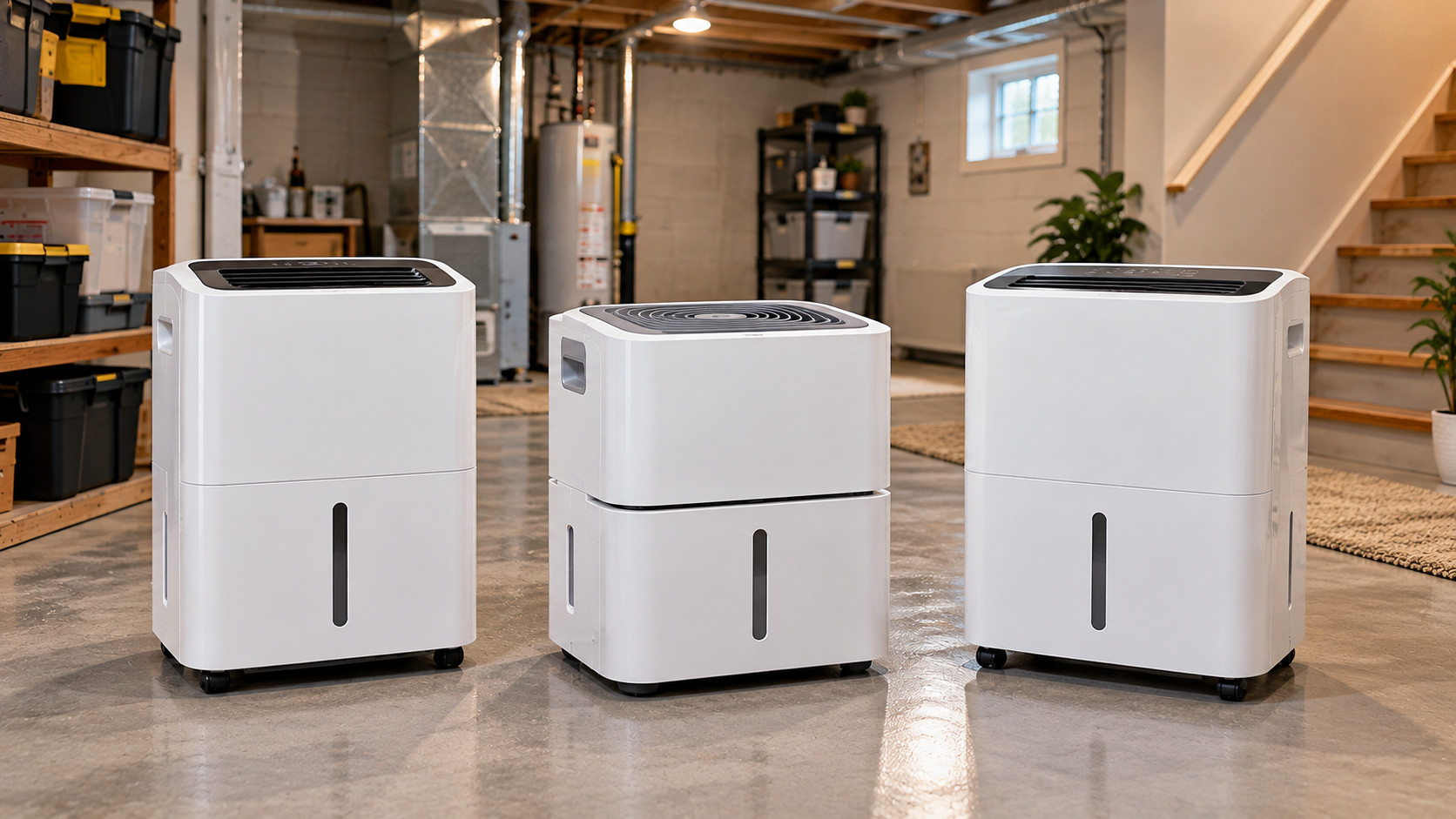
A 50-pint dehumidifier can be a strong choice for a damp basement, but choosing the right model involves more than finding the highest-rated machine or the longest feature list.
Two dehumidifiers with similar moisture-removal capacity can create very different ownership experiences. One may require regular bucket emptying. Another may pump water into a utility sink. A third may offer a larger collection tank but occupy more space.
The best 50-pint dehumidifier for your basement is the one that matches your moisture load, drainage layout, maintenance preferences, and budget.
This 2026 buying guide compares specific models using published manufacturer specifications and official ENERGY STAR information. It focuses on practical differences rather than claiming hands-on performance results.
Quick Picks: Which 50-Pint Dehumidifier Fits Your Basement?
| Model | Best reason to consider it | Built-in pump | Main consideration |
|---|---|---|---|
| Frigidaire FHDP5033Y1 | Connected controls and pump-assisted drainage | Yes | Confirm that smart features justify the price |
| Midea Cube MAD50PS1QWT-A | Flexible tank configuration and pump-assisted drainage | Yes | Check clearance and the Cube’s operating configuration |
| Midea EasyDry MAD50C1AWS | Simpler setup without paying for a built-in pump | No | Requires bucket emptying or suitable gravity drainage |
These are shortlisted models, not laboratory-tested winners. The right choice depends on your installation and the exact version available from your retailer.
Living Pick Lab’s first buying rule: Determine where the collected water will go before comparing smart features or prices.
If your basement has a convenient floor drain below the dehumidifier’s outlet, a pump may be unnecessary. If water must travel upward to a utility sink, a pump-equipped model becomes more attractive.
1. Frigidaire FHDP5033Y1: A Pump-Equipped Option With Smart Controls
Best suited for: Buyers who want pump-assisted drainage and app-based humidity controls in a single appliance.
The Frigidaire FHDP5033Y1 is a 50-pint-class portable dehumidifier with a built-in pump, continuous-drain capability, and connected controls.
According to Frigidaire’s published information, its features include:
- Built-in pump for supported upward drainage
- Continuous-drain option
- Wi-Fi control through the Frigidaire app
- Adjustable humidity settings
- Automatic shutoff when the collection bucket is full
- Washable filter
- Low-temperature operation specified down to 41°F
The manufacturer’s listed bucket capacity is approximately 1.9 gallons.
What makes it appealing?
A basement that needs regular dehumidification can be inconvenient if the owner must frequently carry water upstairs.
The built-in pump addresses an important installation problem: the drainage destination may be higher than the appliance.
App-based controls can also be useful if the basement is not part of the home’s main living area. They allow the owner to adjust settings without visiting the appliance every time.
What should buyers question?
Smart connectivity is a convenience feature, not evidence of superior moisture-removal performance.
Before paying extra, ask whether you will actually use remote monitoring and whether the pump’s supported lift height and hose routing meet your installation needs.
Also remember that a pump adds another component that may require maintenance or eventually fail.
Efficiency information
An ENERGY STAR certification record for model FHDP5033Y1 reports:
- Rated water-removal capacity: approximately 49.95 pints per day
- Integrated Energy Factor: 2.01 L/kWh
- Listed annual energy consumption: 520 kWh/year
The annual figure is a standardized estimate, not a prediction of your home’s electricity use.
Living Pick Lab verdict: A strong candidate when your basement needs upward drainage and you value connected controls. It is less compelling if you already have a suitable gravity drain and do not need app features.
Official product information: Frigidaire FHDP5033Y1
Official certification record: ENERGY STAR — FHDP5033Y1
2. Midea Cube MAD50PS1QWT-A: Flexible Design With a Built-In Pump
Best suited for: Buyers who want a pump-equipped dehumidifier with an unconventional tank and storage design.
The Midea Cube takes a different approach to the traditional tall dehumidifier.
Its lift-and-twist configuration allows the appliance to operate in an extended arrangement or fit into a more compact nested form.
For model MAD50PS1QWT-A, Midea lists:
- 50-pint daily capacity
- Built-in pump
- SmartHome app compatibility
- Extended and nested configurations
- Portable design with wheels
- One-year limited warranty information
The Cube design may be particularly appealing where the appliance must be moved, stored, or positioned in a space with unusual clearance requirements.
What makes it different?
Many conventional dehumidifiers are designed around a relatively small bucket inside a tall cabinet.
The Cube design offers a different water-collection arrangement, potentially reducing the frequency of manual emptying when used as intended.
But larger water storage does not eliminate the need for drainage planning.
A larger tank can become heavy when full, and a basement installation may be better served by continuous drainage than by carrying collected water.
Does the pump make it the best choice?
Only if the pump solves a real installation problem.
If your utility sink is above the unit, a pump-equipped Cube may provide a convenient solution, subject to the manufacturer’s permitted hose length, lift height, and routing instructions.
If your floor drain is already lower than the dehumidifier, the extra pump may offer little value.
Efficiency information
The ENERGY STAR product record for MAD50PS1QWT-A reports approximately:
- 49.7 pints per day of rated moisture removal
- 2.0 L/kWh Integrated Energy Factor as displayed in the public record
- 515 kWh/year of standardized annual energy consumption
These figures are close to those reported for the Frigidaire model. The small difference in standardized estimates should not be treated as proof that one will always cost less to operate in a particular basement.
Living Pick Lab verdict: Worth considering if you value the Cube’s tank configuration, flexible physical design, and integrated pump. Check the exact model suffix before purchasing because similar Midea Cube names can refer to different versions.
Official product information: Midea Cube MAD50PS1QWT-A
Official certification record: ENERGY STAR — MAD50PS1QWT-A
3. Midea EasyDry MAD50C1AWS: A Simpler Choice Without a Built-In Pump
Best suited for: Buyers who do not need upward drainage and prefer a straightforward 50-pint dehumidifier.
The Midea EasyDry MAD50C1AWS offers 50-pint rated capacity without a built-in pump.
Midea’s published specifications identify:
- 50-pint daily capacity
- No built-in pump
- No smart control
- Four-wheel portability
- Built-in timer
- One-year warranty information
This model illustrates an important purchasing principle: a simpler dehumidifier can be the better value when your basement does not require premium features.
Why consider a non-pump model?
If your basement has a properly positioned floor drain, gravity drainage may be sufficient.
In that situation, a built-in pump can represent additional cost and complexity without solving a problem you actually have.
A simpler machine may also appeal to buyers who do not want app setup, account connectivity, or additional pump-related maintenance.
What is the trade-off?
Without a built-in pump, the appliance cannot independently push water upward through a pump hose.
You will need to empty the bucket, use an approved gravity-drain arrangement where supported, or evaluate a compatible external pump.
Do not assume that attaching a hose allows water to flow uphill.
What about energy efficiency?
Do not assume this model is more efficient merely because it lacks a pump.
For a meaningful comparison, locate the exact model’s current energy label or ENERGY STAR certification record and compare its Integrated Energy Factor with other models.
We have not established a current model-specific IEF for MAD50C1AWS in this comparison, so it would be misleading to rank it as the most energy-efficient option.
Living Pick Lab verdict: A practical candidate when you want 50-pint capacity but do not need an integrated pump or connected controls. Its value depends on the current price and whether your drainage arrangement is compatible.
Official product information: Midea EasyDry MAD50C1AWS
4. Side-by-Side Comparison: What Actually Matters?
| Buying factor | Frigidaire FHDP5033Y1 | Midea Cube MAD50PS1QWT-A | Midea EasyDry MAD50C1AWS |
|---|---|---|---|
| Capacity class | 50 pint | 50 pint | 50 pint |
| Built-in pump | Yes | Yes | No |
| Smart controls | Yes | Yes | No |
| Continuous drainage | Manufacturer-supported options | Manufacturer-supported options | Verify exact gravity-drain setup |
| Distinctive feature | App-connected pump model | Lift-and-twist Cube design | Simpler feature set |
| Published IEF in reviewed ENERGY STAR record | 2.01 L/kWh | Approximately 2.0 L/kWh | Not verified here |
| Best fit | Connected, pump-assisted setup | Flexible design and pump | Straightforward setup without pump |
Important: The comparison uses specific model numbers and information available during preparation of this guide. Retailers may sell variants with similar names but different specifications.
Before purchasing, verify the model suffix, current price, included accessories, and certification status.
5. The Biggest Buying Decision: Do You Actually Need a Pump?
This question can be more important than choosing between two brands.
Situation A: Your basement has a floor drain below the dehumidifier
A suitable gravity-drain setup may be the simplest solution.
Water can flow downhill through an approved hose without requiring a built-in pump.
Buying direction: Consider a non-pump model if it meets your capacity, efficiency, and reliability requirements.
Situation B: Your only drain is an elevated utility sink
Gravity cannot move water uphill.
You will need a properly rated pump arrangement or a different water-collection strategy.
Buying direction: Compare pump-equipped models, paying particular attention to permitted lift height and hose routing.
Situation C: You have no suitable drain
A built-in pump is not automatically useful if there is nowhere appropriate for the water to discharge.
You may still need to empty a bucket or arrange a suitable drainage destination.
Buying direction: Solve the drainage destination problem before paying for pump features.
For a more detailed explanation, read:
Do You Need a Pump for Your Basement Dehumidifier? A Drainage Decision Guide
6. ENERGY STAR in 2026: Why the Exact Model Number Matters
ENERGY STAR’s Version 6.0 dehumidifier specification became effective on October 1, 2025.
For portable dehumidifiers in the capacity range above 25 and up to 50 pints per day, the current minimum qualifying Integrated Energy Factor is 2.01 L/kWh.
The precise rated capacity matters because the efficiency criteria are divided into capacity bands.
Integrated Energy Factor measures moisture removed per unit of electricity under a standardized procedure.
A higher value generally indicates better rated energy efficiency, but actual electricity use depends on conditions in your home.
What to verify before buying
Look up the exact model in the official ENERGY STAR database and compare:
- Certified model number
- Rated water-removal capacity
- Integrated Energy Factor
- Standardized annual energy consumption
- Certification details and market availability
Avoid relying solely on a product page that says “ENERGY STAR” without confirming the relevant model and current listing.
Official database: ENERGY STAR Certified Dehumidifiers
Official efficiency criteria: ENERGY STAR Dehumidifier Key Efficiency Criteria
7. Compare Electricity Costs Without Guessing
It is tempting to assume that all 50-pint dehumidifiers cost about the same to operate.
That assumption can be wrong.
Even models with similar rated capacity may differ in energy efficiency, fan operation, control behavior, and actual runtime.
An illustrative calculation
Suppose a dehumidifier consumes an average of 500 watts while operating and runs for eight hours per day.
Daily electricity use:
0.5 kW × 8 hours = 4 kWh
At an illustrative electricity rate of $0.18 per kWh:
4 kWh × $0.18 = $0.72 per day
Over 30 days:
$0.72 × 30 = $21.60
This example is not a measurement of any model in this guide. It simply shows how to estimate costs using actual wattage, runtime, and your utility rate.
Do not compare standardized annual energy figures with a personal daily-runtime calculation as though they describe identical operating conditions.
Use the official efficiency ratings to compare certified models, and use your expected runtime to understand potential household costs.
8. Four Features Worth Paying Extra For—and Two That May Not Be
Worth considering: A pump that solves an uphill-drain problem
A pump can be genuinely valuable if it eliminates frequent bucket emptying and supports a safe drainage route.
But verify the manufacturer’s installation limits.
Worth considering: A reliable continuous-drain setup
For a damp basement that requires frequent operation, uninterrupted drainage can be more valuable than additional smart features.
Worth considering: Suitable low-temperature operation
Cool basements may reduce the effectiveness of some refrigerant-based dehumidifiers.
Check the manufacturer’s specified operating-temperature range and automatic-defrost features.
Worth considering: Accessible maintenance
A washable filter, accessible collection bucket, and clear hose connections make routine care easier.
Not automatically worth extra: Wi-Fi
Remote control can be convenient, but it does not inherently improve moisture-removal efficiency.
Pay for it if you will use it.
Not automatically worth extra: A larger advertised coverage area
Square-foot coverage claims can be based on different assumptions.
A basement’s moisture load, temperature, and air circulation matter more than a large number printed on a product listing.
9. Avoid These Five Common Buying Mistakes
Mistake 1: Choosing a pump model without checking the drain location.
A pump cannot solve the absence of an appropriate discharge destination.
Mistake 2: Treating bucket capacity as daily moisture-removal capacity.
A 50-pint rating describes standardized moisture-removal capability over 24 hours. It does not mean the collection bucket holds 50 pints.
Mistake 3: Comparing similar product names instead of model numbers.
A suffix can distinguish pump-equipped, non-pump, connected, or updated versions.
Mistake 4: Assuming the largest or most expensive model is always best.
The right product is the one that meets your needs without unnecessary expense.
Mistake 5: Using a dehumidifier instead of repairing water intrusion.
Persistent leaks, standing water, and foundation seepage require attention to the underlying moisture source.
10. What If You Are Not Sure You Need 50 Pints?
Before choosing among 50-pint models, confirm that this capacity class is appropriate.
A 35-pint dehumidifier may be sufficient for some basements with moderate moisture loads.
If you are deciding whether the larger capacity is worth paying for, start with:
35-Pint vs 50-Pint Dehumidifier: Is the Bigger Size Worth the Extra Cost?
If you are starting from scratch and do not yet know your required capacity, read:
What Size Dehumidifier Do I Need for My Basement? A 2026 Sizing Guide
The correct sequence is:
Confirm the moisture problem → Choose capacity → Plan drainage → Compare actual models.
Buying in the reverse order can lead to unnecessary features or inadequate performance.
11. Frequently Asked Questions
Which 50-pint dehumidifier is best for a basement with no floor drain?
That depends on where the collected water can be discharged.
A pump-equipped model may help if there is a suitable elevated sink or other approved destination. If there is no appropriate drain, you may still need manual bucket emptying or a separate drainage solution.
Is Midea or Frigidaire better for basement dehumidification?
Neither brand is automatically better for every basement.
Compare the exact models’ drainage features, efficiency ratings, operating-temperature requirements, warranty terms, and price.
The models reviewed here address different installation preferences.
Does a built-in pump make a dehumidifier more powerful?
No. A pump moves collected water to a drainage destination.
It does not directly increase the appliance’s rated moisture-removal capacity.
Do all 50-pint dehumidifiers have the same bucket size?
No. Collection-tank capacity varies by model and is separate from daily moisture-removal capacity.
Can I leave a 50-pint dehumidifier running while I am away?
Follow the manufacturer’s operating and safety instructions.
For unattended use, pay particular attention to drainage reliability, hose routing, bucket shutoff behavior, maintenance, and the risk of water damage if a connection fails.
Should I buy an ENERGY STAR certified dehumidifier?
ENERGY STAR certification is a useful efficiency screening criterion.
However, compare the exact certified model and ensure that its drainage arrangement, operating range, and capacity meet your needs.
Final Verdict: Buy for Your Basement, Not for the Feature List
There is no single 50-pint dehumidifier that is the best purchase for every basement.
Choose the Frigidaire FHDP5033Y1 as a candidate when you want pump-assisted drainage together with connected controls.
Consider the Midea Cube MAD50PS1QWT-A when its flexible physical design and built-in pump solve practical space and drainage problems.
Consider the Midea EasyDry MAD50C1AWS when you want a simpler 50-pint appliance and do not require an integrated pump.
These are conditional buying recommendations based on published specifications, not independently tested performance rankings.
Before purchasing, verify current price, exact model number, official efficiency data, warranty coverage, and compatibility with your basement’s drainage layout.
Living Pick Lab’s final decision rule: The best value is the least complicated dehumidifier that reliably handles your basement’s moisture and drainage requirements.
Sources and Further Reading
- ENERGY STAR — Dehumidifiers
- ENERGY STAR — Key Efficiency Criteria
- ENERGY STAR — Certified Dehumidifier Database
- Frigidaire — FHDP5033Y1 Product Specifications
- Midea — Cube MAD50PS1QWT-A
- Midea — EasyDry MAD50C1AWS
Editorial disclosure: Living Pick Lab has not independently laboratory-tested the products discussed in this article. Product comparisons are based on manufacturer-published specifications and official certification information available during research. Prices, availability, certifications, and model configurations can change. This article does not contain paid placement or affiliate purchase links at the time of publication.