
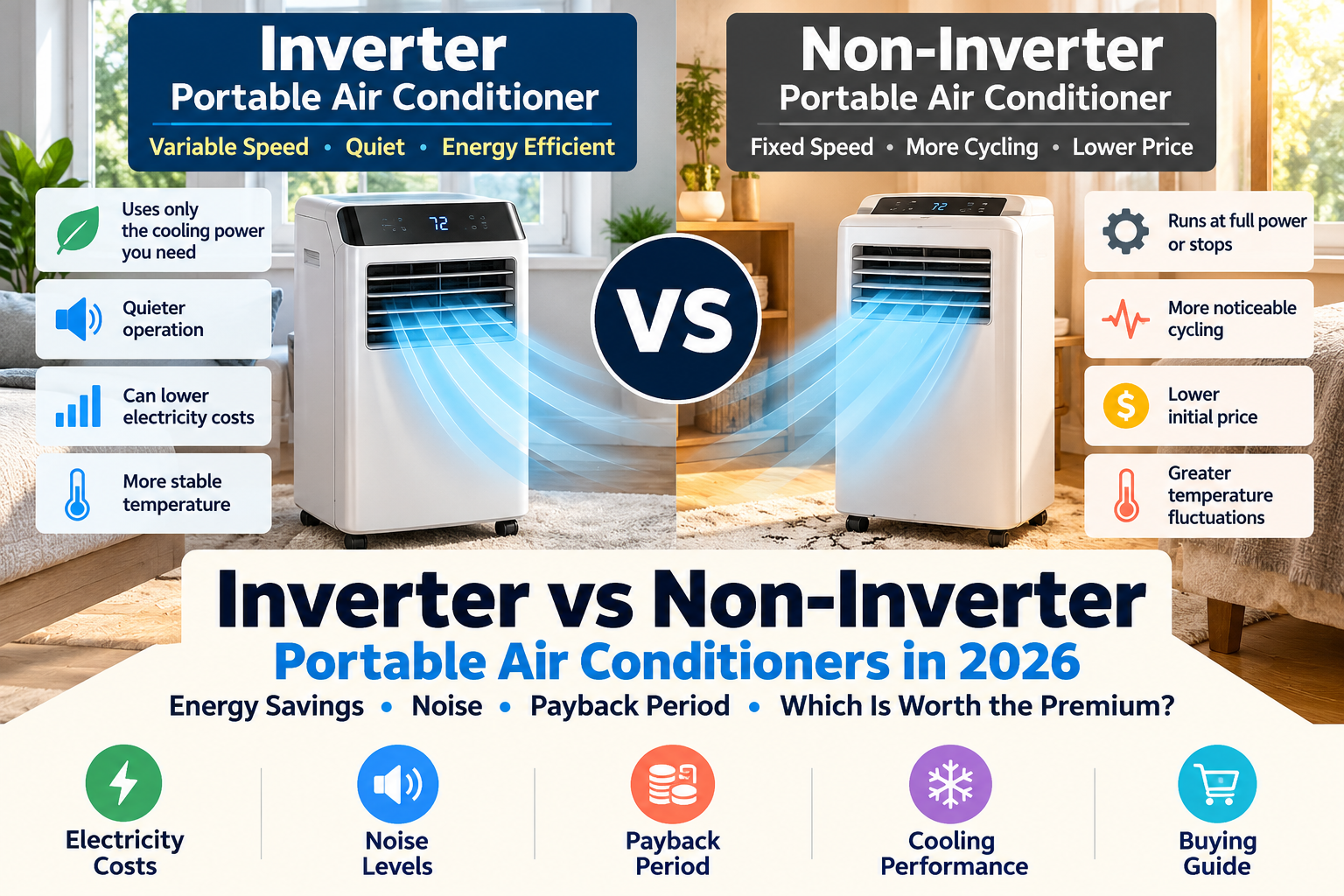
An evidence-led buying guide to variable-speed cooling, real electricity costs, temperature stability, and the financial break-even point of premium portable air conditioners.
A premium portable air conditioner can cost substantially more than a conventional model. Manufacturers often justify that price difference with promises of quieter operation, better energy efficiency, and more consistent cooling.
Much of that promise centers on one feature: inverter compressor technology.
But is an inverter portable air conditioner actually worth paying more for?
The answer is more complicated than the marketing suggests.
An inverter compressor can adjust its operating speed to match changing cooling demands. A conventional fixed-speed compressor generally relies on switching between operating and non-operating states to regulate temperature.
That difference can affect electricity consumption, noise, comfort, and humidity control.
However, it does not mean every inverter portable AC is more efficient than every non-inverter model. Hose design, standardized cooling capacity, installation quality, and the appliance’s complete engineering still matter.
For buyers, the critical question is not simply whether inverter technology is better.
It is whether the additional comfort and potential electricity savings justify the higher purchase price in your particular room.
This guide examines that decision using engineering principles, standardized efficiency ratings, and transparent five-year cost scenarios.
Quick Verdict: Is an Inverter Portable AC Worth It?
An inverter portable air conditioner is generally worth considering when you expect to use it frequently, especially for long periods in a bedroom, home office, or primary living space.
Its ability to modulate compressor output can help maintain more consistent indoor temperatures while avoiding some of the abrupt cycling associated with fixed-speed equipment.
But a conventional portable AC may remain the better financial choice when usage is occasional, the cooling season is short, or the inverter model carries a large price premium.
Our buying recommendation:
- Choose an inverter portable AC when comfort, sustained operation, and potentially lower electricity use justify a higher initial investment.
- Consider a non-inverter portable AC when affordability and occasional cooling are your priorities.
- Compare DOE SACC and CEER, not compressor technology alone.
- Evaluate hose design separately because a single-hose inverter model and a dual-hose inverter model may have significantly different performance characteristics.
- Calculate the payback period using realistic operating hours, rather than relying on manufacturer savings claims.
The most economical choice depends on how much cooling you need and how often you need it.
1. How a Non-Inverter Portable Air Conditioner Works
A conventional non-inverter portable air conditioner typically uses a fixed-speed compressor.
When the thermostat calls for cooling, the compressor operates at its designed speed. Once the target temperature is reached, the compressor stops or cycles according to the appliance’s control system.
As the room warms again, cooling resumes.
This approach is straightforward and widely used.
Advantages of fixed-speed compressors
Conventional models may offer:
- Lower upfront purchase prices.
- Simpler compressor control systems.
- Adequate performance for intermittent cooling.
- A practical solution for guest rooms or occasional summer use.
However, their operation can involve more noticeable temperature fluctuations.
The compressor may also produce audible changes when starting or stopping.
These characteristics vary by product, so a fixed-speed model should not automatically be considered uncomfortable or excessively noisy.
Why cycling matters
Imagine a room with a thermostat setting of 74°F.
A fixed-speed appliance may cool the room until its control system determines that the target has been satisfied, then stop active cooling until the temperature rises sufficiently to restart.
The actual temperature range depends on sensor placement, thermostat logic, airflow, and the room’s heat load.
This cycling is not inherently defective.
It is simply a different method of matching cooling output to changing demand.
2. How an Inverter Portable Air Conditioner Works
An inverter air conditioner uses electronic controls to vary compressor motor speed.
Instead of relying primarily on full-output operation followed by shutdown, the compressor can reduce its output when the room approaches the desired temperature.
During periods of high cooling demand, it can operate at a higher speed within its designed range.
When less cooling is required, it can reduce its output.
The practical advantage
A variable-speed system may maintain the target temperature with fewer abrupt changes in compressor operation.
This can improve comfort in rooms where cooling demand fluctuates throughout the day.
For example:
A west-facing home office may need substantial cooling during the afternoon.
After sunset, the heat load declines.
An inverter compressor can potentially respond by operating at a lower speed rather than repeatedly delivering full output and shutting down.
That ability may reduce energy use under favorable conditions.
However, the extent of any savings depends on the product’s efficiency at different compressor speeds.
An inverter is a control technology, not a guarantee of superior whole-appliance efficiency.
3. Inverter vs Non-Inverter Portable AC: Key Differences
| Buying factor | Inverter portable AC | Non-inverter portable AC |
|---|---|---|
| Compressor operation | Variable speed | Typically fixed speed |
| Temperature regulation | Can adjust cooling output continuously | Often relies more heavily on cycling |
| Initial price | Commonly higher | Commonly lower |
| Energy efficiency | Can improve under variable loads | Depends on complete system design |
| Operating noise | May be steadier and quieter at reduced output | May have more noticeable cycling |
| Humidity management | Potentially smoother under some conditions | Depends on runtime and control strategy |
| Repair complexity | More sophisticated electronics | Generally simpler controls |
| Best use case | Frequent or extended cooling | Occasional or budget-focused cooling |
These are typical design characteristics rather than universal product rankings.
A well-engineered conventional model can outperform a poorly designed inverter unit.
4. The Most Important Buying Mistake: Comparing Compressor Technology Without Hose Design
A portable air conditioner has two major engineering considerations:
- How the compressor regulates cooling output.
- How the condenser exchanges heat with the outdoors.
These are separate decisions.
An inverter model can use a single-hose configuration.
Another inverter model can use a dual-hose or hose-in-hose arrangement.
A conventional model may also use either configuration.
Why the distinction matters
In a conventional single-hose design, the appliance typically draws indoor air across the condenser and exhausts it outside.
This can create negative pressure that encourages replacement air to enter the building.
A dual-hose design generally draws condenser intake air from outdoors and exhausts it through a separate pathway, reducing that particular source of pressure imbalance.
As a result, an inverter compressor cannot automatically eliminate the efficiency disadvantages of a poorly performing single-hose arrangement.
For serious cooling, evaluate compressor technology and condenser airflow architecture together.
For a detailed explanation of those airflow differences, see our related guide:
5. What Independent Testing Reveals About Inverter Performance
Independent appliance testing illustrates why comparing complete products matters more than relying on a single technology label.
RTINGS has evaluated portable air conditioners using standardized comparisons of cooling capacity, efficiency, temperature regulation, and other performance characteristics.
Its comparison of the Midea Duo MAP12S1TBL and LG Dual Inverter LP1419IVSM is particularly instructive.
Both are inverter-equipped portable air conditioners, and both have been listed with a 10,000 BTU/h DOE cooling-capacity rating.
Yet RTINGS found meaningful differences in tested cooling performance and efficiency.
The Midea’s dual-hose configuration contributed to its stronger overall results in that comparison.
The lesson is not that one manufacturer always makes superior appliances.
It is that two inverter products can behave very differently in real use.
For shoppers, this creates a more reliable evaluation hierarchy:
- Confirm sufficient standardized cooling capacity.
- Compare the condenser airflow design.
- Examine independently tested cooling and efficiency results.
- Consider inverter technology and temperature-control behavior.
- Compare price, noise, installation, and long-term cost.
An inverter label should be one factor in a larger purchasing decision.
6. SACC and CEER: The Numbers That Matter More Than Marketing
Portable air conditioner advertisements may feature several technical ratings.
Two are particularly important for U.S. buyers.
DOE SACC
Seasonally Adjusted Cooling Capacity (SACC) is a standardized portable AC cooling-capacity metric.
It accounts for factors relevant to portable systems, including duct-related heat transfer and infiltration effects under specified testing conditions.
This makes SACC especially useful when comparing portable air conditioners.
A larger advertised ASHRAE BTU figure should not automatically be interpreted as greater practical cooling capacity.
CEER
Combined Energy Efficiency Ratio (CEER) expresses standardized cooling performance relative to energy consumption under the applicable test procedure.
Higher CEER generally indicates better efficiency when comparing products evaluated under the same framework.
However, CEER is not simply a measurement of how many watts the compressor uses at one moment.
It reflects the relevant standardized methodology.
A 2026 regulatory detail
U.S. portable air conditioners are subject to federal efficiency standards with compliance requirements that began on January 10, 2025.
DOE also specifies test procedures for portable air conditioners, including provisions relevant to variable-speed equipment.
When shopping in 2026, verify the rating method used in a listing rather than assuming that all displayed BTU or efficiency figures represent identical measurements.
Practical rule: Compare SACC and CEER from the same applicable testing framework before paying extra for inverter technology.
7. How Much Electricity Can an Inverter Portable AC Save?
This is the central financial question.
The answer depends on how much electricity each appliance actually consumes over the same cooling task.
A lower instantaneous power draw does not necessarily mean lower total consumption if one appliance operates longer or delivers less cooling.
For a meaningful comparison, both products should provide reasonably equivalent comfort.
Electricity-cost formula
Electricity cost = Average electrical power (kW) × Operating hours × Electricity rate ($/kWh)
Suppose a conventional portable AC averages 1.10 kW during a defined cooling schedule.
An alternative inverter model averages 0.90 kW while providing comparable comfort under the same conditions.
The modeled power difference is:
1.10 − 0.90 = 0.20 kW
If the appliances are used for six hours per day over 100 days, the annual electricity difference would be:
0.20 kW × 6 hours × 100 days = 120 kWh
At an assumed electricity rate of $0.20 per kWh:
120 kWh × $0.20 = $24 per cooling season
That is a modest annual saving.
It illustrates why a more efficient appliance does not necessarily pay for a substantial purchase-price premium quickly.
Important: These power figures are hypothetical, not measurements of specific products. They assume comparable cooling comfort and a consistent average power difference.
8. Three Electricity-Savings Scenarios
Usage patterns can change the financial outcome substantially.
The following table assumes the inverter model consumes an average of 0.20 kW less electricity while providing comparable comfort.
| Scenario | Daily use | Cooling days | Electricity rate | Annual modeled savings |
|---|---|---|---|---|
| Light use | 3 hours | 60 | $0.15/kWh | $5.40 |
| Moderate use | 6 hours | 100 | $0.20/kWh | $24.00 |
| Heavy use | 8 hours | 120 | $0.25/kWh | $48.00 |
These scenarios reveal an important distinction.
For someone using portable cooling occasionally, the financial value of inverter efficiency may be small.
For a household running the appliance for extended periods during a long cooling season, the savings potential becomes more meaningful.
But those savings still need to be compared with the purchase-price difference.
9. The Payback Period: When Does an Inverter Become Worth the Premium?
Suppose two hypothetical portable air conditioners offer comparable cooling performance.
The conventional model costs $400.
The inverter model costs $520.
The inverter purchase premium is therefore:
$520 − $400 = $120
The simple payback formula is:
Payback period = Additional purchase price ÷ Annual electricity savings
Using the three modeled usage scenarios:
| Usage scenario | Annual savings | Simple payback |
|---|---|---|
| Light use | $5.40 | 22.2 seasons |
| Moderate use | $24.00 | 5.0 seasons |
| Heavy use | $48.00 | 2.5 seasons |
These are simplified financial estimates, not predictions of actual equipment lifespan or measured energy savings.
They exclude maintenance, repairs, replacement, financing, and future electricity-price changes.
What the numbers mean
For light use, the electricity savings alone are unlikely to justify a $120 premium over a typical ownership period.
For moderate use, the financial case is less clear.
For heavy use, the premium could potentially be recovered sooner, assuming the modeled energy savings materialize.
But electricity savings are not the only reason to buy an inverter.
Quieter operation and steadier comfort may justify the premium even when the financial payback is relatively slow.
10. Five-Year Ownership Costs: A More Complete Comparison
A payback calculation considers the additional purchase price and expected savings.
A total ownership comparison goes further by estimating the complete modeled purchase and electricity cost.
Consider the moderate-use scenario.
Assumptions
- Conventional portable AC purchase price: $400.
- Inverter portable AC purchase price: $520.
- Conventional average power: 1.10 kW.
- Inverter average power: 0.90 kW.
- Usage: six hours per day.
- Cooling season: 100 days annually.
- Electricity price: $0.20/kWh.
- Ownership period: five years.
- Comparable delivered comfort is assumed.
| Cost component | Non-inverter | Inverter |
|---|---|---|
| Purchase price | $400 | $520 |
| Annual electricity | $132 | $108 |
| Five-year electricity | $660 | $540 |
| Five-year modeled total | $1,060 | $1,060 |
Under these assumptions, the two appliances have the same five-year modeled total.
The inverter’s electricity savings exactly offset its initial price premium.
This is not evidence that inverter portable air conditioners universally break even after five years.
It demonstrates how a buyer can evaluate a particular price premium using realistic assumptions.
The hidden variable: Actual average energy use
The most uncertain input is often the difference in electricity consumption.
A product’s maximum rated wattage does not necessarily represent its average consumption across an entire cooling season.
Inverter compressors can adjust output.
Conventional compressors cycle.
Both operating patterns must be reflected in realistic energy-use estimates.
When possible, use standardized efficiency data and independent testing rather than assuming that the inverter model will consume a fixed percentage less electricity.
11. Noise: Are Inverter Portable Air Conditioners Really Quieter?
Inverter technology can improve acoustic comfort, particularly when the compressor operates at reduced speed.
Instead of repeatedly transitioning between full-output cooling and shutdown, a variable-speed system may maintain a more consistent operating sound.
That can be useful in bedrooms, nurseries, and home offices.
However, an inverter label does not guarantee low noise.
Portable air conditioners also produce sound from:
- Indoor circulation fans.
- Condenser fans.
- Air movement through hoses.
- Cabinet vibration.
- Compressor mechanical and electrical components.
- Floor and wall resonance.
What to compare
A manufacturer may advertise a particularly low decibel value measured under a quiet operating mode.
That number may not represent noise during high cooling demand.
Look for independent measurements at comparable operating settings.
Pay attention to sound quality as well as volume.
A steady low-frequency sound may be easier to tolerate than frequent abrupt compressor changes.
On the other hand, some people find certain high-pitched inverter tones distracting.
Bedroom buying rule: Prioritize model-specific noise testing and adequate cooling capacity over the inverter label alone.
12. Temperature Stability: Where Variable-Speed Cooling Can Feel Better
Comfort depends on more than average room temperature.
Two air conditioners can maintain similar average temperatures while producing different fluctuations throughout the day.
A conventional compressor may cycle more noticeably around the thermostat setting.
An inverter compressor can potentially reduce those fluctuations by adjusting its output.
This can be especially helpful when:
- The room is occupied for many consecutive hours.
- Outdoor temperature changes significantly during the day.
- Sunlight periodically increases the cooling load.
- A person is sensitive to alternating cold and warm periods.
- Consistent comfort matters more than the lowest purchase price.
However, actual temperature stability also depends on thermostat placement, airflow distribution, control algorithms, and appliance sizing.
A badly oversized inverter unit is not automatically a better comfort solution than a properly sized conventional appliance.
13. Humidity Control: A Benefit That Requires Careful Interpretation
Air conditioning removes moisture when humid indoor air passes over a sufficiently cold evaporator coil and water condenses.
Compressor operation and airflow influence how effectively this process occurs.
An inverter system operating at reduced capacity may be able to sustain cooling and moisture removal under certain conditions without frequent shutdowns.
But humidity performance is not determined by inverter technology alone.
It depends on:
- Evaporator temperature.
- Indoor airflow.
- Compressor control strategy.
- Room moisture load.
- Equipment sizing.
- Condensate handling.
- Duration of cooling operation.
A portable AC may cool a room without maintaining the desired humidity level, particularly if it is oversized or operating under unfavorable conditions.
Likewise, an inverter model may reduce cooling output in a way that changes its dehumidification behavior.
Do not assume that an inverter portable AC replaces a dedicated dehumidifier.
For persistent basement humidity or moisture problems, our existing guides explain when a dedicated dehumidifier is appropriate:
What Size Dehumidifier Do I Need for My Basement? A 2026 Sizing Guide
14. Reliability, Repairs, and the Cost of Complexity
Inverter air conditioners contain sophisticated electronic controls that regulate compressor operation.
These systems can deliver practical benefits, but they also introduce additional components that may be expensive to diagnose or replace.
A conventional fixed-speed appliance generally uses a simpler control approach.
However, it would be misleading to conclude that non-inverter portable ACs always last longer.
Reliability depends on the complete product, including:
- Compressor quality.
- Electronics and thermal management.
- Manufacturing consistency.
- Operating environment.
- Maintenance.
- Parts availability.
- Warranty support.
There is insufficient basis to assign a universal lifespan advantage to either technology.
Questions worth asking
Before purchasing a premium inverter model, check:
- What does the warranty cover?
- Is compressor coverage different from parts and labor coverage?
- Are replacement parts available?
- Is there an established service network?
- Would a major repair be economical relative to replacement?
A premium purchase is easier to justify when the manufacturer offers credible long-term support.
15. Why a Window AC May Still Be the Better Investment
Portable air conditioners are often purchased because conventional window units are impractical.
They can be useful in rental properties, rooms with unusual windows, or situations requiring seasonal removal.
But if a window air conditioner is permitted and can be installed safely, it deserves consideration.
Window units generally avoid some of the duct-related losses associated with portable equipment.
A high-efficiency window AC may therefore offer stronger value than a premium portable inverter model.
This matters because a shopper might otherwise spend hundreds of dollars upgrading from a conventional portable AC to an inverter portable AC without considering a potentially more efficient equipment category.
The best purchase is not always the most sophisticated portable model.
It is the cooling system that meets your needs at the lowest reasonable total cost.
16. Which Type Should You Buy? A Practical Decision Matrix
| Buyer profile | Recommended starting point | Why |
|---|---|---|
| Occasional summer cooling | Conventional portable AC | Lower upfront cost may dominate |
| Daily bedroom cooling | Inverter portable AC | Potential for steadier, quieter operation |
| Long, hot cooling season | Efficient inverter model | Greater opportunity to recover the price premium |
| Short-term rental | Compare budget and portability first | Long payback may not be relevant |
| Home office used all day | Inverter with proven noise performance | Sustained comfort is valuable |
| Very tight budget | Properly sized conventional model | Adequate cooling matters more than premium features |
| High electricity prices | Compare tested efficiency carefully | Energy savings have greater financial value |
| Window installation allowed | Compare efficient window ACs | Potentially stronger overall economics |
The recommendation assumes the chosen appliance has sufficient cooling capacity for the space.
17. A Five-Step Buying Framework for 2026
Step 1: Determine the cooling requirement
Estimate the room’s cooling load based on area, ceiling height, sunlight, insulation, occupancy, and climate.
Avoid selecting equipment solely from broad manufacturer coverage claims.
Step 2: Compare DOE SACC
Use comparable standardized cooling-capacity figures.
Do not treat a larger ASHRAE number as a substitute for evaluating practical cooling performance.
Step 3: Examine hose architecture
Identify whether the unit uses a conventional single-hose, dual-hose, or hose-in-hose condenser arrangement.
This factor can materially affect real-world performance.
Step 4: Calculate your electricity exposure
Estimate daily usage, cooling-season length, and electricity price.
Use realistic energy-consumption assumptions rather than headline wattage alone.
Step 5: Evaluate the premium
Compare the additional purchase price with potential energy savings and comfort benefits.
If the financial payback is too long, decide whether quieter and more stable cooling is worth the difference.
Frequently Asked Questions
Do inverter portable air conditioners use less electricity?
They can, particularly under variable cooling loads, but the result depends on the complete appliance design and actual operating conditions.
Compare standardized efficiency ratings and independent measurements rather than assuming a universal savings percentage.
Are inverter portable ACs quieter?
They may operate more quietly at reduced compressor speed and can avoid some abrupt cycling sounds.
However, fans, vibration, cabinet design, and airflow also influence noise.
Is a dual-hose portable AC the same as an inverter AC?
No.
Dual-hose describes condenser airflow configuration.
Inverter describes compressor speed control.
A portable AC may use either, both, or neither.
How much more should I pay for inverter technology?
There is no universal ideal premium.
Use the expected annual electricity savings to calculate the financial payback, then consider the value of comfort, noise performance, warranty support, and reliability.
Does an inverter AC need to run continuously?
Not necessarily.
An inverter compressor can modulate its output, but actual operation depends on the appliance’s control system and cooling demand.
It may still stop under certain conditions.
Will an inverter portable AC cool a room faster?
Not automatically.
Initial cooling speed depends on available cooling capacity, airflow, room heat load, and operating conditions.
Variable-speed control can improve part-load operation without guaranteeing faster initial cooling.
Are inverter portable air conditioners worth buying for a bedroom?
They are worth considering when the unit will operate for extended periods and noise or temperature stability is important.
However, model-specific noise and cooling performance remain essential.
Can an inverter portable AC replace a dehumidifier?
Not reliably for every situation.
Air conditioners remove some moisture during cooling, but dedicated dehumidifiers are designed for humidity control without necessarily providing room cooling.
Final Verdict: The Premium Must Earn Its Place
Inverter technology is a meaningful advancement in portable air conditioning.
Variable-speed compressors can respond more flexibly to changing cooling demand, potentially improving comfort, acoustic performance, and energy efficiency.
But the value of that technology depends on the appliance around it.
A single-hose inverter unit may still suffer from infiltration-related performance losses.
A dual-hose conventional unit may offer attractive value.
And an expensive inverter model may never recover its purchase premium through electricity savings if it is used only occasionally.
For 2026 buyers, the strongest decision is based on four questions:
Does the unit provide enough standardized cooling capacity?
Is its airflow design appropriate for the room?
Does its measured efficiency justify its price?
Will the comfort and operating-cost benefits matter during your actual usage schedule?
If you run a portable air conditioner frequently, a well-designed inverter model may be worth the additional investment.
If you only need occasional cooling, a properly sized conventional unit may be the more rational purchase.
Buy verified cooling performance first, efficient operation second, and premium technology only when its benefits are relevant to your home.
Sources and Editorial Methodology
This article draws on the following regulatory and independent evaluation resources:
- U.S. Department of Energy — Portable Air Conditioners: https://www.energy.gov/cmei/buildings/portable-air-conditioners
- 10 CFR Appendix CC — Portable Air Conditioner Test Procedure: https://www.law.cornell.edu/cfr/text/10/appendix-CC_to_subpart_B_of_part_430
- RTINGS — Best Portable Air Conditioners: https://www.rtings.com/air-conditioner/reviews/best/portable
- RTINGS — Midea Duo vs LG Dual Inverter Comparison: https://www.rtings.com/air-conditioner/tools/compare/midea-duo-map12s1tbl-lg-dual-inverter-lp1419ivsm/45662/59616
- Good Housekeeping — Best Portable Air Conditioners: https://www.goodhousekeeping.com/what-to-buy/g71076073/best-portable-air-conditioners-tested/
Editorial disclosure: Electricity savings, prices, payback periods, and five-year ownership calculations are hypothetical examples, not measured results from specific products. They assume comparable delivered comfort. Real operating costs depend on equipment performance, installation, climate, electricity rates, and usage patterns. This article does not claim that Living Pick Lab independently laboratory-tested the products discussed.