
Updated October 2026 | Living Pick Lab
A broken dishwasher does not automatically need replacing. But repairing an aging machine is not always the money-saving decision it appears to be.
A $250 repair might be an excellent investment in a three-year-old dishwasher. The same repair could be difficult to justify on a twelve-year-old machine that has already developed several problems.
The difference is not just the repair bill.
It is the condition of the appliance, the type of failure, the cost of installing a replacement, and the likelihood that another expensive problem will appear before the repaired machine has delivered enough additional service.
That is why the familiar advice to replace an appliance whenever repairs exceed 50% of its value is useful—but incomplete.
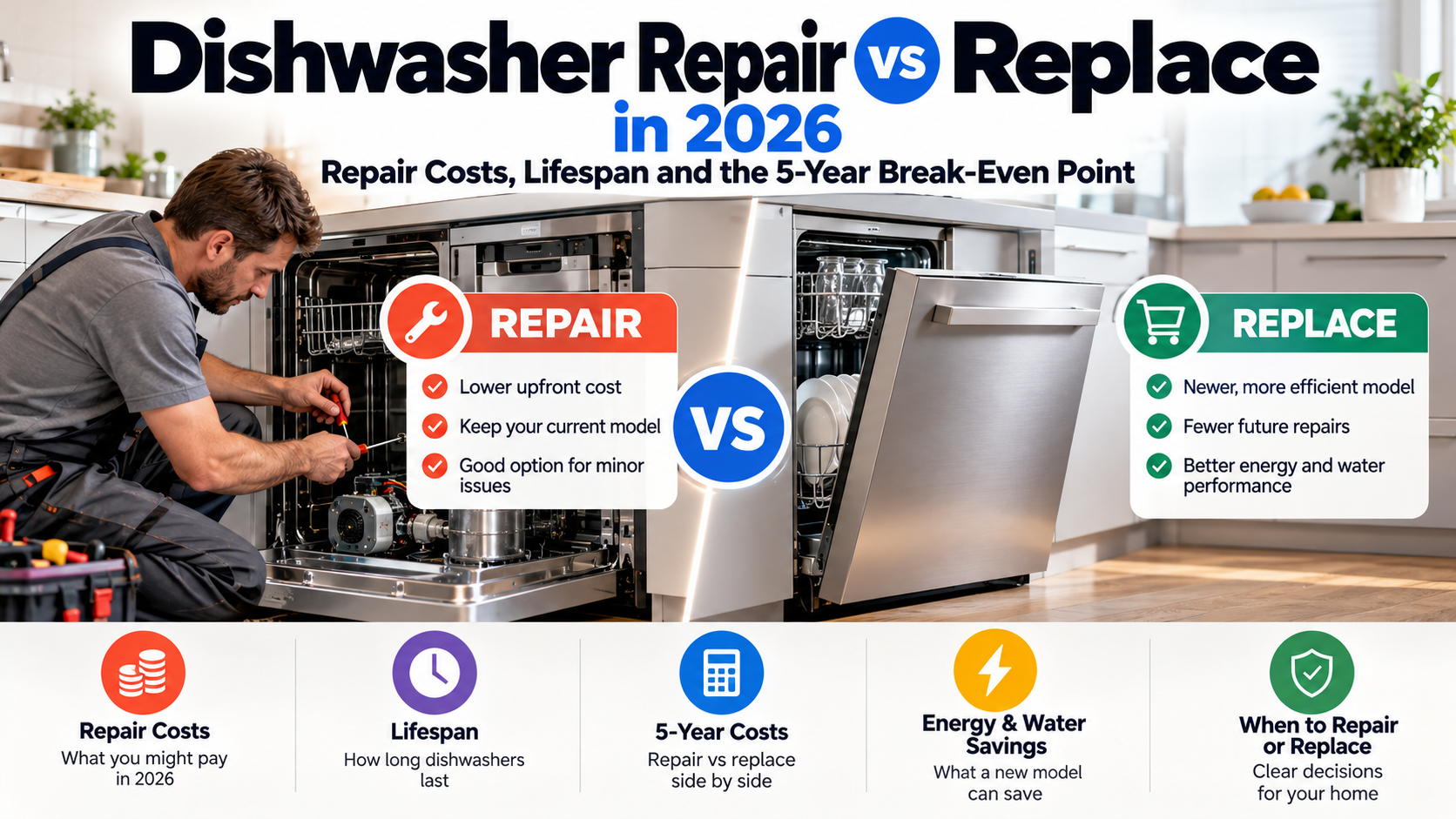
In this guide, Living Pick Lab examines dishwasher repair costs, typical lifespan, warning signs, warranties, and realistic replacement expenses. We then build a transparent five-year cost model to show when repairing, replacing, or delaying replacement makes financial sense.
Our central recommendation: Do not compare a repair estimate with the sticker price of a new dishwasher. Compare the expected cost of keeping your current machine with the complete cost of replacing it, over a period that reflects how long each option is likely to last.
Quick Verdict: Should You Repair or Replace Your Dishwasher?
| Your situation | Recommended starting point | Why |
|---|---|---|
| Dishwasher is under 5 years old | Investigate repair and warranty coverage | The machine may have substantial useful life remaining |
| Dishwasher is 5–9 years old | Compare repair and replacement costs | Age, condition, and repair type become especially important |
| Dishwasher is 10+ years old | Evaluate replacement more seriously | Additional failures may become more consequential |
| Minor latch, seal, or accessible drainage issue | Consider repair | A targeted fix may be economical |
| Expensive motor or control-system failure | Obtain a complete replacement quote | Major repairs can approach the cost of a new machine |
| Repeated breakdowns within 12 months | Lean toward replacement | Multiple failures can change the economics |
| Active leak, burning smell, or electrical concern | Stop using the appliance and seek qualified help | Safety comes before cost |
| Dishwasher is covered by a valid warranty | Contact the warranty provider first | Covered repairs may cost little or nothing |
These are screening guidelines, not automatic rules.
A well-maintained older dishwasher with a minor fault may still be worth repairing. A newer machine with severe water damage or repeated unresolved failures may not be.
1. The 50% Rule: Helpful Shortcut or Expensive Mistake?
The 50% rule suggests that replacing an appliance becomes more attractive when a repair costs more than half the price of a comparable replacement.
For example:
- Quoted repair: $400
- New dishwasher: $700
- Repair-to-purchase-price ratio: 57%
The rule would point toward replacement.
But this comparison leaves out important expenses.
A replacement might also require delivery, installation, old-appliance removal, a new connection kit, or modifications to the kitchen.
If the complete installed replacement costs $1,000, the same $400 repair represents only 40% of the actual replacement investment.
That is a meaningful difference.
Calculate the ratio correctly
Repair ratio = Total repair cost ÷ Total installed replacement cost × 100
Use a complete repair quote, including labor, parts, diagnostic charges not credited toward the work, and applicable taxes.
For the replacement, include all required costs to have a functioning new dishwasher in the same location.
Why the rule can still fail
Imagine two dishwashers requiring identical $350 repairs.
Dishwasher A
- Age: 3 years
- No previous major problems
- Comparable installed replacement: $900
- Repair ratio: 38.9%
Repairing it may be reasonable.
Dishwasher B
- Age: 12 years
- Previous drainage and control problems
- Comparable installed replacement: $900
- Repair ratio: 38.9%
The same percentage does not produce the same expected outcome.
Dishwasher B may need another repair—or complete replacement—much sooner.
Living Pick Lab rule: Use the 50% threshold to identify decisions worth investigating, not to make the final decision automatically.
2. Dishwasher Repair Costs in 2026: What Might You Pay?
Dishwasher repair costs depend on the failed component, appliance design, technician labor, local service rates, and parts availability.
Published consumer-service estimates provide useful budgeting ranges, but they are not guaranteed quotes.
The following ranges are indicative figures drawn from publicly available repair-cost guidance, including Angi. They should be checked against current local quotes before making a decision.
| Repair or component | Indicative repair cost | Decision considerations |
|---|---|---|
| Door latch | $75–$175 | Often worth evaluating on an otherwise healthy machine |
| Drain or circulation pump | $150–$350 | Depends on machine age and the specific pump |
| Electronic control board | $200–$400 | Diagnosis and part availability are important |
| Motor | $250–$600 | High-cost repair; replacement comparison is essential |
Pricing note: These are broad published estimates, not live October 2026 local prices. Actual estimates may fall outside these ranges, and costs should not be added together without checking what labor and diagnostic charges are already included.
A clogged filter, blocked drain hose, or installation problem may produce symptoms that resemble a failed pump.
Likewise, a dishwasher that does not start could have a door-latch problem, a power-supply issue, or a more expensive electrical fault.
The symptom alone does not establish the failed part.
Ask for an itemized quote
A useful repair estimate should identify:
- The diagnosed fault
- The part being replaced
- Parts cost
- Labor cost
- Diagnostic or service-call charge
- Applicable taxes
- Whether the diagnostic charge is credited toward repair
- Warranty on parts and labor
- Any additional work that may be required
Avoid comparing a vague repair estimate with a detailed replacement quote.
The two numbers need to represent complete, comparable outcomes.
3. How Long Should a Dishwasher Last?
A commonly cited planning expectation is approximately 10 years, although actual service life varies substantially.
Some dishwashers fail earlier. Others remain usable for well beyond a decade.
Consumer Reports has discussed an approximately ten-year expected lifespan based on manufacturer input, while other consumer-service resources describe wider ranges.
Neither figure is a promise that your dishwasher will fail—or survive—at a specific age.
Age is only one factor
A dishwasher’s remaining useful life depends on:
- Frequency of use
- Water hardness
- Maintenance history
- Installation quality
- Previous repairs
- Component availability
- Quality of the original appliance
- Signs of corrosion, leaks, or electrical problems
A seven-year-old machine with no previous failures may be a stronger repair candidate than a four-year-old machine with repeated problems.
Three practical age groups
Under five years
Investigate warranty coverage and targeted repair first, unless there is serious damage or a history of recurring failures.
Five to nine years
Compare the complete repair estimate against installed replacement cost. Pay close attention to previous repairs and the expected reliability of the repaired machine.
Ten years and older
Replacement deserves more consideration, especially for expensive components. But a small, well-defined repair may still be reasonable if it safely extends the appliance’s life.
Important distinction: Average lifespan is a planning reference, not an estimate of the exact remaining life of an individual dishwasher.
4. Diagnose the Problem Before Spending Money
Some dishwasher problems have simple explanations. Others require a qualified technician.
The goal is to rule out obvious, low-risk issues—not to encourage unsafe appliance repairs.
Dishwasher will not start
Check whether the household circuit breaker has tripped, whether the appliance has power, and whether the door is fully closed.
Consult the owner’s manual for any control-lock or delayed-start setting.
Do not open electrical panels or bypass safety switches.
Dishwasher will not drain
If the manufacturer permits it, check the accessible filter and visible drain area after the appliance has cooled and is safely turned off.
A blocked filter can sometimes cause poor drainage.
Do not dismantle pumps, electrical components, or plumbing connections without appropriate expertise.
Dishes remain dirty
Check for incorrect loading, blocked spray-arm movement, an improperly seated filter, or unsuitable detergent.
If the problem persists despite normal maintenance, professional diagnosis may be appropriate.
Dishwasher leaks
Stop using the appliance until the source has been identified.
Water may be escaping from a door seal, hose, connection, or internal component.
If water is near electrical equipment or outlets, avoid touching wet electrical areas and seek qualified assistance.
Burning smell, smoke, or repeated electrical trips
Stop using the dishwasher.
Do not repeatedly reset a breaker to keep the machine running. Arrange qualified inspection and follow appropriate electrical-safety procedures.
Safety comes first: A potentially hazardous appliance should not remain in service merely because repair appears cheaper than replacement.
5. The Real Cost of Replacing a Dishwasher
The advertised purchase price is rarely the complete replacement cost.
A proper budget includes everything necessary to remove the old appliance and install the new one safely.
Replacement-cost components
| Expense | What to check |
|---|---|
| Dishwasher purchase | Comparable capacity, features, and warranty |
| Sales tax | Local tax rate |
| Delivery | Whether delivery is included |
| Installation | Labor and required connection materials |
| Old-appliance removal | Haul-away and disposal charges |
| Plumbing adjustments | Supply, drain, or connection changes |
| Electrical adjustments | Work required by the appliance and local code |
| Cabinet modifications | Opening dimensions, flooring, or trim changes |
Illustrative installed replacement budget
| Item | Example cost |
|---|---|
| New dishwasher | $650 |
| Installation | $200 |
| Delivery and removal | $50 |
| Total installed cost | $900 |
This is a hypothetical budgeting example, not a verified national average or current retail offer.
A straightforward same-size replacement may cost substantially less than a project requiring new cabinetry or utility connections.
The installation trap
If your kitchen has a 24-inch dishwasher opening, switching to an 18-inch model may require additional cabinetry work without necessarily lowering total ownership costs.
Before choosing a different size, read our 18-Inch vs 24-Inch Dishwasher in 2026: Capacity, Installation Costs and Which Size Is Worth Buying?.
If permanent installation is difficult, our Countertop vs Built-In Dishwasher in 2026 guide explains the trade-offs between compact and built-in alternatives.
6. The Five-Year Repair vs Replace Formula
A meaningful comparison asks what each decision is likely to cost over the same future period.
That means ignoring the price you originally paid for the existing dishwasher.
The original purchase is a sunk cost. It cannot be recovered by choosing to repair the machine today.
Option A: Repair the existing dishwasher
Expected five-year repair-path cost = Immediate repair + Future operating costs + Expected additional repairs + Expected replacement costs within five years
If the repaired machine is unlikely to last the full five years, include the possibility of purchasing a replacement during that period.
Option B: Replace the dishwasher now
Expected five-year replacement-path cost = Installed replacement price + Future operating costs + Expected repairs and maintenance
Both paths should use consistent assumptions for water, electricity, detergent, and the quantity of dishes washed.
What about the value of the appliance at year five?
For a more complete financial model, subtract the estimated remaining value of each option at the end of the period.
That value is difficult to predict, so our simplified examples omit it and clearly identify that limitation.
This tends to matter most when comparing a nearly new dishwasher with a much older repaired machine.
7. Five-Year Cost Comparison: Three Repair Decisions
The following scenarios are hypothetical. They illustrate how different assumptions can change the decision.
They are not reliability predictions for specific brands or models.
Shared assumptions
- Comparable installed replacement cost: $900
- Existing dishwasher operating cost: $145 per year
- New dishwasher operating cost: $125 per year
- Five-year new-machine maintenance allowance: $75
- No financing or inflation adjustment
- No residual-value credit
- Future repair and replacement costs are shown separately
The operating-cost figures are planning assumptions. Actual differences should be calculated using the appliances’ EnergyGuide information and household utility rates.
Scenario A: Three-year-old dishwasher, minor repair
The machine has no significant repair history.
- Immediate repair quote: $130
- Additional repair allowance over five years: $100
- No replacement anticipated within the five-year model
- New dishwasher installed cost: $900
| Five-year cost | Repair existing | Replace now |
|---|---|---|
| Immediate repair or replacement | $130 | $900 |
| Operating expenses | $725 | $625 |
| Future repair or maintenance allowance | $100 | $75 |
| Total | $955 | $1,600 |
Illustrative result: Repair saves $645.
This is the type of situation where repairing a relatively young machine can be financially compelling.
The conclusion depends on the repair resolving the problem and the existing dishwasher remaining usable throughout the period.
Scenario B: Seven-year-old dishwasher, pump repair
The machine requires a $280 repair.
We compare two possible outcomes.
Outcome 1: The repaired dishwasher lasts another five years
| Five-year cost | Repair existing | Replace now |
|---|---|---|
| Immediate repair or replacement | $280 | $900 |
| Operating expenses | $725 | $625 |
| Additional repair or maintenance allowance | $150 | $75 |
| Total | $1,155 | $1,600 |
If the repair succeeds and the dishwasher lasts, repairing saves $445 in this scenario.
Outcome 2: The repaired dishwasher fails after two years
Assume the household then buys the same $900 installed replacement.
- Initial repair: $280
- Old-machine operation for two years: $290
- Replacement after two years: $900
- New-machine operation for three years: $375
- New-machine maintenance allowance: $45
Five-year total: $1,890
Replacing immediately costs $1,600 under the original assumptions.
In this outcome, the attempted repair costs $290 more.
What does that mean?
The repair decision depends on the likelihood of the repaired dishwasher lasting long enough to justify the expense.
The difference between the two repair outcomes is $735.
If we simplify the problem to just these two possible outcomes, the repair option breaks even with immediate replacement when the probability of the early-failure outcome is approximately:
$445 ÷ $735 ≈ 60.5%
This is a mathematical threshold, not a claim that a seven-year-old dishwasher has a 60.5% chance of failing.
Actual failure probabilities require model-specific reliability evidence, which is often unavailable.
The example demonstrates why a repair quote alone cannot answer the question.
Scenario C: Eleven-year-old dishwasher, major motor repair
Assume:
- Immediate repair: $480
- The repaired machine is expected, for planning purposes, to operate two more years
- A replacement is then purchased for $900
- Old-machine operation for two years: $290
- New-machine operation for three years: $375
- New-machine maintenance allowance: $45
| Five-year cost | Repair, then replace | Replace now |
|---|---|---|
| Initial repair | $480 | $0 |
| Replacement during the period | $900 | $900 |
| Operating expenses | $665 | $625 |
| Maintenance allowance | $45 | $75 |
| Total | $2,090 | $1,600 |
Illustrative result: Replacing now saves $490.
Here, paying for an expensive repair and then replacing the machine only two years later is the less attractive path.
However, if a qualified technician has strong reasons to expect a longer repair life, the conclusion could change.
Three-scenario summary
| Scenario | Repair-path five-year cost | Replace-now five-year cost | Lower-cost option |
|---|---|---|---|
| 3-year-old, minor repair | $955 | $1,600 | Repair |
| 7-year-old, repair lasts five years | $1,155 | $1,600 | Repair |
| 7-year-old, fails after two years | $1,890 | $1,600 | Replace |
| 11-year-old, replacement after two years | $2,090 | $1,600 | Replace |
The point is not that every three-year-old dishwasher should be repaired or every eleven-year-old dishwasher replaced.
It is that the expected duration of the repair matters as much as the repair price.
8. How Much Does a New Dishwasher Really Save on Utilities?
Replacing an older dishwasher with a newer efficient model may reduce electricity and water consumption.
But the savings are not necessarily large enough to justify replacing a functioning appliance.
ENERGY STAR provides efficiency requirements for qualifying dishwashers, and the EnergyGuide label helps consumers compare model-specific energy use.
For standard-capacity dishwashers, ENERGY STAR Version 7.0 establishes maximum certified energy and water-use thresholds.
These certification limits should not be treated as the actual consumption of every qualifying product.
Example: Modest operating savings
Suppose your existing dishwasher costs $145 per year to operate and a new one costs $125.
Annual savings:
$145 − $125 = $20
Over five years:
$20 × 5 = $100
If replacing the machine costs $900, the operating savings alone would not recover the investment within five years.
The simple payback period would be:
$900 ÷ $20 = 45 years
That calculation excludes repairs, future price changes, and differences in reliability.
It illustrates why energy savings alone are often a weak reason to discard a working dishwasher.
When operating savings matter more
They may become more significant when:
- The old dishwasher is particularly inefficient
- Water and electricity prices are high
- The machine is used frequently
- The household currently pre-rinses heavily
- The new model has demonstrably lower operating consumption
For a broader explanation of water, energy, and detergent costs, see our Dishwasher vs Hand Washing in 2026: Real Water, Energy, Detergent and 5-Year Costs.
9. The Most Important Number: Cost per Additional Year
A simple way to assess a repair is to divide its cost by the number of additional years of service it is reasonably expected to provide.
Repair cost per added year = Repair cost ÷ Expected additional years
For example:
| Repair quote | Additional service | Repair cost per added year |
|---|---|---|
| $150 | 3 years | $50 |
| $300 | 3 years | $100 |
| $400 | 2 years | $200 |
| $500 | 1 year | $500 |
This measure is not a substitute for the full five-year calculation.
It ignores operating costs, future failures, and eventual replacement.
But it provides a useful way to think about the immediate repair investment.
Why this matters
A $300 repair that reliably delivers four more years of use may be a better decision than a $150 repair that merely postpones replacement for a few months.
Unfortunately, the remaining service life of a repaired dishwasher is uncertain.
Ask the technician what the repair addresses, whether other problems are visible, and what warranty applies.
Do not interpret a repair estimate as a guarantee of future lifespan.
10. When Repairing Is the Better Choice
Repairing your dishwasher is often worth investigating when several of these conditions apply:
- The machine is relatively young.
- The failure is isolated and clearly diagnosed.
- The total repair cost is modest.
- The dishwasher has a good maintenance history.
- Replacement would require expensive installation changes.
- Parts are readily available.
- The repair includes meaningful parts-and-labor coverage.
- The appliance otherwise cleans and dries dishes satisfactorily.
A particularly strong repair case
Consider a four-year-old dishwasher with a broken door latch and no history of leaks or major failures.
If the repair is inexpensive relative to a complete installed replacement, replacing the entire machine may be unnecessary.
The key is confirming that the latch is genuinely the cause of the problem.
11. When Replacement Is the Better Choice
Replacement deserves serious consideration when:
- The dishwasher is approaching or beyond its expected service life.
- The repair involves an expensive motor or major electronic component.
- Multiple components have failed.
- The machine has repeated unresolved problems.
- Repair parts are difficult to obtain.
- Water damage or corrosion is extensive.
- The repair cost is close to the complete installed replacement cost.
- A repaired machine is unlikely to provide enough additional service.
The repeated-repair problem
A dishwasher that requires three separate service visits can become expensive even if no individual repair exceeds the 50% threshold.
For example:
- First repair: $150
- Second repair: $220
- Third repair: $280
Total repair spending:
$650
That amount may approach the installed cost of a replacement.
When assessing another repair, consider the history as evidence of reliability—but do not treat money already spent as a reason you must keep repairing the appliance.
Past repair spending is also a sunk cost.
The correct decision concerns future costs and expected outcomes.
12. Should You Repair Now and Replace Later?
Sometimes a modest repair is worth making even when you expect to replace the dishwasher eventually.
This can be particularly reasonable when:
- A full kitchen renovation is already planned
- A replacement model is temporarily unavailable
- The immediate repair is inexpensive
- You need time to compare installation quotes
- The repair is safe and likely to restore useful service
Example: Delaying replacement by one year
Suppose:
- A safe, targeted repair costs $120
- A new installed dishwasher costs $900
- The repaired machine is expected to last another year
Paying $120 to defer a $900 purchase may be useful for household cash flow.
But it does not automatically reduce total long-term spending.
The household may still need to purchase the new dishwasher later.
A delayed purchase can be valuable because of timing, flexibility, or a planned renovation—not necessarily because it eliminates replacement costs.
13. Check Warranty, Recall and Service Coverage First
Before authorizing an out-of-pocket repair, check whether the problem is covered.
Manufacturer warranty
Find the appliance’s model and serial number.
Review the original warranty terms and purchase date.
Coverage may differ for labor, specific parts, and particular types of defects.
Retailer or extended-service agreement
If you purchased a separate protection plan, review its claim procedure and exclusions.
Avoid paying for a repair before confirming whether doing so could affect coverage.
Recall information
Check the U.S. Consumer Product Safety Commission recall database for the exact manufacturer and model.
If a recall applies, follow the official remedy instructions.
Do not assume a recalled appliance can be made safe through an unrelated repair.
Repair warranty
Ask whether the technician guarantees the replacement part and labor.
A repair with a clear warranty can be less financially risky than one with no meaningful coverage.
Parts availability
An inexpensive part on paper is not useful if it cannot be obtained within a reasonable time.
Ask whether the required component is available, backordered, or discontinued.
14. Questions to Ask Before Approving a Dishwasher Repair
A professional diagnosis should help you make a better decision, not simply produce a repair price.
Ask:
- What specifically failed, and how was that confirmed?
- Is the quoted repair likely to resolve the symptoms completely?
- Are there signs of other developing problems?
- Does the estimate include parts, labor, taxes, and diagnostic charges?
- Is the diagnostic fee credited toward the repair?
- Is the replacement part new, refurbished, or aftermarket?
- What warranty applies to the part and labor?
- Are the required parts available now?
- Is the machine safe to continue using after repair?
- What is the complete installed cost of a comparable replacement?
For a major repair, consider obtaining a second estimate when practical.
A second opinion may be particularly valuable when the first diagnosis is uncertain or the proposed repair is expensive.
15. A Practical Decision Worksheet
Use this worksheet before spending money.
| Question | Your answer |
|---|---|
| Dishwasher age | ___ years |
| Current repair quote | $___ |
| Diagnostic fee not included in quote | $___ |
| Complete installed replacement price | $___ |
| Repair ratio | ___% |
| Number of significant repairs in past 24 months | ___ |
| Warranty or recall coverage | Yes / No / Unknown |
| Replacement parts readily available | Yes / No |
| Current annual operating cost | $___ |
| New dishwasher annual operating cost | $___ |
| Realistic additional service after repair | ___ years |
| Any leak or electrical safety concern | Yes / No |
Decision sequence
First: Resolve safety concerns and check warranty or recall coverage.
Second: Obtain a complete diagnosis and itemized repair quote.
Third: Compare that quote with a complete installed replacement price.
Fourth: Evaluate the dishwasher’s age, repair history, and likely additional service.
Fifth: Estimate future operating costs and the chance of needing another major repair.
Finally: Choose the option that best balances cost, reliability, safety, and convenience.
When the reliability outlook is highly uncertain, acknowledge that uncertainty rather than relying on a false-precision calculation.
16. Common Mistakes That Lead to Expensive Decisions
Mistake 1: Comparing repair cost with appliance sticker price
Use the full installed replacement cost.
Mistake 2: Replacing a dishwasher simply because it is ten years old
Age matters, but a functioning appliance does not become worthless on its tenth birthday.
Mistake 3: Repairing because you already spent money on earlier repairs
Past expenses cannot be recovered. Evaluate future costs instead.
Mistake 4: Assuming a repaired component guarantees several more years
Fixing one part does not eliminate the possibility of another failure.
Mistake 5: Assuming a new dishwasher will pay for itself through energy savings
Calculate actual operating-cost differences before making that claim.
Mistake 6: Ignoring warranty and recall coverage
A covered repair or official recall remedy can change the decision substantially.
Mistake 7: Choosing the cheapest quote without understanding the diagnosis
A low price is not necessarily a good value if the underlying problem remains unresolved.
Frequently Asked Questions
Is it worth repairing a ten-year-old dishwasher?
It depends on the fault, repair cost, previous reliability, and installed replacement price. A minor repair may be reasonable, while an expensive motor or control-system repair deserves a careful replacement comparison.
What is the 50% rule for dishwasher repair?
It is a guideline suggesting replacement when the repair approaches or exceeds half the cost of a comparable new appliance. A more useful calculation compares the complete repair quote with the full installed replacement cost and considers remaining service life.
How much does dishwasher repair cost in 2026?
Costs vary by fault and location. Published service estimates commonly place minor repairs in the low hundreds of dollars, while major motor or electronic repairs can cost several hundred dollars. Obtain a current itemized local quote.
Is it cheaper to repair a dishwasher or buy a new one?
A targeted repair on a relatively young, otherwise healthy machine can be cheaper. Replacement may become more economical when the appliance is old, repairs are expensive, or additional failures are likely.
How long do dishwashers typically last?
Approximately ten years is a commonly cited planning expectation, but actual lifespan varies with model, maintenance, water conditions, installation, and usage.
Should I replace my dishwasher if it still works but uses more electricity?
Not automatically. Compare the installed cost of replacement with realistic annual electricity and water savings. Operating savings alone may take many years to recover the purchase price.
Is a dishwasher motor worth replacing?
It may be, especially on a newer machine with no other major issues. On an older dishwasher, a high motor-replacement quote may make a new machine more attractive.
Can a dishwasher be repaired after leaking?
Sometimes, but the source and extent of the leak must be identified. Stop using the appliance until it is safe. Significant water damage, corrosion, or electrical concerns can make replacement more appropriate.
Does repairing a dishwasher extend its life?
A successful repair can restore functionality and extend usable service, but it does not reset the age of the other components or guarantee a specific number of additional years.
Should I replace a dishwasher after two repairs?
Not necessarily. Consider what failed, how much the repairs cost, whether the underlying problem was resolved, and whether new failures suggest deteriorating reliability.
Final Verdict: Repair the Problem, Not the Age—and Replace When the Economics Change
The best dishwasher repair decision is not determined by a single percentage or age threshold.
A relatively young machine with an isolated, inexpensive fault may be worth keeping.
An older dishwasher with a major failure, a history of repeated problems, or an uncertain repair outcome may be a better candidate for replacement.
The strongest financial comparison considers:
- The complete repair quote
- The full installed replacement cost
- Expected additional service life
- Future repair risk
- Operating-cost differences
- Warranty and safety considerations
Our final recommendation: If the dishwasher is safe, otherwise reliable, and a reasonably priced repair is likely to provide several more years of service, repair deserves serious consideration.
If the machine is aging, repeatedly failing, or requires a major repair that merely delays an unavoidable replacement, buying a new dishwasher may be the more economical long-term choice.
Do not spend $900 to avoid a $150 problem.
But do not spend $500 on a failing machine simply because the replacement costs more today.
The right decision is the one that delivers reliable dishwashing at the lowest reasonable future cost.
Related Living Pick Lab Guides
- 18-Inch vs 24-Inch Dishwasher in 2026: Capacity, Installation Costs and Which Size Is Worth Buying?
- Countertop vs Built-In Dishwasher in 2026: Installation, Capacity and Real 5-Year Costs
- Dishwasher vs Hand Washing in 2026: Real Water, Energy, Detergent and 5-Year Costs
Sources and Research Methodology
This guide draws on publicly available consumer-research, appliance-repair, manufacturer, and federal efficiency resources.
- Consumer Reports — Should You Repair or Replace Your Broken Dishwasher?
- Consumer Reports — How to Make Your Dishwasher Last Longer
- Angi — How Much Do Dishwasher Repairs Cost?
- Angi — Should You Repair or Replace a Broken Appliance?
- HomeGuide — Dishwasher Repair Cost
- ENERGY STAR — Dishwashers
- ENERGY STAR — Dishwasher Key Product Criteria
- U.S. Consumer Product Safety Commission — Recalls
How We Built the Five-Year Cost Examples
All scenario calculations use clearly stated illustrative assumptions.
The five-year models compare repair and replacement over the same future period. When a repaired appliance fails during that period, the repair path includes a later replacement purchase.
The examples do not claim to predict actual component failure probabilities or model-specific remaining service life.
Prices and repair allowances are educational planning figures unless explicitly identified as published third-party estimates.
The models exclude financing, inflation, taxes not otherwise specified, differences in residual appliance value, and the inconvenience of temporary appliance downtime.
Actual decisions should use current local repair and installation quotes, exact appliance specifications, and warranty information.
Editorial disclosure: Living Pick Lab has not independently tested or inspected the appliances discussed in this article. The repair scenarios are hypothetical financial illustrations, not professional diagnoses or guarantees of future appliance reliability. Electrical, plumbing, and potentially hazardous appliance problems should be assessed by qualified professionals.