
A humidifier that is too small may run continuously without reaching your target humidity. A humidifier that is too powerful may leave nearby surfaces damp, waste water, and make humidity harder to control.
Finding the right size is therefore about more than the square footage printed on the product box.
You also need to understand moisture output, tank capacity, ceiling height, ventilation, humidity controls, and the long-term cost of keeping the machine running.
A 300-square-foot bedroom with an eight-foot ceiling is not the same as a 300-square-foot space with a vaulted ceiling and an open doorway. Likewise, a humidifier with a large water tank is not necessarily capable of humidifying a large room.
This 2026 guide explains how to evaluate humidifier size without relying on misleading shortcuts, compare bedroom and large-room requirements, and estimate the real costs of ownership.
Quick Answer: What Size Humidifier Should You Buy?
Start by measuring the room you actually want to humidify.
Then compare products based on verified moisture output, room-size suitability, humidity control, noise, and refill requirements.
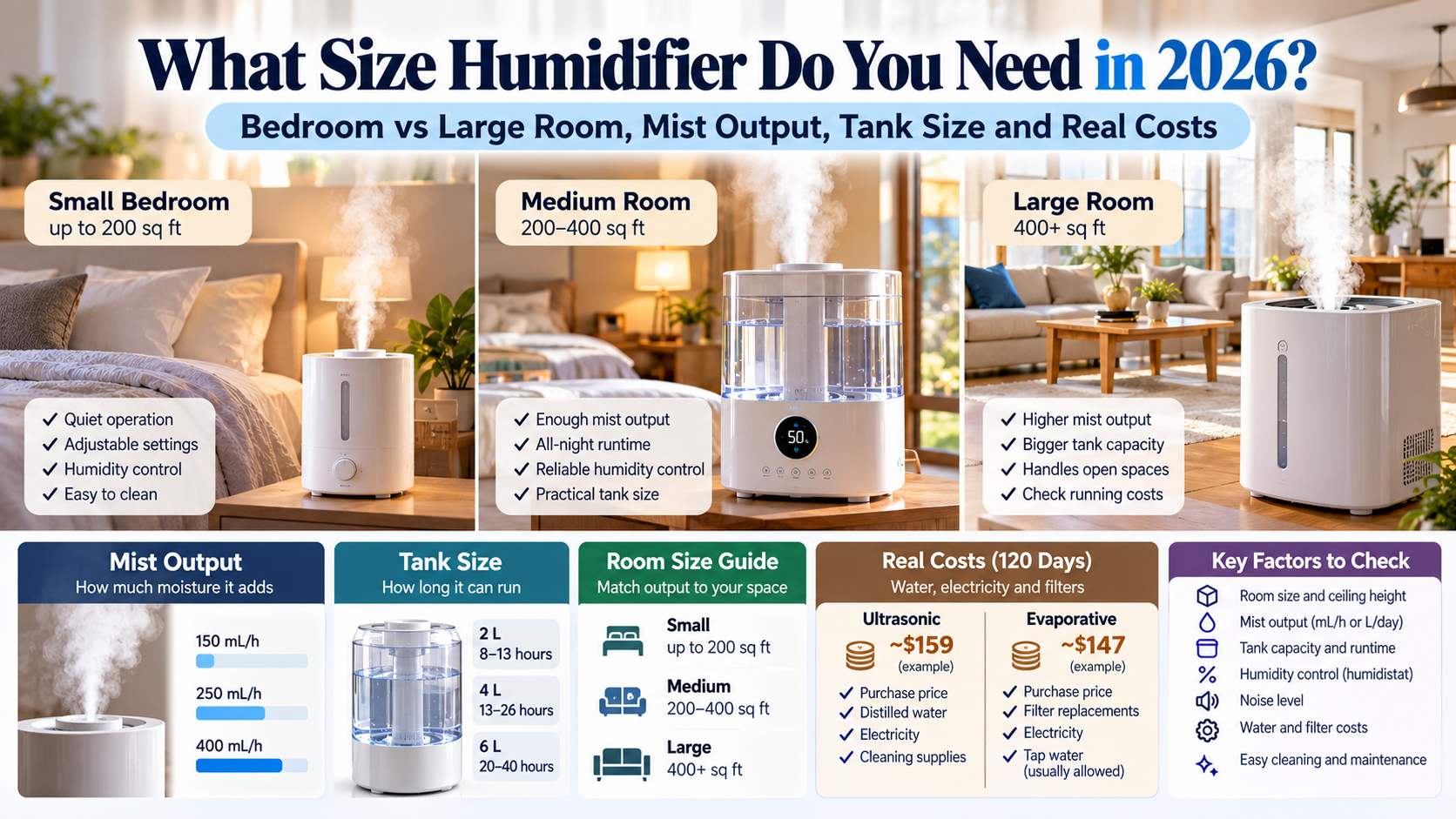
| Space | Main buying priority | Features worth checking |
|---|---|---|
| Small bedroom or home office | Controlled output and quiet operation | Adjustable settings, humidistat, easy cleaning |
| Medium bedroom | Overnight operation without excess moisture | Appropriate output, practical tank capacity |
| Large bedroom or living room | Sufficient daily moisture output | Measured performance, refill convenience |
| Open-plan living area | Higher moisture demand and air movement | Output capacity, room connectivity, humidity monitoring |
| Multiple separate rooms | Humidity where it is actually needed | Multiple units or an appropriately designed central system |
These categories are a decision framework, not universal engineering sizing rules.
The key principle: Match the humidifier’s actual moisture delivery to the room’s needs. Do not choose solely by tank size or an advertised maximum coverage number.
1. Start With Room Size—but Do Not Stop There
The first step is simple:
Room area = length × width
For example, a bedroom measuring 15 feet by 20 feet has an area of:
15 × 20 = 300 square feet
That number helps narrow your shopping options.
Consumer Reports organizes its humidifier evaluations by room size and emphasizes matching the machine to the space rather than automatically buying the largest available unit.
But room area is only the beginning.
Two rooms with identical floor areas may need different amounts of added moisture.
Important variables include:
- Ceiling height
- Air leakage around doors and windows
- Outdoor weather
- Heating system operation
- Open doorways
- Ventilation
- Initial indoor humidity
- Desired humidity level
A well-insulated bedroom may retain moisture more effectively than a drafty room of the same size.
That is why manufacturer coverage claims should be treated as starting points rather than guarantees.
2. Why Ceiling Height Changes the Calculation
Square footage measures floor area.
Humidifiers operate in a three-dimensional space.
Consider two hypothetical rooms.
Room A
- Floor area: 300 square feet
- Ceiling height: 8 feet
- Air volume: 2,400 cubic feet
Room B
- Floor area: 300 square feet
- Ceiling height: 12 feet
- Air volume: 3,600 cubic feet
Room B contains 50% more air volume despite having the same floor area.
That does not automatically mean it requires exactly 50% more humidifier output. Actual moisture demand also depends on ventilation, temperature, moisture losses, and existing humidity.
However, the comparison shows why square footage alone cannot describe the whole problem.
For rooms with unusually high ceilings, compare moisture output and consider how air moves between connected spaces.
3. Mist Output vs Tank Capacity: The Most Important Buying Distinction
These two specifications are frequently confused.
Mist output
Moisture output describes how much water a humidifier can add to the air over time.
Manufacturers may express it in:
- Milliliters per hour (mL/h)
- Liters per day (L/day)
- Gallons per day
Higher output generally indicates greater moisture-delivery potential.
However, advertised output should not be confused with independently measured performance.
Consumer Reports tests humidifier moisture output because real performance can differ from manufacturer claims.
Tank capacity
Tank capacity describes how much water the humidifier can hold.
It is usually expressed in liters or gallons.
A larger tank may reduce refill frequency, but it does not necessarily increase hourly moisture output.
Example
Consider two hypothetical models.
| Specification | Humidifier A | Humidifier B |
|---|---|---|
| Tank capacity | 4 liters | 6 liters |
| Maximum rated output | 300 mL/h | 200 mL/h |
| Theoretical continuous runtime at maximum output | 13.3 hours | 30 hours |
Humidifier A has a smaller tank but a higher rated output.
Humidifier B has a larger tank but releases moisture more slowly.
These calculations assume continuous operation at the stated output with all tank water usable. Actual runtime can differ because of automatic cycling, residual water, and operating settings.
A large tank is a convenience feature. Moisture output is a performance specification.
Both matter, but they answer different questions.
4. How to Calculate Humidifier Runtime
A useful starting formula is:
Theoretical runtime (hours) = usable water capacity (mL) ÷ water consumption rate (mL/h)
Suppose a humidifier has a 5-liter tank and operates at a steady 250 mL/h.
5,000 ÷ 250 = 20 hours
Now consider the same tank operating at 400 mL/h.
5,000 ÷ 400 = 12.5 hours
This illustrates why manufacturers can advertise long runtimes while users experience more frequent refilling at higher settings.
A 40-hour runtime claim may reflect a low-output mode rather than the amount of moisture your room actually needs.
What to check before buying
Look for both maximum moisture output and the operating setting used to support the advertised runtime.
If the manufacturer does not clearly explain its assumptions, treat the runtime figure cautiously.
5. Choosing a Humidifier for a Bedroom
A bedroom humidifier has a different job from a high-output unit designed for an open living area.
You want enough moisture to maintain comfortable conditions without excessive noise, frequent nighttime refilling, or damp surfaces.
Priority 1: Humidity control
A built-in humidistat can automatically adjust or stop output when the target humidity is reached.
This is particularly valuable in smaller rooms where excessive moisture may accumulate quickly.
A separate hygrometer can help verify actual room conditions.
Priority 2: Quiet operation
Noise matters when the appliance runs near a bed.
Ultrasonic humidifiers are often relatively quiet because they do not require the same fan-driven evaporation mechanism used by many evaporative models.
However, individual products vary.
Some evaporative units are quiet at lower fan speeds, while some ultrasonic models produce noticeable mechanical or water sounds.
Use independent noise measurements where available.
Priority 3: Easy daily maintenance
A bedroom unit should have a tank you can empty, refill, and clean without difficulty.
A complicated design becomes less attractive when it needs frequent attention.
Priority 4: Sensible output
A machine that is much too powerful for the room may create moisture problems unless it has reliable control.
Consumer Reports specifically cautions against oversizing humidifiers because excessive humidity can promote mold and dust mites.
Best buying approach: Choose a unit appropriately sized for your bedroom, with adjustable output, dependable humidity control, manageable noise, and accessible cleaning surfaces.
6. Choosing a Humidifier for a Large Room
Large rooms present a different challenge.
They contain more air and may be connected to hallways, kitchens, or other living areas.
A small tabletop unit may operate continuously while delivering insufficient moisture.
Focus on moisture delivery
Compare rated or independently measured output rather than tank size alone.
RTINGS evaluates humidifiers using measured moisture-delivery performance and identifies higher-capacity units as better suited to larger spaces.
Consider the room layout
An open-plan living room is not equivalent to an enclosed bedroom of the same floor area.
Moisture can move into connected spaces, and ventilation can increase the amount of water needed to maintain a target humidity.
Check the refill burden
Higher-output humidifiers can use substantial amounts of water.
A machine may be powerful enough for a large room but inconvenient if it requires frequent refilling.
Evaluate operating noise
A large evaporative model may move considerable air with a fan.
That may be acceptable in a living room but less desirable in a bedroom.
Watch for overhumidification
Large output does not mean unlimited operation is beneficial.
Use a hygrometer and look for condensation on windows or dampness near the machine.
7. Should You Buy One Large Humidifier or Two Smaller Ones?
This question is especially relevant in open-plan homes and households with multiple bedrooms.
One large humidifier
Potential advantages:
- One appliance to refill and maintain
- Potentially fewer separate electrical connections
- May work well for a connected open space
Potential drawbacks:
- Humidity may not distribute evenly
- A powerful unit can be noisy
- Separate rooms may remain relatively dry
- Cleaning one large reservoir may be inconvenient
Two smaller humidifiers
Potential advantages:
- Independent humidity control in different rooms
- More flexible placement
- Less reliance on airflow through doorways
Potential drawbacks:
- Two tanks to empty and clean
- Additional consumables
- More equipment to purchase and store
A practical rule
For two closed bedrooms, separate appropriately sized units may provide more predictable control.
For one large, connected living area, a suitably sized high-output unit may be more convenient.
Neither arrangement is universally superior.
8. Ultrasonic vs Evaporative: Does Technology Affect Sizing?
Yes, although output performance varies substantially within each category.
Ultrasonic humidifiers
These machines use vibration to create fine droplets.
Advantages can include quiet operation, compact designs, and relatively low electrical consumption.
However, mineral-rich water can contribute to white dust, and low-mineral water may be desirable.
Evaporative humidifiers
These machines use a wet wick or similar medium and airflow to evaporate water.
They generally release fewer dissolved minerals into the room but require wick maintenance.
Fan noise can also matter.
What should you prioritize?
For a small bedroom, low noise and precise humidity control may be decisive.
For a large living area, sustained moisture output, tank handling, and replacement-part costs may matter more.
Read our full ultrasonic vs evaporative humidifier comparison before choosing a technology.
9. How Much Water Will Your Humidifier Use?
Water consumption is often overlooked during shopping.
Consider three hypothetical average operating rates over eight hours per day.
| Average output | Water used in 8 hours | Water used over 120 days |
|---|---|---|
| 150 mL/h | 1.2 L | 144 L |
| 250 mL/h | 2.0 L | 240 L |
| 400 mL/h | 3.2 L | 384 L |
These calculations assume continuous output for eight hours daily.
Actual consumption will vary if the humidifier cycles on and off or operates at different settings.
Why this matters
For an ultrasonic humidifier using purchased distilled water, water consumption can become a major operating expense.
For an evaporative unit, water cost may be relatively low when the manufacturer permits tap water, but wick replacement becomes relevant.
See our guide to distilled vs tap vs filtered vs RO water for humidifiers for a detailed comparison.
10. Real Running Costs: A 120-Day Example
A low purchase price does not always mean a low total cost.
Consider two hypothetical humidifiers operated eight hours per day for 120 days.
Model A: Ultrasonic humidifier
Assumptions:
- Purchase price: $60
- Average power draw: 25 watts
- Average water consumption: 2 liters per day
- Purchased distilled water: $1.50 per US gallon
- Electricity rate: $0.18 per kWh
Seasonal electricity use:
0.025 kW × 8 hours × 120 days = 24 kWh
Electricity expense:
24 × $0.18 = $4.32
Seasonal water consumption:
240 liters ÷ 3.785 = approximately 63.4 gallons
Distilled water expense:
63.4 × $1.50 = approximately $95.10
Illustrative first-season total:
$60 + $4.32 + $95.10 = $159.42
This excludes cleaning supplies and any additional consumables.
Model B: Evaporative humidifier
Assumptions:
- Purchase price: $85
- Average power draw: 45 watts
- Average water consumption: 2 liters per day
- Tap water permitted by manufacturer
- Electricity rate: $0.18 per kWh
- Three replacement wicks at $18 each
- Water utility expense excluded as relatively small in this illustrative comparison
Seasonal electricity use:
0.045 kW × 8 hours × 120 days = 43.2 kWh
Electricity expense:
43.2 × $0.18 = approximately $7.78
Wick expense:
3 × $18 = $54
Illustrative first-season total:
$85 + $7.78 + $54 = $146.78, plus water and cleaning costs.
What this comparison actually shows
Under these assumptions, the evaporative model has a slightly lower first-season cost despite a higher purchase price.
But the result can change substantially.
If the ultrasonic owner already has suitable low-mineral RO water, purchased distilled-water expenses may fall.
If the evaporative unit needs more frequent wick replacement, its maintenance costs may rise.
These are illustrative scenarios, not actual product quotations or guaranteed operating costs.
The right choice depends on your water supply, maintenance preferences, and usage pattern.
11. Why a Humidistat Is Often Worth More Than a Bigger Tank
A humidistat measures humidity and helps regulate operation.
Without effective control, a powerful humidifier may continue adding moisture after the room has reached a comfortable level.
The U.S. Environmental Protection Agency recommends avoiding indoor relative humidity above 50%.
For many homes, a general operating range of approximately 30–50% relative humidity is appropriate, although condensation risk and local conditions matter.
What to look for
A useful humidity-control system should offer:
- Adjustable target humidity
- Automatic output reduction or shutoff
- Clear humidity readings
- Consistent behavior as conditions change
Built-in humidity sensors may be affected by their placement near the humidifier.
A separate hygrometer positioned elsewhere in the room can provide a useful comparison.
A smaller humidifier with reliable control may be a better purchase than a larger model that operates without adequate feedback.
12. Seven Humidifier Sizing Mistakes to Avoid
Mistake 1: Buying by tank capacity alone
A large tank does not guarantee sufficient moisture output.
Mistake 2: Assuming advertised coverage is a guarantee
Coverage depends on room conditions and the manufacturer’s assumptions.
Mistake 3: Ignoring ceiling height
A high-ceiling room contains more air than a standard room with the same floor area.
Mistake 4: Buying the largest unit available
Oversizing can create excess moisture, particularly without effective humidity control.
Mistake 5: Trusting maximum runtime without checking output
A long runtime may reflect a very low mist setting.
Mistake 6: Ignoring water and filter costs
The least expensive humidifier may become costly to operate.
Mistake 7: Forgetting cleaning access
A machine that is difficult to maintain may be frustrating even if its capacity is suitable.
For a detailed maintenance checklist, read our humidifier cleaning guide.
13. A Five-Step Buying Decision Framework
Before selecting a humidifier, answer these five questions.
Step 1: What is the actual room size?
Measure length and width, then consider ceiling height and open doorways.
Step 2: How much moisture does the machine deliver?
Compare mL/h, liters per day, or gallons per day. Prefer independent measurements when available.
Step 3: How long will it operate between refills?
Calculate approximate runtime from tank capacity and output.
Step 4: Can it maintain humidity without overshooting?
Prioritize adjustable output and reliable humidity monitoring.
Step 5: What will it cost over an entire season?
Include purchase price, water, electricity, replacement parts, and cleaning supplies.
This process is more reliable than choosing a model because it advertises the highest square-footage coverage.
Frequently Asked Questions
What size humidifier do I need for a 200-square-foot bedroom?
Start with models intended for small rooms, then compare actual moisture output, noise, and humidity controls. A specific output requirement cannot be determined from floor area alone because ceiling height, ventilation, and indoor conditions also matter.
Is a 6-liter humidifier enough for a large room?
Possibly, but tank capacity alone cannot answer the question. Check moisture output and independently evaluated room-size suitability.
Does a bigger humidifier work faster?
A model with greater actual moisture output may raise humidity faster under comparable conditions. However, tank size and advertised coverage are not direct measures of speed.
Can a humidifier be too big for a bedroom?
Yes. Excessive moisture output, especially without effective humidity control, can create condensation and overly humid conditions.
Is one large humidifier better than two small ones?
For an open living area, one large unit may be convenient. For separate closed rooms, individual units may offer more precise humidity control.
What is more important: tank size or mist output?
Both matter for different reasons. Moisture output determines how much water the machine can add to the air over time. Tank capacity primarily affects refill frequency.
How many hours should a bedroom humidifier run?
There is no universal duration. Operate it according to actual room humidity and the manufacturer’s instructions rather than assuming it must run all night.
Should I buy an ultrasonic or evaporative humidifier for a large room?
Compare measured output, noise, maintenance requirements, and water costs. Either technology may work when the product is appropriately sized.
Does a larger humidifier always cost more to run?
No. Operating costs depend on electricity consumption, water type, actual runtime, and consumables. A higher-output unit with effective humidity control may cycle off sooner than an undersized unit that runs continuously.
What indoor humidity should I aim for?
A commonly recommended range is 30–50% relative humidity. Avoid excessive humidity and reduce output if condensation or dampness appears.
Final Verdict: Buy for Moisture Output, Not Marketing Numbers
The best humidifier size is not simply the largest unit your budget allows.
A successful purchase balances five factors:
Room conditions, actual moisture output, tank capacity, humidity control, and long-term operating cost.
For bedrooms, quiet operation and precise humidity control often deserve priority.
For large rooms, sustained moisture delivery and refill convenience become increasingly important.
For open-plan spaces, airflow and connected room volume complicate the sizing decision.
And for every room, easy cleaning and reasonable consumable costs make the difference between an appliance you enjoy using and one you regret buying.
Before purchasing, compare the specifications that determine real ownership—not just the square-footage number on the box.
Sources and Editorial Notes
This guide uses publicly available consumer research and government guidance. Living Pick Lab did not conduct original product testing for this article. Calculations and model scenarios are illustrative, not live retail prices or measured product results.
- Consumer Reports — How to Find the Right Humidifier for Any Room
- Consumer Reports — Best Humidifier Buying Guide
- RTINGS — The Best Humidifiers of 2026
- U.S. Environmental Protection Agency — Use and Care of Home Humidifiers
Editorial disclosure: This article provides general buying and maintenance information. Follow the instructions supplied with your specific humidifier.