
Updated October 2026 | Living Pick Lab Home Moisture Buying Guide
A crawl space dehumidifier is one of those home appliances where choosing the wrong model can become considerably more expensive than the initial purchase.
The machine itself may cost hundreds or even thousands of dollars. But the real expense can include electrical work, drainage installation, replacement filters, maintenance visits, and eventually removing a failed unit from a difficult-to-access space.
And there is another complication: a dehumidifier that performs well in a warm basement may deliver substantially less moisture removal in a cool crawl space.
That makes comparing advertised pint capacities alone a poor buying strategy.
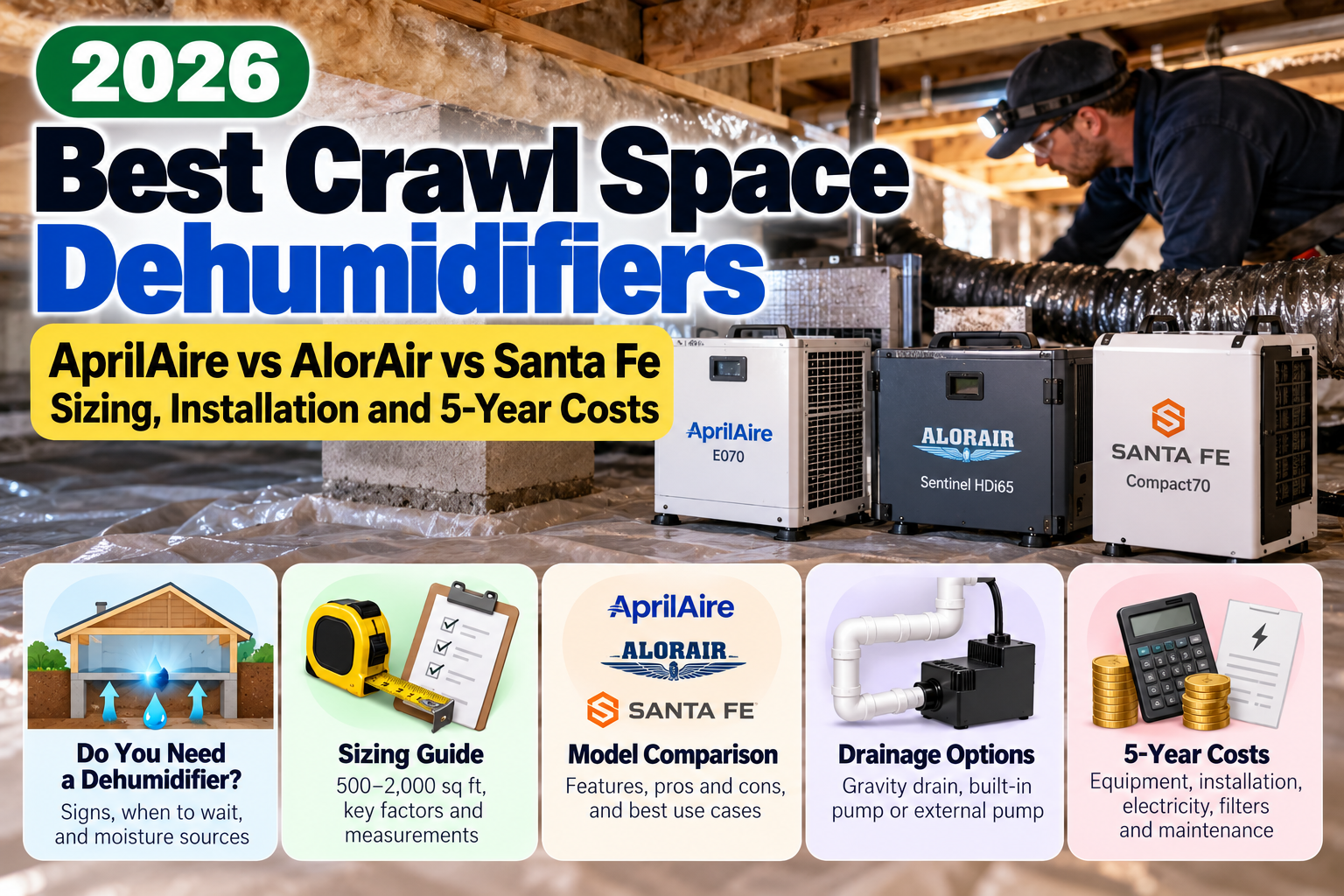
Three established names frequently appear in crawl space dehumidifier comparisons: AprilAire, AlorAir, and Santa Fe. Each offers products designed for demanding installations, but their differences go beyond brand reputation.
This guide examines how to choose between them, what to measure before ordering, how drainage changes installation costs, and how to estimate the real five-year cost of ownership.
Most importantly, we will explain when buying a dehumidifier is the wrong first step.
Quick Verdict: Which Crawl Space Dehumidifier Should You Buy?
The best choice depends on the installation, not simply the highest advertised moisture-removal capacity.
| Your Priority | Model Worth Investigating | Why |
|---|---|---|
| Balanced, professionally oriented installation | AprilAire E070 | Established whole-home moisture-control product line |
| Lower upfront cost and compact equipment | AlorAir Sentinel HD55 | Value-oriented crawl space design |
| Integrated condensate pumping | AlorAir Sentinel HDi65 | Built-in pump for installations requiring water lift |
| Very limited installation clearance | Santa Fe Compact70 | Compact 12 × 12 × 21-inch cabinet |
| Larger moisture load | Higher-capacity AprilAire, AlorAir, or Santa Fe model | Capacity can be matched to the actual conditions |
These are buying shortlists, not results of independent Living Pick Lab laboratory testing.
Our main recommendation: Before selecting any of these machines, confirm that your crawl space is suitable for mechanical dehumidification, that the unit physically fits, and that condensate water has a reliable path out.
A correctly installed, appropriately sized unit is generally a better investment than an oversized machine with inadequate drainage.
1. Do You Actually Need a Crawl Space Dehumidifier?
Not every damp crawl space should immediately receive a dehumidifier.
A machine removes moisture from the air. It does not stop groundwater from entering, repair plumbing leaks, or replace missing moisture barriers.
Before shopping, identify the source of the problem.
Signs a dehumidifier may be appropriate
A dedicated crawl space dehumidifier may be worth considering when:
- Relative humidity remains elevated after moisture sources have been addressed.
- The space is properly sealed or encapsulated.
- There is no unresolved standing water.
- Condensation persists during humid weather.
- A contractor has recommended active humidity control as part of a moisture-management plan.
Signs you should address another problem first
Do not rely on a dehumidifier as the primary solution when you have:
- Active plumbing leaks
- Standing water after rain
- Uncontrolled groundwater intrusion
- Poor exterior drainage
- Missing or damaged ground vapor barriers
- Significant structural or biological damage requiring professional assessment
A dehumidifier may temporarily reduce airborne humidity while the underlying problem continues.
That can lead to unnecessary electricity consumption and disappointing results.
The better sequence is source control, drainage and sealing, followed by humidity control when needed.
If you are unsure whether you need a pump-equipped unit for a conventional basement, see our separate guide:
Do You Need a Pump for Your Basement Dehumidifier? A Drainage Decision Guide
The present article focuses specifically on permanent or semi-permanent crawl space installations.
2. Crawl Space Dehumidifier vs Regular Basement Dehumidifier
A portable basement dehumidifier and a dedicated crawl space unit perform the same basic task: condensing moisture from air.
However, their physical designs and intended operating environments can be very different.
Portable basement dehumidifiers
Typical consumer models are designed for accessible indoor spaces.
They may feature:
- Upright cabinets
- Removable water buckets
- Rolling casters
- Built-in controls
- Optional hose drainage
- Operating conditions suited to ordinary indoor rooms
These features are convenient in a finished basement or laundry room.
They are less useful in a low-clearance crawl space where reaching the appliance is difficult.
Dedicated crawl space dehumidifiers
Purpose-built units often feature:
- Low-profile horizontal cabinets
- Continuous drainage connections
- Remote-control or external humidistat options
- Ducting compatibility on selected models
- Serviceable filters
- Installation methods suitable for elevated platforms or suspension systems
Some are designed for lower-temperature operation, although the exact operating range varies by model.
Important: Not every crawl space dehumidifier operates effectively at the same temperature, and no refrigeration-based unit maintains its full rated capacity under every condition.
Check the manufacturer’s performance data at temperatures representative of your crawl space.
3. AprilAire vs AlorAir vs Santa Fe: What Actually Separates Them?
The three brands serve overlapping customers, but different installations can favor different models.
AprilAire: A strong option for planned HVAC-style installations
AprilAire’s E-series products are designed for moisture management in basements, crawl spaces, and related residential applications.
The E070 is a sensible model to investigate for homeowners who want an established product line with installation accessories and service options.
Potential advantages
- Purpose-built moisture-control design
- Compatibility with selected remote controls and installation accessories
- Familiarity among some HVAC installers
- Suitable for permanent installations
Potential drawbacks
- Initial equipment cost may be higher than value-oriented alternatives.
- Pumping may require additional equipment, depending on the configuration.
- Installation accessories and included components vary by package.
Best suited to: Homeowners planning a professionally installed system with a straightforward drainage route and accessible service support.
AlorAir: A value-oriented option with several drainage configurations
AlorAir offers crawl space units with different capacities and configurations.
The Sentinel HD55 is a model to investigate when a compact, gravity-drain unit is appropriate.
The Sentinel HDi65 is worth considering when an integrated condensate pump would simplify the installation.
Potential advantages
- Multiple capacity choices
- Compact horizontal designs
- Pump-equipped options
- Potentially lower initial equipment costs
Potential drawbacks
- Warranty terms can differ by product and purchase channel.
- Replacement parts and service arrangements should be confirmed before buying.
- Model names with similar numbers can have different drainage configurations.
Best suited to: Cost-conscious buyers who are willing to verify exact model specifications, warranty coverage, and local service availability.
Santa Fe: A premium option for demanding or restricted spaces
Santa Fe manufactures specialized dehumidification equipment for crawl spaces and other demanding environments.
The Compact70 is particularly interesting for installations with limited clearance.
Its published cabinet dimensions are approximately 12 inches wide, 12 inches high, and 21 inches deep.
Santa Fe also publishes performance information at different temperature and humidity conditions, which is valuable for buyers trying to avoid misleading capacity comparisons.
Potential advantages
- Compact equipment options
- Detailed manufacturer performance information
- Purpose-built crawl space designs
- Selected models support ducting and advanced installation configurations
Potential drawbacks
- Premium purchase pricing may apply.
- Condensate pumping may require separate equipment.
- Dealer availability and service costs depend on location.
Best suited to: Homeowners prioritizing installation fit, documented performance, and professional equipment support.
4. The Capacity Trap: Why 70 Pints Does Not Always Mean 70 Pints
One of the most important mistakes to avoid is comparing dehumidifier capacities measured under different conditions.
A machine may remove significantly more moisture from warm, humid air than from cooler air.
That means a unit advertised as removing 70 pints per day under one test condition may remove much less in a cool crawl space.
A real manufacturer example
Santa Fe publishes the following performance figures for the Compact70:
| Test Conditions | Published Water Removal |
|---|---|
| 80°F and 60% relative humidity | 70 pints per day |
| 65°F and 60% relative humidity | 43.7 pints per day |
These are manufacturer-published values for the Compact70, not independently measured results from Living Pick Lab.
The difference is substantial.
A homeowner who compares the 70-pint headline with another model’s capacity at different conditions could reach the wrong conclusion.
What to compare instead
When evaluating two dehumidifiers, look for:
- Moisture removal at comparable temperatures and humidity levels
- Energy efficiency under the same test conditions
- Minimum operating temperature
- Automatic defrost behavior
- Drainage configuration
- Airflow and installation restrictions
Buying principle: A capacity figure is meaningful only when you understand the conditions under which it was measured.
This matters especially in cooler climates, where a crawl space may spend much of the year below normal indoor temperatures.
5. How to Size a Crawl Space Dehumidifier
Sizing is more complicated than multiplying square footage by a single universal number.
Moisture load depends on several interacting factors.
The six variables that matter
1. Crawl space area
A larger space generally contains more air and may have a larger surface area exposed to moisture.
2. Ceiling height
A four-foot-high crawl space has a different air volume from an eight-foot-high basement of the same floor area.
3. Encapsulation quality
An effectively sealed crawl space generally has a different moisture load from a vented or poorly sealed one.
4. Ground and foundation moisture
Moisture entering through the ground, walls, or foundation can significantly increase demand.
5. Climate
Hot, humid outdoor air and seasonal conditions can affect the moisture load.
6. Air exchange
Leaks, vents, ductwork, and connections to conditioned areas influence humidity control.
A practical sizing framework
| Crawl Space Area | What to Investigate |
|---|---|
| Around 500 sq ft | Compact equipment, installation clearance, minimum practical capacity |
| Around 1,000 sq ft | Small to medium dedicated units, sealing quality, drainage |
| Around 1,500 sq ft | Medium-capacity units, actual moisture load, air circulation |
| Around 2,000 sq ft | Manufacturer sizing charts, higher-capacity options, possible ducting |
| Above 2,000 sq ft | Detailed load assessment and professional sizing |
These are decision categories, not guaranteed pint-capacity requirements.
It would be misleading to say every 1,000-square-foot crawl space needs a particular pint rating without knowing its temperature, sealing condition, and moisture load.
Why encapsulation changes the equation
An encapsulated crawl space typically includes measures to limit moisture movement from the ground and surrounding environment.
When properly designed, this can reduce the amount of moisture a dehumidifier must remove.
A poorly sealed crawl space may place a much greater load on the same appliance.
If moisture intrusion is uncontrolled, installing a larger machine is not necessarily the right solution.
Our recommendation: Use the manufacturer’s crawl space sizing guidance as an initial screen, then validate it against the actual installation conditions.
For general basement sizing concepts, see:
What Size Dehumidifier Do I Need for My Basement? A 2026 Sizing Guide
6. The Installation Fit Test: Five Measurements to Take Before Ordering
A powerful dehumidifier is useless if it cannot be moved into the crawl space or installed with the required clearances.
Before placing an order, measure the following.
Measurement 1: Access opening
Measure the clear width and height of the crawl space entrance.
Account for framing, doors, pipes, and obstructions.
Do not assume a unit will fit simply because one cabinet dimension is smaller than the opening.
Measurement 2: Available installation height
Measure the vertical clearance where the machine will operate.
Include room for the mounting platform, vibration isolation, drain slope, and manufacturer-required service clearance.
Measurement 3: Service access
Filters and components may need periodic maintenance.
A machine that technically fits but cannot be serviced is a poor long-term investment.
Measurement 4: Drainage route
Determine where the condensate water will go.
Measure the horizontal distance and any vertical rise between the unit and the approved drain destination.
Measurement 5: Electrical access
Confirm that an appropriate grounded power supply is available.
Avoid improvising with extension cords or unsuitable wiring in a damp environment.
Electrical work should comply with applicable local codes and manufacturer requirements.
Before-you-buy checklist
- Unit fits through the access opening
- Installation clearances are adequate
- Filter and service access is possible
- Drainage route is confirmed
- Electrical supply is appropriate
- Operating temperature is within the manufacturer’s limits
- Moisture sources have been addressed
- Warranty and service options are understood
If any of these items remain unresolved, delay the purchase until you have a workable installation plan.
7. Gravity Drain vs Built-In Pump vs External Pump
Drainage can be the deciding factor between two otherwise similar models.
A dehumidifier continuously collects water from the air.
That water must leave the crawl space safely.
Option A: Gravity drainage
Gravity drainage allows water to flow downhill through a properly sloped drain line.
Advantages
- No separate pump motor
- Fewer mechanical components
- Potentially lower equipment cost
- Simpler maintenance when properly installed
Limitations
- Requires a suitable downhill route
- Drain line must be installed correctly
- Improper slope can cause standing water or backups
Best fit: Installations with a reliable, approved drain destination below the unit’s outlet.
Option B: Built-in condensate pump
Some models include a pump that can move collected water upward to a suitable discharge point.
Advantages
- Useful when gravity drainage is impossible
- Reduces the need for a separate pump appliance
- Can simplify certain installations
Limitations
- Pump failure can interrupt drainage
- Lift height and hose length have limits
- Repair arrangements vary by model
Best fit: Crawl spaces where condensate must rise before reaching the drain destination.
Option C: External condensate pump
A separate condensate pump can be paired with a compatible gravity-drain dehumidifier.
Advantages
- More equipment flexibility
- Pump may be replaceable separately
- Useful for existing installations
Limitations
- Additional purchase cost
- More plumbing and electrical components
- Another item requiring maintenance
Best fit: Homeowners who prefer a particular dehumidifier but need pumped drainage.
The most important drainage question
Do not ask only, “Does this model have a pump?”
Ask:
“Can this exact model move water to my approved drain destination, at the required height and distance, with a reliable failure-management plan?”
That is the question that prevents expensive installation surprises.
8. Low-Temperature Performance: A Critical Difference
Crawl spaces can remain cooler than living areas for much of the year.
Refrigeration-based dehumidifiers typically remove less moisture as temperature decreases.
Some models use automatic defrost systems to manage frost accumulation.
But automatic defrost does not mean the machine maintains its maximum advertised capacity in cold conditions.
What to check
Look for the manufacturer’s:
- Minimum operating temperature
- Moisture-removal data at cooler conditions
- Defrost specifications
- Installation limitations
- Guidance for unconditioned spaces
Why Santa Fe’s published data is useful
The Compact70 example illustrates the importance of realistic conditions.
Its published removal rate decreases from 70 pints per day at 80°F and 60% RH to 43.7 pints per day at 65°F and 60% RH.
That is why a homeowner should compare performance at similar temperatures rather than relying on headline capacities.
Practical takeaway: If your crawl space is frequently cold, compare low-temperature performance before comparing purchase prices.
9. Five-Year Ownership Cost: A Better Way to Compare Brands
A crawl space dehumidifier is usually a long-term home-maintenance purchase.
Comparing only the initial price can be misleading.
A more useful approach includes:
Five-Year Cost = Equipment + Installation + Drainage Equipment + Electricity + Filters + Expected Maintenance
The following example shows how to build that calculation.
Illustrative five-year cost comparison
These are hypothetical purchase scenarios, not current retail quotes or verified costs for specific AprilAire, AlorAir, or Santa Fe models.
| Expense | Value Setup | Premium Setup |
|---|---|---|
| Dehumidifier purchase | $700 | $1,400 |
| Initial installation | $250 | $450 |
| Drainage accessories | $150 | $100 |
| Average electricity use while running | 450 W | 500 W |
| Assumed duty cycle | 35% | 30% |
| Five-year electricity | $1,207.24 | $1,314.00 |
| Five-year filters and maintenance | $200 | $300 |
| Illustrative five-year total | $2,507.24 | $3,564.00 |
Electricity assumes $0.175 per kWh and 8,760 hours per year, with the equipment running only for the stated share of time.
The duty cycles are assumptions, not measured performance.
How the electricity calculation works
For the value setup:
0.450 kW × 8,760 hours × 35% × $0.175 = approximately $241.45 per year
Over five years:
$241.45 × 5 = approximately $1,207.25
Small differences may arise from rounding.
For the premium setup:
0.500 kW × 8,760 hours × 30% × $0.175 = $262.80 per year
Over five years:
$262.80 × 5 = $1,314.00
Why duty cycle matters
The amount of time a dehumidifier runs can have a major effect on electricity cost.
But duty cycle is not a fixed property of a brand.
It depends on:
- Moisture load
- Temperature
- Humidity setting
- Equipment capacity
- Air leakage
- Seasonal conditions
An oversized unit does not automatically use less electricity, and a premium model does not automatically have a lower total ownership cost.
What to request from an installer
Before accepting a quote, ask for:
- Exact equipment model and included accessories
- Installation labor breakdown
- Drainage method and pump specifications
- Filter replacement costs
- Expected maintenance schedule
- Warranty terms, including labor coverage
- Estimated electricity use under your conditions
A detailed quote can be more valuable than a small difference in the advertised equipment price.
10. Is Professional Installation Worth the Cost?
Some crawl space dehumidifiers can be installed by experienced homeowners.
However, difficult access, electrical work, drainage routing, and moisture-control problems may justify professional installation.
DIY installation may be reasonable when:
- The crawl space is safely accessible.
- The moisture source has already been addressed.
- A suitable electrical outlet exists.
- The drain route is straightforward.
- The manufacturer permits the proposed installation.
- No specialized structural or electrical work is required.
Professional installation is especially worth considering when:
- The crawl space has limited clearance.
- The equipment must be suspended.
- Drainage requires a complex pump route.
- Ductwork is involved.
- The space has unresolved moisture intrusion.
- Electrical modifications are needed.
- Warranty coverage depends on installation conditions.
Cost-saving tip: Get an itemized quote rather than accepting a single bundled price without knowing what it includes.
You should be able to identify the cost of the equipment, labor, drainage system, electrical work, and any optional accessories.
11. What Humidity Level Should You Target?
For many homes, a relative humidity target around 45% to 50% can be a reasonable starting point for moisture management, provided it is appropriate for the specific space and climate.
The EPA generally recommends keeping indoor relative humidity below 60%, ideally between 30% and 50%, to help control mold growth.
A crawl space may require a site-specific strategy.
Avoid two common mistakes
Mistake 1: Setting humidity too high
A persistently damp environment can support moisture-related problems.
Mistake 2: Setting humidity unnecessarily low
An aggressive setting may increase electricity use without providing meaningful additional benefits.
The objective is stable moisture control, not the lowest possible humidity reading.
Use a reliable hygrometer and monitor conditions over time.
If readings remain elevated despite continuous operation, investigate the underlying moisture load before automatically buying a larger unit.
12. When Should You Choose AprilAire, AlorAir, or Santa Fe?
Here is a practical decision framework.
Choose AprilAire when:
You want a professionally oriented installation, an established product family, and a clear path for compatible controls and accessories.
The E070 is worth evaluating if its capacity and installation requirements match your space.
Choose AlorAir when:
Purchase cost and drainage configuration are important considerations.
Compare the Sentinel HD55 and pump-equipped HDi65 carefully rather than assuming that similarly named models include identical features.
Choose Santa Fe when:
Compact cabinet dimensions, published operating data, and specialized crawl space equipment are top priorities.
The Compact70 deserves consideration where physical installation clearance is limited.
Choose none of them yet when:
You still have standing water, active leaks, uncertain electrical access, or no safe condensate discharge route.
In that situation, fixing the underlying conditions is a better first investment.
13. Seven Expensive Crawl Space Dehumidifier Mistakes
Mistake 1: Buying before fixing moisture intrusion
The appliance may run continuously while groundwater or leaks keep adding moisture.
Mistake 2: Comparing pint ratings from different test conditions
A warm-temperature rating can overstate what you should expect in a cooler crawl space.
Mistake 3: Ignoring the access opening
The selected unit may not fit through the entrance.
Mistake 4: Forgetting maintenance clearance
A machine that cannot be serviced can become costly to own.
Mistake 5: Choosing the wrong drainage method
A gravity-drain unit cannot move water uphill without additional equipment.
Mistake 6: Assuming the warranty covers everything
Parts, labor, shipping, registration requirements, and installation conditions may differ.
Read the exact warranty before ordering.
Mistake 7: Ignoring five-year electricity and maintenance costs
A low initial price does not guarantee the lowest ownership cost.
14. Frequently Asked Questions
What is the best crawl space dehumidifier in 2026?
There is no universal winner. AprilAire E070, AlorAir Sentinel models, and Santa Fe Compact70 are worth comparing, but the best choice depends on moisture load, temperature, drainage, installation space, and long-term cost.
Is AprilAire better than AlorAir?
Not automatically. AprilAire may suit a professionally planned installation, while selected AlorAir models may offer lower initial costs or integrated pumping. Compare exact models rather than brands alone.
Is Santa Fe worth the extra money?
It can be, particularly when cabinet dimensions, published performance data, and specialized installation requirements matter. Whether the premium is justified depends on your installation and service options.
What size dehumidifier do I need for a 1,000-square-foot crawl space?
Square footage alone is insufficient. Consider ceiling height, sealing quality, climate, moisture intrusion, and operating temperature. Use manufacturer sizing guidance and seek a load assessment when conditions are uncertain.
Do crawl space dehumidifiers need a pump?
Not always. Gravity drainage may be sufficient when an approved drain destination is below the outlet. A pump is needed when condensate must be lifted.
Can I use a regular basement dehumidifier in a crawl space?
Sometimes, if the model is approved for the conditions and can be safely installed and drained. But a dedicated crawl space unit is often better suited to low-clearance, hard-to-access installations.
Should a crawl space dehumidifier run continuously?
Many units cycle according to humidity conditions. Continuous fan or compressor operation may indicate high moisture load, an aggressive humidity setting, or a problem requiring investigation.
Will a dehumidifier fix mold in a crawl space?
A dehumidifier can help control humidity, but it does not remove existing mold or repair the conditions that caused it. Significant mold problems may require professional assessment and remediation.
How long does a crawl space dehumidifier last?
Service life varies with operating conditions, maintenance, installation quality, and product design. Do not treat a warranty period as a guaranteed lifespan.
Is crawl space encapsulation necessary before installing a dehumidifier?
Not in every possible installation, but moisture-source control and appropriate sealing are often important for effective operation. A contractor can evaluate the best approach for your foundation.
Final Verdict: The Best Dehumidifier Is the One That Fits the Installation
Choosing between AprilAire, AlorAir, and Santa Fe is not simply a question of which company makes the strongest machine.
It is a question of which system will control moisture reliably in your specific crawl space without creating unnecessary installation and maintenance expenses.
AprilAire E070 deserves consideration for professionally oriented installations.
AlorAir Sentinel models are worth investigating when value or pump configuration is a priority.
Santa Fe Compact70 stands out as a model to examine when space is limited and detailed operating specifications matter.
But the smartest purchase begins before choosing a brand.
Measure the space. Identify the moisture source. Confirm drainage. Compare capacities at realistic temperatures. Check maintenance access. Then calculate the five-year ownership cost.
A dehumidifier that costs less to buy but more to install, operate, or service may not be the better value.
And if the underlying moisture problem remains unresolved, even an expensive machine may not deliver the results you expect.
Sources and Further Reading
U.S. Environmental Protection Agency — A Brief Guide to Mold, Moisture and Your Home
https://www.epa.gov/mold/brief-guide-mold-moisture-and-your-home
ENERGY STAR — Dehumidifiers
https://www.energystar.gov/products/dehumidifiers
Santa Fe — Compact70 Official Product Specifications
https://www.santa-fe-products.com/product/compact-70-dehumidifier/
Bob Vila — Best Crawl Space Dehumidifiers, Tested and Reviewed
https://www.bobvila.com/articles/best-crawl-space-dehumidifier/
AprilAire — Official Website and Product Information
https://www.aprilaire.com/
AlorAir — Official Website and Product Information
https://www.aloraircrawlspace.com/
Editorial disclosure: Living Pick Lab has not independently laboratory-tested the products discussed in this article. Brand and model comparisons are based on publicly available product information, manufacturer specifications, and third-party editorial research. Cost examples are illustrative calculations, not current retail quotes or guarantees of operating expense. Specifications, product availability, and warranty terms may change. For complex moisture problems, electrical work, structural concerns, or difficult drainage installations, consult qualified professionals.