
Updated October 2026 | Living Pick Lab
The best dishwasher upgrade is not necessarily the most expensive one. It is the feature that solves a problem you actually experience.
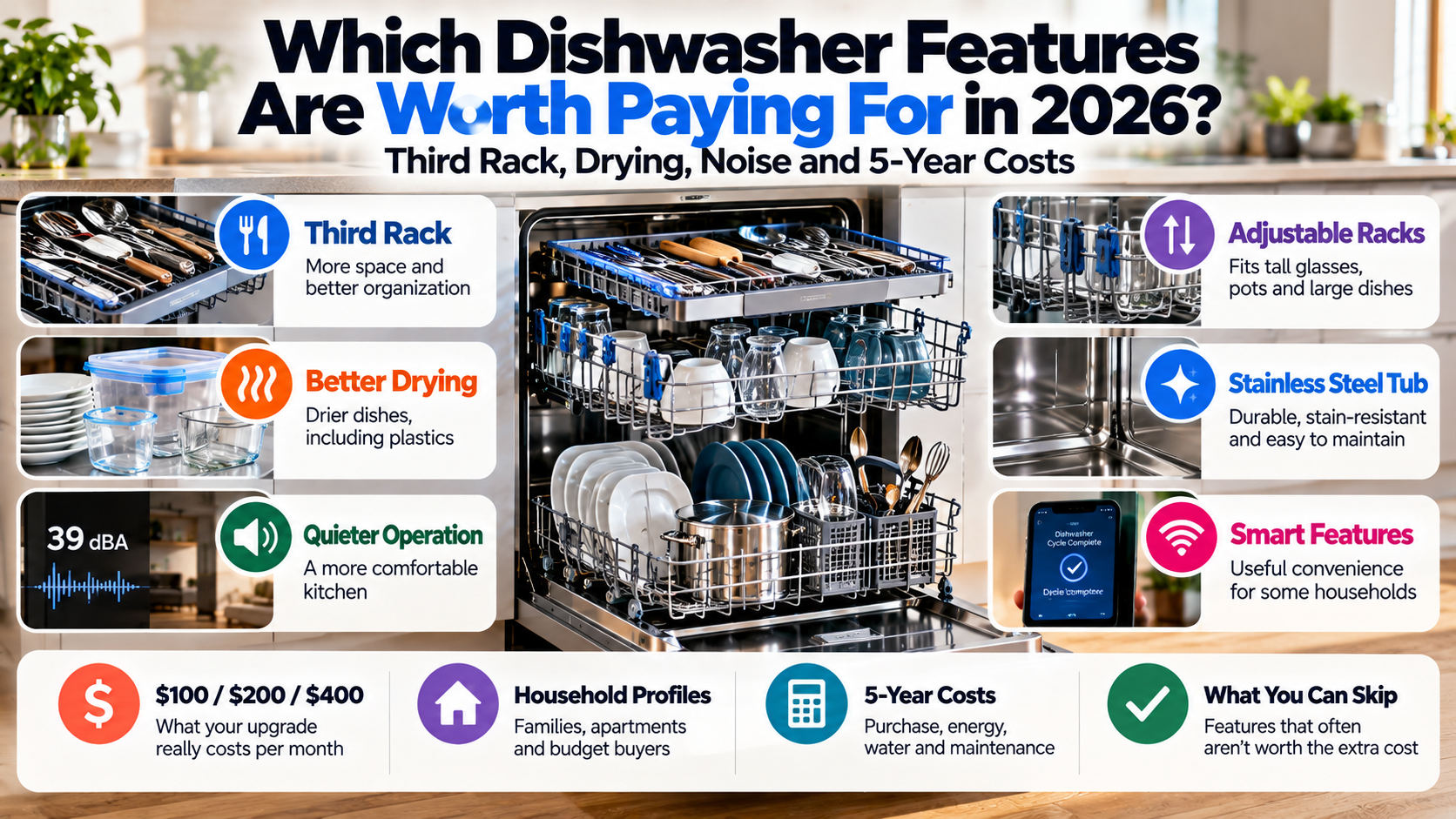
A third rack can make everyday loading easier. Better drying can save you from wiping down plastic food containers. A quieter machine can make an open-plan kitchen more comfortable.
But should you spend another $100 for a third rack? Is a 39-decibel dishwasher worth $400 more than a 44-decibel model? Does a stainless steel tub justify a higher price? And will premium features save enough money to recover their cost over five years?
These questions matter because a dishwasher that costs $1,200 is not automatically a better purchase than one costing $750.
The right answer depends on your dishes, kitchen layout, household routine, and how much you value convenience.
This guide examines the dishwasher features most likely to influence everyday satisfaction, identifies upgrades you can often skip, and introduces a transparent five-year cost framework.
Rather than pretending that every household needs the same premium model, we will show you how to decide which features deserve your money.
Quick Verdict: Which Dishwasher Features Are Worth the Upgrade?
| Feature | Best for | Our buying verdict |
|---|---|---|
| Adjustable upper rack | Households with tall glasses, pots, and mixed dish sizes | High practical value |
| Strong plastic-drying performance | Families washing lunchboxes and reusable containers | Worth prioritizing |
| Third rack | Frequent utensil and small-tool loads | Valuable if the rack layout works |
| Quiet operation around 44 dBA or below | Open kitchens and evening use | Often worth paying for |
| Stainless steel tub | Buyers seeking durable, stain-resistant interiors | Useful, but not essential |
| Soil-sensing cycle | Households with varying levels of food residue | Practical efficiency feature |
| Automatic door opening | Buyers seeking better passive drying | Useful when compatible with the kitchen |
| Wi-Fi connectivity | People who actively use remote alerts and controls | Optional |
| Interior lighting | Buyers who frequently unload in dim conditions | Usually a luxury |
| Numerous specialty wash cycles | Households with specific recurring needs | Often unnecessary |
Living Pick Lab’s recommendation: Prioritize cleaning performance, drying, rack flexibility, and acceptable noise before paying for connected features, decorative details, or an unusually large number of wash programs.
This is a feature-priority framework, not a ranking of tested models.
1. Start With Your Household, Not the Dishwasher’s Feature List
Two families can buy the same dishwasher and have completely different experiences.
One family may appreciate the third rack every day. Another may find that it reduces clearance for taller items.
A household with an open-plan kitchen may notice the difference between a noisy and a quiet dishwasher. Someone who runs the appliance overnight behind a closed kitchen door may care much less.
Before comparing models, answer four questions.
What do you wash most often?
Think about your actual loads.
- Dinner plates and glasses
- Pots, pans, and baking dishes
- Plastic lunchboxes and food-storage containers
- Baby-feeding items, where manufacturer cleaning instructions permit dishwasher use
- Cooking utensils, spatulas, and serving tools
A third rack may be valuable for utensils, but a flexible middle rack could matter more for large cookware.
When do you run the dishwasher?
If you run it during dinner, television time, or while working near the kitchen, noise deserves more attention.
If you run it when the kitchen is empty, paying substantially more for ultra-quiet operation may not be necessary.
What annoys you about your current dishwasher?
Common frustrations include:
- Wet plastic containers
- Awkward loading
- Poor cleaning of heavily soiled items
- Long cycle times
- Loud pumping or draining sounds
- Frequent filter maintenance
Your next dishwasher should address the problems you actually experience.
What is your complete installed budget?
A dishwasher’s advertised price is not always the final cost.
Delivery, installation, connection materials, taxes, and removal of the old machine can change the economics.
If you are still choosing between permanent and compact installation, read our Countertop vs Built-In Dishwasher in 2026: Installation, Capacity and Real 5-Year Costs.
If the opening size is uncertain, our 18-Inch vs 24-Inch Dishwasher in 2026 explains the practical trade-offs.
Once size and installation are settled, you can focus on which features are worth upgrading.
2. Third Rack vs Adjustable Upper Rack: Which Matters More?
A third rack is one of the most visible dishwasher upgrades.
It adds a shallow loading area above the main racks, usually intended for flatware, small utensils, or other items that fit the manufacturer’s loading guidance.
An adjustable upper rack serves a different purpose. It changes vertical clearance so you can accommodate taller glasses or larger items below.
These features are not interchangeable.
Third rack: Where it helps
A third rack may be especially useful when your household regularly washes:
- Spoons and forks
- Measuring spoons
- Small cooking utensils
- Spatulas and other dishwasher-safe tools
- Small cups or bowls, if the rack is designed for them
It can free space elsewhere in the machine, particularly when the alternative is a large cutlery basket in the lower rack.
However, not all third racks are equally functional.
Some are almost flat. Others have deeper sections or adjustable components.
A third rack that looks impressive in product photos may be less useful if it does not fit your actual utensils.
Adjustable upper rack: Where it helps
An adjustable upper rack can make room for:
- Tall drinking glasses
- Large dinner plates below
- Mixing bowls
- Serving dishes
- Certain pots and cookware
For many households, this flexibility affects everyday loading more than an extra shallow rack.
The rack trade-off
| Buying question | Third rack | Adjustable upper rack |
|---|---|---|
| Better organization for cutlery | Usually stronger | Limited |
| More flexibility for tall items | Depends on design | Usually stronger |
| Potentially frees lower-rack space | Yes | Sometimes |
| Can reduce vertical clearance | Yes, depending on design | Adjustment can redistribute clearance |
| Most important evaluation | Usable rack depth and layout | Height positions and real clearance |
What to test before buying
If possible, bring the measurements of your largest dinner plates, glasses, and frequently washed cookware.
Check whether the upper rack moves smoothly when loaded, whether the third rack is removable, and whether the lower rack can still accommodate your largest dishes.
Our verdict: Do not pay for a third rack based on the feature name alone. A flexible two-rack dishwasher can be more useful than a poorly designed three-rack model.
If both features are available within your budget, that combination may be especially practical.
3. Dishwasher Drying Features: Which Technologies Are Worth Paying For?
Drying performance is one of the most important differences between dishwasher designs.
It also creates one of the most common frustrations: plastic containers that remain wet after the cycle ends.
Plastic generally stores less heat than ceramic or glass, making it more difficult to dry using residual heat alone.
Consumer Reports specifically identifies plastic drying as a challenge in dishwasher testing.
That makes drying performance worth examining carefully rather than assuming every dishwasher performs similarly.
Heated drying
Heated drying uses additional heat during the drying process.
Potential advantages:
- Can improve drying under appropriate conditions
- May reduce moisture on certain items
- Familiar and widely available technology
Potential disadvantages:
- Can increase energy use
- Some plastic items may be unsuitable for high-heat settings
- Results still depend on load arrangement and appliance design
Check the manufacturer’s instructions before using heated drying with temperature-sensitive items.
Condensation drying
Condensation drying relies on temperature differences and moisture condensing on cooler surfaces.
It is commonly associated with stainless steel interior designs, although implementations vary.
Potential advantages:
- Can avoid a separate high-power drying element
- Often works well for glass and ceramic
- May support efficient operation
Potential disadvantages:
- Plastic containers may remain wet
- Drying can take time
- Performance varies by machine and cycle
Fan-assisted drying
Some dishwashers use airflow to help remove moisture.
The effectiveness depends on the complete drying system, not merely the presence of a fan.
Automatic door opening
Certain models automatically open the door near the end of a cycle to release moist air.
This can support passive drying, but buyers should consider kitchen conditions, countertop materials, and the manufacturer’s installation instructions.
Do not assume every auto-open design is suitable for every kitchen.
Mineral-based drying
Some premium dishwashers use mineral-assisted drying systems designed to improve moisture removal.
These can be particularly appealing to households that wash many plastic containers.
However, the presence of a premium drying technology is not proof that a particular model outperforms every less expensive alternative.
Independent model-level drying tests remain valuable.
Drying feature comparison
| Drying approach | Main benefit | Important limitation |
|---|---|---|
| Heated dry | Additional heat for moisture removal | Energy use and heat-sensitive items |
| Condensation dry | Uses residual heat and condensation | Plastic may remain wet |
| Fan-assisted dry | Adds airflow | Performance varies by design |
| Auto-open dry | Releases moist air | Kitchen and installation compatibility |
| Mineral-assisted dry | Targets difficult drying conditions | Usually associated with higher-priced models |
Our verdict: If your household frequently washes plastic lunchboxes and storage containers, better verified drying performance may justify a premium.
If you mostly wash glass, ceramic, and metal items, a less expensive dishwasher with satisfactory drying may be enough.
The best evidence is independent testing of the exact model—not the technology name alone.
4. How Quiet Is Quiet Enough? 39 vs 44 vs 48 dBA
Dishwasher noise ratings are usually expressed in A-weighted decibels, or dBA.
A lower number generally indicates a quieter measured sound level.
However, decibels use a logarithmic scale. A five-decibel difference is not the same as a simple five-percent reduction in sound.
What the numbers mean
| Rated noise | Practical interpretation |
|---|---|
| 48 dBA | May be noticeable in a quiet open kitchen |
| 44 dBA | A useful quiet-operation target for many households |
| 42 dBA | Quieter on the published rating |
| 39 dBA | Very low published sound rating |
These descriptions are general buying guidance, not guarantees of perceived loudness in a specific home.
Installation, kitchen acoustics, flooring, load arrangement, and the type of sound produced can all affect the experience.
Consumer Reports also notes that an average decibel rating does not fully capture occasional loud pumping or draining sounds.
The mathematical difference
A 44 dBA sound level is approximately 3.16 times the sound intensity of a 39 dBA sound level under comparable measurement conditions.
That does not mean the dishwasher will sound 3.16 times as loud to a person.
Human loudness perception is more complicated than sound intensity alone.
When paying for quieter operation makes sense
Consider prioritizing noise reduction if:
- Your kitchen opens directly into a living room
- You work from home near the dishwasher
- You frequently run cycles while watching television
- Household members are sensitive to mechanical noise
- You live in a small apartment where sound travels easily
When ultra-quiet operation may be unnecessary
A 39 dBA model may not be worth a large premium if:
- Your kitchen is separated from living areas
- You run the dishwasher when nobody is nearby
- The less expensive model is already acceptably quiet
- Other household appliances produce more noticeable noise
Our verdict: For many buyers, a well-performing dishwasher around 44 dBA offers a reasonable balance of quiet operation and cost.
Paying extra to move from a much louder machine into the low-to-mid 40s may matter more than paying a large premium to move from 44 to 39 dBA.
That is a buying judgment, not a claim that all models with the same rating sound identical.
5. Stainless Steel vs Plastic Tub: Is the Upgrade Worth It?
The interior tub is another feature frequently used to distinguish budget and premium dishwashers.
Common designs include plastic, stainless steel, and hybrid construction.
Stainless steel tub
Potential advantages include:
- Resistance to staining
- Durable interior construction
- Support for certain condensation-drying designs
- A premium interior finish
But stainless steel does not automatically guarantee superior cleaning or lower noise.
The complete appliance design matters more than tub material alone.
Plastic tub
Potential advantages include:
- Lower purchase price in many product lines
- Functional cleaning performance when the machine is well designed
- A reasonable choice for budget-conscious buyers
Potential drawbacks can include staining or odor concerns, depending on material, maintenance, and use.
Hybrid tub
Some dishwashers combine stainless steel and plastic components.
A hybrid design should not automatically be classified as inferior or superior. Evaluate the model’s actual cleaning, drying, durability, and price.
Which should you choose?
| Priority | Buying guidance |
|---|---|
| Lowest reasonable purchase price | Do not rule out plastic tubs |
| Premium interior materials | Consider stainless steel |
| Better plastic drying | Check tested drying performance, not just tub material |
| Lower noise | Compare measured noise and independent tests |
| Long-term durability | Consider model reliability and serviceability as well |
Our verdict: A stainless steel tub can be a worthwhile upgrade, especially when the price difference is modest.
But it should not take priority over demonstrably better cleaning, useful rack design, or reliable drying performance.
6. Soil Sensors, Wash Cycles and Filters: The Features That Are Easy to Overlook
Not every valuable dishwasher feature is visually impressive.
Some of the most useful capabilities affect how the appliance adapts to different loads and how much maintenance it requires.
Soil-sensing cycles
A soil sensor helps the dishwasher adjust aspects of its operation based on the condition of the wash water.
ENERGY STAR identifies soil-sensing and suitable cycle selection as useful considerations when shopping.
A well-designed automatic cycle can reduce the need to guess which wash setting is appropriate.
However, the presence of a soil sensor does not establish the exact water or energy savings of a particular model.
Extra wash programs
A dishwasher with fourteen programs is not necessarily more useful than one with six.
Consider whether you actually need:
- Normal or automatic wash
- Heavy-duty wash
- Quick wash
- Delicate or glassware settings
- Rinse-only operation
- Sanitize options, where applicable and properly certified
Specialized cycles may be useful for particular households, but unused programs provide little everyday value.
Filter maintenance
Some dishwashers have manually cleaned filters. Others use self-cleaning systems.
Manual filters may require periodic cleaning, while certain self-cleaning designs can introduce additional mechanical noise.
Review the manufacturer’s maintenance instructions before choosing.
Sanitize settings
A sanitize-labeled cycle should not be assumed to meet every hygiene requirement.
If sanitization is a priority, look for relevant certification and follow the manufacturer’s instructions, including appropriate loading and cycle selection.
Our verdict: A reliable automatic wash cycle and manageable filter maintenance may matter more than an extensive menu of specialty programs.
7. Which Dishwasher Features Can You Usually Skip?
Premium features are not inherently wasteful.
But a feature has limited value if you rarely use it.
Wi-Fi and app connectivity
Connected features may provide:
- Cycle-completion alerts
- Remote status information
- Maintenance notifications
- Additional program settings
They can be useful for households already comfortable with connected appliances.
However, app connectivity does not automatically improve cleaning performance.
Consider software support, account requirements, and whether the features you want remain available without a smartphone.
Interior lighting
Interior lights can make loading and unloading easier in dim kitchens.
But most buyers should prioritize cleaning, drying, rack design, and reliability first.
Excessive specialty cycles
More programs can create the impression of greater capability.
Yet a household that consistently uses Auto, Normal, and Heavy may gain little from several additional cycles.
Premium touch controls
Touch controls and hidden displays can create a cleaner appearance.
They are not necessarily better for every household, particularly when ease of operation is important.
The practical upgrade test
Before paying for any feature, ask:
What specific problem will this solve, and how often will I benefit?
If you cannot identify a recurring use case, the upgrade may not deserve priority.
8. The $100, $200 and $400 Upgrade Test
One of the simplest ways to assess a dishwasher upgrade is to spread its additional purchase cost over the years you expect to use it.
This is not a loan-payment calculation.
It is a way to understand the price of convenience.
Five-year premium comparison
| Additional purchase cost | Cost per year | Equivalent cost per month |
|---|---|---|
| $100 | $20 | $1.67 |
| $200 | $40 | $3.33 |
| $400 | $80 | $6.67 |
| $600 | $120 | $10.00 |
All values assume 60 months of use and exclude financing, taxes, differences in operating costs, maintenance, and resale value.
Example A: $100 more for an adjustable rack
If the adjustable rack prevents daily loading frustration, the equivalent cost of $1.67 per month may be easy to justify.
But if your dishes already fit comfortably, the benefit may be negligible.
Example B: $200 more for stronger drying
Suppose you regularly unload wet plastic containers and spend several minutes drying them manually.
An additional $3.33 per month may be reasonable if independent tests show that the more expensive dishwasher solves the problem.
The important phrase is if it actually solves the problem.
Do not pay for a drying-system label without evaluating real results.
Example C: $400 more for ultra-quiet operation
Moving from a dishwasher rated around 44 dBA to one rated around 39 dBA might matter in a quiet, open-plan home.
But in a separate kitchen, $6.67 per month may be better spent elsewhere.
The opportunity-cost question
Suppose you have $400 available for upgrades.
Would you prefer:
- A quieter machine
- Better plastic drying
- More flexible racks
- A combination of smaller improvements
You may not be able to obtain every premium feature at the same price.
The best purchase allocates your budget to the improvements you will notice most often.
9. Three Household Profiles: Where Should the Upgrade Money Go?
Household A: Family with children and reusable food containers
Typical loads: Lunchboxes, plastic containers, utensils, dinner plates, and glasses.
Priorities:
- Verified plastic-drying performance
- Flexible rack design
- Third rack with usable space
- Reliable everyday cleaning
- Quiet operation, depending on the kitchen
Features to reconsider: Decorative lighting, premium touchscreens, and connected functions that the family will not use.
Buying strategy: Spend extra on drying and loading convenience before paying for luxury styling.
Household B: Apartment with an open-plan kitchen
Typical loads: Plates, cups, glassware, occasional cookware.
Priorities:
- Acceptably quiet operation
- Good cleaning performance
- Flexible loading
- Reliable installation fit
- Efficient everyday cycles
Features to reconsider: Paying a large premium for specialized drying if plastic containers are rarely used.
Buying strategy: A quieter midrange dishwasher may be more valuable than a louder premium model with unnecessary features.
Household C: Budget-conscious couple
Typical loads: Moderate amounts of plates, cups, cutlery, and occasional pots.
Priorities:
- Reliable cleaning
- Reasonable purchase and installation cost
- Acceptable drying
- Basic rack flexibility
- Manageable maintenance
Features to reconsider: Wi-Fi, interior lighting, elaborate controls, and a third rack that adds little usable capacity.
Buying strategy: A well-performing basic or midrange model may deliver the best value.
Household comparison
| Household | First upgrade priority | Second priority | Lower priority |
|---|---|---|---|
| Family with children | Plastic drying | Rack flexibility | Decorative extras |
| Open-plan apartment | Low noise | Rack flexibility | Unused specialty cycles |
| Budget-conscious couple | Core performance | Total installed cost | Connected features |
These are decision profiles, not recommendations for specific tested models.
10. How to Compare Real Dishwasher Specifications
Feature names can be misleading.
Two dishwashers may both advertise a third rack but offer very different usable space.
Likewise, two machines with stainless steel tubs may differ substantially in drying performance.
To compare models properly, build a specification sheet.
The seven specifications to record
| Specification | Why it matters |
|---|---|
| Exact model number | Prevents confusion between similar versions |
| Installed purchase price | Establishes the real upfront cost |
| Noise rating (dBA) | Helps screen for quiet operation |
| Rack configuration | Determines everyday loading flexibility |
| Drying system | Helps identify likely drying differences |
| Annual energy use (kWh) | Supports operating-cost comparison |
| Water consumption per cycle | Supports water-cost comparison |
Also record tub material, soil-sensing capability, warranty terms, and any independent cleaning or drying test results.
Use the ENERGY STAR certified-product database
The official ENERGY STAR Certified Residential Dishwashers database provides model-level information, including annual energy use, water consumption, tub material, drying methods, and certain additional features.
This is a useful starting point for verifying manufacturer claims.
However, the database does not replace independent testing of cleaning performance, drying effectiveness, noise quality, or long-term reliability.
Understand the certification limits
Under the current ENERGY STAR Version 7.0 criteria, standard dishwashers must meet limits of:
- No more than 240 kWh of annual energy consumption
- No more than 3.2 gallons of water per cycle
Compact models have different thresholds.
These are certification maximums, not the actual usage figures of every certified model.
The annual energy methodology uses a standardized usage assumption, and your household’s actual consumption may differ.
An honest comparison example
Imagine three hypothetical dishwashers:
| Feature | Model A | Model B | Model C |
|---|---|---|---|
| Illustrative installed cost | $750 | $950 | $1,350 |
| Noise rating | 48 dBA | 44 dBA | 39 dBA |
| Third rack | No | Yes | Yes |
| Adjustable upper rack | Yes | Yes | Yes |
| Drying system | Basic | Enhanced | Premium |
| Wi-Fi | No | No | Yes |
These are fictional configurations for demonstrating a comparison process, not verified specifications of actual products.
Model B costs $200 more than Model A and offers a quieter rating plus additional convenience features.
Model C costs another $400 but may provide improvements that some households will rarely notice.
Before choosing, you would still need independent evidence of cleaning and drying performance, along with real current prices.
The lesson is simple: compare complete feature packages rather than one attractive specification.
11. Five-Year Ownership Cost: Do Premium Features Pay for Themselves?
A premium dishwasher can be worth buying even if it does not save money.
Better drying, lower noise, and easier loading are convenience benefits.
But they should not be presented as financial savings unless the numbers support that conclusion.
Our five-year comparison formula
Five-year ownership cost = Installed purchase price + Five-year electricity cost + Five-year water cost + Detergent and maintenance costs + Expected repairs
If two models are expected to use the same detergent quantity, that common expense can be omitted from the difference calculation.
For a more complete analysis, consider residual value and any differences in warranty coverage.
Hypothetical operating-cost comparison
Assume:
- Electricity: $0.18 per kWh
- Combined water and wastewater: $0.015 per gallon
- Usage: 215 cycles per year
- Both models use the same detergent and have the same maintenance allowance
| Specification | Dishwasher A | Dishwasher B |
|---|---|---|
| Installed purchase cost | $750 | $950 |
| Annual energy use | 240 kWh | 210 kWh |
| Water per cycle | 3.2 gallons | 2.8 gallons |
| Annual electricity cost | $43.20 | $37.80 |
| Annual water and wastewater cost | $10.32 | $9.03 |
| Five-year utility cost | $267.60 | $234.15 |
| Purchase + five-year utilities | $1,017.60 | $1,184.15 |
These are illustrative specifications and utility rates, not current verified product offers.
What the calculation shows
Dishwasher B uses less electricity and water.
Its annual utility savings are:
$53.52 − $46.83 = $6.69
Over five years, that equals:
$33.45
But Dishwasher B costs $200 more upfront.
Its five-year purchase-plus-utility cost remains:
$166.55 higher
The premium may still be worthwhile for quieter operation, better drying, or easier loading.
It simply does not pay for itself through the modeled utility savings.
Why this distinction matters
A buyer might reasonably choose Dishwasher B because it makes daily life more convenient.
That is a legitimate purchase decision.
What would be misleading is claiming that the more expensive dishwasher automatically saves money.
What about reliability?
A model with fewer future repairs may have lower long-term costs.
However, estimating that advantage requires reliable model-level evidence.
Do not assume premium price guarantees better reliability.
Yale Appliance publishes service data based on its own service operations, which can provide useful context, but its results should not automatically be treated as nationally representative failure probabilities.
For households replacing an existing broken appliance, our Dishwasher Repair vs Replace in 2026: Repair Costs, Lifespan and the 5-Year Break-Even Point explains how to compare future repair and replacement costs.
12. A Simple Dishwasher Upgrade Scorecard
Use this scorecard to evaluate whether a more expensive dishwasher fits your needs.
Rate each feature from 0 to 3.
- 0: I do not need this.
- 1: Occasionally useful.
- 2: Frequently useful.
- 3: Solves a major everyday problem.
| Feature | Your score (0–3) |
|---|---|
| Better plastic drying | ___ |
| Adjustable upper rack | ___ |
| Third rack | ___ |
| Quieter operation | ___ |
| Stainless steel tub | ___ |
| Automatic soil sensing | ___ |
| Connected features | ___ |
| Specialty wash cycles | ___ |
Now compare the scores with the actual price premium.
How to interpret the results
A feature scoring 3 deserves serious consideration, particularly if independent evidence shows that the model delivers the promised benefit.
A feature scoring 0 should not influence your decision simply because it appears on a premium product.
Do not add the scores into a universal product ranking.
The scorecard is intended to reveal your personal priorities, not establish scientifically measured product quality.
13. Questions to Ask Before Buying
Before ordering a dishwasher, confirm:
- Does the model fit the existing kitchen opening?
- What is the complete installed price?
- Is the third rack genuinely useful for my utensils?
- Can the upper rack accommodate my tallest items?
- How well does the exact model dry plastic containers?
- What is its rated noise level?
- Are independent cleaning and noise test results available?
- What is its annual energy use?
- What drying methods does it use?
- What maintenance does the filter require?
- What parts-and-labor warranty applies?
- Is authorized service available in my area?
- Which premium features will I use every week?
- Can a less expensive model solve the same problems?
If you cannot identify a clear benefit from the more expensive dishwasher, reconsider the upgrade.
14. Common Dishwasher Buying Mistakes
Mistake 1: Paying for the lowest possible decibel rating
A quieter dishwasher can be valuable, but the quietest specification may not justify a large premium for every household.
Mistake 2: Assuming three racks always mean more usable capacity
Rack geometry and clearance matter more than rack count alone.
Mistake 3: Assuming stainless steel guarantees better cleaning
Tub material is only one part of the dishwasher’s design.
Mistake 4: Buying premium drying without checking actual results
Look for model-specific drying tests, especially if plastic containers are important.
Mistake 5: Comparing only purchase prices
Include installation, removal, operating costs, and likely maintenance.
Mistake 6: Treating Wi-Fi as a core cleaning feature
Connectivity may improve convenience but does not automatically improve washing.
Mistake 7: Assuming ENERGY STAR certification identifies the best overall dishwasher
ENERGY STAR addresses efficiency requirements. It is not a complete ranking of cleaning performance, drying, noise, and reliability.
Frequently Asked Questions
Is a third rack worth paying extra for?
It can be, particularly for households that wash many utensils and small items. Check usable space and rack design rather than assuming every third rack is equally practical.
Is a 39 dBA dishwasher worth more than a 44 dBA model?
Possibly, especially in an open-plan kitchen. But both ratings are relatively quiet, and the additional benefit depends on room acoustics, actual sound characteristics, and the price difference.
Are stainless steel dishwasher tubs better than plastic?
Stainless steel can offer durability, stain resistance, and benefits for certain drying systems. Plastic tubs can still be part of capable, economical dishwashers. Compare the complete machine.
Which dishwasher drying system is best for plastic?
Some advanced drying systems are designed to improve plastic drying, but results vary by model. Independent tests of the exact dishwasher are more useful than technology labels alone.
Do expensive dishwashers clean better?
Not necessarily. Price often reflects additional features, styling, sound insulation, or premium construction. Cleaning performance should be assessed independently.
Are dishwasher Wi-Fi features worth it?
They may be useful if you regularly use remote notifications or connected controls. Otherwise, core washing, drying, and rack flexibility usually deserve greater priority.
Does a more energy-efficient dishwasher save enough to justify a higher price?
Not always. Compare actual annual energy and water consumption using consistent utility rates. A modest annual saving may take many years to recover a substantial price premium.
Is a dishwasher with a soil sensor worth buying?
A well-designed soil-sensing cycle can be convenient for varying loads. However, the feature alone does not guarantee better cleaning or a specific reduction in water and energy use.
Should I buy a dishwasher with a stainless steel tub or a third rack?
Choose based on the problem you want to solve. A third rack may improve utensil organization, while a stainless steel tub may offer material and drying-related benefits. Neither feature is universally more important.
What dishwasher features should I prioritize on a budget?
Prioritize dependable cleaning, acceptable drying, useful rack flexibility, reasonable noise, and total installed cost. Skip luxury extras that do not address your routine.
Final Verdict: Buy the Features You Will Actually Use
A great dishwasher purchase is not about collecting the longest feature list.
It is about choosing a machine that cleans reliably, dries your dishes adequately, fits your kitchen, and makes everyday loading and unloading easier.
For many households, the most valuable upgrades are:
1. Flexible racks that fit real dishes.
2. Drying performance that solves recurring moisture problems.
3. Noise levels appropriate for the kitchen and household routine.
4. Reliable automatic washing and manageable maintenance.
Features such as Wi-Fi, interior lighting, elaborate displays, and numerous specialty programs can be pleasant additions.
But they should not consume your budget at the expense of performance you will notice every day.
Before spending another $100, $200, or $400, calculate what the upgrade costs over five years and ask whether the benefit is genuinely worth it to your household.
The best-value dishwasher is not necessarily the cheapest model or the most expensive one. It is the one that delivers the right everyday performance without making you pay for features you do not need.
Related Living Pick Lab Guides
- Countertop vs Built-In Dishwasher in 2026: Installation, Capacity and Real 5-Year Costs
- 18-Inch vs 24-Inch Dishwasher in 2026: Capacity, Installation Costs and Which Size Is Worth Buying?
- Dishwasher vs Hand Washing in 2026: Real Water, Energy, Detergent and 5-Year Costs
- Dishwasher Repair vs Replace in 2026: Repair Costs, Lifespan and the 5-Year Break-Even Point
Sources and Research Methodology
This article uses published consumer-testing guidance, appliance service reporting, and federal efficiency information.
- Consumer Reports — Choose the Right Dishwasher for Your Kitchen
- Consumer Reports — 2026 Buying Guide
- Yale Appliance — Best Dishwashers for 2026
- ENERGY STAR — Dishwashers
- ENERGY STAR — Dishwasher Key Product Criteria
- ENERGY STAR — Certified Residential Dishwashers Database
Editorial Methodology
The feature recommendations are based on practical household use cases, published consumer guidance, and publicly available appliance specifications.
The fictional model comparison and five-year cost calculations are educational examples, not actual retail offers or laboratory measurements.
Five-year upgrade costs are calculated by dividing the stated price premium by 60 months. Utility calculations use the energy, water, usage, and price assumptions disclosed in the article.
No model-specific cleaning, drying, sound, or reliability performance has been independently tested by Living Pick Lab for this guide.
Features and specifications vary by model. Buyers should confirm exact product specifications, installation requirements, warranty terms, and current local prices before purchasing.
Editorial disclosure: Living Pick Lab provides independent consumer decision guidance. This article does not claim firsthand product testing or manufacturer endorsement.